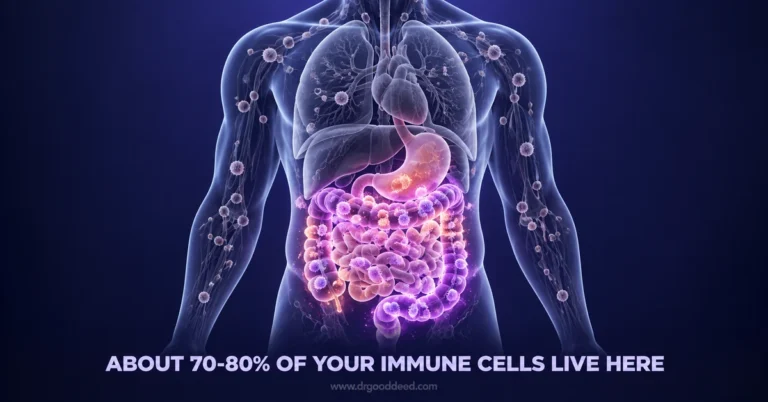

Probiotics are live beneficial microorganisms that may help support a healthy balance of gut bacteria, while prebiotics are types of dietary fiber that serve as food for beneficial gut bacteria and help promote their growth.
Probiotic supplements contain specific strains of bacteria or yeast, whereas prebiotic supplements typically contain fibers such as inulin or fructooligosaccharides. Both may support digestive health, but their effects can vary depending on the individual and the specific product.
Key Takeaways
- Probiotic supplements deliver live microorganisms, mainly Lactobacillus and Bifidobacterium species, in doses measured as colony forming units (CFU).
- Prebiotic supplements deliver concentrated fiber, most often inulin or other selectively fermented substrates, that feeds bacteria your gut already has.
- Current evidence does not support daily probiotic use as a general health recommendation for people who are already healthy.
- Real benefit clusters around specific situations: recovering from antibiotics, managing IBS, or treating a diagnosed digestive condition.
- A “synbiotic” label only means something when the product is backed by evidence of a genuine synergistic effect, not just because it lists both ingredients.
Probiotic vs Prebiotic Supplements at a Glance (Comparison Table)
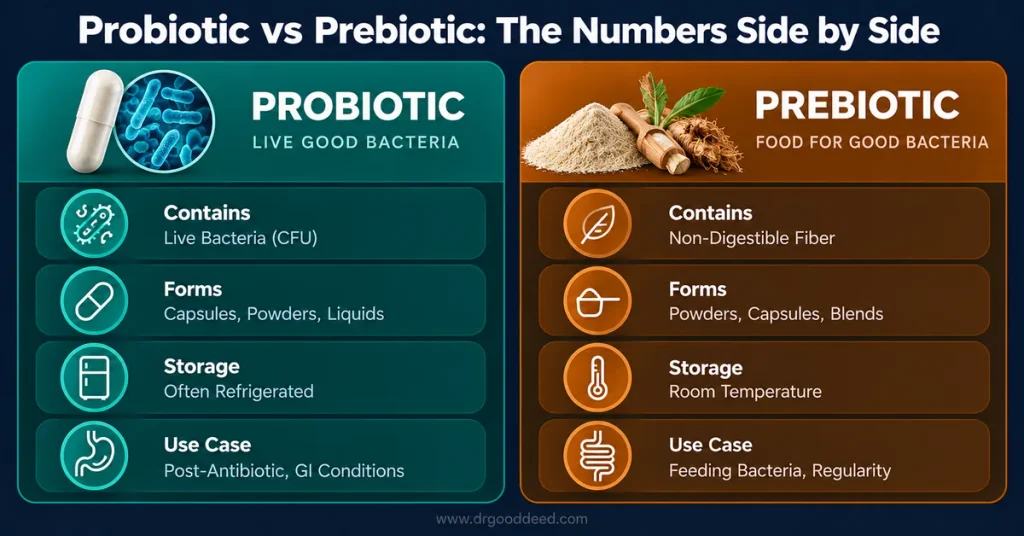
The fastest way to see the split between these two supplement categories is side by side. Probiotics and prebiotics work through different mechanisms, come in different forms, and demand different storage habits. Use this table as a quick reference before reading the detailed breakdown below.
| Feature | Probiotic Supplements | Prebiotic Supplements |
| What it contains | Live bacterial strains (CFU-measured) | Non-digestible fiber (inulin, FOS, GOS) |
| Common forms | Capsules, powders, liquids, chewables | Powders, capsules, fiber blends |
| Storage needs | Often requires refrigeration; some are shelf-stable | Room temperature, no refrigeration needed |
| Typical use case | Post-antibiotic recovery, specific GI conditions | Feeding existing gut bacteria, mild regularity support |
What Are Probiotic Supplements?
Probiotic supplements contain live microorganisms, mostly strains of Lactobacillus and Bifidobacterium, packaged in capsules, powders, or liquid drops. ISAPP defines a true probiotic as a strain studied in human trials and shown to produce a measurable health benefit at a specific dose.
- Strain specificity matters more than species. Lactobacillus rhamnosus GG and a generic “Lactobacillus” listing are not interchangeable; only the studied strain carries the evidence for that particular benefit.
- Dose is expressed in CFU, not milligrams. A 10 billion CFU product delivers a different microbial load than a 1 billion CFU product, and effective doses vary by strain and intended use.
- Multi-strain blends are not automatically superior. Some conditions respond better to a single well-studied strain than a broad mix with weak evidence behind each component.
What Are Prebiotic Supplements?
Prebiotic supplements deliver concentrated, non-digestible fiber compounds, most commonly inulin, fructooligosaccharides (FOS), or galactooligosaccharides (GOS). Your digestive enzymes can’t break these fibers down, so they travel to the colon intact, where resident bacteria ferment them into short-chain fatty acids.
This is a supplement-format alternative to eating prebiotic food sources like garlic, onions, and bananas, and it concentrates the fiber dose into a measured serving.
- Fermentation produces short-chain fatty acids (SCFAs), including butyrate, which supports the cells lining your colon and plays a role in gut barrier function.
- Selective utilization defines a true prebiotic. ISAPP’s 2017 consensus statement requires that the substrate be selectively used by beneficial bacteria, not just any fiber that happens to reach the colon.
- Gas and bloating are common when starting. Prebiotic fiber ferments quickly, and a high starting dose often causes more gas than a gradual introduction would.
Probiotic vs Prebiotic Supplements: Key Differences
Beyond the basic definition, probiotic and prebiotic supplements differ in composition, label information, and how you need to store them.
What Each Actually Contains
A probiotic supplement label lists specific bacterial genus, species, and strain, alongside a CFU count guaranteed through the end of shelf life. A prebiotic supplement label lists a fiber type and a gram amount per serving, similar to how a fiber supplement is labeled.
Probiotics add microorganisms directly. Prebiotics feed the microorganisms you already carry, without adding new ones.
How to Read the Label (CFUs, Strains, Fiber Types)
CFU stands for colony-forming units, a count of viable bacteria capable of reproducing once ingested. Check CFU count is guaranteed at the end of shelf life since bacteria die off gradually. For prebiotics, check the specific fiber type listed, inulin, FOS, or GOS, and the gram dose, since studies use specific amounts (often 5 to 10 grams daily) tied to specific outcomes.
Storage and Shelf Life
Some probiotic strains, particularly certain Bifidobacterium species, are sensitive to heat and moisture and require refrigeration to stay viable. Other strains are freeze-dried or encapsulated to survive at room temperature. Check the label for specific storage instructions rather than assuming, since requirements vary by product. Prebiotic fiber supplements are shelf-stable and don’t require refrigeration, since fiber doesn’t die the way bacteria do.
Do Healthy People Actually Need Probiotic Supplements?
A 2024 expert review published in Advances in Nutrition by Merenstein and colleagues, output from an ISAPP discussion group, examined whether evidence supports recommending probiotics to the general healthy population.
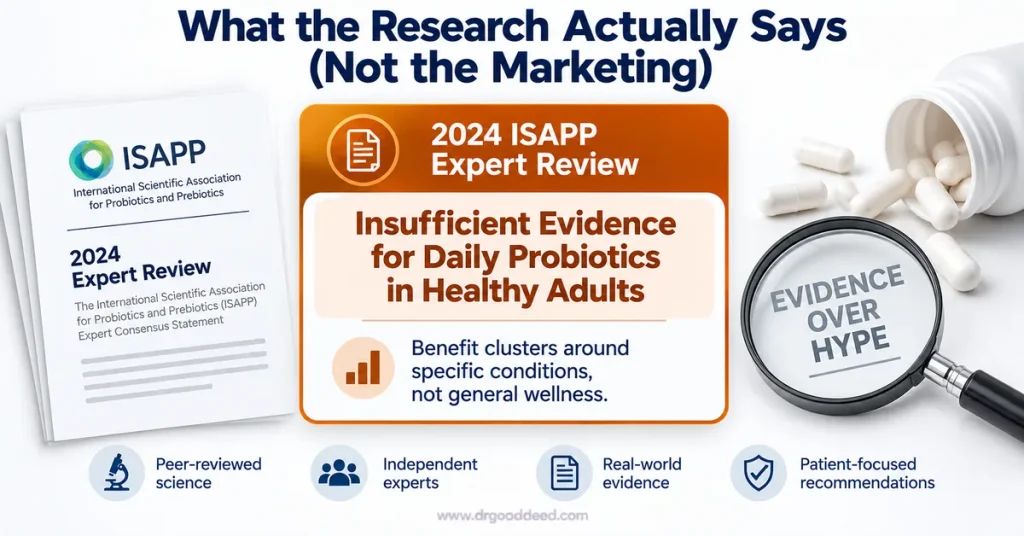
The review found insufficient evidence for a blanket recommendation that healthy people take a daily probiotic.
- No universal recommendation exists. Unlike a vitamin D or fiber intake target, there’s no guideline body currently telling every healthy adult to take a daily probiotic.
- Benefit is condition-specific, not general. Strong evidence clusters around specific uses, antibiotic-associated diarrhea prevention, certain IBS symptom patterns, and some pediatric conditions, rather than general wellness in people without symptoms.
- Research gaps are real, not just marketing spin. The review authors specifically flagged that studying prevention in healthy people is methodologically harder than studying treatment in people with existing conditions, which is why data remains limited.
What About “Synbiotic” Combination Products?
Products combining probiotics and prebiotics are often marketed as “synbiotics,” but ISAPP’s 2020 consensus statement, published in Nature Reviews Gastroenterology & Hepatology, sets a stricter bar than simply listing both ingredients on one label.
- Complementary synbiotics pair an independently studied probiotic with an independently studied prebiotic, each meeting its own evidence and dose requirements, without needing to interact.
- Synergistic synbiotics are formulated so the specific fiber is selectively used by the specific bacterial strain included, with evidence showing the combination outperforms either component alone.
- Most “synbiotic” labels on store shelves don’t specify which type they are. A product simply listing a probiotic strain plus inulin is not automatically synergistic just because both ingredients appear on the same label.
Expert Insight: A synbiotic label with no strain-substrate matching data behind it is functionally two separate supplements sold in one capsule. Clinicians evaluating a synbiotic product should ask whether the manufacturer can point to a study testing that exact combination, not just studies on each ingredient in isolation.
Who Might Genuinely Benefit From Supplementing
Certain groups have real, evidence-backed reasons to consider probiotic or prebiotic supplements.
- People recovering from a course of antibiotics fall into this category, since antibiotics disrupt gut bacterial populations and specific probiotic strains have data supporting reduced diarrhea risk during recovery.
- People with diagnosed irritable bowel syndrome are another group with genuine strain-specific evidence; our detailed guide to the best probiotics for IBS covers strain selection for that condition specifically.
- People managing constipation or mild digestive irregularity sometimes see benefit from prebiotic fiber, since it directly feeds bacteria linked to regularity.
When to Talk to Your Doctor
Persistent digestive symptoms, unexplained weight loss, blood in stool, or symptoms lasting more than two weeks warrant medical evaluation rather than a supplement trial. You should also talk to a doctor before starting probiotics if you have a weakened immune system, a central line, or a serious underlying illness, since live bacterial products carry rare but documented infection risk in immunocompromised patients. A doctor can also confirm whether your symptoms fit a pattern where strain-specific evidence actually exists.
Pro Tip: If digestive symptoms flare within the first week of starting a new probiotic, it doesn’t automatically mean the product failed. Some strains cause temporary gas or bloating as gut bacteria adjust, but symptoms that worsen past two weeks or include pain warrant stopping the supplement and checking in with a doctor.
FAQs
Can you take probiotics and prebiotics together?
Yes. Taking them together is safe for most healthy adults and is the basis of synbiotic products. Prebiotic fiber can support the survival of probiotic bacteria already in your gut, though combining them doesn’t guarantee added benefit unless the specific pairing has supporting evidence.
Do probiotic supplements need to be refrigerated?
It depends on the strain and formulation. Bifidobacterium-heavy products often need refrigeration, while freeze-dried or encapsulated formulas are shelf-stable. Check the product label directly, since the National Institutes of Health notes that storage requirements vary by manufacturing process, not by brand reputation.
How long does it take for probiotics to work?
Most strain-specific studies show measurable effects within one to four weeks of consistent daily use. Antibiotic-associated diarrhea prevention studies typically measure outcomes within the treatment course itself, while IBS symptom studies often run four to eight weeks before showing significant change.
Can probiotics make digestive symptoms worse?
Yes, temporarily. Gas, bloating, and mild changes in bowel habits are common in the first one to two weeks as gut bacteria adjust to a new strain. Symptoms that worsen beyond two weeks, or that include pain or fever, are not typical and need medical evaluation.
Are food sources better than supplements?
Neither is universally better. Fermented foods like yogurt and kefir provide live cultures alongside nutrients, while prebiotic food sources like garlic and oats provide fiber in a whole-food matrix. Supplements offer precise, measured doses matching clinical study amounts, which food alone often can’t replicate.
Sources
- ISAPP – Is There Evidence to Support Probiotic Use for Healthy People? link
- Merenstein DJ, et al. Adv Nutr. 2024;15(8):100265 link
- ISAPP Consensus Statement on the Definition and Scope of Synbiotics, Nat Rev Gastroenterol Hepatol. 2020 link
- ISAPP Consensus Statement on Prebiotics, Nat Rev Gastroenterol Hepatol. 2017 link
- NIH Office of Dietary Supplements – Probiotics Health Professional Fact Sheet link
- ISAPP – The ISAPP Quick Guide to Probiotics for Health Professionals link
- World Gastroenterology Organisation – Probiotics and Prebiotics Global Guideline link
- ISAPP – New Synbiotic Definition Lays the Groundwork for Continued Scientific Progress link
- ISAPP – A Roundup of the ISAPP Consensus Definitions link
- Mayo Clinic – Probiotics and Prebiotics: What You Should Know link
Medical Disclaimer: This article is for general information only and is not medical advice. It does not replace a diagnosis, treatment plan, or guidance from a qualified healthcare professional. Always talk to your doctor about your own symptoms and before starting, stopping, or changing any treatment. If you think you may be having a medical emergency, call 911 or go to your nearest emergency room.