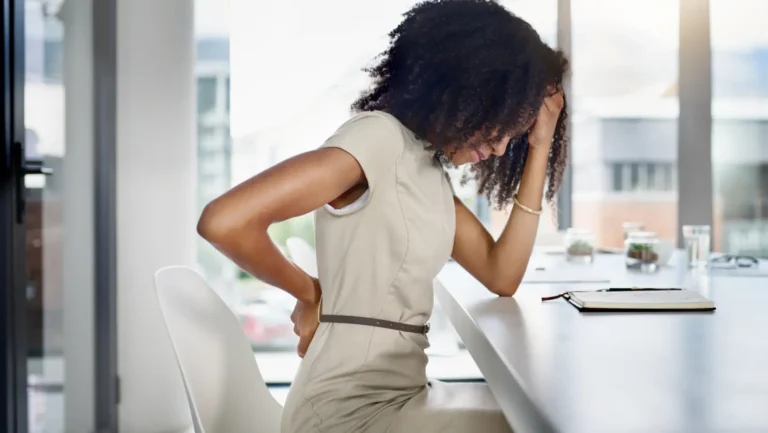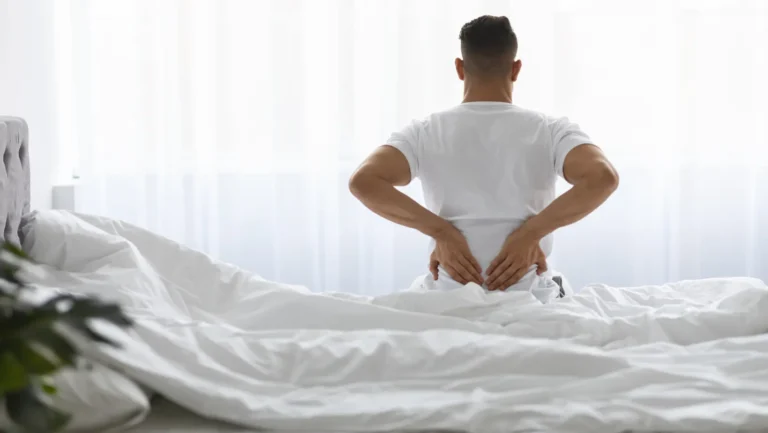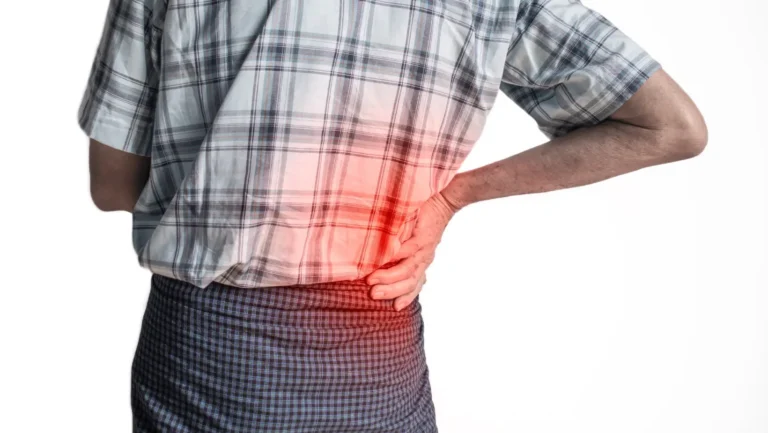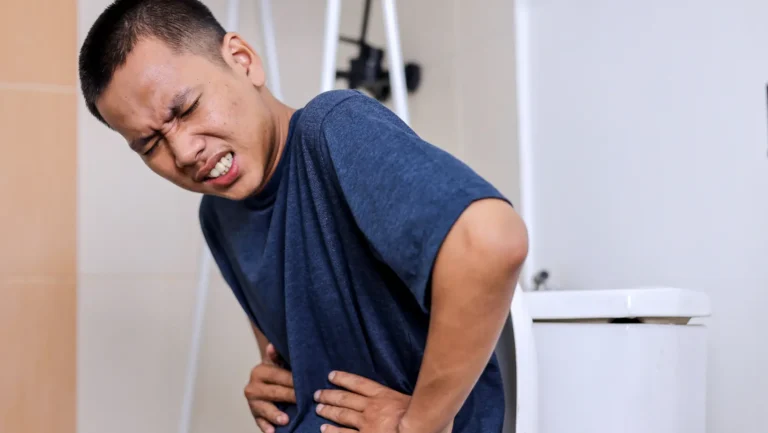
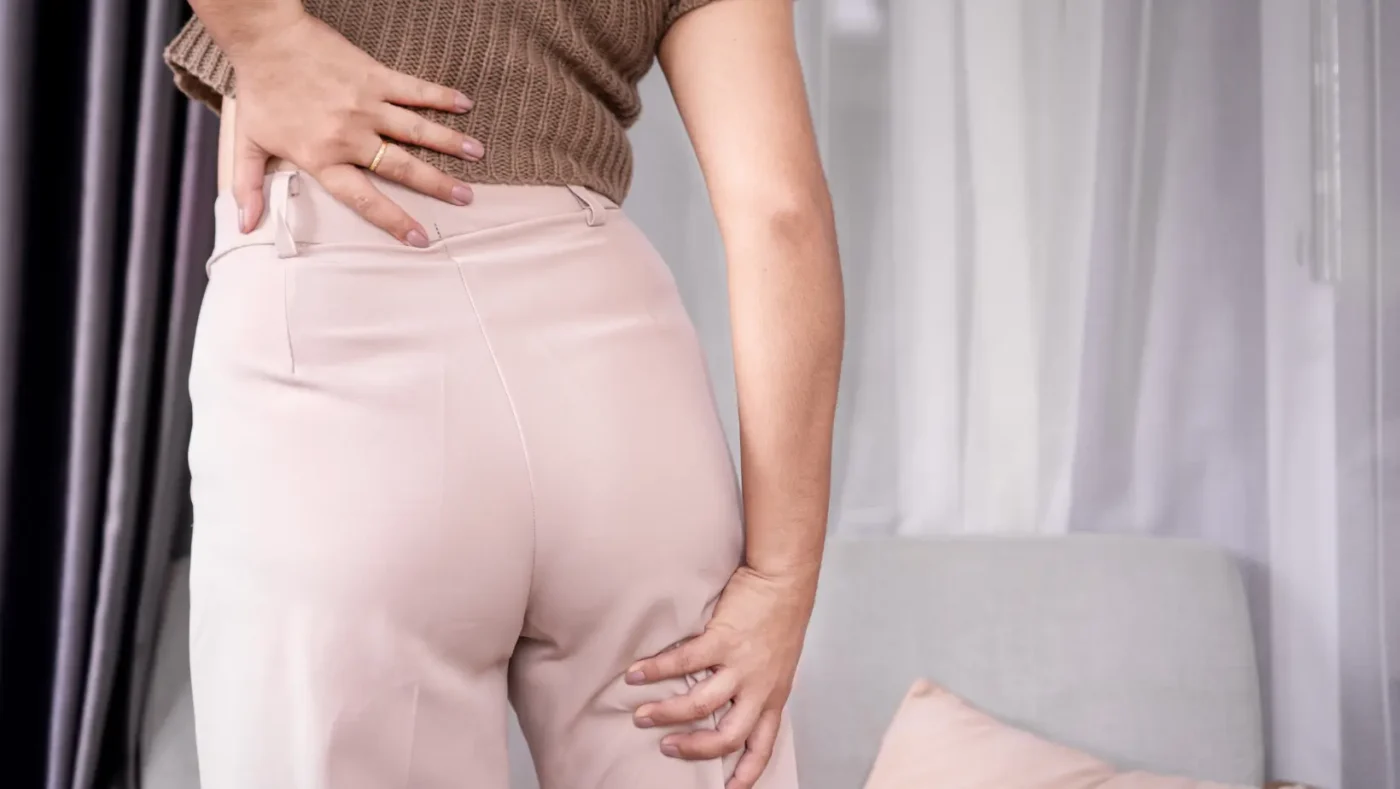

Lower back pain when standing affects roughly 80% of American adults at some point in their lives, according to the National Institute of Neurological Disorders and Stroke. It is one of the top reasons people visit primary care physicians in the US.
Mechanical lower back pain when standing is almost always addressable without surgery or strong medication. Movement breaks, targeted stretching, core strengthening, and posture correction resolve most cases within 4 to 6 weeks when applied consistently.
The key is identifying whether the pain is purely muscular or involves a structural issue like disc herniation or stenosis.
Causes of Lower Back Pain While Standing
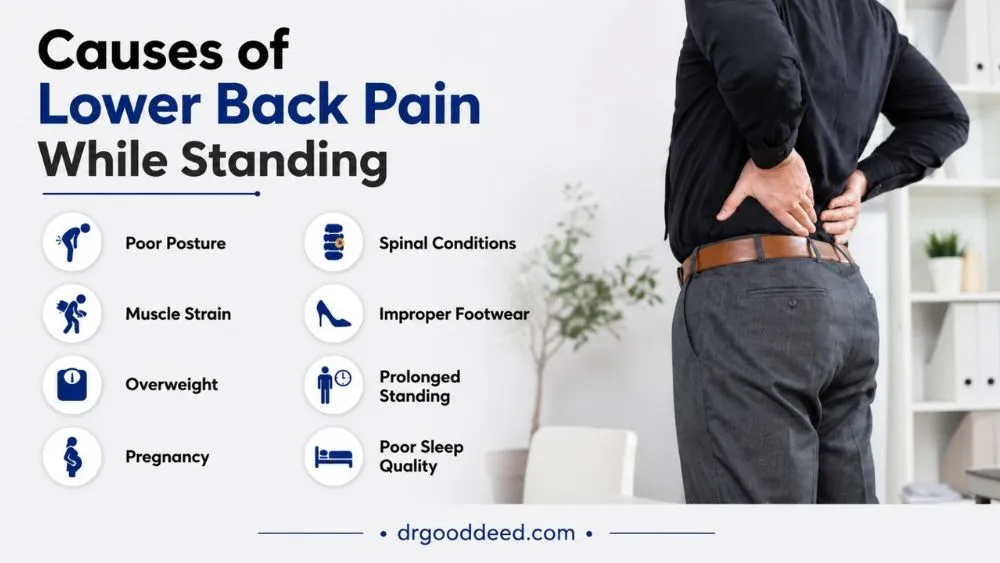
Causes of back pain while standing range from muscle fatigue to structural spine problems. Most cases involve a combination of posture habits and physical deconditioning. Identifying the root cause determines the right fix.
Poor Posture and Spinal Alignment
When the spine curves out of its natural S-shape during standing, the lumbar vertebrae absorb uneven load. Anterior pelvic tilt, where the pelvis tips forward and the lower back arches too much, is one of the most common culprits.
Office workers and people who sit for long hours and then stand for extended periods are especially prone to low back pain when sitting when standing. The muscles on one side tighten while the opposing muscles weaken, pulling the spine out of alignment over time.
Muscle Fatigue from Prolonged Standing
Standing still for more than 30 minutes can contribute to lower back pain when standing too long by placing a continuous static load on the lumbar erector muscles. Unlike walking, standing does not allow the muscle groups to alternate contraction and rest. Research published in Applied Ergonomics found that workers who stood for over 2 hours without breaks reported significantly higher lumbar pain scores compared to those who alternated postures. The muscles simply run out of endurance.
Weak Core and Back Muscles
The core is not just the abs. It includes the transverse abdominis, multifidus, pelvic floor, and diaphragm. When these muscles are weak, the lumbar spine takes on load it should not carry alone.
Studies from the Journal of Orthopaedic & Sports Physical Therapy confirm that people with chronic lower back pain when standing consistently show reduced activation in the multifidus muscle, a deep spinal stabilizer.
Degenerative Spine Conditions
Conditions like lumbar facet arthropathy and disc degeneration become symptomatic faster in standing positions because of the compressive load. Facet joints at L4-L5 and L5-S1 are the most commonly affected levels in adults over 40.
Why Standing Can Trigger Lower Back Pain
Standing seems passive, but pain when standing can occur when the lumbar spine handles roughly 1.3 times your body weight just from upright posture. When muscles tire or joints compress, pain signals fire. Most people do not realize that staying still is mechanically harder on the spine than slow walking.
Increased Pressure on the Lumbar Spine
The lumbar discs at L4-L5 and L5-S1 carry the most compressive force during standing. Intradiscal pressure measurements, first documented by orthopedic surgeon Alf Nachemson in the 1960s and later verified by MRI-based studies, show that standing increases disc pressure by 30% compared to lying down. That pressure stays constant as long as standing continues.
Tight Hip and Hamstring Muscles
Tight hip flexors pull the pelvis forward. Tight hamstrings pull it backward. Both patterns disrupt the neutral spine position. The body compensates by overusing the lumbar extensors, which leads to aching, burning, or sharp lower back pain when standing. People who sit at desks for 8-hour shifts consistently have restricted hip flexor length, even if they exercise regularly.
Reduced Circulation and Muscle Fatigue
Prolonged standing reduces venous return from the lower limbs. Blood pools in the legs. This causes local tissue hypoxia in the paraspinal muscles, meaning they get less oxygen. Fatigued muscles accumulate lactic acid faster, which amplifies pain perception. This is the biomechanical reason lower back pain when standing worsens progressively as the standing duration increases.
Stiffness in Lower Back After Standing
Stiffness in lower back after standing is the feeling of tightness or reduced range of motion that sets in after extended upright time. It is different from sharp pain. Stiffness usually eases within minutes of movement but signals that the tissues need attention.
Muscle Tension and Fatigue
Paraspinal muscles held in static contraction for long periods develop micro-tension. This is similar to the neck stiffness felt after hours of computer work. The muscles do not fully relax until they go through a movement cycle.
Reduced Mobility After Prolonged Posture
Synovial fluid in the facet joints distributes unevenly during sustained standing. Movement replenishes this fluid distribution. Without movement, the joints stiffen. This is why a short walk after long standing reduces stiffness in lower back after standing faster than rest alone.
Inflammation Around Joints and Muscles
Low-grade inflammation around the lumbar facet joints accumulates with repetitive compressive loading. In people with early arthritis, even 20 minutes of standing triggers enough joint irritation to cause morning-style stiffness that can last 30 to 60 minutes post-standing.
Poor Posture Causing Lower Back Pain
Poor posture causing lower back pain is the most preventable category. The lumbar spine has natural lordosis, a gentle inward curve. Any sustained deviation from that curve multiplies joint and disc stress by 3 to 5 times.
Slouching and Anterior Pelvic Tilt
Slouching flattens the lumbar lordosis. Anterior pelvic tilt exaggerates it. Both are posture faults. Workers in retail, food service, and manufacturing industries frequently develop anterior tilt from standing on hard floors without footwear support, combining with weak glutes that fail to stabilize the pelvis.
Uneven Weight Distribution
Standing with weight consistently shifted to one leg loads the hip and sacroiliac joint asymmetrically. Over months, this creates muscle imbalances on both sides of the lumbar spine. Physical therapists call this the Trendelenburg pattern.
Poor Standing Ergonomics
Hard floors, no anti-fatigue mats, and shoes without arch support all externally drive poor posture causing lower back pain. A 2019 study in Ergonomics found that anti-fatigue mats reduced reported lumbar discomfort by 32% in workers who stood for 4+ hours per shift.
Conditions That May Cause Pain While Standing
Some cases of lower back pain when standing are not purely mechanical. These conditions need clinical evaluation.
Sciatica and Nerve Irritation
Sciatica occurs when the sciatic nerve, which runs from the lumbar spine down each leg, gets compressed. Standing increases lumbar lordosis, which can narrow the nerve exit points. The pain typically radiates from the lower back into the buttock, thigh, and sometimes the foot. L4-L5 and L5-S1 nerve root compressions are the most common levels.
Herniated Disc or Spinal Stenosis
A herniated disc at L4-L5 becomes more symptomatic during standing because the disc is under maximum load. Lumbar spinal stenosis, a narrowing of the spinal canal, causes neurogenic claudication, where standing or walking produces leg heaviness, numbness, and back pain that resolves only when sitting or bending forward.
Arthritis Affecting Spinal Joints
Lumbar osteoarthritis and ankylosing spondylitis both worsen with sustained standing. Ankylosing spondylitis notably improves with movement but stiffens severely after rest, making early morning standing particularly painful.
How to Relieve Lower Back Pain When Standing
Relieving lower back pain when standing starts with breaking the static load cycle. No single stretch or exercise works without also changing standing habits.
Taking Movement Breaks
Set a timer for 20 to 25 minutes. Walk for 2 to 3 minutes. This simple pattern resets disc pressure, replenishes facet joint fluid, and restores muscle oxygen. The 2020 Active Working Summit guidelines recommend breaking standing or sitting time every 20 to 30 minutes.
Stretching Tight Muscles
- Standing hip flexor stretch: Step one foot forward into a lunge, keep back knee down, and hold for 30 seconds each side.
- Seated hamstring stretch: Straighten one leg on a chair and hinge forward slightly until a pull is felt behind the knee. Hold 30 seconds.
- Child’s pose: Kneel, sit back toward heels, extend arms forward on the floor. This decompresses lumbar vertebrae directly.
Strengthening Core Muscles
Dead bugs and bird-dogs are the two exercises physical therapists prescribe most for lumbar stability. Neither requires equipment. Both activate the deep core without stressing the lumbar spine in extension.
Posture Correction for Lower Back Support
Posture correction for lower back support reduces pain without any medication. The goal is to maintain neutral lumbar lordosis, which distributes load evenly across discs and facet joints.
Neutral Spine Positioning
Stand with ears over shoulders, shoulders over hips, and hips over ankles. The lower back should have a slight natural inward curve, not flat and not exaggerated. Tucking the tailbone slightly and engaging the lower abs sets this position.
Proper Weight Distribution While Standing
Distribute weight evenly on both feet. Avoid locking the knees. A slight knee bend reduces pelvic stress. Alternating feet on a small footrest (6 to 8 inches high) reduces lumbar compression by up to 25%, according to ergonomic research from Cornell University.
Footwear and Ergonomic Adjustments
Shoes with adequate arch support and cushioning reduce ground reaction forces that travel up to the lumbar spine. Anti-fatigue mats further reduce this. Avoid flat shoes like flip-flops or worn-out sneakers for prolonged standing.
Best Exercises and Stretches for Relief
Cat-Cow Stretch
On hands and knees, alternate between arching the back upward (cat) and letting it sag downward (cow). Do 10 slow repetitions. This mobilizes lumbar vertebrae and reduces facet joint stiffness after prolonged standing.
Hip Flexor Stretches
Tight hip flexors directly worsen lower back pain when standing by pulling the pelvis into anterior tilt. The kneeling lunge stretch, held for 45 seconds per side and repeated twice, produces measurable hip flexor lengthening when done daily for 3 weeks.
Core Strengthening Exercises
- Bird-dog: From hands and knees, extend opposite arm and leg simultaneously. Hold 5 seconds. 3 sets of 10.
- Dead bug: Lie on back, press lower back to floor, extend opposite arm and leg. 3 sets of 10.
- Glute bridge: Lie on back, feet flat, push hips up and squeeze glutes. Hold 5 seconds. 3 sets of 12.
FAQs
Why does my lower back hurt more after standing too long?
After 30 minutes of static standing, lumbar muscle oxygen supply drops and intradiscal pressure stays elevated. Both conditions amplify pain signals. The pain compounds because there is no muscle cycling to relieve the load.
Can weak core muscles increase pressure on the lower spine?
Yes. Weak core muscles force the lumbar spine to absorb 40% more compressive load than a well-supported spine. The multifidus and transverse abdominis are the two muscles most responsible for offloading that pressure.
How does poor posture affect the lumbar spine during standing?
Anterior pelvic tilt increases lumbar extension and compresses the posterior facet joints by 3 to 5 times the normal load. This directly triggers the joint irritation behind most lower back pain when standing complaints.
What type of shoes help reduce standing-related back pain?
Shoes with a heel-to-toe drop of 4 to 8 mm, firm arch support, and cushioned midsoles work best. Brands like Brooks, New Balance 990, and HOKA ONE ONE are commonly recommended by podiatrists for long-standing shifts.
Can tight hips and hamstrings worsen lower back stiffness?
Yes. Tight hamstrings restrict pelvic rotation, forcing the lumbar vertebrae to compensate during movement. This produces the stiffness in lower back after standing that many people notice when trying to straighten up after long periods upright.
Is walking better than standing still for lower back discomfort?
Walking is better. Slow walking alternates muscle load, reduces intradiscal pressure by roughly 10% compared to standing, and keeps facet joints lubricated. Standing still concentrates static load on the same structures without relief.
What sleeping position helps recovery from lower back strain?
Side-lying with a pillow between the knees, hips stacked, maintains lumbar alignment through the night. This position reduces lumbar compressive force by approximately 75% compared to standing.
How often should posture be corrected during long-standing hours?
Every 20 to 25 minutes. Reset posture by doing a quick glute squeeze, knee unlock, and spine tall check. This prevents the gradual postural drift that triggers cumulative loading on the lumbar joints.
Can prolonged standing lead to chronic spinal problems?
Prolonged standing without corrective habits accelerates lumbar facet joint degeneration. Research published in Spine journal found a significant association between occupational standing exceeding 6 hours daily and early-onset lumbar spondylosis in adults under 50.
When should standing-related lower back pain become a medical concern?
Seek evaluation if you have extreme pain in lower back when standing up, especially if it shoots into the leg, causes numbness or tingling in the foot, or changes bladder or bowel function. These signs suggest nerve compression, not simple muscle fatigue.