
Birth control does not cause infertility. No form of FDA-approved hormonal contraception causes permanent infertility. The American College of Obstetricians and Gynecologists (ACOG) confirms that all hormonal birth control methods work through reversible mechanisms.
Fertility delays after stopping contraception are temporary, not permanent. What birth control sometimes does is mask underlying conditions like PCOS or endometriosis that affect fertility independently. This article covers how each method works, realistic return-to-fertility timelines, and what actually causes the delays women experience.
Does Birth Control Affect Long-Term Fertility?
Birth control does not cause infertility permanently. Every form of approved hormonal contraception, including pills, patches, rings, hormonal IUDs, and injections, produces only temporary suppression of reproductive function.
A 2018 Danish cohort study following over 17,000 women found no difference in 12-month conception rates between women who used hormonal contraception and those who never did. The body restores its own hormonal rhythm after stopping any method.
Depo-Provera (the injectable contraceptive) delays fertility return for a longer window than other methods. That delay is still temporary, not permanent.
How Hormonal Birth Control Works on Ovulation
How hormonal birth control works on ovulation involves three simultaneous mechanisms.
Ovulation suppression: Synthetic estrogen and progestin in combined pills raise hormone levels artificially. This prevents the pituitary gland from releasing FSH and LH, the two hormones that trigger egg development and release. No LH surge means no ovulation.
Cervical mucus thickening: Progestin thickens cervical mucus into a barrier that sperm can’t pass through. This acts as a backup mechanism on cycles where suppression isn’t complete.
Uterine lining thinning: The lining becomes too thin for implantation. This is a third-layer mechanism, not the primary one.
All three effects reverse when the method stops. No permanent changes to ovarian function or egg supply occur from any of these pathways.
Temporary Suppression of Fertility After Birth Control
Temporary suppression of fertility birth control causes is the only documented effect on reproductive function.
After stopping combined pills, the pituitary gland resumes normal FSH and LH secretion within 1 to 3 months for most women. Ovulation returns within 1 to 3 cycles on average.
The delay isn’t the pill damaging fertility. The hypothalamus and pituitary need time to resume their natural rhythm after receiving suppressive signals for months or years.
Temporary suppression of fertility birth control creates what doctors call “post-pill amenorrhea” in some women: absent periods for up to 3 months after stopping. This is normal. Periods absent beyond 3 months warrant investigation, not because the pill caused damage, but because an underlying hormonal condition may now be visible.
How Birth Control Pills Affect Fertility
How birth control pills affect fertility is one of the most misunderstood topics in women’s health.
Pills don’t damage the ovaries. They don’t reduce egg count. AMH levels (the marker of egg supply) temporarily drop while on the pill, then return to pre-pill baseline within 3 months of stopping. Research published in Human Reproduction confirmed this AMH normalization pattern.
The misconception that long-term pill use “ages” the ovaries is not supported by any peer-reviewed data. A woman who used pills for 10 years has the same ovarian reserve she would have had without them.
How birth control pills affect fertility in the short term is entirely through hormone suppression. Stop the pill; restore the hormones. The ovaries were never damaged.
Fertility Timeline After Stopping Birth Control
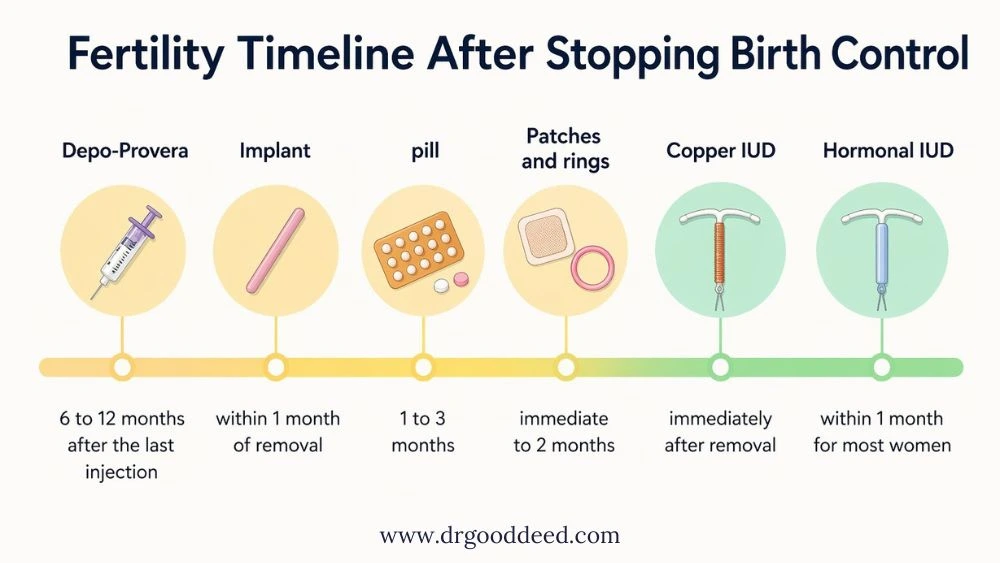
Return-to-fertility timelines differ significantly by method.
Combined oral contraceptive pill:
- Ovulation returns: 1 to 3 months
- Normal cycles restored: 1 to 3 cycles
- 12-month pregnancy rate: equivalent to women who never used pills
Hormonal IUD (Mirena, Kyleena):
- Ovulation returns: within 1 month for most women
- The IUD works locally on the uterus, with minimal systemic hormone absorption
- Fertility restoration is the fastest of all hormonal methods
Copper IUD (non-hormonal):
- Ovulation returns: immediately after removal
- No hormonal mechanism means no hormonal delay
Depo-Provera injection:
- Ovulation returns: 6 to 12 months after the last injection
- Full fertility restoration: up to 18 months in some women
- This is the longest delay of any reversible method
Implant (Nexplanon):
- Ovulation returns: within 1 month of removal
- The hormone clears fast once the implant is removed
Difficulty Getting Pregnant After the Pill
Difficulty getting pregnant after pill is real for some women, but the cause is almost never the pill itself.
Birth control masks underlying conditions by regulating cycles artificially. A woman with PCOS who had regular-seeming cycles on the pill may notice irregular cycles only after stopping. The PCOS existed before; the pill hid it.
Conditions that become visible after stopping the pill:
- PCOS (irregular ovulation or anovulation)
- Hyperprolactinemia (too much prolactin hormone blocking ovulation)
- Hypothalamic amenorrhea (low body weight or high stress suppressing ovulation)
- Primary ovarian-cyst infertility (reduced ovarian function)
- Thyroid disorders
Difficulty getting pregnant after pill that lasts beyond 3 months of cycle irregularity needs investigation of these underlying conditions, not the pill’s history.
Types of Birth Control and Their Fertility Impact
Birth control does not cause infertility differently depending on type. No permanent infertility from any method, but recovery timelines differ.
Combined oral contraceptive pills: Suppress ovulation systemically. Recovery: 1 to 3 months.
Progestin-only pills (mini-pill): Work mainly through cervical mucus, not full ovulation suppression. Some women ovulate on them. Fertility returns within weeks of stopping.
Hormonal IUD: Local uterine effect. Systemic hormone levels stay low. Fertility returns within 1 month of removal.
Copper IUD: Zero hormonal effect. Fertility returns immediately after removal. Studies show the highest 12-month conception rates after removal of any method.
Depo-Provera: Highest progesterone dose of any method. The hormone stays in tissue long after the injection window passes. Delay of 6 to 18 months is documented and normal.
Implant: Quick clearance after removal. Fertility returns within 1 month.
Factors That Actually Affect Fertility
Birth control does not cause infertility in the same way these factors do. These are the real drivers of fertility problems.
Age: Female fertility declines measurably after 32, sharply after 37. Egg quality and quantity both drop. This is the single most significant fertility factor for women.
PCOS: Affects 6 to 12% of US women. Causes irregular or absent ovulation through elevated androgens and insulin resistance. Birth control masks PCOS symptoms; it doesn’t create them.
Thyroid disorders: Both hypothyroidism and hyperthyroidism disrupt the hormonal signals controlling ovulation. TSH levels outside the 1.0 to 2.5 mIU/L range reduce conception rates.
Body weight: BMI below 18.5 or above 30 both disrupt ovulation. Adipose tissue converts androgens to estrogen, raising estrogen levels abnormally.
Smoking: Reduces ovarian reserve by accelerating follicle loss. Smokers enter menopause 1 to 4 years earlier than non-smokers on average.
How to Restore Fertility After Birth Control
How to restore fertility after birth control begins with understanding that the body does most of the work automatically.
Track ovulation actively. After stopping any hormonal method, start using LH strips from Day 10 of the cycle. This confirms when ovulation resumes and identifies any irregularity early. Basal body temperature charting alongside LH tracking gives clearer data.
Support progesterone recovery. The luteal phase (post-ovulation) sometimes remains short for 2 to 3 cycles after stopping hormonal contraception. Adequate zinc, vitamin B6, and magnesium support progesterone production during this transition.
Rule out PCOS early. If cycles stay irregular beyond 3 months, request an ultrasound and hormonal panel (FSH, LH, testosterone, AMH). Don’t wait 12 months before investigating cycle irregularity.
Restoring fertility after birth control doesn’t require supplements or special protocols for most women. Normal ovulation typically resumes within 90 days without intervention.
When to See a Doctor
See a doctor if:
- Periods don’t return within 3 months of stopping any pill or implant
- Periods don’t return within 6 months of the last Depo-Provera injection
- Cycles return but stay highly irregular (more than 40 days between periods)
- No pregnancy after 12 months of trying (6 months if over 35)
- Sudden weight gain, facial hair, or severe acne after stopping birth control (PCOS signs)
Don’t attribute all post-pill symptoms to the pill. PCOS, thyroid dysfunction, and hyperprolactinemia all appear clearly once hormonal suppression lifts.
Long-Term Fertility Outlook
The long-term fertility outlook after stopping any form of birth control is positive. Birth control does not cause infertility that persists for years. No clinical evidence supports this.
Large-scale studies, including a 2020 review in Contraception covering over 22,000 women, consistently show that prior contraceptive use doesn’t reduce lifetime pregnancy rates. Women who used birth control for 10 or more years conceive at rates comparable to those with no contraceptive history once they start trying.
The honest caveat: if a woman used birth control from ages 20 to 34 and starts trying at 35, the age-related fertility decline is real and independent of the contraceptive. Birth control does not cause infertility here.
FAQs
Can birth control pills cause permanent infertility?
No. No peer-reviewed study has linked combined oral contraceptive pills to permanent infertility. AMH (egg supply marker) temporarily dips on the pill and returns to baseline within 3 months of stopping. Birth control does not cause infertility permanently.
How long does it take to get pregnant after stopping birth control?
For pills and implants: ovulation returns within 1 to 3 months. For hormonal IUDs: within 1 month of removal. For Depo-Provera: 6 to 18 months. Most women who stop any method except Depo-Provera conceive within 12 months at the same rate as non-users.
Does long-term birth control delay fertility?
Slightly, but temporarily. Women who used pills for 5 or more years take an average of 1 to 2 extra months to conceive compared to short-term users, per a 2013 BMJ study. Temporary suppression of fertility birth control creates is not cumulative. It doesn’t compound with years of use.
Can birth control hide fertility problems like PCOS?
Yes. Combined pills regulate cycles artificially. A woman with PCOS appears to have regular periods on the pill. After stopping, irregular ovulation becomes visible. Difficulty getting pregnant after pill in PCOS cases reflects the underlying condition, not pill damage.
Is fertility different after using IUD vs pills?
Yes. Copper IUD removal restores fertility immediately, with the highest post-removal conception rates of any method (over 80% within 12 months). Hormonal IUD removal restores fertility within 1 month. Pills take 1 to 3 months. The IUD carries zero long-term fertility penalty.
Why are my periods irregular after stopping birth control?
The hypothalamus needs 1 to 3 months to re-establish its natural GnRH pulse pattern after hormonal suppression lifts. Irregular cycles beyond 3 months suggest an underlying condition like PCOS, hyperprolactinemia, or thyroid dysfunction, not pill damage. home-fertility Test hormones before assuming the pill is responsible.
Can Depo-Provera delay pregnancy longer than other methods?
Yes. Depo-Provera is the only reversible contraceptive with a documented median delay of 10 months to ovulation return after the last injection. 25% of women take up to 18 months. This is the longest delay of any reversible method and is dose-related, not permanent damage.
What helps ovulation return faster after stopping birth control?
Maintaining a healthy BMI (18.5 to 24.9), reducing high-intensity exercise if training heavily, and managing stress (which suppresses GnRH) support faster recovery. To restore fertility after birth control through supplements has limited evidence; vitamin B6 and zinc support luteal phase progesterone but don’t accelerate ovulation onset.
Should I stop birth control months before trying to conceive?
For pills and implants: stopping 1 to 3 months early gives cycles time to normalize before trying. For Depo-Provera: stopping 12 to 18 months before the target conception window is clinically reasonable. For IUDs: removal timing doesn’t need advance planning since fertility returns within weeks.
When should I worry about infertility after stopping birth control?
Worry, meaning investigate clinically, at 3 months if periods haven’t returned after stopping pills or implants, at 6 months if periods haven’t returned after Depo-Provera, and at 12 months of regular trying without conception (6 months if over 35).