
Ovarian cysts can cause infertility, but only specific types do. Most ovarian cysts are harmless and disappear without affecting conception at all. The ones that threaten fertility, namely endometriomas and PCOS-related follicles, work through clear biological mechanisms that doctors understand well.
In the US, approximately 10% of women face fertility issues directly tied to cyst-related conditions. This article covers types, ovulation effects, hormonal disruption, diagnosis, treatment, and when to get medical help.
What Are Ovarian Cysts?
An ovarian cyst is a fluid-filled sac that grows on or inside an ovary. They form when a follicle (the sac holding an egg) fails to release the egg or doesn’t dissolve after releasing it.
Most women develop at least one cyst in their reproductive years. Many never know because the cysts cause no symptoms and resolve within 1 to 3 menstrual cycles.
- Common cysts form during a normal ovulation cycle. They’re called functional cysts, and they’re usually benign.
- Abnormal cysts form from irregular cell growth. These include endometriomas, dermoid cysts, cystadenomas, and PCOS-related follicles.
Women between ages 15 and 44 are most likely to develop them. Estrogen activity during these years drives follicle formation constantly.
Types of Ovarian Cysts and Fertility Impact
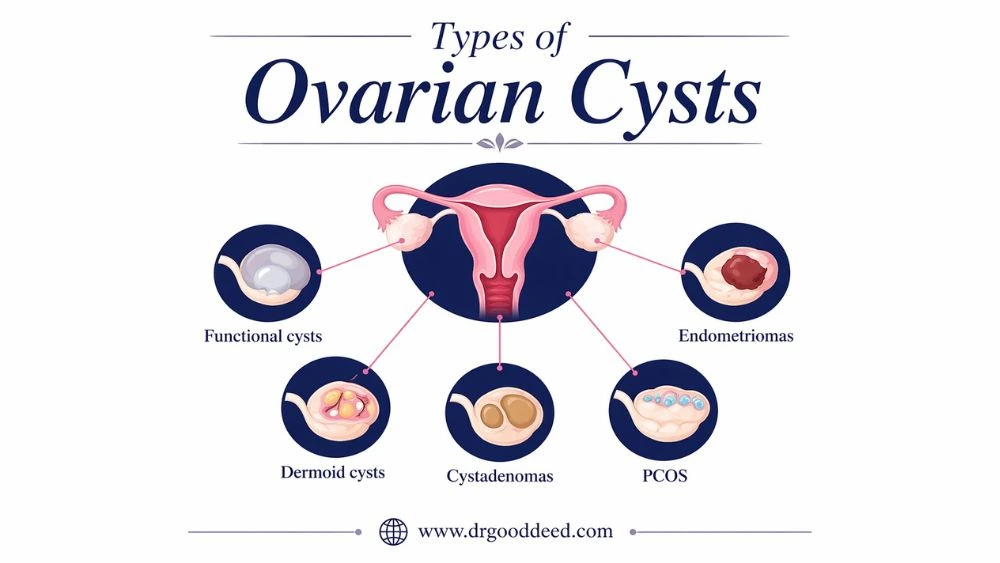
Not every cyst threatens fertility. The type matters far more than the diagnosis alone.
- Functional cysts are the most common type. They form during ovulation and disappear within 1 to 3 cycles. These rarely affect fertility.
- Endometriomas are the most fertility-damaging type. They develop when endometrial tissue grows on the ovary and fills with old blood. Research in Human Reproduction shows endometriomas reduce ovarian reserve by destroying healthy egg-containing tissue. Women with bilateral endometriomas show up to a 50% drop in AMH, a key marker of egg supply.
- Dermoid cysts grow from embryonic cells. They expand slowly but can grow large enough to twist the ovary, cutting off blood supply entirely.
- Cystadenomas form on the surface of the ovary and expand to sizes that physically block egg release.
- PCOS-related cysts are technically not true cysts. They’re 12 or more small follicles per ovary that fail to mature. PCOS cysts and infertility symptoms are tightly linked through chronic anovulation and elevated androgens.
How Ovarian Cysts Affect Ovulation
Ovarian cysts affect ovulation, depending entirely on type and size.
A follicular cyst over 5 cm prevents new follicle development in that same cycle. When the cyst fails to rupture, the egg stays trapped inside. No egg release means no chance of fertilization.
Endometriomas physically destroy ovarian tissue. Each time the cyst bleeds internally, scarring spreads across surrounding tissue. That scar tissue reduces the number of viable eggs the ovary holds over time.
PCOS disrupts the hormonal signals needed for egg release. LH (luteinizing hormone) stays elevated instead of spiking at the right moment. Without that spike, follicles don’t mature fully. This is called anovulation. It’s the primary reason ovarian cysts can cause infertility that becomes a clinical concern for PCOS patients.
PCOS and Infertility
PCOS cysts and infertility symptoms follow a recognizable pattern:
- Cycles longer than 35 days or fewer than 8 per year
- Elevated testosterone causing acne and excess facial hair
- Polycystic ovaries on ultrasound (12 or more follicles per ovary)
- Insulin resistance in roughly 70% of PCOS cases
Chronic anovulation is the core fertility problem. Women with PCOS sometimes go months without ovulating at all. No ovulation means no egg to fertilize.
Insulin resistance compounds this. High insulin pushes the ovaries to produce more androgens. Those androgens block follicle maturation further.
The CDC estimates PCOS affects 6 to 12% of American women in reproductive age. It’s the leading cause of anovulatory infertility in the US. The treatment response is strong. Ovulation induction with letrozole or clomiphene restores ovulation in most patients.
Hormonal Imbalance and Fertility Issues
Hormonal imbalance, ovarian cyst, and fertility issues work through two pathways.
- First: when ovulation doesn’t occur, progesterone isn’t produced in the second half of the cycle. Without progesterone, the uterine lining doesn’t thicken enough for implantation. A fertilized egg has nowhere stable to attach.
- Second: persistent follicular cysts and endometriomas raise estrogen abnormally. That elevated estrogen disrupts implantation timing even when fertilization occurs.
Both pathways lead to failed implantation. The biological routes differ, but the fertility outcome is the same.
Can You Get Pregnant With an Ovarian Cyst?
You can get pregnant with an ovarian cyst. Millions of American women with ovarian cysts conceive each year naturally.
Functional cysts rarely block pregnancy. When the cyst is small, located on one ovary only, and not disrupting hormone levels, fertility stays intact.
Risk increases when the cyst exceeds 6 cm, when it’s an endometrioma, or when it’s actively altering hormone output. Pregnancy with an undiagnosed endometrioma carries elevated risk of miscarriage and premature delivery.
Medical attention is urgent when a cyst grows during pregnancy, pain becomes severe, or torsion (twisting) occurs. Ovarian torsion is a medical emergency. Delayed treatment can result in loss of the ovary.
You can get pregnant with an ovarian cyst while undergoing IVF, but fertility specialists monitor this closely. Cysts that produce estrogen interfere with stimulation protocols. Most clinics drain problematic cysts before beginning IVF stimulation.
Symptoms That May Signal Fertility Problems
These symptoms don’t confirm infertility on their own, but two or more together warrant a pelvic ultrasound:
- Periods fewer than 21 days or more than 35 days apart
- Recurring pelvic pain or pressure on one side
- Deep pain during sex
- Sharp mid-cycle pain lasting more than 2 days
- Unexplained weight gain (possible insulin resistance signal)
- New facial hair or severe adult acne in women
Diagnosis of Ovarian Cysts Affecting Fertility
Transvaginal ultrasound is the first-line test. It identifies cyst size, location, and whether the ovaries show the polycystic pattern.
Hormonal blood tests follow:
- AMH: measures remaining egg supply (ovarian reserve)
- FSH and LH: assess ovulatory function
- Testosterone and DHEAS: elevated in PCOS
- Day 21 progesterone: confirms whether ovulation occurred that cycle
At-home LH tracking test strips or basal body temperature charting help identify cycles where ovulation is absent. Three or more missed ovulation cycles is grounds for further specialist workup.
Treatment Options to Improve Fertility
Functional cysts: Watchful waiting for 1 to 3 cycles. Most resolve without any intervention.
Endometriomas: Laparoscopic cystectomy (surgical removal) is the standard approach. Research in Fertility and Sterility confirms that removing endometriomas over 4 cm improves natural conception rates. However, the surgery itself can slightly reduce ovarian reserve, so timing with a fertility specialist is important.
PCOS: Letrozole is the current first-line ovulation induction agent in most US fertility centers, confirmed by a 2014 landmark NEJM trial. Weight loss of just 5 to 10% of body weight in overweight women with PCOS restores ovulation in up to 55% of cases without any medication.
Hormonal imbalance ovarian cyst fertility issues tied to PCOS also respond to metformin, which directly addresses insulin resistance.
IVF remains an option when other treatments don’t work. Success rates for women with PCOS undergoing IVF are comparable to those without PCOS when managed properly.
When to See a Doctor
- You’ve been trying to conceive for 12 months without success (6 months if you’re over 35)
- Periods are consistently irregular over 3 or more cycles
- You’ve had a previous ovarian cyst diagnosis
- Pelvic pain is recurring, worsening, or sudden and severe
Don’t wait for intense pain. Ovarian torsion from a large cyst can happen fast, without warning.
Prevention and Fertility Support Strategies
No method fully prevents ovarian cysts. These strategies reduce recurrence and protect fertility long-term.
- Weight management: In PCOS patients, maintaining a BMI under 27 reduces androgen production and improves cycle regularity.
- Cycle monitoring: Tracking ovulation monthly with LH strips identifies missing cycles early. That data is clinically useful.
- Low-glycemic diet: Reducing insulin spikes lowers androgen levels in PCOS. Multiple randomized controlled trials support this approach.
- Regular gynecological checkups: Catching cysts early, before they exceed 4 to 5 cm, protects ovarian tissue from damage.
Birth control pills reduce functional cyst recurrence. They don’t treat infertility. They suppress ovulation while in use, which means no conception is possible during that time.
FAQs
Can ovarian cysts stop ovulation completely?
Yes. Endometriomas and PCOS both cause complete anovulation in some cases. Endometriomas destroy egg-bearing tissue directly. PCOS blocks the LH spike needed for ovulation. When ovulation stops for multiple consecutive cycles, fertility drops to zero without medical intervention.
Are all ovarian cysts linked to infertility?
No. Functional cysts (follicular and corpus luteum types) don’t affect fertility in most cases. Only endometriomas, large cystadenomas, and PCOS-related follicles consistently interfere with conception. Type and size determine fertility risk, not the cyst diagnosis alone.
Can functional cysts affect pregnancy chances?
Rarely, and only temporarily. A follicular cyst over 5 cm can block ovulation in that one cycle. The next cycle usually normalizes. Functional cysts don’t scar tissue. An ovarian cyst causes infertility through functional cysts only when very large and only for that cycle.
How does PCOS differ from regular ovarian cysts?
PCOS follicles aren’t true cysts. They’re underdeveloped follicles stuck at an early growth stage, usually 12 or more per ovary. Regular cysts are single, fluid-filled sacs. PCOS also involves elevated androgens and irregular cycles. The infertility mechanism is anovulation, not tissue damage.
Can ovarian cysts cause miscarriage?
Yes, endometriomas increase miscarriage risk through inflammatory prostaglandins that disrupt implantation and early placental development. PCOS raises early miscarriage risk by 30 to 50% compared to women without it, driven by insulin resistance and poor endometrial receptivity.
Do ovarian cysts need surgery to improve fertility?
Only endometriomas over 4 cm consistently benefit from surgical removal before fertility treatment. Functional cysts don’t need surgery. PCOS doesn’t require surgery. Letrozole is the first-line treatment. Operating on smaller cysts sometimes reduces ovarian reserve without improving conception rates at all.
How long after cyst removal can you try to conceive?
After laparoscopic cystectomy for an endometrioma, most specialists recommend 4 to 6 weeks for recovery, then attempting conception within 6 months. Waiting beyond 12 months after surgery reduces the fertility benefit, since endometriomas recur in 30% of women within 2 years.
Can birth control help with cyst-related infertility?
No. Birth control suppresses ovulation, making conception impossible while using it. It manages endometriosis progression and reduces functional cyst recurrence. Hormonal imbalance, ovarian cyst, and fertility issues require ovulation induction or surgical treatment, not hormonal suppression.
Are ovarian cysts common in women trying to conceive?
Yes. Studies show roughly 7% of premenopausal American women have a detectable cyst at any given time. Women monitoring fertility through regular ultrasounds detect cysts more often simply because they’re being scanned. Most are functional and resolve within weeks.
What size ovarian cyst is dangerous for fertility?
Endometriomas over 4 cm actively damage ovarian reserve and are fertility-threatening. Any cyst over 6 cm, regardless of type, risks ovarian torsion. Ovarian cyst can cause infertility through size when endometriomas exceed 4 cm or when any cyst exceeds 6 cm without treatment.