

In most cases, abortion does not cause infertility. A single safe abortion procedure, whether medical or surgical, does not cause ovarian-cyst infertility. The World Health Organization and the American College of Obstetricians and Gynecologists (ACOG) both confirm that legal, properly performed abortions carry no long-term fertility risk for most women.
The exceptions involve complications like infection, uterine scarring, or unsafe procedures performed outside clinical settings. This article covers the real risks, what the evidence says, and how to protect fertility after an abortion.
Does Abortion Affect Future Fertility?
In most cases, abortion does not cause infertility on its own. A single uncomplicated abortion does not reduce the chance of future pregnancy.
A landmark 2019 study in The Lancet followed over 50,000 women and found no statistically significant difference in future fertility between women who had abortions and those who had not. The uterine lining regenerates fully within one menstrual cycle after a properly performed procedure.
The risk to fertility comes from complications, not the procedure itself. Infection, uterine perforation, and cervical damage raise the risk of infertility after abortion procedure significantly when left untreated.
Types of Abortion and Their Fertility Impact
The method matters. Two types exist in clinical practice.
Medical abortion uses mifepristone and misoprostol (the abortion pill regimen). No surgical instruments enter the uterus. The FDA approves this method up to 10 weeks of pregnancy. Medical abortion carries no documented risk of uterine scarring or cervical damage. Fertility typically returns within 2 to 4 weeks.
Surgical abortion includes two main procedures:
- Aspiration (suction) abortion: Used up to 14 weeks. A thin tube removes the pregnancy through the cervix. Complication rate at accredited US clinics is under 1%.
- Dilation and Evacuation (D&E): Used in the second trimester. Requires cervical dilation before the procedure. Slightly higher complication risk than aspiration, but still low at qualified facilities.
Surgical procedures carry a small risk of uterine perforation (0.1 to 0.3% of cases) and cervical injury. Both complications affect fertility only if undetected and untreated.
Risk of Infertility After Abortion Procedure
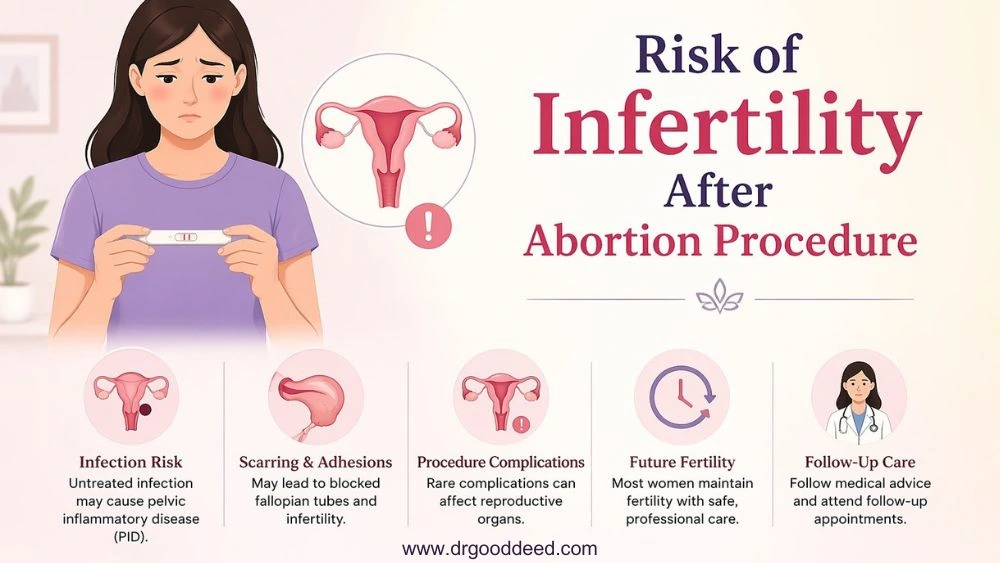
The risk of infertility after abortion procedure is low when the procedure happens in a licensed facility with follow-up care.
Factors that raise risk:
- Procedure performed outside a licensed medical setting
- Untreated post-procedure infection
- Multiple procedures on the same uterus within a short period
- Pre-existing cervical weakness or uterine abnormalities
- Incomplete evacuation requiring a second procedure
Risk factors that don’t increase infertility: gestational age at time of abortion (within the first trimester), general anesthesia use, age of the patient, or the number of prior pregnancies.
Women who develop fever, heavy bleeding, or severe pain within 2 weeks of the procedure need immediate medical evaluation. These are the early signs of complications that drive fertility risk upward.
Infection After Abortion and Infertility Risk
Post-abortion infection typically involves bacteria traveling into the uterus and fallopian tubes. When untreated, this progresses to Pelvic Inflammatory Disease (PID). PID scars the fallopian tubes. Scarred tubes block eggs from reaching the uterus, causing tubal factor infertility.
Approximately 10 to 15% of untreated PID cases result in tubal infertility. One episode of PID raises the risk of ectopic pregnancy by 6 to 10 times. This isn’t specific to abortion; PID from any source causes the same damage.
Most US abortion providers administer prophylactic antibiotics (typically doxycycline) before surgical procedures. This single step reduces post-abortion infection rates by up to 42%, according to data from Planned Parenthood’s clinical outcomes reporting.
Infection after abortion and infertility risk is preventable with antibiotics and follow-up care. The infection itself causes infertility, not the abortion.
Uterine Damage and Structural Complications
Structural complications are rare but real.
Asherman’s syndrome develops when the uterine lining scars heavily after repeated uterine procedures or after a single procedure complicated by infection. Scar tissue bands form inside the uterine cavity. These bands reduce or eliminate the space where an embryo implants. Asherman’s syndrome causes recurrent miscarriage or secondary infertility.
The incidence of Asherman’s syndrome after a single first-trimester abortion is less than 1%. It rises to 16% after three or more procedures on the same uterus, according to a review in the Journal of Minimally Invasive Gynecology.
Cervical damage from dilation can cause cervical incompetence in rare cases, where the cervix can’t hold a pregnancy to term. This leads to second-trimester pregnancy loss rather than failure to conceive.
Hysteroscopy (a camera inside the uterus) is the standard diagnostic tool for Asherman’s syndrome. Mild to moderate cases respond well to surgical adhesion removal with good fertility outcomes post-treatment.
Repeated Abortions and Fertility Risk
Repeated abortions and fertility risk follow a cumulative pattern. One procedure carries low risk. The risk profile changes with multiple procedures.
Research published in Obstetrics & Gynecology shows:
- 1 abortion: No measurable increase in infertility risk
- 2 abortions: Slight increase in risk of preterm birth in future pregnancies (not infertility)
- 3 or more abortions: Increased risk of Asherman’s syndrome, placenta previa, and preterm labor in future pregnancies
Repeated abortions and fertility risk are more connected to structural uterine changes than to complete infertility. Most women who have had multiple abortions conceive again. The concern is pregnancy complication risk, not inability to get pregnant.
Each subsequent dilation procedure carries slightly more cervical trauma. This is the mechanical basis for the elevated preterm birth risk seen in large-cohort studies.
Signs of Difficulty Conceiving After Abortion
Signs of difficulty conceiving after an abortion are worth tracking after any uterine procedure.
Watch for:
- Periods that became significantly lighter or stopped entirely after the procedure (possible Asherman’s syndrome)
- Severe cramping during periods that wasn’t present before
- Chronic pelvic pain or pressure lasting more than 3 months post-procedure
- No positive pregnancy test after 12 months of unprotected sex (6 months if over 35)
- Two or more consecutive miscarriages after the procedure
Difficulty conceiving after abortion signs related to Asherman’s syndrome specifically include absent or very light periods (hypomenorrhea) with no other hormonal explanation. This pattern after a uterine procedure warrants a transvaginal ultrasound and possibly hysteroscopy.
How to Protect Fertility After Abortion
To protect fertility, abortion-related care starts immediately after the procedure and continues through the first follow-up visit.
At the clinical level:
- Take the full course of prescribed antibiotics without skipping doses
- Attend the follow-up appointment (typically 2 to 4 weeks post-procedure) for ultrasound confirmation of complete evacuation
- Report fever above 100.4°F, soaking more than one pad per hour, or foul-smelling discharge immediately
At home:
- Avoid penetrative sex for at least 2 weeks to prevent bacteria from entering the uterus
- Avoid tampons during the healing period; use pads only
- Don’t douche. It disrupts the vaginal flora that protects against infection
Hormonal recovery: Ovulation returns within 2 weeks of a first-trimester abortion in most women. Hormonal contraception started immediately after the procedure won’t delay fertility recovery when stopped.
To protect fertility after abortion long-term means staying current with annual gynecological exams, treating any STIs promptly, and getting tested for chlamydia and gonorrhea (the two primary causes of PID) if sexually active with new partners.
When to See a Doctor for Fertility Concerns
See a doctor promptly if any of these occur after an abortion:
- Fever within the first 2 weeks post-procedure
- Periods stop entirely after previously being regular
- Severe cramping during cycles that wasn’t there before
- No pregnancy after 12 months of trying (6 months if over 35)
- Two miscarriages in a row without explanation
Don’t wait 12 months if periods changed noticeably after the procedure. A lighter period post-abortion is enough reason to request a uterine cavity evaluation within 3 to 6 months.
Long-Term Fertility Outlook After Abortion
The long-term fertility outlook after a safe, uncomplicated abortion is positive. Studies consistently show that women who have had abortions at accredited US facilities carry the same subsequent live birth rates as women who have not.
In most cases, abortion does cause infertility permanently, but in rare cases when Asherman’s syndrome develops severely, or when untreated PID destroys both fallopian tubes. But both outcomes are preventable with proper care and early treatment.
The strongest predictor of post-abortion fertility is not the procedure itself. It’s whether complications were treated quickly.
FAQs
Can a single abortion cause permanent infertility?
Rarely. A single uncomplicated abortion at a licensed facility carries less than 1% risk of any structural complication. Permanent infertility from one procedure occurs only when uterine perforation goes untreated or severe Asherman’s syndrome develops without surgical correction. In most cases, abortion does not cause infertility permanently. Only in untreated complication cases.
Is medical abortion safer for future fertility than surgery?
Yes. Medical abortion (mifepristone and misoprostol) involves no instruments inside the uterus, so it carries zero risk of uterine perforation, cervical damage, or Asherman’s syndrome. It’s the lower-risk option for fertility preservation when used within the FDA-approved 10-week window.
How common is infertility after abortion?
Rare. The risk of infertility after abortion procedure at licensed US clinics is under 1% for a single procedure. Studies in The Lancet show no measurable long-term fertility difference between women who had abortions and those who didn’t when proper medical protocols were followed.
Can abortion lead to blocked fallopian tubes?
Yes, but only through untreated infection. Post-abortion PID that spreads to the fallopian tubes causes scar tissue. That scar tissue blocks egg transport. Infection after abortion and infertility risk through tubal blockage is real but preventable with prophylactic antibiotics and rapid infection treatment.
How long should you wait to try to conceive after abortion?
Physically, ovulation returns within 2 weeks. Most US clinics recommend waiting one full menstrual cycle (4 to 6 weeks) before trying to conceive. This allows the uterine lining to fully regenerate and confirms the absence of residual pregnancy tissue on follow-up ultrasound.
Does abortion increase the risk of miscarriage later?
One abortion does not increase miscarriage risk. Three or more abortions modestly raise the risk of preterm birth and second-trimester loss, likely due to cumulative cervical dilation. First-trimester miscarriage rates remain unchanged regardless of abortion history, per data from the UK’s Royal College of Obstetricians and Gynecologists.
Can untreated infection after abortion affect fertility?
Yes, severely. Untreated post-abortion infection that becomes PID scars the fallopian tubes in 10 to 15% of cases. One episode of PID raises the risk of ectopic pregnancy 6 to 10 times. Early antibiotic treatment within 48 hours of symptom onset prevents permanent tubal damage.
Are repeated abortions harmful to fertility long-term?
Repeated abortions and fertility risk increase with each procedure. Three or more procedures raise Asherman’s syndrome risk to 16%. Most women still conceive, but face higher risks of preterm birth and placenta previa in future pregnancies. The risk is to pregnancy outcomes, not conception ability in most cases.
What tests check fertility after an abortion?
Transvaginal ultrasound checks for uterine abnormalities and residual tissue. Hysteroscopy diagnoses Asherman’s syndrome directly. HSG (hysterosalpingogram) evaluates fallopian tube patency. AMH blood test measures ovarian reserve. Difficulty conceiving after abortion signs like absent periods warrant hysteroscopy as the first diagnostic step.
Can you have a healthy pregnancy after abortion?
Yes. The majority of women who have had one or more abortions carry subsequent pregnancies to term without complication. In most cases, abortion cause infertility that prevents a healthy future pregnancy. Only in untreated complication cases. Most women with abortion history deliver healthy babies with no increased risk over baseline.