

Depression is a disability under US federal law, it can be. The Americans with Disabilities Act (ADA) and the Social Security Administration (SSA) both recognize major depressive disorder as a qualifying condition when it significantly limits a person’s ability to function.
Depression affects over 21 million adults in the United States each year, according to the National Institute of Mental Health. Not every case qualifies, but severe, documented, and treatment-resistant depression does. This article covers when depression qualifies, how to apply, what the SSA looks for, and why most claims get denied.
When Depression Qualifies as a Disability
Depression is a disability under US law when it meets specific functional criteria. The SSA evaluates depression under Listing 12.04 (Depressive Disorders). A diagnosis alone isn’t enough. The condition must limit your ability to work and function in daily life in measurable ways.
Inability to Work Due to Depression
Inability to work due to depression is one of the clearest qualifiers. The SSA looks at whether depression prevents sustained full-time employment for at least 12 months. This includes jobs you previously held and any job in the national economy. If you cannot maintain attendance, complete tasks, or interact appropriately with coworkers because of depression, that matters to the SSA.
Severe Functional Limitations
The SSA evaluates four functional areas, called the Paragraph B criteria:
- Understanding and applying information: Difficulty processing instructions or learning new tasks
- Interacting with others: Inability to maintain appropriate social behavior at work
- Concentrating and maintaining pace: Can’t focus on tasks for extended periods
- Adapting and managing oneself: Struggling to manage hygiene, schedule, or responses to stress
You need marked limitation in two of these areas, or extreme limitation in one, to meet the listing.
Long-Term or Recurrent Symptoms
Depression that recurs frequently or has lasted for years without remission qualifies differently. Under Paragraph C criteria, if your disorder has lasted at least 2 years and you require a highly structured living arrangement just to function, the SSA can approve your claim even without meeting Paragraph B.
Impact on Daily Life Activities
Symptoms that stop a person from driving, managing finances, cooking, maintaining personal hygiene, or keeping basic appointments are documented as functional limitations. These details strengthen a claim more than symptom descriptions alone.
Can You Get Disability Benefits for Depression?
You can get disability benefits for depression through two SSA programs: Social Security Disability Insurance (SSDI) and Supplemental Security Income (SSI). SSDI requires a work history; SSI is income-based. Both programs use the same medical criteria to evaluate depression claims.
Key eligibility requirements:
- A formal DSM-5 diagnosis of major depressive disorder from a licensed mental health provider
- Medical records documenting symptoms for at least 12 months
- Evidence that depression prevents any substantial gainful activity (SGA), which in 2024 means earning less than $1,550 per month
- Documented functional impairment across the four Paragraph B categories
- Proof that treatment has been attempted and symptoms persist
Mental illness classification as disability under the SSA applies to major depression, persistent depressive disorder (dysthymia), and treatment-resistant depression. Situational depression or adjustment disorder generally does not qualify.
Medical Evaluation for Disability Benefits
Medical evaluation for disability benefits is the backbone of every depression claim. The SSA reviews your complete psychiatric record, not just a doctor’s letter saying you’re disabled.
Psychiatric Diagnosis and History
The SSA requires a documented DSM-5 diagnosis from a licensed psychiatrist or psychologist. The diagnosis must include onset date, symptom history, and clinical observations. A general practitioner’s note alone is rarely sufficient.
Functional Impairment Documentation
Your doctor must document how depression affects your ability to function at work. Statements like “patient feels sad” are not useful. Statements like “patient is unable to sustain attention for more than 15 minutes, cannot follow multi-step instructions, and has missed 12 appointments in the last 6 months” are what the SSA responds to.
Treatment Records and Response
The SSA wants to see that treatment was tried and failed. This includes medication trials, dosages, durations, and documented side effects. If an antidepressant didn’t work, your records should say that clearly. Gaps in treatment without explanation raise red flags.
Consistency of Symptoms
The SSA looks for consistent reporting across all providers. If your psychiatrist documents severe depression but your primary care notes say mood is stable, that inconsistency hurts your claim. Every provider you see should receive the same honest account of your symptoms.
Therapy Impact on Disability Status
Therapy impact on disability status is widely misunderstood. Many people believe that seeking therapy or showing improvement disqualifies them. That’s wrong.
Does Treatment Disqualify You?
No. Active treatment does not disqualify a depression disability claim. The SSA actually expects to see treatment attempts. What matters is whether treatment has produced enough improvement to allow full-time work. If you’ve completed 2 years of therapy and multiple medication trials with minimal functional improvement, that history strengthens your claim.
Importance of Documented Treatment Attempts
Every medication tried, every therapy session attended, and every hospitalization becomes evidence. A well-documented treatment history shows the SSA that depression is persistent and treatment-resistant, which is exactly what Listing 12.04 requires.
Ongoing Therapy as Supporting Evidence
Continuing therapy during the claim process is actually beneficial. It shows that depression is ongoing and serious enough to require professional management. A therapist’s functional assessment letter, separate from therapy notes, is one of the most useful documents in a depression disability claim.
Why Many Disability Claims for Depression Get Denied
Most depression disability claims get denied on the first application. The SSA denies approximately 67% of initial applications. The reasons are specific and avoidable.
Depression disability claims get denied most often because:
- Medical records are incomplete or show large treatment gaps
- Functional limitations are described vaguely rather than documented with specific examples
- There’s no psychiatric diagnosis from a licensed mental health provider
- The claimant earns above the SGA income threshold
- Records from different providers contradict each other
- The applicant doesn’t appeal after the initial denial
The appeal process matters. About 45% of applicants who appeal and request a hearing before an Administrative Law Judge (ALJ) win their case. Most people who give up after the first denial would have qualified had they continued.
What Strengthens Your Disability Claim
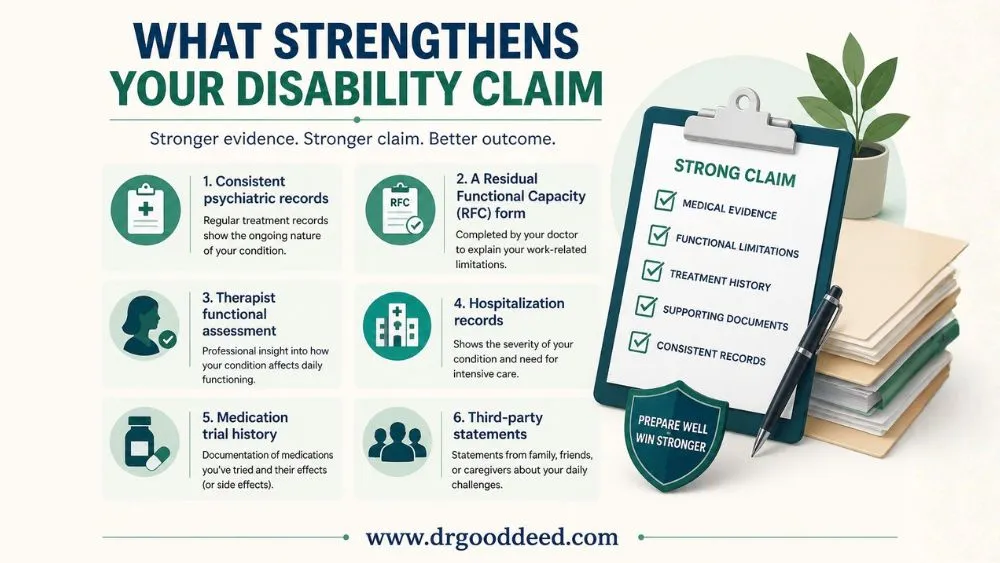
A strong depression disability claim rests on documentation, not just diagnosis. Depression is a disability when these elements are present.
What SSA adjudicators look for:
- Consistent psychiatric records spanning at least 12 months from a licensed psychiatrist
- A Residual Functional Capacity (RFC) form completed by your treating doctor, specific to work limitations
- Therapist functional assessment describing your ability to concentrate, interact, and adapt in a work setting
- Hospitalization records for depressive episodes or crisis intervention
- Medication trial history showing at least two antidepressants tried with documented outcomes
- Third-party statements from family members describing daily functional limitations
Working with a Social Security disability attorney significantly improves outcomes. Attorneys who specialize in SSA claims work on contingency, meaning no upfront cost, and they receive a portion of back pay only if you win.
FAQs
Is depression legally considered a disability?
Yes. Under the ADA and the SSA’s Listing 12.04, major depressive disorder is a disability when it significantly limits major life activities or prevents substantial gainful employment. It qualifies as both a workplace accommodation trigger under the ADA and a benefits-qualifying condition under the SSA.
Can you get disability benefits for depression?
Yes. You can get disability benefits for depression through SSDI if you have a qualifying work history, or through SSI if your income falls below federal limits. Both require documented psychiatric diagnosis, 12 months of symptoms, and proof that depression prevents earning more than $1,550 per month in 2024.
What level of depression qualifies for disability?
Major depressive disorder with marked limitations in at least two of the four Paragraph B functional areas qualifies. Mild or situational depression does not. Treatment-resistant major depression lasting 2-plus years under Paragraph C criteria also qualifies, even without meeting Paragraph B thresholds.
How does inability to work due to depression affect eligibility?
Inability to work due to depression is the central test. The SSA evaluates whether depression prevents any job in the national economy, not just your previous job. If depression prevents sustained 8-hour workdays, consistent attendance, or basic task completion, that directly supports eligibility.
What is required in a medical evaluation for disability benefits?
Medical evaluation for disability benefits requires a DSM-5 diagnosis from a licensed psychiatrist, functional impairment documentation across the four Paragraph B areas, a 12-month treatment history, and an RFC form completed by your treating provider. Vague symptom descriptions without functional specifics result in denial.
Does therapy impact disability status negatively?
No. Therapy’s impact on disability status is positive, not negative. Documented therapy attempts that show limited improvement are evidence of treatment resistance, which strengthens a claim. Abandoning treatment actually hurts claims because the SSA interprets gaps as signs that symptoms may not be severe.
Why are depression disability claims denied?
The most common reasons: incomplete medical records, no psychiatric diagnosis, income above the SGA limit, and vague functional documentation. Mental illness classification as disability requires specific evidence, not just a diagnosis. Most denials happen because records don’t prove functional limitation clearly enough.
How long do disability benefits for depression last?
SSDI and SSI benefits continue as long as the condition persists and you remain unable to work. The SSA conducts Continuing Disability Reviews (CDRs) every 3 to 7 years. Benefits stop only if a CDR finds substantial medical improvement allowing full-time work.
Can mild depression qualify as a disability?
No. Mild depression does not meet SSA criteria under Listing 12.04. The SSA requires marked or extreme functional limitations. Mild depression that responds to treatment and doesn’t prevent employment falls outside mental illness classification as disability thresholds under federal standards.
Do you need medication to qualify for disability?
No medication requirement exists. However, the SSA expects to see documented treatment attempts. If medication was tried and caused severe side effects or failed to produce improvement, those records support the claim. Refusing treatment without a documented medical reason weakens eligibility.