


Vegetative symptoms of depression are the physical, bodily changes that depression causes, separate from sadness or emotional distress. These include disrupted sleep, appetite changes, extreme fatigue, reduced sex drive, and slowed physical movement.
The DSM-5 recognizes these as core diagnostic criteria for major depressive disorder, not secondary effects. In the United States, roughly 60% of people with depression report physical symptoms as their most disabling feature, yet most online content focuses almost entirely on the emotional side.
Common Vegetative Symptoms of Depression
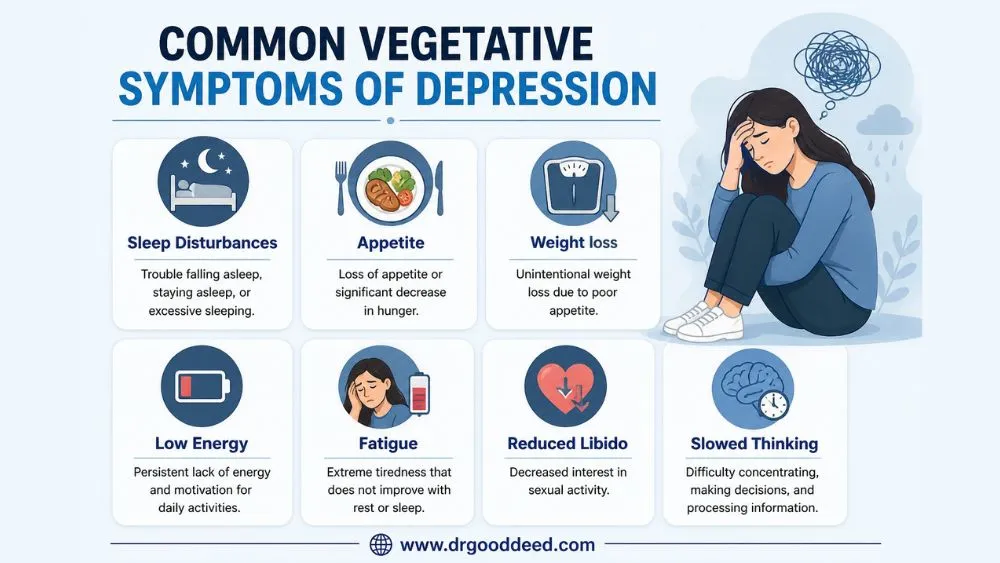
Vegetative symptoms of depression are biological disruptions caused by changes in brain chemistry, not by external circumstances. They appear whether or not a person feels visibly sad. Many people with depression get diagnosed late precisely because their most obvious symptoms are physical.
Sleep Disturbances: Insomnia or Hypersomnia
Depression disrupts the brain’s sleep architecture in two opposite directions. Some people develop insomnia, specifically early morning awakening, where they wake at 3 or 4 AM and can’t fall back asleep. Others develop hypersomnia, sleeping 10 to 12 hours and still feeling exhausted. Both patterns reflect the same underlying problem: disrupted REM sleep regulation driven by serotonin and norepinephrine imbalance.
Appetite and Weight Changes
Depression alters appetite-regulating signals in the brain. Some people lose all interest in food and drop weight rapidly. Others develop carbohydrate cravings and gain weight. Both responses trace back to dysregulation of ghrelin (the hunger hormone) and leptin (the satiety hormone), both of which the brain modulates through the same pathways depression disrupts.
Low Energy and Fatigue
Brain chemistry and energy levels depression research shows that low dopamine and norepinephrine directly reduce cellular energy production. This isn’t tiredness from exertion. It’s a neurobiological state where the brain fails to generate the motivation signals that allow normal physical functioning. Patients describe it as “moving through concrete.”
Reduced Libido
Low serotonin and dopamine reduce sexual drive at the neurochemical level. This symptom appears in over 70% of people with untreated major depression, according to data from the Journal of Clinical Psychiatry. It often worsens with SSRIs, which is a frequently missed clinical detail when managing vegetative symptoms of depression.
Psychomotor Slowing or Agitation
Psychomotor retardation means slowed thinking, slowed speech, and slowed physical movement. It’s visible to others. Psychomotor agitation is the opposite; restless, repetitive movement like pacing or hand-wringing. Both reflect disrupted dopamine signaling in the basal ganglia. Either pattern signals moderate to severe depression.
Hormonal Changes Affecting Appetite and Sleep
Hormonal changes affecting appetite and sleep are the biological engine behind most vegetative symptoms. Most online sources list the symptoms without explaining why the body produces them. The hormonal layer is where the real mechanism lives.
Cortisol Imbalance and Stress Response
In depression, the HPA axis becomes overactive. Cortisol stays elevated throughout the day instead of following its normal morning-peak, evening-drop pattern. Chronically high cortisol suppresses appetite in some people and triggers stress-eating in others. It also delays sleep onset and shortens deep sleep stages. This is why many people with depression feel “wired but tired,” simultaneously exhausted and unable to sleep.
Melatonin Disruption and Sleep Cycles
Research on circadian rhythm disruption and depression consistently shows that melatonin secretion timing shifts in depressed patients. The brain releases melatonin later than normal, which delays the sleep window. Simultaneously, brain chemistry and energy levels depression studies confirm that disrupted melatonin affects next-day dopamine availability, creating a cycle where poor sleep worsens daytime energy and mood.
Appetite-Regulating Hormones: Ghrelin and Leptin
Depression increases ghrelin (which stimulates hunger) and decreases leptin sensitivity (which signals fullness). The net result varies by individual. Some patients experience complete appetite loss because cortisol overrides ghrelin signals.
Others experience constant hunger because leptin resistance prevents the brain from registering fullness. Hormonal changes affecting appetite and sleep don’t produce one predictable pattern; they produce opposite extremes depending on which hormonal pathway dominates.
Lifestyle Changes for Neurovegetative Symptoms
Lifestyle changes for neurovegetative symptoms address the biological roots of these symptoms, not just their surface presentation. The goal is circadian stabilization and neurotransmitter support through consistent behavioral changes.
Sleep Regulation Strategies
Fix the sleep window first. Going to bed and waking at the same time every day, including weekends, resets the circadian system within 2 to 3 weeks. Avoid naps longer than 20 minutes. Naps beyond that length suppress nighttime sleep drive and worsen the insomnia pattern common in depression.
- Set a fixed wake time of 7 AM regardless of when sleep occurred
- Avoid screens for 60 minutes before bed (blue light suppresses melatonin)
- Keep the bedroom below 68°F; cooler temperatures accelerate sleep onset
- Avoid alcohol; it suppresses REM sleep and worsens early morning waking
Structured Daily Routine
Circadian rhythm disruption depression responds directly to behavioral scheduling. Eating meals at the same time daily stabilizes ghrelin and leptin release. Fixed activity times anchor the body’s internal clock. Patients who follow a consistent daily schedule show measurable improvements in sleep quality within 4 weeks, according to interpersonal and social rhythm therapy (IPSRT) research at the University of Pittsburgh.
Nutrition and Physical Activity
Lifestyle changes for neurovegetative symptoms must include dietary protein at every meal. Protein provides tryptophan, the amino acid the brain uses to make serotonin. Skipping breakfast, common in depressed patients, starves the brain of serotonin precursors for the entire morning.
Aerobic exercise for 30 minutes daily raises dopamine and norepinephrine within 20 minutes of starting. This directly counteracts the fatigue and psychomotor slowing that define vegetative symptoms of depression.
Light Exposure and Circadian Alignment
Morning light exposure for 20 to 30 minutes within one hour of waking is one of the most evidence-backed interventions for circadian rhythm disruption depression. Bright light suppresses lingering melatonin and triggers cortisol’s natural morning peak, which is the signal the body needs to start the day properly. Light therapy boxes (10,000 lux) produce clinical results equivalent to antidepressants for seasonal depression and improve sleep quality in non-seasonal depression as well.
Medical Treatment for Vegetative Symptoms
Vegetative symptoms of depression often require targeted medication, especially when lifestyle interventions don’t produce sufficient improvement within 4 to 6 weeks.
Antidepressants Targeting Physical Symptoms
Different antidepressants target different vegetative symptoms of depression:
- SNRIs (venlafaxine, duloxetine): Address fatigue, pain, and psychomotor slowing through norepinephrine and serotonin pathways
- Bupropion (Wellbutrin): Raises dopamine and norepinephrine; preferred when fatigue, low motivation, and reduced libido are the dominant symptoms; less likely to cause side effects on body than SSRIs
- Mirtazapine: Used when insomnia and appetite loss are severe; sedating at low doses, appetite-stimulating through histamine receptor activity
- SSRIs alone (fluoxetine, sertraline): Effective for emotional symptoms but sometimes worsen fatigue and libido issues in the short term
Sleep-Focused Treatments
When insomnia is severe and non-responsive to sleep hygiene, trazodone at 50 to 100 mg is commonly prescribed alongside an antidepressant. It’s sedating without being habit-forming. Cognitive Behavioral Therapy for Insomnia (CBT-I) is the first-line non-drug treatment and produces lasting improvement in sleep architecture that medication alone doesn’t achieve.
Hormonal and Metabolic Considerations
Thyroid dysfunction and testosterone deficiency both mimic and worsen vegetative symptoms of depression. A TSH (thyroid-stimulating hormone) test and testosterone panel should be part of the initial workup for any patient presenting primarily with fatigue, weight change, and low libido. Treating subclinical hypothyroidism alongside depression produces significantly better outcomes than treating depression alone.
FAQs
What are vegetative symptoms of depression?
Vegetative symptoms of depression are the physical changes depression causes: disrupted sleep (insomnia or hypersomnia), appetite and weight changes, extreme fatigue, reduced libido, and psychomotor slowing or agitation. They’re driven by serotonin, dopamine, and cortisol dysregulation, not by emotional distress alone.
How are vegetative symptoms different from emotional symptoms?
Emotional symptoms are sadness, hopelessness, and guilt. Vegetative symptoms of depression are biological: broken sleep, appetite loss or gain, physical exhaustion, and slowed movement. A person can show severe vegetative symptoms with minimal visible sadness, which is why depression gets missed in clinical settings that focus only on mood.
What causes appetite and sleep changes in depression?
Hormonal changes affecting appetite and sleep drive these symptoms. Cortisol overactivation disrupts sleep architecture. Ghrelin and leptin dysregulation changes hunger signals. Melatonin secretion shifts later, delaying sleep onset. All three systems are disrupted simultaneously in major depression.
How does circadian rhythm disruption affect depression?
Circadian rhythm disruption depression creates a self-reinforcing cycle. Delayed melatonin reduces sleep quality. Poor sleep lowers dopamine the next day. Low dopamine worsens fatigue and mood. Morning light therapy at 10,000 lux for 20 minutes resets the circadian system and breaks this cycle within 1 to 2 weeks.
Can hormonal changes worsen vegetative symptoms?
Yes. Hypothyroidism, low testosterone, and elevated cortisol all amplify vegetative symptoms of depression. A TSH test and sex hormone panel should be checked before concluding that antidepressants alone are sufficient. Untreated hypothyroidism makes antidepressants significantly less effective.
How to manage neurovegetative symptoms naturally?
Fix the sleep window first with a consistent wake time. Add 20 minutes of morning sunlight daily. Exercise aerobically for 30 minutes. Eat protein at breakfast to support serotonin production. These four lifestyle changes for neurovegetative symptoms produce measurable improvement within 3 to 4 weeks without medication.
Do antidepressants help with vegetative symptoms?
Yes, but the choice of antidepressant matters. Bupropion works best for fatigue and low libido. Mirtazapine works best for appetite loss and insomnia. SSRIs alone address mood but sometimes worsen fatigue initially. Matching the antidepressant to the dominant vegetative symptoms of depression produces faster results.
Why does depression affect energy levels?
Brain chemistry and energy levels depression research shows low dopamine and norepinephrine reduce the brain’s ability to generate motivation and initiate physical movement. This is a neurochemical deficit, not laziness. Bupropion targets this pathway specifically by blocking dopamine and norepinephrine reuptake.
Are vegetative symptoms a sign of severe depression?
Psychomotor retardation and hypersomnia specifically correlate with melancholic or severe depression. Mild depression rarely produces visible psychomotor changes. When vegetative symptoms of depression dominate the clinical picture, especially with early morning waking and complete appetite loss, the depression is typically moderate to severe by DSM-5 criteria.
When should you seek help for vegetative symptoms?
Seek medical evaluation when sleep disturbance or appetite changes persist beyond 2 weeks, when fatigue prevents normal daily functioning, or when libido drops suddenly without an obvious physical cause. Vegetative symptoms of depression that appear together rather than individually warrant immediate psychiatric or primary care assessment.