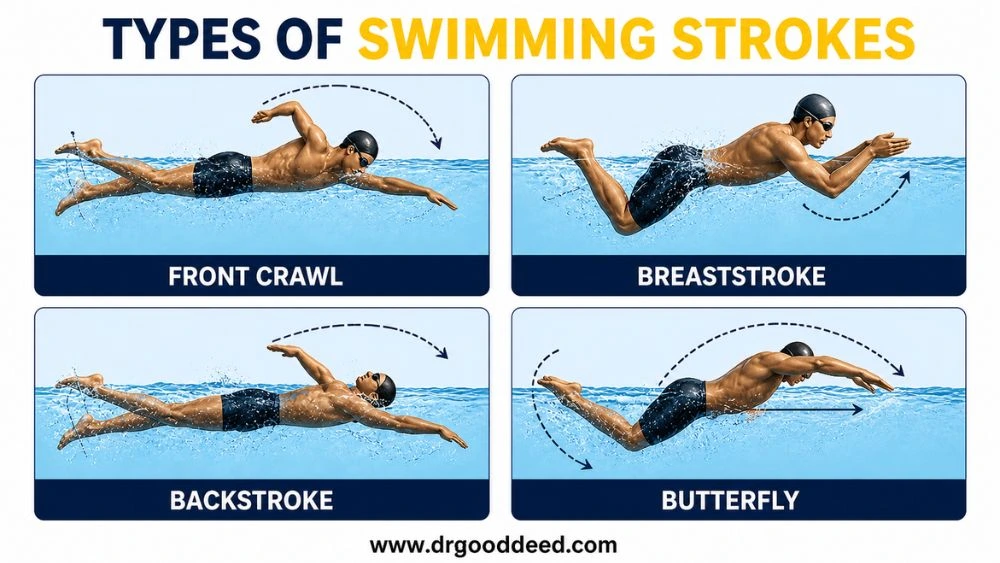

A 155-pound person burns between 400 and 700 calories per hour, depending on Types of swimming stroke type and pace. That range is wide for a reason. Swimming is not a fixed-output workout. Your weight, your technique, and how hard you push all shift those numbers fast.
This guide breaks down calorie burn by session length, body weight, stroke, and intensity. You’ll also get a full breakdown of which workouts get the most out of every lap.
Calories Burned Swimming (Quick Table)
Calories that swimming burns per hour depends on your body weight and how hard you swim. A slow, casual swim burns far less than a competitive-pace freestyle session. Use this table as your baseline.
| Body Weight | Slow/Casual (cal/hr) | Moderate Pace (cal/hr) | Fast/Vigorous (cal/hr) |
| 130 lbs | 354 | 472 | 590 |
| 155 lbs | 422 | 563 | 704 |
| 180 lbs | 490 | 654 | 817 |
| 205 lbs | 558 | 745 | 931 |
These numbers come from MET (metabolic equivalent) values used by Harvard Medical School. Butterfly stroke pushes the upper end of the vigorous column. Backstroke casual laps sit at the lower end.
Duration and Pace Affecting Calorie Burn
Duration and pace affecting calorie burn is the biggest variable most guides skip past. Two people swimming for 30 minutes burn completely different amounts, and it’s not just body weight doing that work.
Slow vs. Moderate vs. Fast Swimming
A slow swim, around 1 mile per 60 minutes, keeps your heart rate at 50-60% of max. That burns roughly 300-400 calories per hour for a 155-pound person.
Moderate pace, 1.5 miles per hour, pushes heart rate to 70% and burns 500-600 calories per hour. Fast swimming above 2 miles per hour, competitive training level, can hit 700+ per hour.
The difference between slow and fast is about 300 extra calories burned per hour. That’s significant.
Continuous vs. Interval Training
Steady-state laps keep you at one heart rate zone. You burn calories during the swim, then return to baseline fast after stopping.
Interval training, where you sprint for 50 meters, rest 20 seconds, then sprint again, creates EPOC (excess post-exercise oxygen consumption). Your body keeps burning more calories for 12-24 hours after the workout ends. A 30-minute interval session can produce the same calorie result as a 45-minute steady swim.
Stroke Efficiency and Technique
Bad technique costs you calories. Sinking legs, a wide arm pull, and poor rotation all create drag. You work harder to go slower. That does burn more calories short-term, but it destroys endurance. Better technique means you can sustain higher speeds longer, burning more total calories per session.
How Long to Swim to Burn Calories
How long to swim to burn calories matters when you’re working around a schedule. Here’s what each session length realistically delivers for a 155-pound person at moderate pace.
15 Minutes
Around 140 calories. Good for a lunch break session. Not enough on its own for weight loss, but it builds the habit.
30 Minutes
Around 280 calories at moderate pace. Push to vigorous and that climbs to 350. Thirty minutes is the sweet spot for most people balancing time and results.
60 Minutes
550-700 calories depending on stroke and pace. An hour of butterfly or fast freestyle is one of the highest non-gym calorie burns available. Elite triathletes training open water commonly hit 800+ per hour.
Body Weight and Swimming Calorie Burn
Body weight and swimming calorie burn have a direct relationship. More mass requires more energy to move through water. It’s physics.
Heavier Individuals Burn More Calories
A 205-pound person burns about 30% more calories than a 130-pound person doing the same swim at the same pace. That gap narrows with distance training because lighter, more efficient swimmers can sustain higher speeds.
Muscle Mass Impact
Muscle burns more energy than fat even at rest. Two swimmers at the same weight burn different amounts if one has significantly more muscle mass. The more muscular swimmer’s body demands more oxygen during exertion, increasing total calorie burn.
Energy Expenditure Differences
Water is 800 times denser than air. Every stroke pulls against real resistance. That’s why how many calories swimming burn beats walking at the same time investment. Walking burns roughly 300 calories per hour for a 155-pound person. Swimming at moderate pace burns nearly double that.
Swimming Workout for Maximum Calorie Burn
Swimming workout for maximum calorie burn requires structure. Casual lapping won’t get you there.
High-Intensity Interval Swimming (HIIT)
Swim 50 meters at full sprint. Rest 20-30 seconds. Repeat 10 times. Total session: 20 minutes. Calorie burn rivals a 45-minute moderate swim. The EPOC effect adds another 100-200 calories post-session.
Mixed Stroke Workouts
Alternating butterfly, freestyle, and breaststroke within one session prevents muscle adaptation. Each stroke activates different muscle groups. When muscles aren’t adapted to a movement, they burn more energy performing it.
Increasing Pace Gradually
Start at 60% effort for the first 10 minutes. Move to 75% for 10 minutes. Finish with 90% effort for the final 10 minutes. This progressive structure keeps your heart rate climbing throughout the session, maximizing total calorie output.
Which Swimming Stroke Burns the Most Calories?
How many calories does swimming burn varies sharply by stroke. Same weight, same time, different stroke, completely different results.
Butterfly (Highest Burn)
Butterfly burns 450-650 calories per 30 minutes for a 155-pound person. It demands full-body coordination, strong core engagement, and powerful dolphin kicks. Most recreational swimmers can’t sustain it for more than a few laps, which is why mixing it into a workout makes more sense than trying to swim butterfly for 60 minutes straight.
Freestyle (Fast and Efficient)
Freestyle burns 400-580 calories per 30 minutes. It’s the most sustainable high-output stroke. Olympic swimmers train almost entirely in freestyle because it produces the highest speed-to-effort ratio.
Breaststroke and Backstroke
Breaststroke burns around 350-500 calories per 30 minutes. Backstroke is typically 300-450. Both are lower intensity but easier to sustain for longer sessions. For beginners, breaststroke for 45-60 minutes still clears 500 calories total.
Low Impact Exercise Calorie Burn Swimming
Low-impact exercise calorie burn, such as swimming, is why doctors recommend it for patients with joint pain, obesity, and post-surgical recovery.
Joint-Friendly Workout
Water supports up to 90% of your body weight when submerged to neck level. Your knees, hips, and spine handle almost no impact force. That makes swimming one of the few high-calorie workouts that people with arthritis or knee injuries can do consistently.
Full-Body Muscle Engagement
A single freestyle lap engages your lats, deltoids, core, glutes, hamstrings, and hip flexors simultaneously. Very few gym exercises produce that breadth of muscle activation in one movement.
Suitable for All Fitness Levels
A 60-year-old recovering from knee surgery and a college swimmer can both swim laps. The water levels the environment. Beginners start slow, burn fewer calories, but still build cardiovascular fitness that eventually allows them to swim harder and burn more.
Factors That Influence Swimming Calorie Burn
Water Temperature
Cold water, below 78°F, forces your body to generate heat. Thermogenesis adds roughly 5-10% to your calorie burn. Open water swimmers in cold lakes burn more than pool swimmers doing the same workout.
Skill Level
Beginners burn more calories per lap than advanced swimmers because poor technique creates more drag and resistance. The tradeoff: beginners also fatigue faster and swim fewer total laps. Net calorie burn still favors skilled swimmers who can sustain effort for longer.
Consistency and Endurance
How many calories swimming burn over a month depends almost entirely on showing up. Three 30-minute sessions per week at moderate pace burns roughly 3,360 calories per month for a 155-pound person, equivalent to just under one pound of fat.
FAQs
Does duration and pace affect calorie burn?
Yes. Pace doubles the impact of duration. Swimming vigorously for 30 minutes burns more than swimming slowly for 45 minutes. A 155-pound person burns 282 calories in 30 minutes at moderate pace and 352 calories at vigorous pace in the same time.
How does body weight affect swimming calorie burn?
Heavier bodies burn more calories swimming because they require more energy to move through water. A 205-pound person burns roughly 30% more calories per session than a 130-pound person at identical pace and stroke. This gap narrows as fitness and technique improve.
Which stroke burns the most calories?
Butterfly burns the most, up to 650 calories per 30 minutes for a 155-pound person. Freestyle follows at 580. Breaststroke and backstroke sit lower. Most people cannot sustain butterfly for full sessions, so mixing strokes produces higher total burn practically.
Is swimming a low impact exercise for weight loss?
Yes. Swimming burns 400-700 calories per hour with near-zero joint stress. That combination makes it sustainable long-term. Most high-calorie land workouts, like running, produce overuse injuries within months. Swimmers maintain consistent training schedules without the injury interruptions.
Can swimming help lose belly fat?
Yes. Swimming reduces total body fat, including visceral belly fat. A 2015 study in the Journal of Exercise Rehabilitation found that women who swam three times weekly for 12 weeks significantly reduced waist circumference. You cannot spot-reduce fat, but swimming creates the calorie deficit that drives fat loss everywhere.
How often should I swim for weight loss?
Swim four times per week at minimum. Three sessions maintain fitness. Four or more sessions create the consistent weekly calorie deficit needed for measurable fat loss. Each session should be at least 30 minutes at moderate-to-vigorous pace.