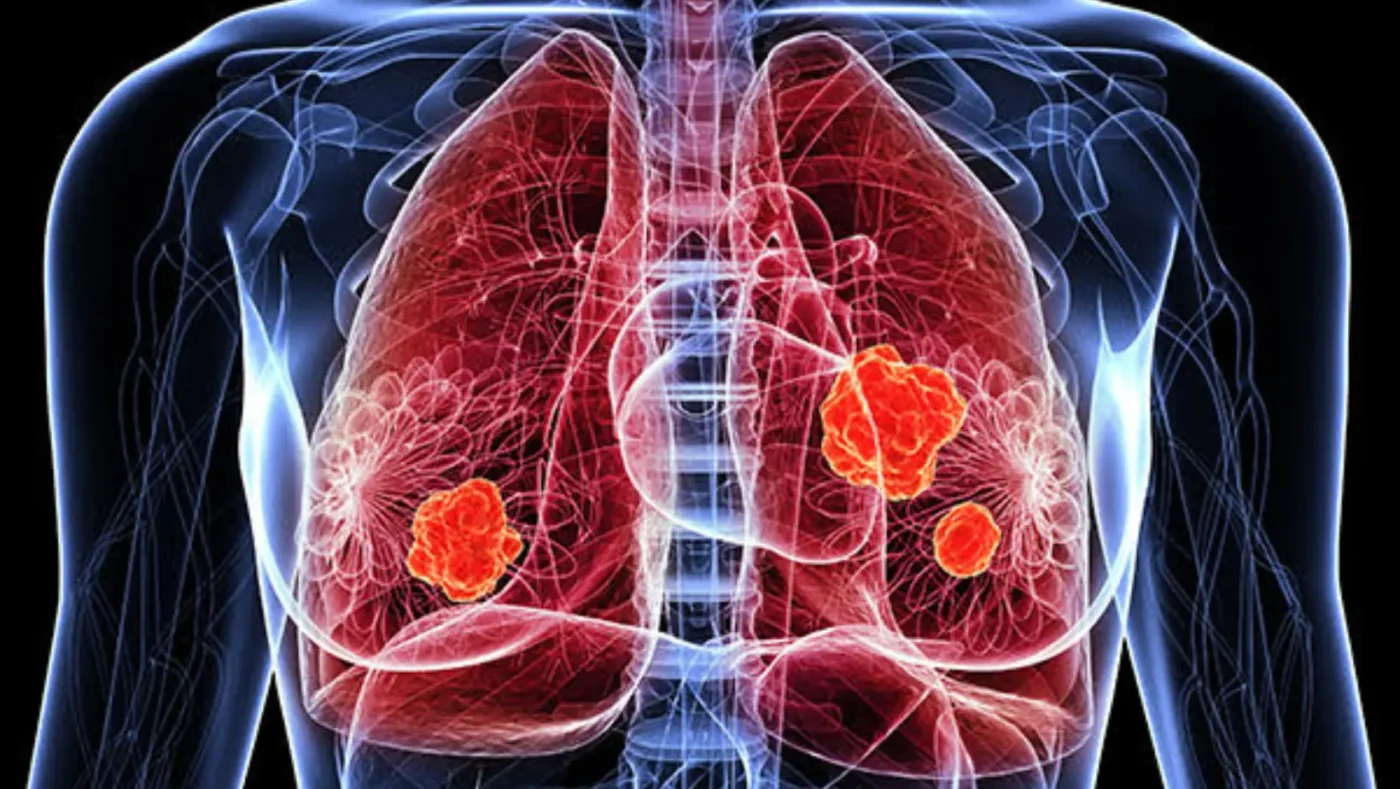

Early signs of lung cancer are easy to write off as a stubborn cold, allergies, or age. Lung cancer is the top cancer killer in the USA, taking more lives each year than colon, breast, and prostate cancers combined. At stage I, five-year survival exceeds 70%. At stage I to IV, it falls to 7%. The difference between those numbers is timing. Spotting the first signals and acting on them quickly changes outcomes. This guide covers symptoms, risk factors, diagnosis, and treatment.
Warning Signs of Lung Cancer
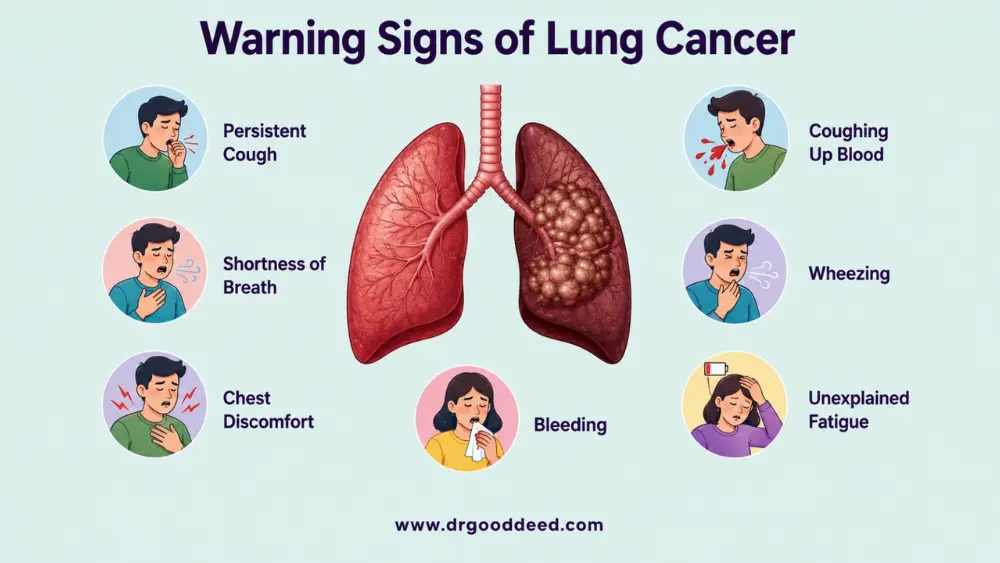
Warning signs of lung cancer look so much like everyday respiratory illness that most patients dismiss them for months.
Persistent Cough
A cough that lasts more than three weeks without any cold or allergy cause is the most reported early red flag. Lung cancer symptoms start for most patients with a dry, chest pain worsening cough that does not clear up on its own.
Coughing Up Blood
Coughing up blood, even pink-tinged or rust-colored mucus, is called hemoptysis and needs immediate evaluation. It ranks among the most specific warning signs of lung cancer in adults over 40, even when the amount of blood seems minor.
Shortness of Breath
A lung tumor narrows airways or fills air sacs, reducing how much oxygen you take in. This is one of the early signs of lung cancer most often chalked up to poor physical condition or normal aging.
Wheezing
A high-pitched sound when breathing signals a tumor partially blocking an airway. New wheezing with no history of asthma or allergies, and no response to standard inhalers, warrants a chest scan.
Chest Discomfort
Chest pain and lung cancer symptoms are regularly confused with heartburn or a strained muscle. In early lung cancer, the sensation is typically a dull ache or pressure that worsens when you breathe deeply, cough, or lie flat.
Unexplained Fatigue
Persistent tiredness that does not improve with rest is a missed early warning. Cancer triggers inflammatory responses that drain energy steadily, often before other symptoms develop or become obvious.
Lesser-Known Early Lung Cancer Symptoms That Can Appear Outside the Lungs
Early signs of lung cancer do not always start in the chest. Some tumors grow near nerves or vessels that connect to body regions far from the lungs. This causes symptoms in the shoulder, throat, or voice box with no chest pain at all.
Shoulder Pain Without an Injury
A Pancoast tumor grows at the very top of the lung and compresses nerves running into the shoulder and arm. Deep, persistent shoulder pain with no injury history is a known early presentation. Many patients see orthopedic specialists for months before lung cancer is suspected.
Hoarseness or Voice Changes
A tumor compressing the recurrent laryngeal nerve (the nerve controlling the voice box) makes the voice raspy and does not improve. Hoarseness lasting over two weeks without a throat infection needs chest imaging, not just throat lozenges.
Repeated Throat Clearing
Constant throat clearing without any post-nasal drip or known allergy is an underreported early symptom. Tumor-related airway irritation drives this reflex, and it persists despite antihistamines or allergy treatments.
Frequent Respiratory Infections
Two or more lung infections in the same location within one year is a serious pattern. A tumor blocking that airway traps bacteria and fluid, causing repeated bronchitis or pneumonia in the same part of the lung.
Symptoms Can Depend on Where the Tumor Is Located
Early signs of lung cancer differ significantly based on where in the lung the tumor grows. Two patients with the same cancer type can describe completely different first symptoms depending on tumor location relative to airways, nerves, and the chest wall.
Tumors Near Major Airways
Central tumors near the bronchi (the main breathing tubes) cause early coughing, blood in mucus, chest pain and lung cancer symptoms. Their central position also makes them more visible on standard chest X-rays than peripheral tumors.
Tumors in the Outer Lung
Peripheral tumors at the lung’s outer edges are silent until large or chest-wall-invasive. Many are found accidentally during imaging ordered for an unrelated condition, such as a pre-surgical chest scan or spine MRI.
Tumors Near Important Nerves
Tumors near the recurrent laryngeal or phrenic nerve cause hoarseness, shoulder pain, and diaphragm elevation on X-ray. Chest pain and lung cancer symptoms in this pattern point to nerve compression rather than airway obstruction.
Early Signs of Lung Cancer in Non-Smokers
Early signs of lung cancer in non-smokers appear more subtly and later than in smokers, which delays diagnosis further. Between 15% and 20% of USA lung cancer cases occur in people who have never smoked. Non-smokers most commonly develop adenocarcinoma, a slow-growing subtype in the outer lung with EGFR gene mutations (changes that respond specifically to targeted oral drugs). Radon gas at home, secondhand smoke, and long-term air pollution are the main causes in this group. Women who have never smoked face a disproportionately higher risk than male non-smokers in the USA.
Risk Factors of Lung Cancer
Smoking and lung cancer risk factors are the most studied in cancer medicine, but they extend beyond cigarettes. Environmental exposures, occupational chemicals, and inherited traits all add risk.
Cigarette Smoking
Smoking accounts for roughly 85% of all USA lung cancer cases. Smoking and lung cancer risk factors apply to both active smokers and former smokers, who stay at elevated risk for years after quitting. Risk scales with pack-years (cigarettes per day multiplied by years smoked).
Secondhand Smoke Exposure
Non-smokers living with a smoker inhale thousands of carcinogens (cancer-causing chemicals) each day. Long-term secondhand smoke exposure raises lung cancer risk by 20% to 30%, according to the CDC. Children of smokers carry elevated risk into adulthood.
Radon Exposure
Radon is a colorless, odorless radioactive gas rising from soil and collecting inside buildings, especially basements. It is the second-leading cause of lung cancer in the USA, linked to roughly 21,000 deaths each year per the EPA. Home test kits cost under $30 at hardware stores.
Occupational Chemical Exposure
Long-term contact with asbestos, arsenic, chromium, nickel, and diesel exhaust raises lung cancer risk sharply. Construction workers, miners, and auto mechanics face the highest workplace exposure. Risk multiplies significantly when combined with smoking.
Air Pollution
Long-term exposure to fine particulate matter (PM2.5) from vehicle traffic and industry raises lung cancer risk even in non-smokers. Urban populations near heavy traffic corridors consistently show higher lung cancer rates than rural counterparts.
Family History of Lung Cancer
A parent or sibling with lung cancer raises personal risk even without smoking. Researchers are actively identifying inherited genetic variants in carcinogen-processing (cancer-substance-processing) pathways as risk markers for at-risk family members.
How Lung Cancer Is Diagnosed
Symptoms alone cannot confirm early signs of lung cancer. A structured diagnostic process confirms cancer type, rules out other causes, and determines how far the disease has spread before a treatment plan is built.
Medical History and Physical Examination
A doctor reviews your symptom timeline, smoking history, chemical exposures, and family history. Physical examination looks for lymph node swelling, abnormal breath sounds, and finger clubbing (a sign of long-term reduced oxygen levels).
Chest X-Ray
A chest X-ray is the first imaging step. It can reveal a mass or shadow, but routinely misses tumors smaller than 1 cm. A normal result does not rule out early lung cancer.
Low-Dose CT Scan
The USPSTF recommends annual low-dose CT (LDCT) for adults aged 50 to 80 with a 20 pack-year smoking history who currently smoke or quit within the last 15 years. LDCT catches tumors far smaller than any X-ray can detect.
Sputum Cytology
This test checks mucus coughed from the lungs for cancer cells under a microscope. It is most useful for central airway tumors and adds diagnostic value when imaging findings are uncertain.
Biopsy Procedures
A biopsy collects tissue directly from the suspicious area. Bronchoscopy, CT-guided needle biopsy, and VATS (video-assisted thoracoscopic surgery) are the main methods. Biopsy confirms cancer type and molecular mutations that direct targeted treatment.
Treatment Options for Early Stage Lung Cancer
Treatment options for early-stage lung cancer are more effective today than at any previous point. Diagnosing early signs of lung cancer in time opens access to curative surgery, precisely targeted radiation, and molecular drugs not available to late-stage patients.
Surgical Removal of Tumors
Surgery is the leading treatment option for early-stage lung cancer for localized tumors in patients healthy enough to undergo surgery. VATS lobectomy (minimally invasive removal of a lung section) delivers five-year survival rates of 70% to 80% at stage I.
Radiation Therapy
Stereotactic body radiation therapy (SBRT) for cancer can delivers concentrated, precisely aimed radiation to the tumor. It is the main alternative for patients who cannot have surgery due to heart disease or reduced lung function, with local control rates above 90%.
Targeted Therapy
Targeted drugs block specific gene mutations driving cancer growth. EGFR mutations (found in 10% to 15% of USA non-small cell lung cancers) respond to osimertinib. ALK rearrangements respond to alectinib. Both are taken as once-daily pills.
Immunotherapy
Checkpoint inhibitors like pembrolizumab help the immune system find and attack cancer cells. In early-stage lung cancer with high PD-L1 protein expression, immunotherapy is now given before or after surgery to reduce recurrence risk.
Adjuvant Chemotherapy
Adjuvant chemotherapy after surgery targets remaining cancer cells not visible on imaging. It is standard for stage II and select stage III cases. Drug choice and dosage vary by stage, patient age, and kidney function.
How Robert Callahan’s Five-Week Cough Uncovered Stage I Lung Cancer
Robert Callahan, 61, from Chicago, Illinois, visited his primary care doctor in October 2023 about a dry cough lasting five weeks. He had smoked a pack a day for 30 years and quit at 55. His doctor referred him for LDCT screening through the USPSTF protocol. The scan identified an 8mm nodule in his right upper lobe. A CT-guided biopsy confirmed stage IA squamous cell carcinoma. Robert had VATS lobectomy the following month. No chemotherapy was required. At his twelve-month follow-up, imaging showed no recurrence. His case shows exactly how a single symptom taken seriously, combined with the right screening test, can produce a fully curative outcome.
Robert’s name has been altered to protect patient privacy.
FAQs
How do lung cancer symptoms start?
How lung cancer symptoms start depends on tumor location. Central tumors cause coughing and blood-tinged mucus within weeks. Peripheral tumors stay silent longer. Most patients report a persistent cough as the first symptom, appearing 3 to 8 weeks before anything else.
Is a persistent cough always a sign of lung cancer?
No. Most persistent coughs come from GERD, postnasal drip, or asthma. But a cough over three weeks producing rust-colored mucus in a 20-pack-year smoker is a specific warning sign of lung cancer pattern that requires imaging before other causes are assumed.
Can chest pain be an early symptom of lung cancer?
Yes. Dull chest pressure appears early when a central tumor presses on the chest wall or pleura (lung lining). Chest pain and lung cancer symptoms in this pattern worsen specifically during deep breathing and coughing, which distinguishes them from cardiac or muscle causes.
What does lung cancer chest pain feel like?
Lung cancer chest pain is a dull, steady ache rather than sharp or sudden. Chest pain and lung cancer symptoms do not radiate to the jaw or left arm the way cardiac pain does. Pain worsening when you inhale deeply or cough is the most clinically specific pattern.
Can lung cancer cause shortness of breath?
Yes. Tumors narrow airways or compress lung tissue. Breathlessness from early signs of lung cancer develops gradually over weeks. New breathlessness during previously easy activities, such as walking at a normal pace, is the specific symptom pattern worth investigating.
What are the major smoking and lung cancer risk factors?
Smoking and lung cancer risk factors include a 20+ pack-year smoking history, radon levels above 4 pCi/L at home, daily secondhand smoke exposure, asbestos or arsenic in the workplace, urban PM2.5 air pollution, and a first-degree relative with lung cancer.
Can non-smokers develop lung cancer?
Yes. Around 15% to 20% of USA lung cancer cases occur in never-smokers. Radon is the leading cause in this group. Non-smokers more often develop EGFR-mutant adenocarcinoma, which responds to targeted oral medications rather than standard intravenous chemotherapy.
Is early-stage lung cancer curable?
Yes. Stage I lung cancer treated with surgery achieves 70% to 80% five-year survival. Identifying early signs of lung cancer before reaching stage III is the single most important factor in outcomes, as survival falls sharply with every advancing stage.
How can I reduce my risk of developing lung cancer?
Quit smoking (risk drops by 50% within 10 years of quitting), test your home for radon, and limit secondhand smoke exposure. If aged 50 to 80 with a 20 pack-year history, ask about annual LDCT screening and treatment options for early-stage lung cancer if a nodule is found.