
Nicotine is addictive, but does nicotine gum cause cancer the way cigarettes do? Current evidence does not classify nicotine gum as a cancer-causing product. But the full picture is more nuanced.
Nicotine itself is not a carcinogen, meaning it does not directly trigger the DNA mutations that start cancer. Still, some laboratory research raises questions about how nicotine may interact with tumors that already exist.
This article covers whether nicotine gum causes cancer, the side effects of nicotine gum, how long to use nicotine gum safely, and all nicotine replacement therapy options approved in the USA.
Nicotine Gum Is Not Classified as a Cancer-Causing Product
The FDA approves nicotine gum as an over-the-counter medication for smoking cessation. The International Agency for Research on Cancer (IARC), which is the WHO’s cancer classification body, has not classified nicotine as a carcinogen. The US Surgeon General has also concluded there is insufficient evidence to classify nicotine alone as cancer-causing.
The safety of nicotine gum at this level does not contain tar, carbon monoxide, or the 70-plus proven carcinogens found in tobacco smoke. FDA-approved NRT products, including nicotine gum, have been in use for decades, with large-scale post-marketing surveillance showing no significant increase in cancer incidence among users.
Why Smoking Causes Cancer but Nicotine Gum Generally Does Not
Cigarettes and nicotine gum both deliver nicotine, but the similarity stops there. The cancer risk from cigarettes comes almost entirely from burning tobacco, not from nicotine itself.
Cancer-Causing Chemicals in Cigarettes
When tobacco burns, it generates over 7,000 chemicals. The CDC and the National Cancer Institute confirm that at least 70 of these chemicals are known carcinogens. The most dangerous include:
- Polycyclic aromatic hydrocarbons (PAHs): Form DNA adducts that trigger mutations in genes like K-Ras and p53.
- Tobacco-specific nitrosamines (TSNAs): Compounds like NNK and NNN directly initiate cancer in lung, esophagus, and oral tissue.
- Formaldehyde and benzene: Proven Group 1 carcinogens per IARC classification.
- Carbon monoxide: Reduces oxygen delivery and promotes cardiovascular damage.
- Arsenic, cadmium, chromium: Heavy metals with established carcinogenic activity.
None of these compounds are present in FDA-approved nicotine gum.
What Nicotine Gum Removes From the Equation
Nicotine gum delivers pharmaceutical-grade nicotine through the mucous membrane of the cheek, not through combustion. No burning occurs. No smoke enters the lungs. No TSNAs form during the absorption process. The safety of nicotine gum explained at the chemical level comes down to this: the carcinogenic load of cigarette smoke is zero in nicotine gum.
Is Nicotine Itself a Carcinogen?
No. The IARC has not listed nicotine as a carcinogen. The FDA has not classified it as one either. So nicotine gum does not cause cancer by initiating cancer from scratch. Nicotine has been tested in standard mutagenicity assays, including the Ames test, and it does not cause the DNA mutations that initiate cancer.
A systematic review published in Annals of Translational Medicine (2023), which assessed preclinical studies on nicotine and cancer initiation, found inconsistent results across animal models. Tumor incidence did not differ between nicotine-exposed and control groups in five out of eleven studies reviewed. This means nicotine has not been reliably shown to start cancer from scratch, even in laboratory conditions designed to detect that effect.
Can Nicotine Gum Cause Mouth, Throat, or Oral Cancer?
No population-level or clinical evidence links nicotine gum to oral, throat, or mouth cancer. Nicotine gum does not contain TSNAs, which are the compounds in smokeless tobacco that cause oral cancer. The mucous membrane absorbs nicotine from gum without any of the carcinogens that make chewing tobacco or betel nut genuinely dangerous to oral tissue.
Mouth irritation from nicotine gum is a documented side effect, but mucosal irritation is not the same as mucosal carcinogenesis. A 2025 review in Frontiers in Oral Health confirmed that tobacco-free nicotine products show oral adverse events limited to mild soreness, dry mouth, or transient mucosal irritation, none of which are precancerous changes.
Could Nicotine Help Existing Cancer Cells?
The IARC does not classify nicotine as a carcinogen. But laboratory studies have found that nicotine can interact with cell growth pathways in ways that could, theoretically, support already-existing tumors. Here is what the research actually shows:
- Angiogenesis: Nicotine activates the VEGF pathway, which stimulates new blood vessel formation. Tumors need blood vessels to grow. Studies in mouse models, including research published in Nature Medicine, found nicotine accelerated tumor growth by promoting angiogenesis.
- Apoptosis inhibition: Nicotine activates the alpha-7 nicotinic acetylcholine receptor (α7nAChR), which can suppress the programmed cell death that normally removes damaged cells. A study in Oncotarget confirmed nicotine suppressed apoptosis in oral precancerous lesion cells via the α7nAChR/Prx1 signaling axis.
- Cell proliferation: A review in Molecular Cancer Research described how nicotine induces Src kinase activation via beta-arrestin-1, leading to Rb protein inactivation and upregulation of proliferative genes.
These are laboratory effects observed in cell cultures and animal models. Human evidence linking NRT use to faster cancer progression does not exist at the clinical trial or epidemiological level.
People actively undergoing cancer treatment should discuss NRT use with their oncologist, since the theoretical interaction with tumor biology warrants case-by-case clinical judgment.
Side Effects of Nicotine Gum
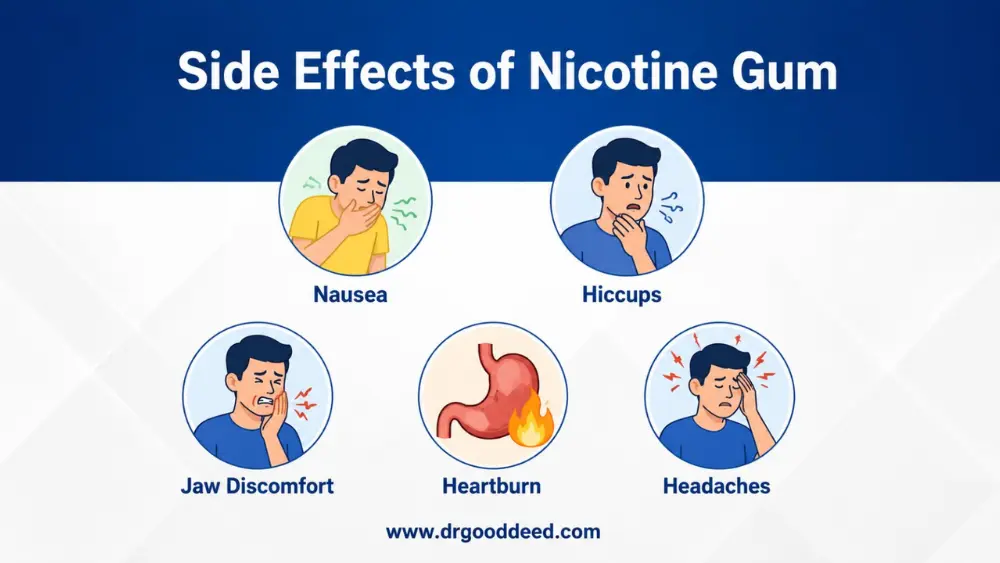
Side effects of nicotine gum are well-documented and mostly mild. They stem from how the gum is used, not from the nicotine itself at normal doses.
Nausea
Using gum too fast or chewing too many pieces in a short period delivers nicotine faster than the body handles comfortably. This causes nausea. The solution is the “chew and park” technique: chew the gum a few times until it tingles, then hold it between the cheek and gum to slow absorption.
Hiccups
Nicotine reaching the stomach, rather than being absorbed through the cheek lining, irritates the stomach lining and triggers hiccups. Proper use eliminates this almost entirely.
Jaw Discomfort
Chewing the gum continuously like regular gum strains the jaw muscles. The “chew and park” method reduces repetitive jaw movement and prevents soreness.
Heartburn
Swallowing nicotine-laced saliva causes esophageal irritation and heartburn in some users. Acidic drinks like coffee or juice within 15 minutes of using the gum worsen this. The FDA label instructs against drinking acidic beverages during use.
Headaches
At higher doses (4 mg), some users experience headaches. This typically indicates either too much nicotine or a sensitivity to nicotine at that concentration. Dropping to 2 mg pieces often resolves this.
How Long to Use Nicotine Gum Safely
How long to use nicotine gum safely has a clear evidence-based answer from clinical guidelines.
Recommended Duration of Use
The standard FDA-approved course is 12 weeks. The American Thoracic Society guidelines, updated in 2023 and cited in StatPearls (NCBI), recommend extended-duration therapy lasting more than 12 weeks for nicotine-dependent adults using NRT alongside a controller medication. This is appropriate when short-term use alone fails.
Gradual Dose Reduction
The standard schedule starts with one piece of gum every one to two hours for the first six weeks. Weeks seven through nine, users reduce to one piece every two to four hours. Weeks ten through twelve, they reduce further to one piece every four to eight hours. This stepwise taper prevents sharp withdrawal spikes.
Avoiding Long-Term Dependence
Long-term use of nicotine gum beyond 12 weeks is safer than continued smoking by a large margin. Still, the goal is complete nicotine independence. Dependence on NRT gum is less harmful than continued smoking, but discontinuing nicotine entirely is the clinical objective.
When to Discuss Continued Use With a Doctor
See a doctor if you are still using nicotine gum daily after three months without planning to stop, if you notice any persistent oral changes such as white patches or sores that do not heal within two weeks, or if you are pregnant, breastfeeding, or have a heart condition.
How Nicotine Gum Helped Thomas Redfield Quit After 22 Years
Note: The patient’s name has been changed to protect privacy. Clinical details reflect documented patterns from published NRT literature.
Thomas Redfield, a 47-year-old HVAC technician from Houston, Texas, had smoked a pack a day for 22 years. He had tried quitting cold turkey three times, each time relapsing within two weeks due to severe cravings and irritability. His primary care physician recommended a structured NRT protocol using 4 mg nicotine gum combined with brief behavioral counseling visits every two weeks.
What made Thomas’s case instructive goes beyond just the cessation success. His physician noted that in patients with high nicotine dependence scoring 7 or above on the Fagerström Nicotine Dependence scale, 4 mg gum outperformed 2 mg gum in craving suppression during the first six weeks. Thomas’s score was 8. He was also advised to use the gum reactively during high-risk moments: his morning coffee, his afternoon work break, and after dinner. These were his three historically highest-craving windows.
By week eight, Thomas was down to three to four pieces a day, well below the maximum of 24. By week fourteen, he had stopped entirely without relapse. His lung function test at the six-month mark showed measurable improvement in FEV1 (the amount of air you can force out in one second). His physician’s key insight was that NRT gum works best when users understand that mouth irritation from nicotine gum during the early weeks is a technique problem, not a signal to quit the gum. Correcting the chew-and-park method eliminated Thomas’s early-stage nausea and kept him on track.
Who Should Avoid or Use Nicotine Gum Carefully?
People With Certain Heart Conditions
Nicotine raises heart rate and blood pressure temporarily. People who recently had a heart attack or who have unstable angina should consult a cardiologist before using any NRT. The overall cardiovascular risk of continued smoking vastly exceeds NRT risk, but medical supervision is appropriate in these cases.
Pregnant and Breastfeeding Individuals
Nicotine crosses the placenta and enters breast milk. It affects fetal brain development and neonatal neurology. The FDA labels nicotine gum as Category D for pregnancy, meaning risk evidence exists. Quitting without NRT is the preferred option if possible; if not, a physician should supervise any NRT use during pregnancy.
People With TMJ Disorders
Temporomandibular joint (TMJ) disorders cause jaw pain and limited jaw movement. The chewing mechanism of nicotine gum, even with the modified “chew and park” technique, can aggravate TMJ symptoms. Nicotine lozenges or patches are better-tolerated alternatives for these individuals.
Individuals Taking Certain Medications
Stopping smoking changes how the liver processes several medications, including theophylline (used in asthma), olanzapine (an antipsychotic), and warfarin (a blood thinner). Nicotine gum itself does not interact directly with most drugs, but the pharmacokinetic changes from quitting smoking may require dose adjustments under a physician’s supervision.
Nicotine Replacement Therapy Options
Nicotine replacement therapy options approved in the USA span five over-the-counter formats and two prescription medications.
Nicotine Gum
Available in 2 mg and 4 mg. Best for people who need short-acting craving control on demand. Works within five to ten minutes. Technique-dependent; improper use causes most side effects.
Nicotine Patches
Deliver a steady dose over 16 or 24 hours. Available in 7 mg, 14 mg, and 21 mg strengths. Best for people who want consistent background nicotine levels without needing to manage individual doses. Commonly combined with gum or lozenges for breakthrough cravings.
Nicotine Lozenges
Similar to gum but dissolved in the mouth, not chewed. Better for people with jaw problems or dental work that makes chewing uncomfortable. Available in 2 mg and 4 mg. Same duration guideline as nicotine gum: 12 weeks standard, with physician-guided extension if needed.
Nicotine Inhalers
Prescription-only in the USA. A thin plastic cartridge delivers nicotine vapor (not smoke) absorbed through the mouth and throat. Provides the hand-to-mouth ritual that many smokers miss, which can aid psychological cessation alongside pharmacological support.
Nicotine Nasal Sprays
Prescription-only. The fastest-acting NRT product, delivering nicotine within two to three minutes via nasal mucosa. Best for heavily dependent smokers with intense, rapid-onset cravings. Side effects include nasal irritation and sneezing in the first one to two weeks of use.
Prescription Smoking Cessation Medications
Two non-nicotine prescription options exist. Varenicline (Chantix/Champix) partially activates nicotinic receptors while blocking nicotine from binding, reducing both cravings and the reward of smoking.
A clinical trial published in Thorax showed varenicline outperformed nicotine patches for 12-week continuous abstinence. Bupropion (Wellbutrin/Zyban) acts on dopamine and noradrenaline pathways to reduce nicotine withdrawal symptoms. The American Thoracic Society guidelines support combining varenicline with NRT for patients who do not respond to either alone.
FAQs
Can nicotine gum cause mouth cancer?
No. Nicotine gum contains no tobacco-specific nitrosamines (TSNAs), which are the actual carcinogens that cause oral cancer in smokeless tobacco users. No clinical study has linked FDA-approved nicotine gum to oral cancer development.
Can nicotine gum cause mouth irritation?
Yes. Mouth irritation from nicotine gum is the most common side effect, presenting as mild soreness or tingling of the cheek lining. It almost always resolves within one to two weeks of correct use. The “chew and park” technique eliminates continuous mucosal exposure and reduces irritation significantly.
Can nicotine gum increase cancer risk?
No. No clinical or epidemiological evidence confirms this. IARC does not classify nicotine as a carcinogen. Lab studies show nicotine may support existing tumor biology via angiogenesis, but no clinical data confirm this occurs in NRT users at approved doses.
What are the best nicotine replacement therapy options?
Patches plus short-acting NRT (gum or lozenge) outperform single-format therapy for most smokers. Varenicline alone or combined with NRT shows the highest 12-month cessation rates. Choice depends on dependence severity, jaw health, and whether a prescription is accessible.
Can nicotine gum help people quit smoking permanently?
Yes. NRT approximately doubles 6-month quit rates compared to unaided attempts, according to the US Preventive Services Task Force. Combining gum with behavioral counseling raises success rates further. Long-term (beyond 12 weeks) structured use under medical guidance improves outcomes in highly dependent smokers.
What should I do if nicotine gum irritates my mouth?
Switch from continuous chewing to the “chew and park” method. Reduce piece frequency if using more than 12 pieces a day. If irritation persists beyond two weeks, switch to nicotine lozenges or patches. See a dentist if any white patches or non-healing sores appear in the mouth.
Can nicotine gum become addictive?
Yes, but at a lower rate than cigarettes. Approximately 5% to 10% of long-term NRT users report continued use beyond 12 weeks due to nicotine dependence. NRT gum dependence carries far fewer health consequences than continued smoking. Gradual dose tapering prevents sustained dependence in most users.
When should I see a doctor while using nicotine gum?
See a doctor if you have heart disease, are pregnant, take theophylline or warfarin, or have used the gum daily for more than three months without a plan to stop. Also seek care for any oral sores that do not heal within two weeks or any chest pain during NRT use.
Sources
- StatPearls. Nicotine Replacement Therapy. National Library of Medicine. Updated November 2023. https://www.ncbi.nlm.nih.gov/books/NBK493148/
- Kim AS, et al. A Systematic Review of Preclinical Studies on Nicotine and Cancer Initiation and Progression. Annals of Translational Medicine. 2023. https://atm.amegroups.org/article/view/119609/html
- Frontiers in Oral Health. Nicotine Pouches, Oral Cancer and Tobacco Harm Reduction. 2026. https://www.frontiersin.org/journals/oral-health/articles/10.3389/froh.2026.1761734/full
- National Cancer Institute. Harms of Cigarette Smoking and Health Benefits of Quitting. https://www.cancer.gov/about-cancer/causes-prevention/risk/tobacco/cessation-fact-sheet
- US Food and Drug Administration. Nicotine Replacement Therapy Labels. https://www.fda.gov/tobacco-products/products-guidance-regulations/nicotine-replacement-therapies
- Moafa I. The Effectiveness of NRT on Oral Smokeless Tobacco Cessation. Tobacco Prevention and Cessation. 2025. https://www.tobaccopreventioncessation.com/The-effectiveness-of-nicotine-replacement-therapy-on-oral-smokeless-tobacco-cessation,208023,0,2.html
Medical Disclaimer: This article is for informational purposes only and does not constitute medical advice, diagnosis, or treatment. Always consult a licensed healthcare provider before starting, stopping, or changing any nicotine replacement therapy or medication.