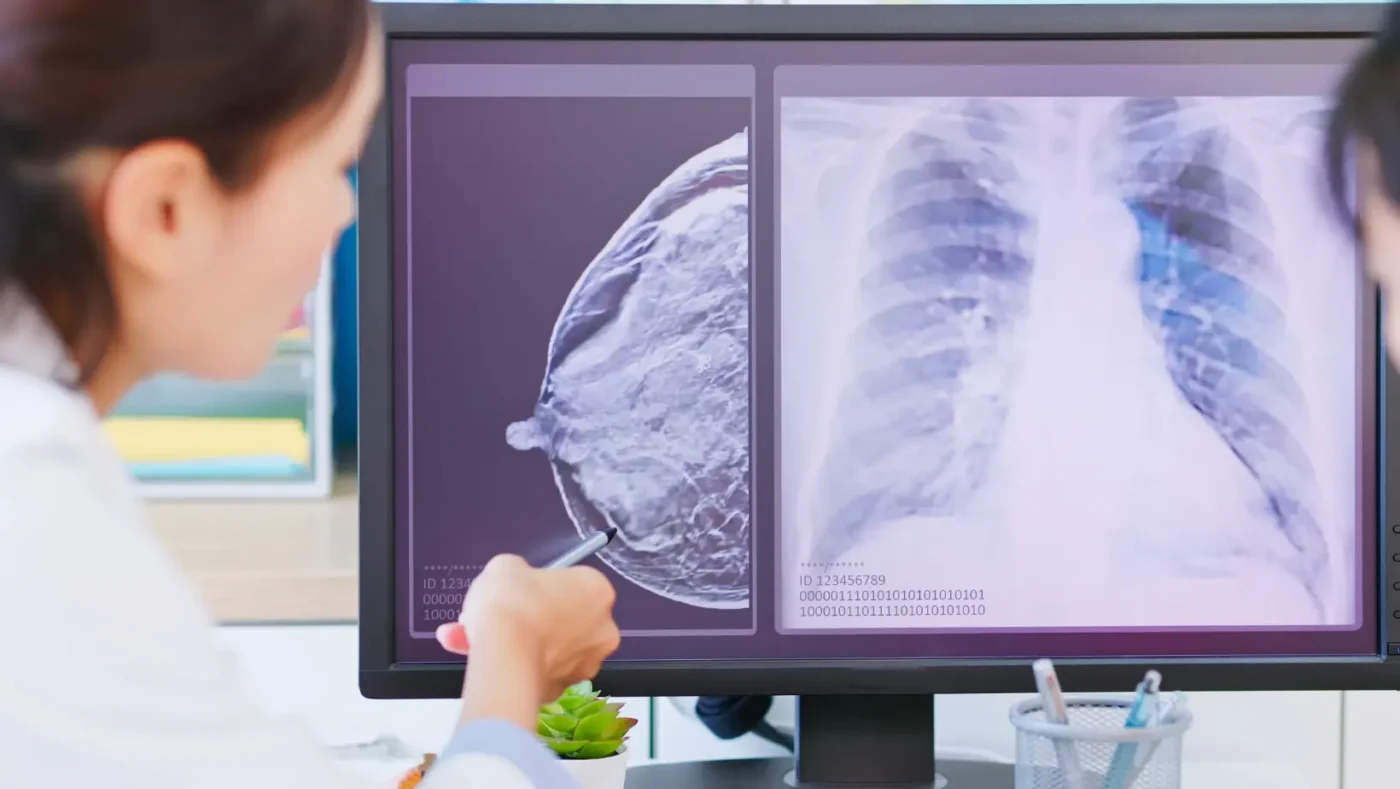

Signs of breast cancer in women range from an obvious new lump to subtle skin changes that get dismissed for months. In the US, one in eight women will face a breast cancer diagnosis in her lifetime, according to the American Cancer Society. Most cases show some kind of physical change before diagnosis, but not always a lump.
This guide covers the early signs of breast cancer, the skin changes that get missed, and the treatment options that breast cancer doctors use once a diagnosis is confirmed.
Early Signs of Breast Cancer
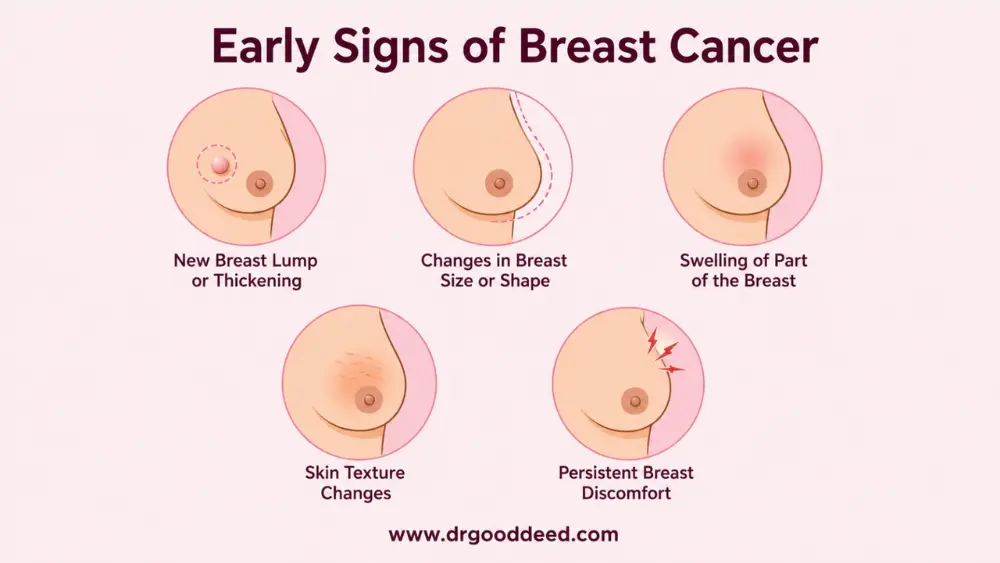
Early signs of breast cancer show up in the breast tissue itself, long before pain ever enters the picture. Most early breast cancer causes no pain at all, which is exactly why so many women wait too long before getting checked.
New Breast Lump or Thickening
A new lump or thickening, in the breast or under the arm, is the most common physical sign doctors see. A cancerous lump tends to feel hard, with edges that aren’t smooth, though some are soft, round, or tender instead. Among symptoms of breast cancer in women, this one drives the most doctor visits, yet many lumps still turn out to be cysts or fibrous tissue. Any new lump still needs a doctor’s evaluation.
Changes in Breast Size or Shape
An unexplained change in the size or shape of one breast, without a clear cause like weight change or pregnancy, deserves attention. Among the signs of breast cancer in women, this shift often happens slowly enough that it’s easy to miss in the mirror, which is why many women only notice it once clothes start fitting differently.
Swelling of Part of the Breast
Swelling confined to part of one breast, especially without a lump anyone can feel, ranks among the signs of breast cancer in women that get overlooked the longest. Tumors can grow without forming a single hard mass, so among signs of breast cancer in women, swelling alone is reason enough to get checked.
Skin Texture Changes
The skin over the breast may start looking pitted or dimpled, similar to an orange peel. This happens when cancer cells block tiny lymph vessels in the skin, causing fluid to build up under the surface.
Persistent Breast Discomfort
Pain isn’t the leading symptom of breast cancer, but discomfort that doesn’t follow the menstrual cycle and doesn’t go away after a few weeks is worth mentioning to a doctor. Cyclical breast pain tied to hormones is common and usually harmless among everyday symptoms of breast cancer in women that turn out benign. Constant, one-sided pain is not the typical pattern.
Skin Changes in Breast Cancer Women
Skin changes are some of the least talked about signs of breast cancer in women, mostly because they look like ordinary irritation at first glance. They deserve their own category because they often show up without any lump at all, which throws off the usual mental checklist people run through.
Dimpling or Skin Retraction
Skin that pulls inward, rather than out, can signal a tumor tugging on connective tissue beneath the surface. Among visible signs of breast cancer in women, this retraction sometimes only becomes visible when raising the arms, which is why a visual self-check works better in front of a mirror with arms up.
Persistent Redness
Redness that doesn’t fade with time, and isn’t explained by a rash, infection, or recent injury, can point to inflammatory breast cancer. This type spreads through lymph vessels in the skin rather than forming a typical lump, making it one of the more dangerous patterns to miss.
Thickened Skin
Skin that feels noticeably thicker or firmer than the surrounding area, sometimes resembling the texture of an orange peel, is medically known as peau d’orange. It’s strongly associated with inflammatory breast cancer and tends to develop fast, often within weeks.
Unusual Breast Rash
A rash that doesn’t respond to typical creams, especially around the nipple or areola, can signal Paget’s disease of the breast, a rare form linked to underlying cancer in many cases. Scaly, flaky, or crusted skin in this area should never get treated as a routine skin issue without medical evaluation first.
Breast Cancer Signs That Appear Outside the Breast
Some signs of breast cancer in women show up nowhere near the breast itself, which is exactly why they get missed so often. Cancer cells can travel through lymph channels before any change appears in breast tissue, meaning these symptoms sometimes arrive first.
Swollen Lymph Nodes Under the Arm
A lump or swelling in the armpit can appear even when nothing is felt in the breast yet. Lymph nodes here filter fluid coming from breast tissue, so among signs of breast cancer in women, cancer cells traveling through that system often land there first.
Swelling Near the Collarbone
Lymph nodes above the collarbone can swell when cancer has spread further along the lymphatic chain. Among signs of breast cancer in women, this location matters clinically, since involvement here often signals more advanced disease than swelling under the arm alone.
Unexplained Fullness in the Armpit
A vague sense of fullness or heaviness in the armpit, without an obvious lump, still warrants a check. This subtle symptom gets brushed off constantly, partly because it doesn’t match what most people picture as a cancer warning sign.
Risk Factors for Breast Cancer in Women
Risk factors for breast cancer in women fall into categories that can’t be changed and a smaller set tied to daily habits. Knowing both groups helps explain why two women with similar lifestyles can face very different odds.
- Increasing age: Risk rises steadily after age 50, with the majority of diagnoses occurring in women over that age.
- Family history of breast cancer: Having a mother, sister, or daughter with breast cancer roughly doubles personal risk compared with no family history.
- BRCA1 and BRCA2 gene mutations: These inherited mutations raise lifetime risk to between 50% and 72%, compared with about 12% for the average woman in the US, a gap that puts genetics among the strongest risk factors for breast cancer in women, according to National Cancer Institute data.
- Hormonal factors: Early menstruation, late menopause, and long-term hormone replacement therapy all extend the body’s exposure to estrogen, a known driver of certain breast cancer types.
- Dense breast tissue: Dense tissue both raises cancer risk and makes tumors harder to spot on a standard mammogram, since dense tissue and tumors both appear white on the image, making this one of the quieter risk factors for breast cancer in women to track.
- Previous breast conditions: A prior diagnosis of atypical hyperplasia or lobular carcinoma in situ increases future risk, even after that specific area has been treated.
Treatment Options for Breast Cancer
Treatment options for breast cancer depend on tumor size, hormone receptor status, genetic markers like HER2, and how far the cancer has spread.
Surgery
Surgery remains the most common of all treatment options for breast cancer, usually paired with one or more systemic treatments.
Lumpectomy
This removes the tumor along with a small margin of healthy tissue, preserving most of the breast. It’s typically followed by radiation to reduce the chance of recurrence in the same breast.
Mastectomy
This removes the entire breast and is used for larger tumors, multiple tumors in different areas, or when a patient carries a high-risk genetic mutation and chooses more extensive removal to lower future risk.
Radiation Therapy
High-energy beams target remaining cancer cells in the breast or chest wall after surgery, cutting the risk of local recurrence significantly compared with surgery alone.
Chemotherapy
Drugs circulate through the bloodstream to kill fast-dividing cancer cells throughout the body. It’s used before surgery to shrink large tumors, after surgery to lower recurrence risk, or as the primary treatment when cancer has already spread to distant organs.
Hormone Therapy
For tumors that test positive for estrogen or progesterone receptors, drugs like tamoxifen or aromatase inhibitors block hormone signals that fuel tumor growth. This treatment often continues for five to ten years after initial diagnosis.
Targeted Therapy
Drugs like trastuzumab specifically target HER2-positive tumors, a subtype that grows faster than average but responds well to this precise approach. Targeted therapy spares much of the healthy tissue that chemotherapy affects.
Immunotherapy
Immunotherapy helps the immune system recognize and attack cancer cells, and it’s increasingly used for triple-negative breast cancer, a subtype that doesn’t respond to hormone therapy or HER2-targeted drugs.
FAQ
What symptoms of breast cancer in women should not be ignored?
A new lump, skin dimpling, nipple discharge, persistent redness, or swelling without a lump. Among signs of breast cancer in women, any one of these lasting more than two weeks needs evaluation, regardless of pain level.
Is a breast lump always cancer?
No. Most breast lumps are benign, often cysts or fibroadenomas. Roughly 80% of biopsied breast lumps turn out to be non-cancerous, but every new lump still needs medical evaluation.
Can breast cancer occur without a lump?
Yes. Inflammatory breast cancer and Paget’s disease often present with skin redness, swelling, or nipple changes instead of a lump, making them easy to misdiagnose as infection.
What does a cancerous breast lump feel like?
Typically hard, irregular in shape, and fixed in place rather than mobile under the skin. Some cancerous lumps are soft or tender, so texture alone cannot rule cancer out.
Can breast cancer cause breast pain?
Yes, though pain is not the most common symptom. Constant, one-sided pain unrelated to the menstrual cycle is more concerning than cyclical pain tied to hormonal changes.
What age should women start breast cancer screening?
The American Cancer Society recommends annual mammograms starting at 40, with women 40 to 44 given the option and screening becoming standard at 45.
What breast changes should prompt a doctor visit?
New lumps, skin dimpling, nipple inversion or discharge, persistent redness, or unexplained swelling. Waiting more than two weeks to get any of these checked delays diagnosis unnecessarily.
Are nipple changes a sign of breast cancer?
Yes. Nipple inversion, scaling, discharge other than breast milk, or a rash around the nipple can indicate Paget’s disease or an underlying tumor pulling on nipple tissue.
When should I seek medical evaluation for breast symptoms?
Within two weeks of noticing any new lump, skin change, or persistent discomfort. Earlier evaluation consistently leads to earlier-stage diagnosis and better treatment outcomes.
Sources
- American Cancer Society, Breast Cancer Signs and Symptoms
- National Cancer Institute, BRCA1 and BRCA2: Cancer Risk and Genetic Testing
- National Breast Cancer Foundation, Signs and Symptoms of Breast Cancer
- Cleveland Clinic, Breast Cancer Symptoms
- Mayo Clinic, Breast Cancer: Symptoms and Causes
- Susan G. Komen, Genetic Factors and Dense Breasts
- American Cancer Society, Treatment of Breast Cancer by Stage