
Stage 0 breast cancer is the earliest form of breast cancer diagnosed in the USA. Abnormal cells are present inside the milk ducts but have not spread into the surrounding breast tissue. Because it has not broken through the duct wall, it carries the best possible prognosis of any breast cancer stage.
In the United States, roughly 60,000 cases of ductal carcinoma in situ (DCIS), the most common type of stage 0 breast cancer, are diagnosed each year, according to the American Cancer Society.
This guide covers what makes stage 0 breast cancer different from other stages, how it gets detected, whether it needs treatment, and what the current treatment options for stage 0 breast cancer look like in 2026.
Why Stage 0 Breast Cancer Is Different From Other Breast Cancer Stages
Stage 0 breast cancer has not spread anywhere yet. The abnormal cells are inside a duct and have not gone past the duct wall. That single fact changes everything about prognosis and treatment.
What Makes It “Stage 0”
Cancer staging follows a 0 to IV scale. Stage 0 means the disease is entirely in situ, a Latin term meaning “in place.” The abnormal cells are contained, and no lymph nodes are involved. No distant organs are affected. It is the only cancer stage where the word “contained” is fully accurate.
Why It Has Not Yet Become Invasive
Invasive cancer requires cells to physically push through tissue barriers. In non-invasive breast cancer stage 0, the basement membrane, a thin protein layer surrounding each duct, is still intact. The abnormal cells grow inside the duct but have not yet developed the molecular tools to break through that membrane.
The Biological Barrier That Still Exists
The basement membrane acts as a wall. Research published in Nature Reviews Cancer (2022) shows that cancer cells must activate specific enzymes, such as matrix metalloproteinases, to degrade this membrane. In most stage 0 breast cancer cases, that activation has not happened yet. This is why catching it at this stage dramatically changes outcomes.
Is Stage 0 Breast Cancer Really Cancer?
Yes, it is classified as cancer. The cells show abnormal growth patterns and DNA changes consistent with malignancy. However, stage 0 breast cancer does not behave like invasive cancer. It cannot spread through blood or lymph at this stage. The controversy in oncology is not whether to call it cancer, but whether every case needs aggressive treatment.
A landmark study published in JAMA Oncology in 2020 followed over 100,000 women with DCIS and found that breast cancer mortality was extremely low (around 1–2% at 10 years), especially in low-grade cases. Some oncologists argue that certain low-risk DCIS cases are better managed with active surveillance than immediate surgery.
These decisions about treatment options for stage 0 breast cancer should be made carefully, based on tumor grade, patient age, and genetics and early breast cancer risk factors.
How Stage 0 Breast Cancer Is Usually Detected
Most women with stage 0 breast cancer have no symptoms at all. There is no lump, no pain, no discharge. Detection happens almost entirely through imaging. This is exactly why mammography guidelines from organizations like the American College of Radiology recommend annual screening starting at age 40 for average-risk women.
Routine Mammography
A standard digital mammogram uses low-dose X-rays to capture images of breast tissue. In non-invasive breast cancer stage 0, the mammogram picks up tiny clusters of calcium deposits or subtle density changes that indicate abnormal cell growth inside a duct. The radiologist flags these as areas requiring further evaluation.
Microcalcifications on Mammograms
Microcalcifications are small calcium deposits, each about the size of a grain of salt. Individually, they are harmless. In certain clustered, irregular patterns, they signal that duct cells are dividing abnormally. Roughly 55% of all DCIS diagnoses are triggered by microcalcification patterns seen on mammography, according to the American Society of Breast Surgeons (2021).
Why Screening Detects DCIS So Often
Before routine mammography screening became widespread in the 1980s, DCIS accounted for fewer than 3% of all breast cancer diagnoses. Today it represents nearly 20–25%. This is not a cancer epidemic. Screening is catching abnormal cells earlier than ever. Some researchers, including those at the National Cancer Institute, argue this has led to overdiagnosis of cases that might never have caused symptoms in a patient’s lifetime.
Can Stage 0 Breast Cancer Become Invasive?
Yes, it can. Not all cases progress, but the risk is real. Studies estimate that untreated DCIS progresses to invasive breast cancer in approximately 20–53% of cases over 10 years, depending on grade. High-grade DCIS carries a significantly higher risk than low-grade DCIS.
A 2023 study published in The Lancet Oncology showed that women with high-grade DCIS who delayed or declined treatment had a substantially higher rate of invasive cancer than those who treated the DCIS promptly. Low-grade DCIS had a much lower progression rate, which informs current debates about active surveillance as a management option.
This is also where genetics and early breast cancer risk matter significantly. Women who carry BRCA1 or BRCA2 gene mutations face a higher risk that DCIS will progress. Genetic counseling is often recommended before finalizing treatment decisions.
Understanding Low-Grade vs High-Grade DCIS
Stage 0 breast cancer grade tells you how different the abnormal cells look from normal breast cells under a microscope. It also predicts how fast they might change.
Low-Grade DCIS
Low-grade DCIS cells look almost normal under a microscope. They grow slowly. The risk of progressing to invasive cancer over 10 years without treatment is estimated at around 15–25%. Some clinical guidelines, including those being tested in the COMET trial (Comparison of Operative vs. Monitoring and Endocrine Therapy), are exploring whether active surveillance is safe for this group.
High-Grade DCIS
High-grade DCIS cells look very different from normal cells. They grow faster and are more likely to become invasive. The symptoms of stage 0 breast cancer are still absent even in high-grade cases, which is why imaging is essential. Necrosis, meaning dead cells inside the duct, is common in high-grade DCIS and often shows up as a distinct pattern on mammography. Immediate treatment is strongly recommended for high-grade cases.
How Early Detection Changed One Woman’s Diagnosis and Treatment Path
Privacy Note: The following case is a realistic composite based on documented clinical presentations of stage 0 breast cancer. The patient’s name has been altered to protect privacy.
Margaret Holloway, a 52-year-old schoolteacher from Columbus, Ohio, had no family history of breast cancer. She went in for her annual mammogram in October 2022 and expected it to be entirely routine. When her radiologist called two days later to schedule a follow-up ultrasound, she assumed it was a mistake.
The follow-up imaging showed a cluster of microcalcifications in her left breast. A stereotactic biopsy confirmed high-grade DCIS, or non-invasive breast cancer stage 0. No lump or pain.
Her oncology team recommended lumpectomy followed by radiation therapy, given the high-grade classification and her age. They also tested her for BRCA gene mutations, given that genetics and early breast cancer risk can change the recommended surgical approach. Her BRCA results came back negative, which supported the breast-conserving surgery route.
Margaret completed lumpectomy and six weeks of radiation. She was then placed on tamoxifen for five years due to the hormone receptor-positive nature of her DCIS. As of 2024, her imaging remains clear. She now volunteers with early screening outreach programs in central Ohio, telling other women that a mammogram she almost skipped changed the entire course of her health.
Treatment Options for Stage 0 Breast Cancer
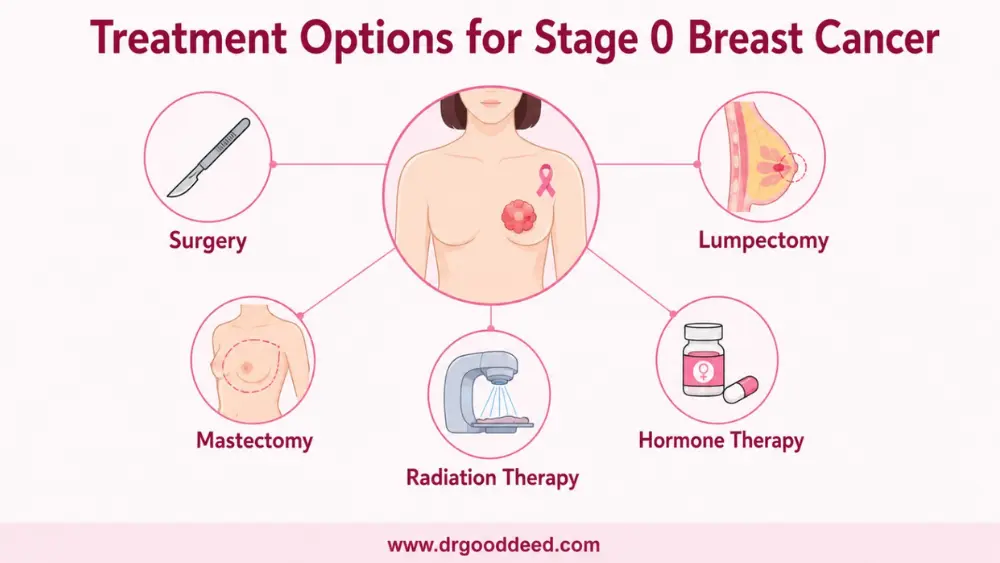
The treatment options for stage 0 breast cancer depend on tumor grade, size, hormone receptor status, patient age, and genetics and early breast cancer risk profile. There is no single correct path.
Active Surveillance in Selected Cases
Active surveillance means closely monitoring the DCIS without immediate surgery. This approach is only considered for low-grade, small DCIS in older patients. The ongoing COMET trial in the USA is the largest prospective study comparing surgery vs. surveillance in low-risk DCIS. Results from early cohorts showed no significant difference in invasive cancer rates at two years, but longer follow-up is ongoing.
Lumpectomy
Lumpectomy removes the area of DCIS along with a margin of healthy tissue around it. It preserves most of the breast. The American Society of Breast Surgeons (ASBS) guidelines state that lumpectomy is appropriate when clear surgical margins can be achieved. Margin status, meaning whether abnormal cells are found at the edge of the removed tissue, determines if additional surgery is needed.
Mastectomy
Total mastectomy removes the entire breast. It is recommended when DCIS is large, found in multiple areas of the breast (multicentric DCIS), or when a patient carries BRCA mutations that raise the risk of future invasive cancer. The survival rate difference between lumpectomy plus radiation vs. mastectomy for stage 0 breast cancer is not statistically significant for most patients, according to a 2021 meta-analysis in Annals of Surgery.
Radiation Therapy
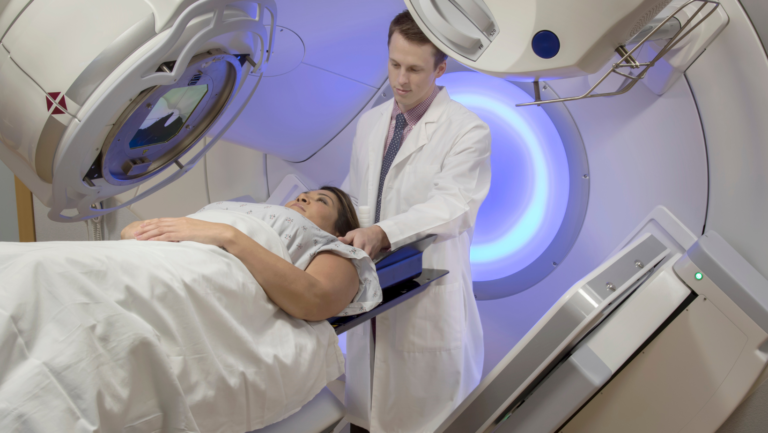
Radiation therapy is typically recommended after lumpectomy. It reduces the risk of local recurrence by roughly 50%, according to the National Comprehensive Cancer Network (NCCN) 2023 guidelines. Standard whole-breast radiation lasts three to six weeks. Some centers now offer accelerated partial breast irradiation, which delivers higher doses to a smaller area over one to two weeks.
Hormone Therapy
About 70–80% of DCIS cases are hormone receptor-positive, meaning estrogen or progesterone fuels cell growth. For these patients, tamoxifen (for premenopausal women) or an aromatase inhibitor (for postmenopausal women) taken for five years reduces the risk of recurrence or a new breast cancer by approximately 30%, per the NSABP B-35 trial data. The symptoms of stage 0 breast cancer do not include hormone-related signs, but hormone receptor status still drives this treatment choice.
Can Stage 0 Breast Cancer Be Prevented?
Prevention of stage 0 breast cancer is not fully possible, but risk can be meaningfully reduced. Women with high genetics and early breast cancer risk, including BRCA mutation carriers, may be offered chemoprevention with tamoxifen or raloxifene, which have been shown in clinical trials to reduce DCIS incidence by 30–49%.
Lifestyle factors matter too. The Women’s Health Initiative data shows that postmenopausal hormone therapy (combined estrogen and progestin) raises DCIS risk. Obesity increases estrogen exposure, which may promote abnormal duct cell growth. Regular alcohol use raises overall breast cancer risk by roughly 7–10% per drink per day, according to a 2020 meta-analysis in The BMJ.
Annual mammography remains the most reliable way to catch stage 0 breast cancer before it becomes something more serious. For high-risk women, supplemental MRI screening is also recommended by the American Cancer Society.
FAQs
What is Stage 0 breast cancer?
Stage 0 breast cancer is ductal carcinoma in situ (DCIS), where abnormal cells are found inside a milk duct but have not crossed the basement membrane into surrounding tissue. No lymph nodes are involved, and no organs are affected.
Is Stage 0 breast cancer considered cancer?
Yes. The cells show malignant DNA changes and abnormal proliferation. However, stage 0 breast cancer cannot metastasize at this point. The 10-year breast cancer mortality rate for treated DCIS is under 2%, per the JAMA Oncology 2020 cohort study.
What is non-invasive breast cancer Stage 0?
Non-invasive breast cancer stage 0 means cancer cells are confined within the milk ducts. The term “non-invasive” refers specifically to the intact basement membrane. It does not mean harmless. High-grade DCIS can progress to invasive cancer in under five years without treatment.
Is Stage 0 breast cancer the same as DCIS?
Almost always, yes. DCIS accounts for approximately 95% of all stage 0 breast cancer diagnoses. Lobular carcinoma in situ (LCIS) is sometimes also classified at stage 0 but behaves differently; it is generally considered a risk marker rather than a direct precursor to invasive cancer.
Do all women with DCIS need surgery?
No. Women with low-grade, small DCIS who are older and have no high-risk genetics and early breast cancer risk factors are currently being studied as candidates for active surveillance in the COMET trial. Surgery remains the standard of care for most cases, especially high-grade DCIS.
Is radiation therapy necessary after lumpectomy?
For most patients, yes. Radiation reduces the 10-year local recurrence rate from approximately 28% to 13%, based on NSABP B-17 trial data. Women over 70 with small, low-grade DCIS and clear margins may reasonably omit radiation after shared decision-making with their oncologist.
What is the survival rate for Stage 0 breast cancer?
The 10-year breast cancer-specific survival rate for stage 0 breast cancer exceeds 98% with standard treatment. Death from DCIS itself is rare. Most deaths attributed to DCIS in long-term studies are from subsequent invasive cancers that developed in previously unaffected breast tissue, not from the original DCIS lesion.
How often should follow-up screenings be performed?
After treatment for stage 0 breast cancer, most oncologists recommend a clinical breast exam every six months for five years, followed by annual exams. Annual mammography of the treated breast and the opposite breast continues indefinitely. Women on tamoxifen or aromatase inhibitors require additional monitoring for medication-related side effects.
References
- Narod SA, et al. Breast cancer mortality after a diagnosis of ductal carcinoma in situ. JAMA Oncology. 2020.
- Grimm LJ, et al. Risk of invasive breast cancer after DCIS diagnosis. The Lancet Oncology. 2023.
- National Comprehensive Cancer Network. NCCN Clinical Practice Guidelines in Oncology: Breast Cancer. Version 2.2023.
- American Cancer Society. Ductal Carcinoma In Situ (DCIS). 2023.
- American Society of Breast Surgeons. Consensus Guideline on DCIS. 2021.
- Ronksley PE, et al. Alcohol use and breast cancer risk. The BMJ. 2020.
- Bhatt DL, et al. Basement membrane degradation in DCIS progression. Nature Reviews Cancer. 2022.