
The effects of depressants on the body go far beyond feeling sleepy or relaxed. Depressants slow down the central nervous system, and when misused, they damage the brain, lungs, liver, and heart over time.
In the U.S., over 100,000 drug overdose deaths were recorded in 2022 alone, with depressants, including opioids and benzodiazepines, responsible for the majority. This article covers how depressants work, what they do to each body system, signs of overdose, and how addiction gets treated.
What Do Depressant Drugs Do to the Body?
Depressant drugs slow communication between the brain and the rest of the nervous system by reducing electrical activity across nerve cells. This affects breathing, heart rate, alertness, and muscle control. The result depends on the dose. A small amount feels calming. A large amount can shut down breathing entirely.
Slowing Brain Activity and Nerve Signaling
The brain sends and receives messages through neurons. Depressants interrupt that process. They reduce how fast neurons fire signals, which slows down everything the brain controls: your speech, reaction time, balance, and judgment.
Opioids like fentanyl and benzodiazepines like Xanax both work this way, but through slightly different pathways. The outcome is the same: a brain running at reduced speed.
Enhancing GABA (Inhibitory Neurotransmitter)
GABA is the brain’s natural “slow down” chemical. It reduces nerve activity. Depressants, especially benzodiazepines and alcohol, force GABA receptors to stay open longer than normal. This floods the brain with calming signals.
The problem is the brain adjusts. Over time, it stops producing enough GABA on its own. When you stop the drug, the brain goes into overdrive with no natural balance. That causes withdrawal: seizures, anxiety, tremors.
Impact on Breathing and Heart Rate
This is where depressants get dangerous fast. The brainstem controls breathing automatically, without you thinking about it. Depressants suppress brainstem activity. At high doses, breathing slows to the point where oxygen drops in the blood.
Heart rate follows. A slower, weaker heartbeat means less oxygen reaching the organs. This is why opioid overdoses kill: breathing stops before the person wakes up.
Common Side Effects of Depressants
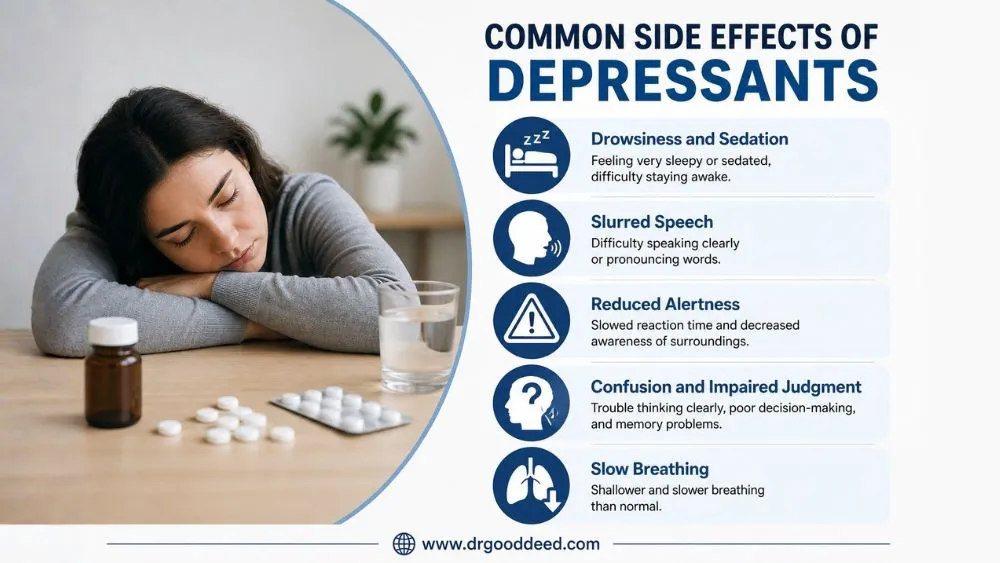
The common side effects of depressants appear even at prescribed doses. They are not rare reactions. They are expected effects of how this drug class works.
Drowsiness and Sedation
The most immediate effect of depressants on the body is sedation. The brain’s reduced activity makes you feel heavy, tired, and slow. Even therapeutic doses of benzodiazepines like lorazepam cause this within 30 minutes of taking them.
Slurred Speech and Poor Coordination
Depressants affect the cerebellum, the part of the brain managing movement and coordination. With reduced activity there, speech becomes slurred and walking becomes unsteady. This is why alcohol intoxication looks similar to a benzodiazepine overdose: both are depressants hitting the same systems.
Reduced Alertness and Reaction Time
Studies from the National Highway Traffic Safety Administration confirm that benzodiazepines increase crash risk by 40 to 60 percent. The drug slows the brain’s ability to process what the eyes see and respond to it. Driving on depressants is dangerous, even at a therapeutic dose.
Confusion and Impaired Judgment
The prefrontal cortex, which handles decision-making and impulse control, gets suppressed. This leads to poor judgment, impulsive behavior, and difficulty following conversations or instructions.
Slow Breathing
Even at moderate doses, respiratory rate drops. In healthy adults, normal breathing is 12 to 20 breaths per minute. Depressants can reduce this to 8 or fewer. Below 8, the brain starts losing oxygen.
Long-Term Effects of Depressants on the Body
The long-term effects of depressants build quietly. Most people do not notice organ damage or cognitive decline until it is significant. Here is what the research shows.
Physical Dependence and Addiction
The brain rewires itself around the drug. Chronic benzodiazepine use changes GABA receptor density within weeks. By 4 to 6 weeks of daily use, the brain starts depending on the drug to function at baseline. Stopping without medical supervision triggers severe withdrawal, including grand mal seizures.
Memory Problems and Cognitive Decline
Long-term benzodiazepine use is linked to reduced hippocampal volume. The hippocampus stores new memories. A 2014 study published in the BMJ found that people who used benzodiazepines for more than 3 months had a 51 percent higher risk of developing Alzheimer’s disease. This is not a minor cognitive side effect. It is structural brain damage.
The effects of depressants on the body include this kind of slow, invisible damage that shows up years later.
Liver and Organ Damage
Alcohol, the most widely used depressant, causes fatty liver disease, alcoholic hepatitis, and cirrhosis. Chronic opioid use leads to hormonal disruption, including reduced testosterone and cortisol dysregulation. The kidneys face increased stress from chronic dehydration associated with alcohol use.
Mood Disorders and Depression Worsening
Depressants reduce serotonin activity over time. People who use them long-term often experience rebound anxiety and worsening depression, the exact conditions many were trying to treat. This creates a cycle: using the drug to feel better, the drug making the condition worse.
Effects on the Body Systems
Respiratory System
Opioids suppress the respiratory drive in the brainstem. This is dose-dependent. As blood concentration rises, breathing slows further. At toxic doses, the person stops breathing. Naloxone reverses this by blocking opioid receptors within minutes.
Cardiovascular System
Depressants lower blood pressure and heart rate. Long-term alcohol use leads to alcoholic cardiomyopathy, a condition where the heart muscle weakens and loses its ability to pump efficiently. The American Heart Association links chronic alcohol use to a three-fold increase in atrial fibrillation risk.
Digestive System
The gut slows down. Constipation is one of the most consistent effects of depressants on the body among opioid users. Chronic opioid use leads to opioid-induced bowel dysfunction, causing abdominal pain, bloating, and in severe cases, bowel obstruction. Alcohol damages the stomach lining and disrupts gut bacteria balance.
Nervous System
Outside of the brain, depressants affect peripheral nerves. Chronic alcohol use causes peripheral neuropathy, burning pain, numbness, or weakness in the hands and feet. This happens because alcohol is directly toxic to nerve cells.
Managing Depressant Overdose Symptoms
Managing depressant overdose symptoms requires fast action. Overdose occurs when the drug dose overwhelms the body’s ability to compensate. Identifying it early saves lives.
Signs include:
- Breathing rate below 8 breaths per minute
- Blue or gray lips or fingertips (cyanosis)
- Unresponsiveness or loss of consciousness
- Pinpoint pupils (opioids specifically)
- Gurgling or choking sounds
- Limp body and cold, clammy skin
Immediate steps:
- Call 911 right away
- Administer naloxone (Narcan) if opioids are involved. It works in 2 to 3 minutes.
- Place the person in the recovery position (on their side) to prevent choking
- Do not leave them alone
- Perform rescue breathing if trained
Naloxone is available without a prescription in all 50 U.S. states. Many pharmacies carry it over the counter. It does not help with benzodiazepine or alcohol overdose. For those, the priority is airway management and emergency care.
Treatment for Depressant Addiction
Treatment for depressant addiction is most effective when it combines medical support with behavioral therapy. Willpower alone rarely works because the brain’s chemistry has changed.
Medical Detox and Supervision
Quitting benzodiazepines or alcohol cold turkey is medically dangerous. Seizures and cardiac events are real risks. Supervised medical detox uses tapering protocols to gradually reduce the drug dose, giving the brain time to adjust.
For opioid dependence, FDA-approved medications include methadone, buprenorphine (Suboxone), and naltrexone. These reduce cravings and prevent overdose during recovery.
Behavioral Therapy and Counseling
Cognitive Behavioral Therapy (CBT) changes the thought patterns tied to drug use. Research from the National Institute on Drug Abuse shows CBT reduces relapse rates by 40 to 60 percent in the first year. Motivational Interviewing (MI) helps patients commit to change by working through ambivalence.
Long-Term Recovery Strategies
Recovery is not a fixed endpoint. It is ongoing. Peer support groups like SMART Recovery or Narcotics Anonymous provide community and accountability. Ongoing psychiatric care addresses the underlying anxiety or depression that often drives depressant misuse.
FAQs
What are the effects of depressants on the body?
The effects of depressants on the body include slowed breathing, reduced heart rate, sedation, impaired coordination, and suppressed nerve signaling. Long-term use damages the liver, shrinks hippocampal volume, and causes physical dependence within 4 to 6 weeks of daily use.
What do depressant drugs do to the brain?
They force GABA receptors to open longer than normal, flooding the brain with inhibitory signals. Over time, the brain stops producing enough GABA naturally, creating chemical dependence. Structural brain changes, including reduced hippocampal volume, appear after months of regular use.
What are common side effects of depressants?
The common side effects of depressants include drowsiness, slurred speech, poor coordination, slowed breathing, and impaired judgment. These appear even at prescribed doses. Benzodiazepines increase road accident risk by 40 to 60 percent due to reaction time impairment.
What are the long-term effects of depressants?
The long-term effects of depressants include liver damage, peripheral nerve damage, worsening depression, cognitive decline, and a 51 percent higher Alzheimer’s risk with benzodiazepine use beyond 3 months.
How do depressants slow breathing and heart rate?
They suppress the brainstem, which automatically controls breathing. GABA enhancement reduces electrical activity across the nervous system. At toxic doses, the brainstem stops triggering breath cycles entirely, causing respiratory arrest.
What are signs of depressant overdose?
Breathing below 8 breaths per minute, blue lips, unresponsiveness, pinpoint pupils, and cold clammy skin. Gurgling sounds mean the airway is partially blocked. Call 911 immediately and administer naloxone if opioids are involved.
How is depressant addiction treated?
Treatment for depressant addiction uses medical detox with tapering protocols, followed by FDA-approved medications like buprenorphine for opioids. CBT therapy is added alongside, reducing relapse rates by 40 to 60 percent in year one.
Why are depressants dangerous when misused?
The therapeutic window is narrow. A dose twice the prescribed amount suppresses breathing below the safe threshold. Mixing depressants, like alcohol with benzodiazepines, multiplies this effect and is responsible for a large share of accidental overdose deaths.
Can depressants cause memory problems?
Yes. Benzodiazepine use beyond 3 months reduces hippocampal volume and raises Alzheimer’s risk by 51 percent according to a BMJ study. Opioids impair working memory and attention even at therapeutic doses.
When should you seek help for depressant use?
Seek help when you need the drug to feel normal, when stopping triggers anxiety or shaking, or when the dose keeps increasing for the same effect. These are signs of physical dependence, not weakness, and they require medical management to reverse safely.