

Stress does not directly cause appendicitis. Appendicitis is caused by a physical blockage or infection inside the appendix, not by psychological stress. However, stress produces gut symptoms so similar to early appendicitis that many people confuse the two.
According to the American College of Surgeons, appendicitis affects approximately 250,000 Americans annually, making it the most common abdominal surgical emergency in the US. This guide covers the real causes, what stress actually does to the gut, how to tell the difference, and when abdominal pain becomes a medical emergency.
Does Stress Affect Appendix Health?
Stress does not affect appendix health directly. The appendix does not inflame in response to cortisol or psychological stress. But stress does change bowel motility, pain sensitivity, and gut inflammation in ways that indirectly create conditions where appendix-related symptoms feel more intense or confusing.
Gut-Brain Axis and Digestive Changes
The gut-brain axis is a two-way communication system between the central nervous system and the enteric nervous system (the gut’s own nerve network). Stress signals travel from the brain to the gut through the vagus nerve, changing bowel movement speed, gut muscle contractions, and how the intestinal lining responds to bacteria. This produces real, measurable physical symptoms, not imagined ones.
Stress Affecting Bowel Movements
Cortisol speeds up bowel transit in some people (stress causing diarrhea) and slows it in others (causing constipation). Constipation from chronic stress matters here because hardened stool is one mechanism of blockage causing appendicitis. Stress itself does not cause the blockage, but it sets up the gut condition that increases the risk.
Stress Worsening Abdominal Discomfort Perception
Stress lowers the pain threshold in the gut. A 2016 study in Gut confirmed that psychological stress reduces the gut’s sensory threshold, meaning the same level of intestinal pressure or inflammation produces stronger pain signals. A person under chronic stress feels mild gut discomfort more sharply than someone who is not stressed. This makes distinguishing stress pain from early appendicitis genuinely difficult.
Stress raises mast cell activity in the gut lining. Mast cells release histamine and cytokines that cause localized gut inflammation. This inflammation is real and measurable, but it is diffuse across the intestines, not concentrated in the appendix. That distinction matters for diagnosis.
Causes of Appendicitis
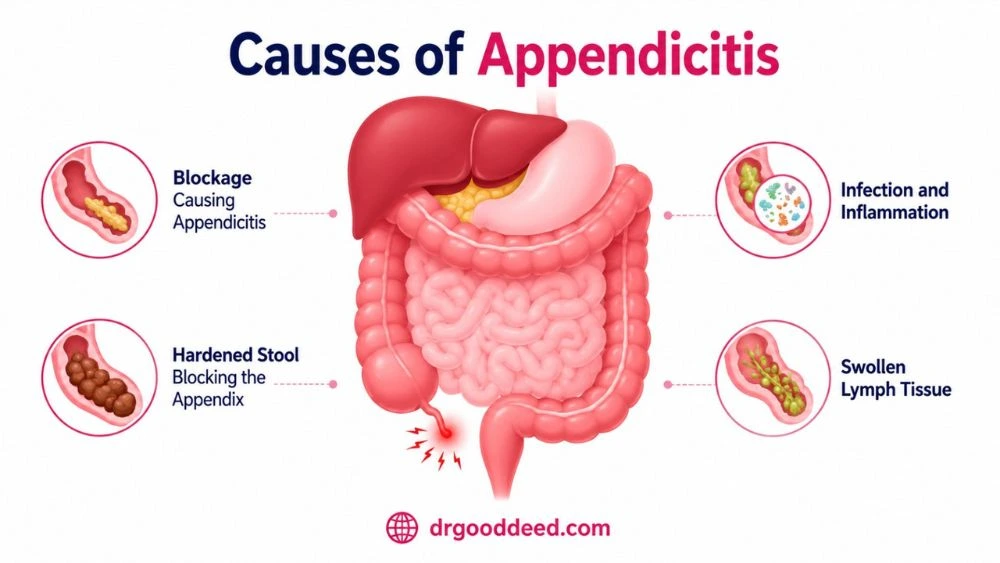
Causes of appendicitis are always physical. There is no psychological or emotional pathway to appendix inflammation. The appendix is a small finger-shaped tube attached to the large intestine in the lower right abdomen. When its opening gets blocked, bacteria inside multiply rapidly, the appendix swells, and inflammation follows.
Blockage Causing Appendicitis
Blockage causing appendicitis is the most common trigger. The blockage material is called a fecalith, a hardened mass of stool that lodges at the appendix opening. Fecaliths account for approximately 35% of appendicitis cases in adults. Mucus buildup, parasites, and foreign objects are less common causes of the same mechanical blockage.
Infection and Inflammation
Bacterial and viral infections of the gastrointestinal tract can cause the lymph tissue inside the appendix to swell. When this tissue swells enough, it blocks the appendix opening from inside. This mechanism is more common in children and young adults, often following a respiratory infection or gastroenteritis.
Hardened Stool Blocking the Appendix
Chronic constipation increases fecalith formation risk. Low-fiber diets, inadequate hydration, and sedentary behavior all contribute to harder blood in stools. Research published in Diseases of the Colon and Rectum identified low dietary fiber as a population-level risk factor for appendicitis in Western countries.
Swollen Lymph Tissue
The appendix wall contains lymph nodes that respond to infection. Conditions like Yersinia enterocolitica infection, Crohn’s disease, and even severe gastroenteritis cause this lymph tissue to enlarge. Enlarged lymph nodes inside the appendix wall narrow or close the opening, setting off the same inflammatory cascade as a physical blockage.
Why Stress May Feel Like Appendicitis
Stress can cause appendicitis symptoms that mimic the real condition. Stress produces abdominal pain, nausea, and even low-grade fever through entirely different mechanisms, but the experience feels similar.
Stress-Related Abdominal Cramps
Cortisol increases intestinal muscle contractions. These contractions produce cramping pain anywhere in the abdomen, including the lower right side. Irritable bowel syndrome (IBS), which stress strongly aggravates, produces lower right quadrant pain in approximately 30% of IBS patients, overlapping directly with the location of appendix pain.
Anxiety Causing Nausea and Stomach Pain
Anxiety activates the sympathetic nervous system, which slows digestion and causes gastric acid buildup. The result: nausea, stomach tightening, and mid-to-lower abdominal pain. These symptoms appear within 20 to 40 minutes of a significant anxiety episode and can last for hours.
Muscle Tension and Digestive Discomfort
Chronic stress tightens the abdominal wall muscles. Sustained tension in these muscles produces a dull, constant ache across the lower abdomen that worsens with movement or deep breathing. This muscle-tension pain is frequently mistaken for the early stages of appendicitis by patients and even some emergency room physicians.
Symptoms of Appendicitis You Should Not Ignore
The difference between stress pain and actual appendicitis is location progression, fever, and symptom intensity over time.
Pain Starting Near the Belly Button
Appendicitis almost always begins with pain around the navel (periumbilical pain). This is because the appendix and small intestine share the same nerve fibers early in the inflammation process. The brain initially mislocates the pain source as the belly button region.
Pain Moving to the Lower Right Abdomen
Within 12 to 24 hours, appendicitis pain shifts and settles in the lower right abdomen, specifically at a point called McBurney’s point (one-third of the way from the right hip bone to the belly button). Stress pain does not migrate this way. If pain clearly shifts from center to lower right over hours, that is appendicitis until proven otherwise.
Fever and Appendicitis Warning Signs
Fever and appendicitis warning signs go together. A fever above 99°F appearing alongside worsening lower right pain is a clinical red flag. Stress alone does not cause fever. If fever develops alongside abdominal pain, this eliminates stress as the primary cause.
Nausea, Vomiting, and Appetite Loss
Appendicitis causes nausea and vomiting after pain begins. In stress-related gut symptoms, nausea tends to precede or accompany pain without a clear pain-then-nausea sequence. Appetite loss in appendicitis is rapid and complete. In stress, appetite changes are more gradual.
Fever and Appendicitis Warning Signs
Fever and appendicitis warning signs follow a specific pattern that separates appendicitis from stress-related symptoms with near certainty.
Low-Grade Fever With Worsening Pain
A temperature between 99°F and 100.5°F in the first 12 to 24 hours of lower right pain is characteristic of early appendicitis. As inflammation progresses, fever rises. A temperature above 101°F with severe localized pain indicates the appendix wall is significantly inflamed or beginning to rupture.
Pain Becoming Sharper Over Time
Appendicitis pain consistently gets worse over hours. It does not come and go rhythmically like gas cramps or IBS pain. Applying pressure to the lower right abdomen and releasing it quickly produces a sharp pain spike called rebound tenderness. This sign does not appear with stress pain.
Difficulty Walking or Moving Normally
When the appendix inflammation reaches the peritoneum (the lining around the abdominal organs), any movement becomes painful. People with appendicitis walk hunched over and avoid straightening their bodies. This symptom does not occur with anxiety or stress-related abdominal pain.
How Appendicitis Is Diagnosed
Physical Examination
Physicians check for McBurney’s point tenderness, rebound tenderness, and Rovsing’s sign (pressing the left side of the abdomen causes pain on the right). These physical signs are reliable enough that experienced surgeons diagnose appendicitis correctly from examination alone in over 80% of cases.
Blood Tests and Imaging Scans
A complete blood count (CBC) showing elevated white blood cells (above 10,000 per microliter) confirms infection or inflammation. CT scan of the abdomen identifies appendix swelling with 94% accuracy. Ultrasound is preferred for children and pregnant women to avoid radiation exposure.
Identifying Inflammation and Blockage
CT imaging shows the appendix diameter (normal is under 6 mm; inflamed appendix measures 7 mm or more), periappendiceal fat stranding (inflammation spreading to surrounding tissue), and the presence of a fecalith causing the blockage.
Treatment Options for Appendicitis
Treatment options for appendicitis are limited to two approaches: surgery or antibiotics, depending on severity.
Emergency Surgery (Appendectomy)
An appendectomy is the standard treatment option for appendicitis in the US. Laparoscopic surgery (3 small cuts) is performed in most cases. The procedure takes 30 to 60 minutes. Recovery time averages 2 to 3 weeks for laparoscopic removal and 4 to 6 weeks for open surgery.
Antibiotics in Selected Cases
Research published in JAMA (2020) confirmed that uncomplicated appendicitis (no rupture, no abscess) responds to intravenous antibiotics alone in 70% of cases without surgery. Antibiotics used include piperacillin-tazobactam and metronidazole. However, 30% of antibiotic-treated patients require surgery within 5 years.
Recovery After Appendix Removal
Most people return to light activity within 1 to 2 weeks after laparoscopic appendectomy. The appendix has no critical digestive function in adults. Removal does not affect long-term gut health or nutrient absorption. Dietary restrictions are minimal after the first week.
When to Seek Emergency Medical Care
Stress doesn’t cause appendicitis to worsen. But misattributing appendicitis symptoms to stress delays treatment. A ruptured appendix causes peritonitis, a life-threatening infection of the abdominal cavity. Time between symptom onset and rupture averages 24 to 72 hours.
Go to the emergency room immediately if:
- Lower right abdominal pain starts near the belly button and migrates right within hours
- Fever above 99°F appears alongside abdominal pain
- Nausea or vomiting follows the onset of pain (not before)
- Pain worsens with movement, deep breaths, or releasing pressure from the abdomen
- Symptoms intensify continuously over 4 to 6 hours without relief
Do not wait for stress management strategies to resolve pain that follows the pattern above.
FAQs
Can anxiety cause pain similar to appendicitis?
Yes. Anxiety triggers IBS flares and abdominal muscle tension that produce lower right quadrant pain nearly identical to early appendicitis. The key difference: anxiety pain does not migrate from navel to lower right over 12 hours, does not cause fever, and improves with rest or bowel movement. Appendicitis does none of these.
What is the difference between stomach pain and appendicitis?
General stomach pain is diffuse, cramping, and often linked to meals, gas, or bowel changes. Appendicitis pain starts around the belly button, shifts to the lower right abdomen within 12 to 24 hours, worsens continuously, and appears with fever and nausea. Stomach pain rarely causes fever or rebound tenderness.
Can digestive issues triggered by stress affect the appendix?
Indirectly. Stress-driven constipation increases fecalith formation, and fecaliths are the primary blockage causing appendicitis in adults. Stress does not inflame the appendix itself, but the constipation it causes creates the physical conditions for a blockage. Maintaining fiber and fluid intake reduces this risk.
What are the earliest warning signs of appendicitis?
The first sign is dull pain around the belly button, often dismissed as indigestion. Within 6 to 12 hours, appetite drops completely. Within 12 to 24 hours, pain shifts to the lower right abdomen and sharpens. Low-grade fever and nausea follow. Most people miss the first 6-hour window.
Does appendicitis pain come and go at first?
No. Appendicitis pain is constant and progressively worsening from onset. It does not improve between episodes. Pain that comes and goes in waves points to gas, IBS, or kidney stones. Continuous, escalating right-lower pain that does not ease with position changes is the defining feature of appendicitis.
Can constipation increase the risk of appendix blockage?
Yes. Chronic constipation increases fecalith formation in the colon. Fecaliths that migrate into the appendix opening cause blockage causing appendicitis. A high-fiber diet (25 to 35 grams daily) and 2.5 liters of water daily reduce fecalith risk measurably. Low-fiber Western diets correlate with higher appendicitis rates globally.
Why does appendicitis pain usually move to the right side?
Initial appendix pain travels through shared nerve fibers from the small intestine, which registers near the belly button. As inflammation spreads to the appendix wall and surrounding tissue, the pain source becomes specific and localizes to the upper right abdomen, directly over the appendix at McBurney’s point.
Can appendicitis happen without fever or vomiting?
Yes. Early appendicitis presents without fever or vomiting in approximately 30% of cases. Fever appears as inflammation progresses, usually after 12 to 24 hours. Relying on fever absence to rule out appendicitis is clinically dangerous. Pain migration and rebound tenderness are more reliable early indicators.
How quickly can appendicitis become serious?
Appendicitis can progress from onset to rupture in 24 to 72 hours. Rupture releases intestinal bacteria into the abdominal cavity, causing peritonitis, which has a 30-day mortality rate of 10 to 15% without aggressive surgical treatment. Symptoms that started as mild discomfort become surgical emergencies within 2 days.
When should abdominal pain be treated as an emergency?
Treat abdominal pain as an emergency when it localizes to the lower right abdomen, worsens over 4 to 6 hours without relief, appears with fever above 99°F, causes pain on releasing abdominal pressure, or makes normal movement difficult. These signs point to appendicitis and require immediate evaluation, not monitoring at home.