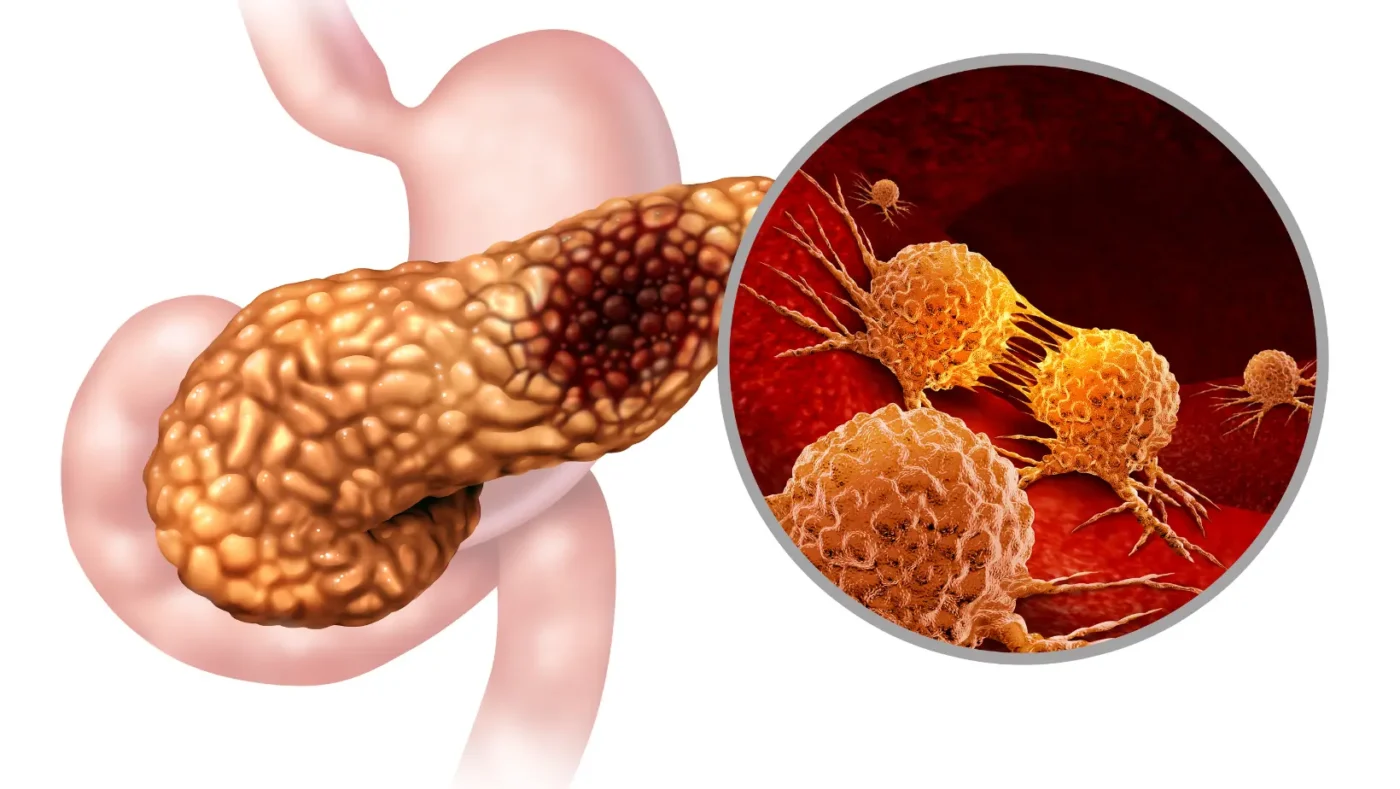

The most reliable signs of pancreatic cancer rarely appear until the disease has already grown or spread, per the American Cancer Society. This makes subtle warning signs especially important to know. Pancreatic cancer affects about 1 in 64 people in the United States over a lifetime, and most cases appear after age 65.
This guide covers early signs of pancreatic cancer, symptom stages, jaundice, digestive warning signs, risk factors, diagnosis, and treatment options.
Early Signs of Pancreatic Cancer
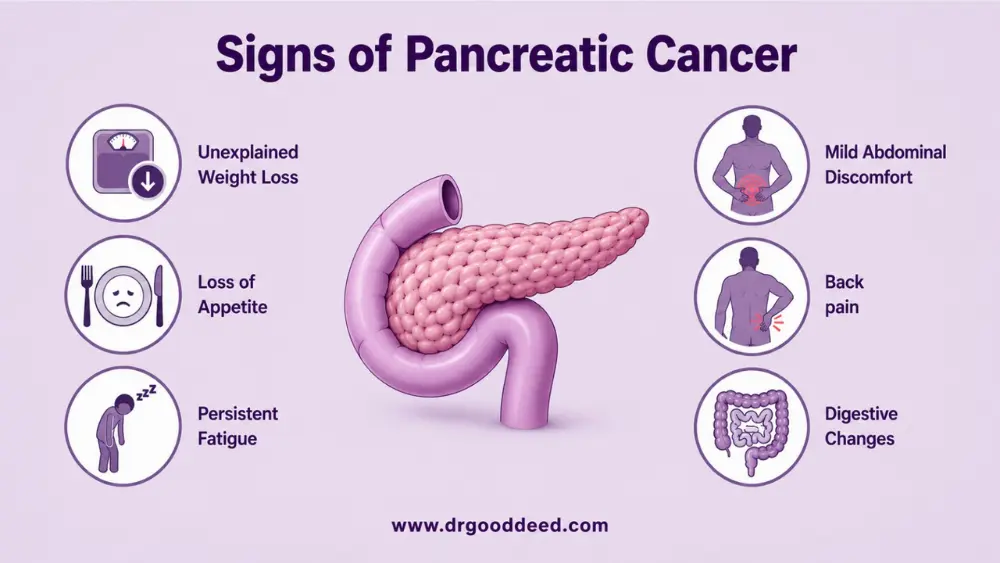
Early signs of pancreatic cancer rarely point to the pancreas directly. Most feel like digestive trouble or stress, missed until imaging gets ordered for another reason.
Unexplained Weight Loss
Losing weight without trying, especially with reduced appetite, ranks among the most common early symptoms.
Loss of Appetite
Pancreatic tumors can release substances that suppress hunger, making meals feel unappealing before pain starts.
Persistent Fatigue
Ongoing tiredness unrelated to activity or poor sleep often accompanies early pancreatic cancer, though rarely alone.
Mild Abdominal Discomfort
Back pain and pancreatic cancer symptoms overlap here, since discomfort can radiate from the upper abdomen toward the mid-back as the tumor presses on nearby nerves.
Digestive Changes
Bloating, nausea, or feeling full after small meals can signal a tumor narrowing digestive structures.
New-Onset Diabetes
Early signs of lung cancer sometimes appear as sudden diabetes after age 50. A 2025 study of nearly 19,000 adults linked new-onset diabetes to a higher pancreatic cancer rate within 3 years.
Stages of Pancreatic Cancer
Doctors combine signs of pancreatic cancer with imaging to assign a stage, guiding treatment more than symptoms alone. The SEER system sorts US cases into three categories by spread.
Localized Disease
Localized disease means no detectable spread beyond the pancreas, found in about 1 in 7 cases.
Locally Advanced Disease
Locally advanced disease has grown into nearby blood vessels or organs, without reaching distant body parts yet.
Metastatic Disease
Metastatic disease means cancer has reached distant organs, most often the liver, in close to half of new diagnoses.
How Staging Influences Treatment
Stage determines whether surgery is possible. Only localized and some locally advanced tumors qualify, since surgery remains the only potentially curative option.
How Pancreatic Cancer Symptoms Start
How pancreatic cancer symptoms start depends on where the tumor forms. Head tumors press on the bile duct early, while body or tail tumors often grow silently for months.
Gradual Symptom Development
Symptoms typically build slowly over weeks or months instead of appearing suddenly, delaying recognition.
Why Early Symptoms Are Often Vague
How pancreatic cancer symptoms start so quietly comes down to anatomy: the pancreas sits deep behind the stomach, hidden from touch during a routine exam.
Symptoms Commonly Mistaken for Other Conditions
How pancreatic cancer symptoms start resembling other conditions explains why doctors often suspect acid reflux, gallstones, or irritable bowel syndrome first.
Changes That Warrant Medical Attention
New digestive symptoms lasting more than two weeks, especially with weight loss, deserve a doctor’s evaluation.
Jaundice and Pancreatic Cancer
Jaundice ranks among the most recognizable signs of pancreatic cancer, especially for head tumors. It happens when a tumor blocks the bile duct, letting bilirubin build up in the blood.
Yellowing of the Skin and Eyes
Skin and the whites of the eyes turn yellow as bilirubin rises, often the first sign people notice.
Dark Urine
Urine darkens to a tea or cola color, sometimes before skin yellowing becomes obvious.
Pale or Clay-Colored Stools
Stools lose their normal brown color and turn pale or gray when bile cannot reach the intestines.
Itchy Skin
Bile salts building up under the skin cause widespread itching, often before jaundice looks obvious.
Why Jaundice Is an Important Warning Sign
Jaundice from a head tumor can appear while the cancer is still small, allowing earlier, more treatable detection.
Digestive Symptoms of Pancreatic Cancer
Digestive symptoms emerge once a tumor affects pancreatic enzymes or blocks nearby structures. These signs of pancreatic cancer often get blamed on diet or stress for months.
Nausea and Vomiting
A tumor pressing on the stomach outlet can block food from passing, causing nausea worse after eating.
Bloating
Trapped gas and slowed digestion create persistent bloating unrelated to any specific food.
Changes in Bowel Habits
New diarrhea or looser stools appear once digestive enzymes fail to break down food properly.
Fatty or Greasy Stools
Stools that float, smell foul, or leave an oily residue suggest undigested fat passing through the gut.
Difficulty Digesting Fat
Reduced enzyme output, called exocrine insufficiency, leaves fat poorly absorbed, driving both weight loss and greasy stools.
How New-Onset Diabetes Led to an Earlier Pancreatic Cancer Diagnosis for Margaret Ellison
Margaret Ellison, a 58-year-old retired teacher from Tulsa, Oklahoma, developed type 1 and 2 diabetes after a routine checkup, despite a stable weight and no diabetes in her family. Within four months she lost 12 pounds without trying. Her doctor recalled new-onset diabetes as an early pancreatic cancer signal and ordered a CT scan instead of just adjusting her medication. It found a 2.1-centimeter tumor confined to the head of her pancreas, classified as localized disease.
Margaret had a Whipple procedure followed by chemotherapy, and her most recent scans show no recurrence. Her case shows why doctors now treat sudden diabetes in older adults as one of the signs of pancreatic cancer worth investigating, not just managing.
Name and identifying details have been altered to protect patient privacy.
Risk Factors for Pancreatic Cancer
Knowing your risk factors will not predict signs of pancreatic cancer with certainty, but it helps decide when symptoms deserve faster follow-up instead of a wait-and-see approach.
- Smoking doubles pancreatic cancer risk and accounts for about 25 percent of cases, per the American Cancer Society
- Obesity, a BMI of 30 or higher, raises risk by about 20 percent
- Long-standing type 2 diabetes and chronic pancreatitis both raise risk
- Inherited gene changes, including BRCA1, BRCA2, PALB2, and Lynch syndrome, cause up to 10 percent of cases
- Age past 45 raises risk steadily, and average diagnosis age is 70
- A first-degree relative with pancreatic cancer roughly doubles personal risk
How Pancreatic Cancer Is Diagnosed
Tests used to diagnose pancreatic cancer combine blood work, imaging, and tissue sampling, since no single test confirms the disease alone.
Medical History and Physical Examination
Doctors ask about weight loss, pain location, and family history before testing.
Blood Tests
Two blood tests offer useful, imperfect clues.
Liver Function Tests
Elevated bilirubin and liver enzymes often appear first when a tumor blocks bile flow.
CA 19-9 Tumor Marker
CA 19-9 is part of the tests used to diagnose pancreatic cancer, but it misses roughly 1 in 5 confirmed cases and rises falsely with jaundice alone.
Imaging Studies
Imaging shows tumor size, location, and spread.
CT Scan
A contrast CT scan is usually the first imaging test ordered for suspected cases.
MRI
MRI shows the bile and pancreatic ducts more clearly than CT alone.
PET Scan
PET scans help detect cancer spread not clearly seen on CT or MRI.
Endoscopic Ultrasound (EUS)
EUS passes a small camera through the mouth to capture close, detailed pancreas images.
Biopsy Confirmation
Biopsy remains the only test used to diagnose pancreatic cancer step confirming cancer cells under a microscope, usually taken during the EUS visit.
Treatment Options for Pancreatic Cancer
Treatment options for pancreatic cancer depend mostly on whether surgery is possible. Only 15 to 20 percent of patients have a tumor safely removable at diagnosis.
Surgery
Surgery offers the only realistic chance at a cure.
Whipple Procedure
The Whipple procedure removes the pancreatic head, part of the small intestine, the gallbladder, and bile duct.
Distal Pancreatectomy
Distal pancreatectomy removes the pancreas body and tail, often along with the spleen.
Chemotherapy
FOLFIRINOX and gemcitabine with nab-paclitaxel are the two leading regimens, used before, after, or instead of surgery.
Radiation Therapy
Radiation can shrink tumors before surgery or relieve pain in inoperable cases.
Targeted Therapy
Treatment options for pancreatic cancer now include olaparib for patients with BRCA mutations, blocking a DNA-repair pathway cancer cells depend on.
Immunotherapy
Immunotherapy helps only a small subset of patients with specific mismatch-repair gene changes.
Palliative Care
Palliative care, one of the treatment options for pancreatic cancer available at every stage, manages pain, nausea, and nutrition alongside other treatments.
Can Pancreatic Cancer Be Prevented?
There is no guaranteed way to prevent pancreatic cancer, but several habits lower risk. Quitting smoking is the single most effective step, since smokers face roughly double the risk of never-smokers. A healthy weight, less processed meat, and managed diabetes help too. None of this guarantees protection, but it beats ignoring early signs of pancreatic cancer.
FAQs
Is back pain a sign of pancreatic cancer?
Yes, sometimes. Back pain and pancreatic cancer symptoms connect when a tumor presses on nerves behind the stomach, often worsening at night, unlike typical muscle strain.
Where is pancreatic cancer pain usually felt?
Pain centers in the upper abdomen pain and radiates to the mid-back. Back pain and pancreatic cancer symptoms rarely appear in the back alone.
Can pancreatic cancer cause weight loss before diagnosis?
Yes. Unexplained weight loss, often 10 pounds or more in a few months, appears in most patients and ranks among the clearest early signs of pancreatic cancer.
What digestive symptoms are common in pancreatic cancer?
Nausea, greasy floating stools, new diarrhea, and bloating are common, caused by enzyme blockage or pressure on the stomach outlet.
Can a blood test detect pancreatic cancer?
No single blood test confirms it. CA 19-9 offers clues but misses early tumors, so it is never used alone to screen.
Who is at highest risk for pancreatic cancer?
Adults over 65 who smoke, carry a BRCA or Lynch syndrome mutation, or have a parent or sibling diagnosed face the highest combined risk among known signs of pancreatic cancer causes.
Can pancreatic cancer be cured if caught early?
Localized tumors caught before spreading have a 44 percent 5-year survival rate, versus 3 percent once cancer reaches distant organs, per ACS data.
When should I see a doctor about pancreatic cancer symptoms?
See a doctor for unexplained weight loss, new jaundice, or sudden diabetes after 50. Acting on early signs of pancreatic cancer within weeks changes treatment options significantly.
How can I reduce my risk of pancreatic cancer?
Quit smoking, maintain a healthy weight, limit processed meat, and manage diabetes carefully. These address the most provable risk factors confirmed in large studies.
Sources
- American Cancer Society – Signs and Symptoms of Pancreatic Cancer
- American Cancer Society – Pancreatic Cancer Stages
- American Cancer Society – Survival Rates for Pancreatic Cancer
- American Cancer Society – Pancreatic Cancer Risk Factors
- American Cancer Society – Can Pancreatic Cancer Be Prevented?
- American Cancer Society – Tests for Pancreatic Cancer
- Gastroenterology – Risk of Pancreatic Cancer in Glycemically Defined New-Onset Diabetes: A Prospective Cohort Study, 2025
- CA: A Cancer Journal for Clinicians – Advances in Pancreatic Cancer Early Diagnosis, Prevention, and Treatment, 2026