
The symptoms of testicular cancer usually start with a small, painless lump or a change in the size or weight of one testicle. This cancer affects men between the ages of 15 and 44 more than any other cancer type in the United States, according to the American Cancer Society and the National Cancer Institute’s SEER program.
This guide covers every early and late symptom, what causes this cancer, how doctors confirm it, and which treatments actually work.
The Most Common Early Symptoms of Testicular Cancer
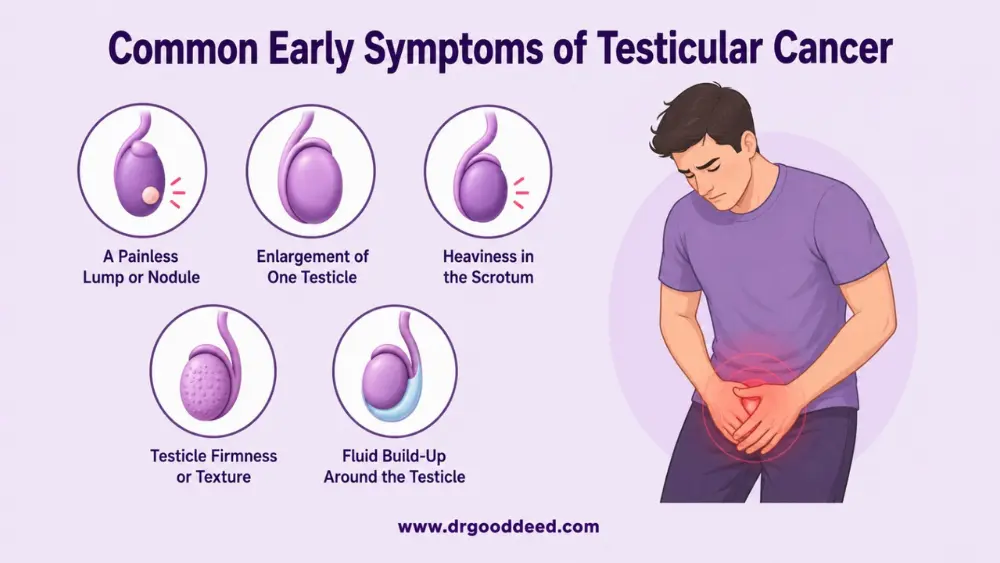
The most common early symptoms of testicular cancer show up directly on the testicle. About 90% of men notice a lump, swelling, or a texture change first, usually with no pain at all.
A Painless Lump or Nodule
This is the lump in testicle cancer symptom doctors check for first: a hard, pea to marble-sized spot on the front or side of the testicle that does not move when pressed.
Enlargement of One Testicle
One testicle growing larger or heavier than the other, without any injury, is a real warning sign worth a doctor’s check within weeks.
A Feeling of Heaviness in the Scrotum
Painless testicular swelling signs can also feel like a dragging heaviness in the scrotum before any lump shows up, caused by the tumor’s added weight or fluid.
Changes in Testicle Firmness or Texture
A testicle that feels uneven, lumpy, or harder than usual needs checking, since healthy testicles feel smooth and firm throughout.
Symptoms That Many Men Do Not Realize Can Be Related to Testicular Cancer
A few warning signs of testicular cancer show up far from the scrotum. A dull backache, breast swelling, or sudden fluid buildup can trace back to the same tumor, which is why men often dismiss them as unrelated.
Dull Ache in the Groin or Lower Abdomen
A nagging ache in the groin or lower belly, separate from the testicle, often comes from the tumor pulling on nearby tissue, sometimes before any lump appears.
Sudden Fluid Build-Up Around the Testicle
A hydrocele, fluid collecting around the testicle, can develop alongside a tumor and hide it. A sudden fluid increase deserves an ultrasound, not a wait-and-see approach.
Intermittent Testicular Discomfort
Pain that comes and goes fools many men into thinking nothing is wrong, but testicular cancer does cause pain in about 15% of cases.
Breast Tenderness or Breast Enlargement
Some tumors release beta-hCG, the hormone found in pregnancy tests, which can make breast tissue swell or feel tender, a sign that should prompt a scrotal exam.
What Causes Testicular Cancer?
The exact trigger behind the symptoms of testicular cancer is not fully known, but most tumors start in germ cells, the same cells that make sperm. Nearly every case begins as germ cell neoplasia in situ, abnormal cells sitting inside the testicle for years before turning cancerous.
An undescended testicle, called cryptorchidism, raises the risk four to seven times due to the higher internal temperature. A family history in a father or brother, or a past tumor in the other testicle, also raises the odds. None of this means a man caused his own cancer.
Age Related Risk of Testicular Cancer
The age related risk of testicular cancer is unlike most cancers: it targets young, healthy men, not older adults. Men between 20 and 34 face the highest risk, with a median diagnosis age of 32, making this the rare cancer where youth raises the odds.
Most Common Age Groups Affected
Testicular cancer is the most diagnosed cancer in American men aged 15 to 44. The age-related risk of testicular cancer peaks twice: once between 25 and 29, again between 30 and 43.
Risk in Teenagers and Young Adults
Teens and men in their twenties mostly develop faster-growing non-seminoma tumors, which make up two-thirds of cases in this age group and respond extremely well to chemotherapy.
Risk After Age 40
Risk does not disappear after 40. The symptoms of testicular cancer can still appear later through slower-growing seminomas, median age 35, or the rare spermatocytic tumor, which mostly strikes men around 60.
Why Younger Men Are More Commonly Diagnosed
Younger men get diagnosed more because the germ cells that turn cancerous divide fastest during peak fertility years, making mutations more likely to take hold.
What Advanced Testicular Cancer Symptoms Can Look Like
Advanced symptoms of testicular cancer appear once cancer spreads beyond the testicle, usually to lymph nodes, lungs, or liver. These feel unrelated to the testicle itself, which is exactly why doctors and patients miss them. About 1 in 4 men has one of these before diagnosis.
Persistent Lower Back Pain
Constant pain low in the back, near the belt line, can mean cancer reached lymph nodes behind the abdomen, and it does not improve with rest.
Shortness of Breath or Chest Symptoms
A cough, chest pain, or breathlessness can signal lung spread. Coughing up blood is rare but needs same-day care.
Unexplained Fatigue or Weight Loss
Losing weight without trying, paired with constant tiredness, often means cancer cells are outpacing the body’s energy supply.
Swollen Lymph Nodes
A lump in the neck or above the collarbone can mean cancer has traveled far through the lymphatic system.
Symptoms That Are Often Mistaken for Testicular Cancer (But Usually Aren’t)
Most scrotal lumps are not a lump in testicle cancer symptom at all. A doctor uses touch, light, and ultrasound to tell the symptoms of testicular cancer apart from harmless look-alikes within minutes, including the epididymis, the coiled tube behind the testicle.
| Symptom | Possible Cause | Key Difference |
| Painful swelling | Infection (epididymitis) | Usually painful, warm, and inflamed |
| Soft, fluid-filled swelling | Hydrocele | Lights up when a flashlight shines through it |
| Enlarged veins above the testicle | Varicocele | Feels like a “bag of worms,” worse standing up |
| Small, movable lump near the testicle | Epididymal cyst | Sits separate from the testicle itself |
Self-Checks: Symptoms Men Often Notice During Everyday Activities
Most men find a lump outside a formal exam: in the shower, while exercising, or during sex, when the scrotum is relaxed. Painless testicular swelling signs show up easiest this way, and a two-minute monthly check is the simplest way to catch symptoms of testicular cancer before they spread.
These checks catch warning signs of testicular cancer doctors might miss between annual physicals:
- Roll each testicle gently between thumb and fingers, one at a time.
- Feel for a hard lump, smooth bump, or change in size or weight.
- Compare both testicles, since one is normally slightly larger or lower.
- Repeat after a warm shower, when scrotal skin is loose.
Tests Used to Diagnose Testicular Cancer
Diagnosing testicular cancer never starts with a biopsy, since cutting into the testicle can spread cancer cells. Doctors instead combine a physical exam, ultrasound, and blood work to confirm the symptoms of testicular cancer before surgery, protecting fertility and avoiding unnecessary procedures.
Ultrasound Findings
An ultrasound is always the first imaging test, showing whether a mass is solid, which suggests cancer, or fluid-filled, which usually points to a hydrocele or cyst.
Tumor Marker Testing
This blood test checks for proteins some testicular cancers release. Not every tumor produces them, so a normal result never fully rules out cancer.
CT Scans for Staging
A CT scan of the abdomen, pelvis, and chest checks for spread to lymph nodes or lungs and decides the official stage, from I to III.
Determining Cancer Spread
Doctors combine the CT scan with tumor marker levels to map where cancer has traveled, usually starting with lymph nodes behind the abdomen.
Blood Tests for Tumor Markers
Three specific markers matter most, each pointing to a different tumor type.
AFP
Alpha-fetoprotein stays under roughly 10 ng/mL in healthy adults. An elevated AFP almost always means a non-seminoma, since pure seminomas never raise it.
Beta-hCG
Beta-hCG should sit near zero. About 15% of seminomas and most choriocarcinomas push this number high enough to help confirm the diagnosis.
LDH
LDH (lactate dehydrogenase) is the least specific marker, but levels over 1.5 times normal signal a larger tumor and factor into treatment risk grouping.
Imaging Tests
Beyond ultrasound and CT, an MRI or PET scan sometimes checks for brain spread or confirms a leftover mass after chemotherapy.
Surgical Evaluation
Confirming cancer for certain means removing the testicle through the groin and examining the tissue under a microscope, never a needle biopsy.
Treatment Options for Testicular Cancer
Treatment options for testicular cancer depend on the cell type, stage, and tumor marker levels measured after surgery, not before.
Orchiectomy Surgery
A radical inguinal orchiectomy, removing the testicle through a small groin incision, is the first treatment for nearly all cases. Most men keep normal hormones and fertility using the other testicle.
Active Surveillance
For low-risk stage I cancers, active surveillance skips extra treatment and instead uses regular scans and blood tests for five years or more, avoiding chemotherapy side effects.
Radiation Therapy
Radiation targets abdominal lymph nodes and works best for seminomas, though it is used less often today since chemotherapy causes fewer long-term side effects.
Chemotherapy
BEP, combining bleomycin, etoposide, and cisplatin, is the standard regimen. Most men need only one to four cycles, even for cancer that has spread to the lungs.
Lymph Node Surgery
A retroperitoneal lymph node dissection removes lymph nodes behind the abdomen when imaging shows spread there, now often using nerve-sparing techniques that preserve normal ejaculation.
Treatment Based on Cancer Type
The treatment options for testicular cancer split mainly by cell type. Seminomas respond extremely well to radiation and chemotherapy, while non-seminomas usually need surgery plus chemotherapy since they grow faster. Both share a five-year survival rate above 95%.
Recognizing the symptoms of testicular cancer early, and acting within days rather than months, keeps survival rates above 95% even in advanced cases. These warning signs of testicular cancer get brushed off since most cause no pain, but a monthly self-check catches them before they spread. Given the age related risk of testicular cancer, men under 40 should treat any new lump as worth a same-week visit.
FAQs
Can testicular cancer cause pain?
Yes. About 15% of testicular cancers cause pain, though most are painless. Sudden, severe pain usually signals testicular torsion (the testicle twisting and losing blood flow), not cancer, and needs same-day care.
What does a cancerous testicular lump feel like?
The lump in testicle cancer symptom feels hard, pea to marble sized, fixed in place, and usually painless. Cysts and infections feel softer, move freely, or sit separate from the testicle.
Are painless testicular swelling signs common in cancer?
Yes. Painless testicular swelling signs appear in about 90% of testicular cancer cases, making painless swelling the single most reliable early symptom doctors rely on.
What are the treatment options for testicular cancer?
Treatment options for testicular cancer include orchiectomy, active surveillance, radiation, and chemotherapy with the BEP regimen, chosen by stage, cell type, and post-surgery marker levels.
Can testicular cancer be cured?
Yes. Stage I testicular cancer is cured in over 99% of cases. Even cancer that has spread responds to chemotherapy, with cure rates above 95% in most advanced cases.
Does testicular cancer spread quickly?
Yes, non-seminomas can double in size within days to weeks. Seminomas grow slower, over months. Both stay highly treatable even after spreading to lymph nodes or lungs.
When should I see a doctor about a testicular lump?
See a doctor within 1 to 2 weeks of finding any new lump, swelling, or heaviness, even without pain. Sudden, severe pain needs same-day care, since it usually means torsion, not cancer.
Should men perform regular testicular self-exams?
Yes. The American Cancer Society recommends checking monthly after puberty, especially with a history of undescended testicle, since most lumps are found this way, not at checkups.
References
- American Cancer Society: Signs and Symptoms of Testicular Cancer
- SEER Cancer Stat Facts: Testicular Cancer
- National Cancer Institute: Testicular Cancer Treatment (PDQ)
- MedlinePlus: Testicular Cancer
- Cleveland Clinic: Testicular Cancer
- American Cancer Society: Tests for Testicular Cancer
- American Cancer Society: Treatment Options by Stage
- Johns Hopkins Medicine: Testicular Cancer Tumor Markers
- EAU Guidelines on Testicular Cancer
- Cancer Research UK: Risks and Causes of Testicular Cancer
- AAFP: Evaluation of Scrotal Masses