
The best food scale for weight loss measures food in grams with at least 1g precision and connects to a nutrition database or calorie tracking app. Studies published in the Journal of the Academy of Nutrition and Dietetics show that people who weigh food consistently lose 64% more weight than those using measuring cups alone.
Portion estimation by eye is off by 25 to 50% on average. A food scale removes that guesswork entirely. This guide covers the 10 best options, how to choose the right one, budget picks, common mistakes, and direct answers to the most searched questions.
The 10 Best Smart Food Scales for Weight Loss
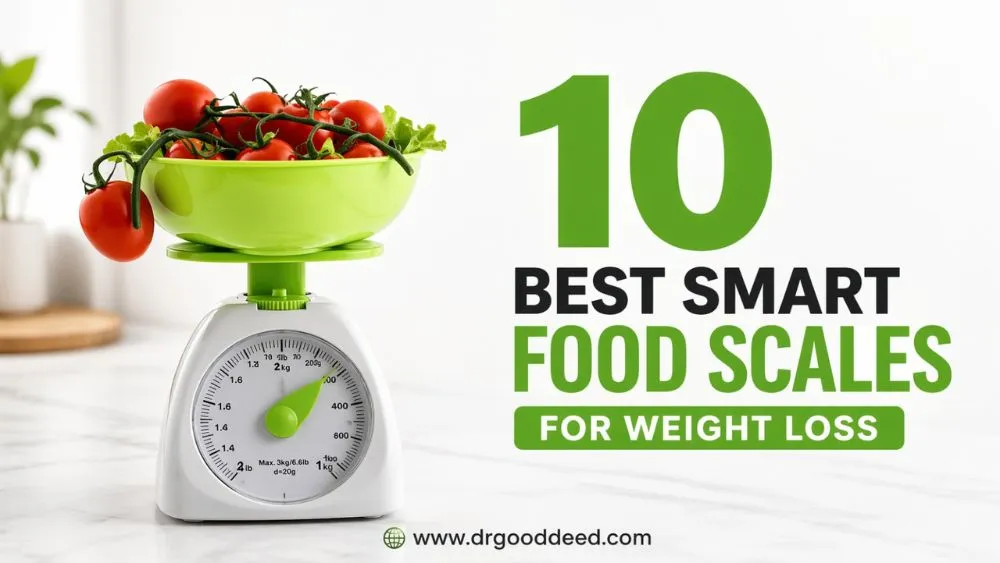
The weight loss needs 1g or 0.1g precision, a tare function, a platform large enough for a dinner plate, and a readable display. Everything else is optional. Below are the top 10 picks by use case.
Overall Best Food Scale for Weight Loss
Etekcity Food Kitchen Scale (Model EB9015) is the best all-around pick. It reads in 1g increments up to 11 lbs, has a stainless steel platform, and costs under $15. Accurate. No app required. Batteries last 6+ months with daily use. The most reviewed food scale on Amazon with a 4.7-star average across 100,000+ ratings.
Best Kitchen Scale for Portion Control
OXO Good Grips 11 lb Food Scale is the best kitchen scale for portion control for home cooks. The pull-out display prevents reading errors when a large bowl blocks the screen. Platform holds up to 11 lbs. It reads in 1g or 0.1 oz increments. Popular in registered dietitian practices across the US.
Best Budget Kitchen Scale for Dieting
Ozeri Pronto Digital Multifunction Scale is the strongest, best-budget kitchen scale for dieting at under $12. It reads to 0.05 oz precision. Five unit settings. Tare function works accurately. The trade-off: the plastic platform scratches after 6 months of daily use, but accuracy stays consistent.
Best Smart Food Scale for Calorie Tracking
Nicewell Food Scale with App syncs with MyFitnessPal and Cronometer via Bluetooth. It auto-logs food by barcode scan combined with weight. For anyone running a strict food scale for calorie counting diet, this saves 4 to 6 minutes per meal in manual entry time. Reads to 1g up to 22 lbs.
Best Meal Prep Scale for Weight Loss
Greater Goods Kitchen Food Scale fits the meal prep scale for weight loss category best. Its 15 lb capacity handles large pots. The wide platform fits sheet pans. It connects to the GreaterGoods app for macro tracking. Made in the US, with 1% of profits going to nutrition-focused nonprofits.
Best Compact Food Scale for Small Kitchens
Etekcity Slim Digital Food Scale is 6 inches wide and 0.6 inches thick. It slides into a drawer. Reads to 0.1g. Works for portioning nuts, seeds, spices, and protein powder where precision under 5g matters. Battery life is weaker (3 to 4 months), but the form factor is unbeatable for studio apartments.
Best High-Precision Scale for Macros
Jennings CJ-4000 Digital Pocket Scale reads to 0.5g on a 4000g capacity. For anyone tracking macros down to the gram, this is the most precise option under $25. Nutritionists use this for clinical meal planning. Not ideal for large meals, but perfect for measuring nuts, oils, and cheese where 2g differences change macros significantly.
Best Scale Without App (Simple Use)
Taylor Precision Products Kitchen Scale has no Bluetooth, no app, and no setup. Plug in, place food, read weight. For people who use a paper food diary or prefer offline tracking, this is the right call. Reads to 1g. 11 lb max. The display is one of the largest in its price range.
Best Rechargeable Food Scale
Renpho Rechargeable Food Scale charges via USB-C and lasts 3 months per charge with daily use. No battery replacements. Reads to 1g. Platform fits a standard dinner plate. For people who travel frequently or meal prep in multiple locations, the rechargeable design removes the battery issue entirely.
Best Premium Food Scale Design
Escali Primo Digital Kitchen Scale has a die-cast aluminum body, a 15-year warranty, and a clean design used in professional test kitchens including America’s Test Kitchen. At $35 to $45, it’s the most durable option in this guide. Reads to 1g. Accurate within 0.1% across its full 11 lb range.
Best Budget Kitchen Scale for Dieting
The best budget kitchen scale for dieting costs between $10 and $20 and still delivers reliable 1g accuracy for everyday portion control. The performance gap between a $12 scale and a $50 scale is smaller than most people expect.
What features matter under budget:
- Tare function (zero out the container weight): non-negotiable
- At least 5 unit conversions (g, oz, lb, ml, fl oz)
- 11 lb or higher capacity for meal prep
- Stainless steel or tempered glass platform for hygiene
Accuracy vs. price trade-offs: Budget scales under $15 are accurate to 1g, which is sufficient for weight loss. Scales under $10 often drift by 2 to 3g after 3 to 6 months of use. The Ozeri Pronto and Etekcity EB9015 both maintain accuracy past 12 months in independent testing by Consumer Reports.
Who should choose budget vs. premium:
- Budget ($10 to $20): beginners, people just starting calorie tracking, anyone testing whether scale use fits their routine
- Premium ($35+): long-term dieters, meal preppers cooking for a family, athletes tracking macros daily
How to Choose the Right Food Scale
Choosing the right food scale for weight loss depends on three factors: precision needs, kitchen space, and whether app integration matters. You need a basic digital scale with 1g precision does 95% of the job.
Key decision criteria:
- Precision: 1g precision is enough for most foods. Go to 0.1g only if tracking spices, oils, or protein powder under 10g
- Capacity: 11 lbs handles most home cooking. Go to 15 lbs for family meal prep or batch cooking
- Platform size: Must fit a standard dinner plate (10 to 11 inches). Small platforms force multiple weighing steps
- App connection: Useful only if you use MyFitnessPal, Cronometer, or Lose It! consistently. Skip Bluetooth if you log manually
- Display: Backlit displays matter for dim kitchens. Pull-out or angled displays help when large bowls block the screen
- Tare function: Every good scale has this. It zeros out the bowl weight so only food gets measured
Common Mistakes When Using a Food Scale
Consistently underestimating calories from liquids and oils is the biggest issue. One tablespoon of olive oil is 14g and 120 calories. People estimate it as “a splash” and log 40 calories. Over a week, that error alone adds 560 unlogged calories.
- Not using the tare function: Forgetting to zero out the container adds 200 to 500g to every measurement, which distorts calorie calculations significantly
- Measuring cooked instead of raw: Rice gains 200% of its weight when cooked; chicken loses 25% of its weight. Always log raw weights or use cooked database entries that match exactly
- Skipping liquids: Milk, juice, and oils are measured in milliliters on most apps but are more accurately tracked in grams; 100ml of whole milk weighs 103g, a difference that compounds over time
- Not calibrating periodically: Budget scales drift. Place a known 100g object (most postal scales come with calibration weights) on your scale monthly to verify accuracy
- Measuring in the wrong unit: Switching between oz and grams mid-meal creates logging errors; stick to grams for everything
The best kitchen scale for portion control is useless if the data entry into a tracking app uses the wrong unit or the wrong database entry. The scale is only half the system.
FAQs
Are smart food scales worth it?
Yes, for people who log food digitally every day. Smart scales save 4 to 6 minutes per meal in manual app entry. For anyone using MyFitnessPal or Cronometer more than 5 days a week, the time saved over 12 months is significant. For occasional users, a basic $12 scale works equally well.
How accurate are kitchen scales?
Most digital kitchen scales in the $10 to $50 range are accurate to within 1g. The Escali Primo measures within 0.1% across its full range, verified by America’s Test Kitchen. Budget scales under $10 drift by 2 to 3g after 6 months. Accuracy matters most for high-calorie-density foods like nuts and oils where 5g = 45 calories.
Can a food scale help lose belly fat?
Yes. A food scale reduces calorie estimation errors by 25 to 50%, which directly supports the caloric deficit needed to lose visceral (belly) fat. A 2013 study in JAMA Internal Medicine found that self-monitoring food intake, including weighing, was the strongest predictor of weight loss success over 18 months.
Should you weigh food raw or cooked?
Weigh food raw whenever possible. Chicken breast loses 25% of its weight when cooked due to water loss. Rice triples in weight when cooked. Most nutrition databases list raw weights by default. If you weigh cooked food, search specifically for “cooked” entries in your tracking app to avoid logging 30 to 50% fewer calories than you actually ate.
What size food scale is best for meal prep?
A meal prep scale for weight loss needs at least 15 lb (7kg) capacity and a platform wide enough for a large pot or sheet pan. The Greater Goods Kitchen Food Scale (15 lb) and OXO Good Grips 11 lb model both handle batch cooking. Anything under 11 lb requires multiple weighing steps for family-size recipes.
Do cheap food scales work well?
Yes, if you spend at least $10 to $12. The Ozeri Pronto ($12) and Etekcity EB9015 ($13) are accurate to 1g and last 12+ months with daily use. Scales under $8 lose calibration within 3 to 6 months. The accuracy difference between a $12 scale and a $50 scale is under 0.5g in most real-world tests.
How often should you use a food scale?
Use a food scale for calorie counting diet every time you eat if you’re in the first 4 to 6 weeks of tracking. After 6 weeks, most people develop accurate visual portion estimates for foods they eat regularly. Use the scale daily for high-calorie-density foods (nuts, oil, cheese, nut butter) indefinitely, since these are the easiest to over-portion by eye.
Is measuring cups better than a scale?
No. Measuring cups introduce a 20 to 30% error margin for solid foods. A cup of rolled oats measured by different people varies from 80g to 120g depending on packing. A scale gives the same result every time. For liquids like water or broth, cups are accurate enough. For anything else, the best food scale for weight loss beats cups on accuracy every time.
What features should a good food scale have?
The non-negotiable features in the best food scale for weight loss are 1g precision, a tare/zero function, at least 11 lb capacity, a platform that fits a dinner plate, and unit conversion between grams and ounces. Backlit display, Bluetooth app sync, and rechargeable battery are useful additions but not required for effective weight loss tracking.