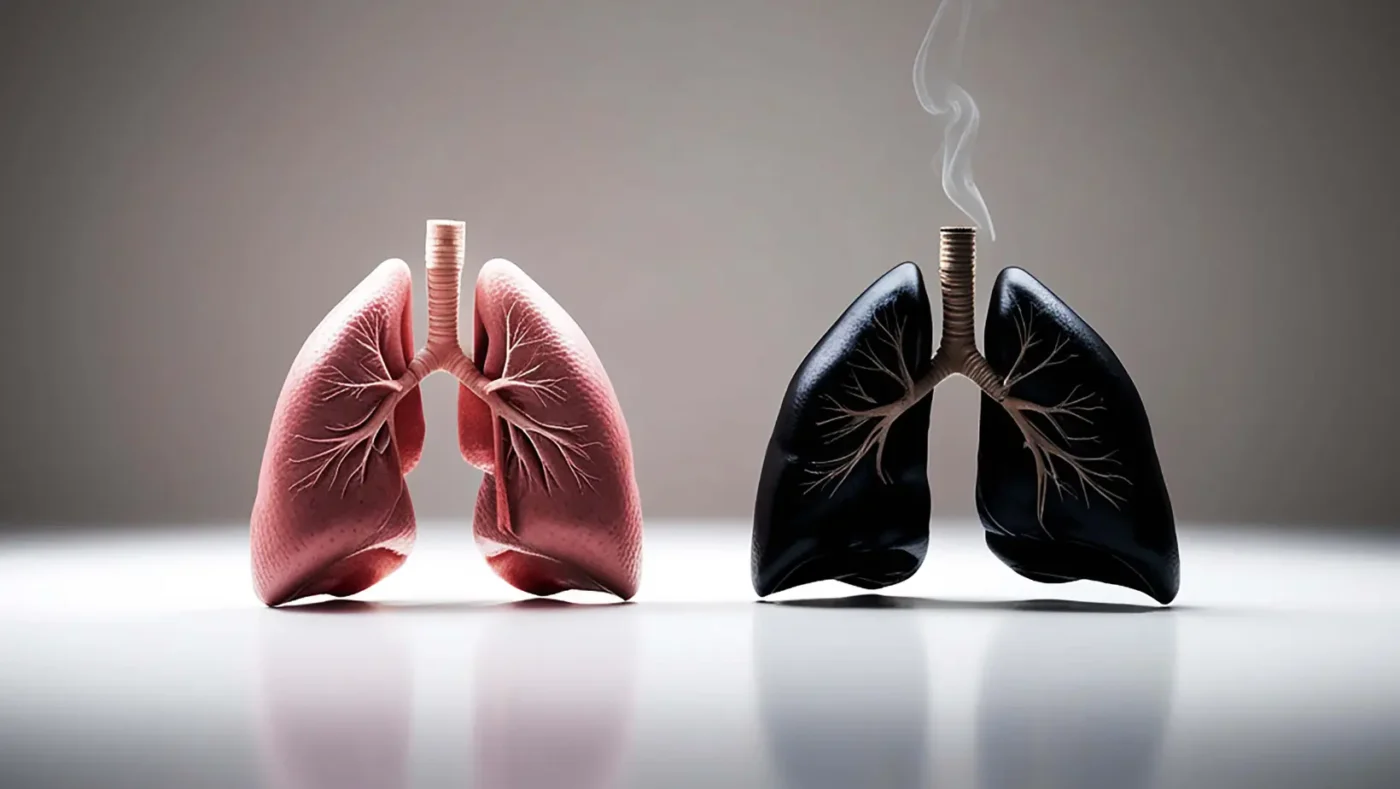

Stage 4 lung cancer means the disease has moved past the lungs into distant organs like bone, brain, liver, or adrenal glands. It’s the most advanced stage on the TNM scale oncologists use worldwide. Roughly 57% of US lung cancer patients already have stage 4 lung cancer at diagnosis, mostly because early symptoms barely register.
What Is Stage 4 Lung Cancer?
A patient with stage 4 lung cancer has tumor cells outside the chest. That single fact separates it from earlier stages, where surgery or focused radiation can still target one location.
What Makes Lung Cancer Stage 4?
Doctors use the TNM system. T measures tumor size, N checks lymph node involvement, M tracks metastasis. Once M turns positive, the case becomes stage 4 no matter how small the original tumor was. A tiny 1-centimeter tumor that’s reached the liver counts as stage 4. A 6-centimeter tumor confined to one lung does not.
How Metastatic Lung Cancer Develops
Cancer cells break off the original tumor, slip into blood vessels or lymph channels, and travel. Most die en route. Survivors land in a new organ, attach to tissue there, and build their own blood supply. This can take months, sometimes years, before it shows on a scan.
Stage 4A vs Stage 4B Lung Cancer
Oncologists split stage 4 further:
- Stage 4A: Cancer has reached fluid around the lungs or heart, the opposite lung, or one spot in a single distant organ.
- Stage 4B: Cancer has spread to multiple spots in one organ, or to more than one distant organ.
Stage 4A sometimes allows localized treatment of that one distant spot alongside systemic therapy. Stage 4B almost always needs whole-body treatment from day one.
How Lung Cancer Spreads
Spread moves through three routes, and each one opens a different set of organs to attack.
Local Spread Within the Chest
Before traveling far, cancer often invades nearby chest structures first: the chest wall, the pleura, the diaphragm, blood vessels near the heart. This can happen even while distant metastasis is already building elsewhere.
Spread Through the Lymphatic System
Lymph nodes filter fluid moving through tissue. Cancer cells entering lymph channels get trapped in nearby nodes first, then work toward nodes deeper in the chest, and from there into the bloodstream.
Spread Through the Bloodstream
This route drives distant organ metastasis. The lungs receive nearly the entire body’s blood supply with every heartbeat, since blood passes through pulmonary vessels to pick up oxygen. That constant traffic gives escaping lung tumor cells easy access to distant sites.
Common Sites of Metastasis
Four organs account for most stage 4 lung cancer spread.
Bones
Bone metastasis shows up in 30 to 40% of advanced lung cancer patients. The warning sign of lung cancer spreading to bones is symptoms like deep, localized pain that worsens at night, usually in the spine, ribs, pelvis, or upper arm and thigh bones. It can also trigger hypercalcemia, spinal cord compression, and pathologic fractures, meaning the bone breaks from ordinary stress rather than injury. Hypercalcemia causes confusion, constipation, and nausea, and needs urgent treatment.
Brain
Non-small cell lung cancer reaches the brain in about 47% of patients, a higher rate than almost any other cancer type. Headaches, sudden confusion, vision changes, balance problems, or seizures can signal brain involvement, sometimes before the lung tumor itself is even found.
Liver
The liver filters a huge volume of blood every minute, making it a frequent landing spot for circulating cancer cells. Symptoms, when they appear, include upper right abdominal discomfort, nausea, jaundice, and abnormal liver enzymes on routine bloodwork.
Adrenal Glands
These small glands sit atop each kidney and receive rich blood flow despite their size. Adrenal metastasis usually causes no symptoms and gets found only through CT or PET imaging done for staging.
Symptoms of Stage 4 Lung Cancer
Symptoms of lung cancer depend on where the disease has spread, but a core group shows up in most patients.
Persistent Cough
A cough lasting three or four weeks, especially one that deepens or produces more mucus, deserves a doctor’s visit. Smokers often dismiss this as routine, which delays diagnosis more than almost any other factor.
Shortness of Breath
Breathlessness during activities that used to be easy, like one flight of stairs, often signals fluid around the lung or a blocked airway. It tends to creep in slowly enough that patients quietly cut back activity instead of noticing the decline.
Chest Pain
Sharp pain with deep breathing or coughing usually points to pleural involvement. Dull, constant pain unrelated to breathing can mean the tumor has grown into the chest wall or ribs.
Fatigue and Weakness
Cancer-related fatigue doesn’t improve much with rest. It worsens with disease progression, driven partly by the cancer itself and partly by anemia, common in advanced lung cancer.
Unexplained Weight Loss
Losing 5% or more of body weight without dieting, within six months, is a red flag across nearly every cancer type. Tumors release inflammatory compounds that disrupt metabolism, so weight drops even before appetite changes much.
Loss of Appetite
Appetite loss often arrives before noticeable weight loss and gets blamed on stress or minor illness. The same inflammatory signaling drives both.
Coughing Up Blood
Even small streaks of blood in mucus need immediate medical attention. It happens when a tumor erodes into a blood vessel inside the airway, and it sends more people to a doctor than almost any other symptom on this list.
Risk Factors for Metastatic Lung Cancer
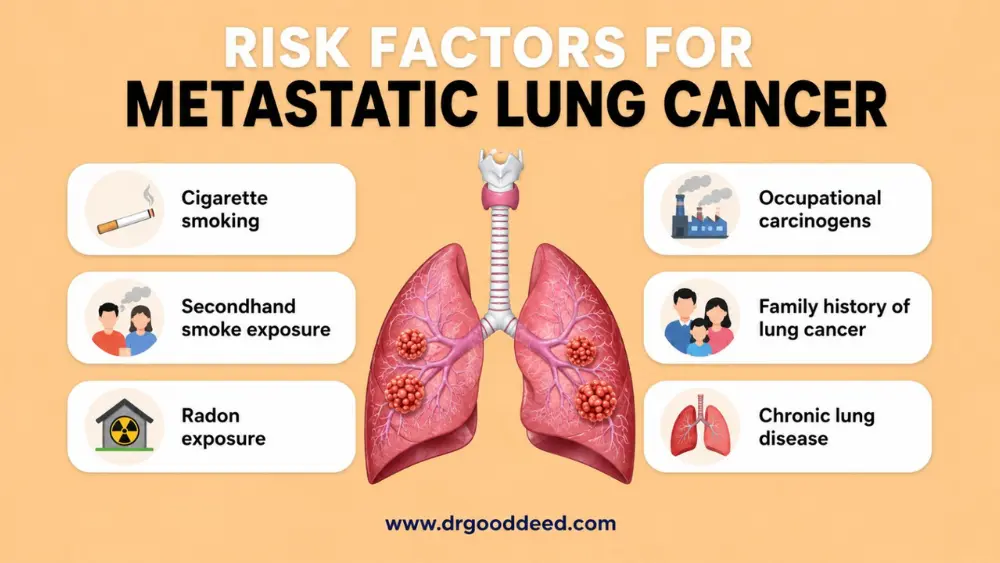
Risk factors for metastatic lung cancer overlap with lung cancer risk generally, though some exposures correlate more strongly with disease that’s already advanced by diagnosis.
- Cigarette smoking: Causes roughly 80 to 90% of US lung cancer cases. Risk rises with years smoked and stays elevated for over a decade after quitting.
- Secondhand smoke exposure: Nonsmokers living with a smoker face meaningfully higher risk than those in smoke-free homes.
- Radon exposure: The leading cause of lung cancer among people who’ve never smoked. Radon is an odorless gas seeping in from soil, and most homes never get tested.
- Occupational carcinogens: Asbestos, diesel exhaust, silica dust, and arsenic raise risk substantially in construction, mining, and manufacturing workers.
- Family history of lung cancer: A first-degree relative with lung cancer roughly doubles personal risk.
- Chronic lung disease: COPD and pulmonary fibrosis cause ongoing tissue damage that raises malignancy risk independent of smoking status.
How Stage 4 Lung Cancer Is Diagnosed
Diagnosis i’s a sequence that narrows down exactly what’s happening and where it’s spread.
Medical History and Physical Examination
Doctors ask about symptom duration, smoking history, occupational exposure, and family history, then check for decreased breath sounds, swollen lymph nodes, or fluid around the lungs.
Chest X-Ray
Usually the first test ordered. Fast and cheap, but rarely detailed enough for full staging.
CT Scan
Shows tumor size, shape, and location in far more detail, and often catches early spread to lymph nodes, liver, or adrenal glands in the same scan.
PET Scan
Tracks metabolic activity. Cancer cells burn glucose faster than normal cells, so a PET scan lights up active tumor tissue anywhere in the body.
Brain MRI
Because brain metastasis is so common with lung cancer, an MRI gets ordered routinely at stage 3 or 4 diagnosis, even without neurological symptoms yet.
Biopsy and Tissue Testing
A tissue sample, taken through bronchoscopy, needle biopsy, or surgery, confirms the diagnosis and identifies non-small cell versus small cell lung cancer. Imaging alone can suggest cancer. Biopsy confirms it.
Molecular and Genetic Testing
Tumor tissue gets tested for mutations like EGFR, ALK, ROS1, and KRAS, plus PD-L1 expression. These results decide whether a patient qualifies for targeted therapy, immunotherapy for advanced lung cancer, or chemotherapy first.
Treatment Options for Stage 4 Lung Cancer
Treatment for stage 4 lung cancer isn’t just chemotherapy anymore. The field shifted hard toward precision approaches built around tumor biology.
Immunotherapy for advanced lung cancer works by blocking PD-1 or PD-L1, proteins tumor cells use to hide from the immune system. PD-L1 on tumor cells binds PD-1 on T cells and suppresses the immune response. Drugs like pembrolizumab and nivolumab block that interaction, freeing T cells to attack again. Patients with PD-L1 expression of 50% or higher respond best to immunotherapy alone, while lower expression usually calls for pairing it with chemotherapy.
Targeted therapy only applies when a specific mutation is present. EGFR, ALK, and ROS1 inhibitors shrink tumors driven by those mutations with fewer side effects than chemotherapy, but they do nothing without a matching mutation.
Chemotherapy still has a role, alone, combined with immunotherapy, or as a backup once targeted therapy stops working. Radiation targets specific painful or dangerous metastases, especially bone or brain. Surgery is rare at stage 4 but sometimes used on a single isolated metastasis alongside systemic treatment.
Survival Outlook
About 7% of stage 4 non-small cell lung cancer patients survive five years from diagnosis, per SEER registry data. That number sounds bleak alone, but it undersells recent change. A community-practice study following 182 stage 4 NSCLC patients found one-year survival of 46.7%, with chemo-immunotherapy patients reaching median overall survival of 17 months, well above chemotherapy alone.
Among patients matching modern trial criteria, over 20% reach five-year survival, a figure unheard of a decade ago. Outcomes depend heavily on PD-L1 status, mutation profile, and how many organs are involved at diagnosis, which is exactly why molecular testing matters before treatment starts.
FAQ
How long can someone live with stage 4 lung cancer?
Median survival runs 10 to 17 months depending on treatment combination, but patients with high PD-L1 expression on immunotherapy alone have reached median survival past 30 months in trial data.
What does metastatic lung cancer mean?
It means cancer cells have spread from the lung to a distant organ, such as bone, brain, liver, or adrenal glands, through the bloodstream or lymphatic system.
Can stage 4 lung cancer be cured?
No. Stage 4 lung cancer is not curable. Treatment focuses on controlling growth and extending survival, though some patients reach years of stable disease.
What is metastatic non-small cell lung cancer?
It’s non-small cell lung cancer, the most common lung cancer type, that has spread beyond the chest to distant organs, qualifying as stage 4.
What are the risk factors for metastatic lung cancer?
Smoking, secondhand smoke, radon exposure, occupational carcinogens like asbestos, family history, and chronic lung diseases such as COPD all raise advanced-disease risk.
How does immunotherapy for advanced lung cancer work?
It blocks PD-1 or PD-L1 proteins that let tumor cells hide from immune attack, letting T cells recognize and destroy cancer cells again.
What treatments are available for advanced lung cancer?
Immunotherapy, targeted therapy for specific mutations, chemotherapy, radiation for symptomatic metastases, and occasionally surgery on isolated sites, chosen by biomarker testing.
Can targeted therapy help stage 4 lung cancer patients?
Yes, but only with a matching mutation like EGFR, ALK, or ROS1. Genetic testing confirms eligibility before targeted therapy gets prescribed.
Sources
- National Cancer Institute, SEER Cancer Stat Facts: Lung and Bronchus Cancer
- American Cancer Society, Lung Cancer Survival Rates
- American Cancer Society, Non-Small Cell Lung Cancer Stages
- Cleveland Clinic, Bone Metastasis
- National Cancer Institute, Metastatic Cancer: When Cancer Spreads
- PMC/NCBI, Bone Metastasis: Concise Overview
- New England Journal of Medicine, Pembrolizumab versus Chemotherapy for PD-L1-Positive NSCLC
- PMC/NCBI, Efficacy Outcomes in NSCLC Patients Treated With PD Axis Inhibitor Agents
- PMC/NCBI, A Brief Report on Outcomes of Metastatic Non-Small Cell Lung Cancer