

Travel constipation means fewer than three bowel movements a week, or hard, difficult stools, that start during a trip. About 16 out of 100 US adults have constipation symptoms at any time. Travel is a known trigger.
Opioid pain relievers slow the gut. So do sedating antihistamines, iron pills, and some diarrhea remedies. This guide covers travel constipation causes, the medication risk, fiber targets, relief steps, and how to stay healthy while traveling.
Key Takeaways
- It is normal to be constipated while traveling for the first day or two.
- Travel constipation and medication clash most with opioid pain relievers.
- Adults generally need 25 to 30 grams of fiber a day, travel or not.
- Dehydration, disrupted routine, and unfamiliar bathrooms cause most cases.
- Pain, bleeding, or no relief after several days needs a doctor.
Is It Normal to Be Constipated for the First Day or Two of a Trip?
Yes, mild constipation in the first day or two of travel is common and does not usually need treatment. Meals, sleep, movement, and bathroom access all change at once, and the bowel adjusts slowly. Treat it only if it drags on or brings pain, bleeding, or heavy bloating. Steady meal times and a daily walk help most people. It is normal to be constipated while traveling.
Normal Adjustment Versus a Problem
| What you notice | What it usually means | What to do |
| One skipped day after arrival | Routine adjustment | Drink water, walk, eat fiber |
| Fewer than three movements in a week, hard stools | Meets the clinical definition | Add fluids, fiber, and movement |
| No movement for over a week, pain, or bleeding | Needs medical evaluation | Contact a doctor |
A Medication Risk Most People Don’t Know About
Certain medications, especially opioid pain relievers, significantly raise the risk of travel constipation. Opioids bind receptors in the gut wall, slow movement through the bowel, and dry the stool.
Opioids also raise anal sphincter tone and cut gut secretions, so stool dries out and stays put. Travel stacks on top of that. Long sitting, less water, and skipped toilet stops add to a drug effect already running.
Medicines That Slow the Gut on the Road
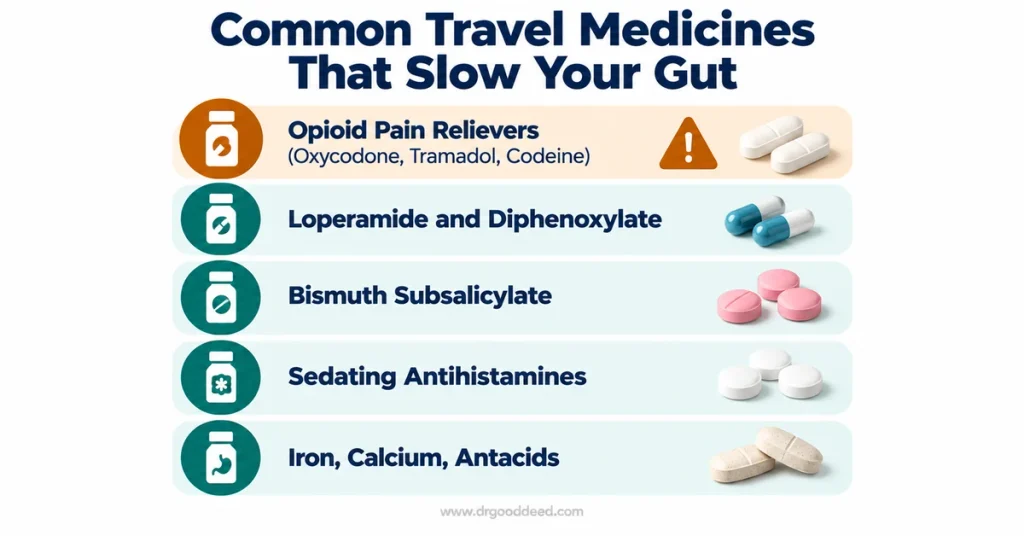
Travel constipation and medication trouble rarely stop at prescriptions. Several travel staples slow the bowel too.
- Opioid pain relievers: Oxycodone, tramadol, and codeine all slow transit. UK pharmacies also sell low-dose codeine products such as co-codamol, so read labels.
- Loperamide and diphenoxylate: These synthetic opiates that cut bowel movement frequency. Stop once your stools normalize.
- Bismuth subsalicylate (Pepto-Bismol): The CDC lists constipation as a side effect, alongside black stool and a black tongue.
- Sedating antihistamines: Diphenhydramine (Benadryl) helps people sleep on flights and calms motion sickness. It also blocks acetylcholine, a chemical that drives gut muscle movement.
- Iron, calcium, and antacids: Iron pills and calcium supplements can cause constipation. So can antacids with calcium or aluminum, such as Tums.
- Daily prescriptions: SSRIs, tricyclic antidepressants, and calcium channel blockers such as verapamil and diltiazem also appear on the list. Keep taking them as prescribed, and ask before changing anything.
Plan With Your Doctor Before You Fly
Ask your prescriber what to take, and when, before departure. A short conversation beforehand costs far less than a clinic visit abroad.
- Ask whether to start a laxative alongside the opioid.
- Never stop a prescribed medicine without talking to your doctor or GP.
- Keep medicines in original labeled packaging, in hand luggage.
- Check destination rules for controlled drugs before packing opioids.
- Pack the exact laxative your clinician names.
- Ask how to space doses across time zones.
- Start any planned laxative before the flight, not after symptoms.
The Real Causes of Travel Constipation
Travel constipation usually comes from several small changes stacking up. Think less fluid, more sitting, shifted meal times, avoided toilets, and sometimes a constipating medicine. Dry cabin air plays a smaller role than most people assume. Each cause is minor alone. Together they slow the gut.
- Dehydration: Drinking less than usual leaves less water available to keep stool soft.
- Long sitting: Hours in a seat reduce the body movement that nudges stool along.
- Gut jet lag: A 2025 Frontiers in Nutrition review by Li and colleagues proposes a model. Time zone shifts pull the brain’s body clock out of step with the gut microbiome. That mismatch may drive functional constipation. The model is a proposal, not a trial in travelers.
- Holding it in: Resisting the urge to go in an unfamiliar bathroom makes constipation worse.
- Cabin air: Dry air adds little next to the other causes.
For the full mechanism behind each of these, including why dry cabin air is a smaller factor than assumed, see how to avoid constipation during travel.
How Much Fiber Do You Actually Need While Traveling?
Adults generally need 25 to 30 grams of fiber a day, the same target whether traveling or not. The FDA Daily Value is 28 grams, which reflects 14 grams per 1,000 calories.
You can aim for the normal fiber target while traveling. Multiply your daily calories by 0.014 for a personal number. A 2,500-calorie day works out to 35 grams.
Travel-Friendly Fiber Sources
| Food | Fiber (approx.) | Travel note |
| Raspberries, 1 cup | 8 g | Buy fresh locally, eat the same day |
| Pear, medium, with skin | 5 g | Travels well, ripens in a bag |
| Chia seeds, 1 tablespoon | 4 g | Stir into liquid first, dry chia swells |
| Almonds, 1 ounce | 3.5 g | Shelf-stable and pocket-sized |
| Instant oatmeal packet | 3 to 4 g | Needs only hot water |

Oats, beans, and fruit skins supply soluble and insoluble fiber. Both types help stool form and move. Add a few grams at a time, and drink water alongside. Extra fiber without fluid can worsen travel constipation.
Quick Relief If You’re Already Constipated
Quick relief for travel constipation starts with fluids, movement, and one gentle, predictable remedy. Most over-the-counter laxatives work within one to three days, so start early and don’t stack products. Skip new stimulant laxatives on travel days, since urgency and cramps are hard to manage on a plane.
- Drink a full glass of water with every meal.
- Walk after meals and stretch your hips on long rides.
- Raise your feet on a stool so knees sit above hips.
- Go when the urge hits, even in an unfamiliar bathroom.
- Use psyllium briefly, and track how much fiber your meals supply while traveling.
- Magnesium citrate draws water into the bowel. Glycinate acts as a weaker laxative.
- Single-dose polyethylene glycol sachets pack easily and carry strong guideline backing.
- Stool softeners like docusate help mildly, though evidence is limited.
- Avoid new stimulant laxatives without medical advice while traveling.
Bulk-forming products such as psyllium usually take two to three days to work. Start them early in the trip, not on day four. Osmotic options like polyethylene glycol tend to act faster.
Use over-the-counter laxatives for no more than seven days. If travel constipation persists after three days of laxatives, talk to a pharmacist or doctor. Check with a clinician before using magnesium if you have kidney disease.
Pro Tip:
Eat your first meal within a couple of hours of local breakfast time after landing. Animal studies and reviews show meal timing resets gut tissue clocks, though no trial has tested it for travel constipation.
When to See a Doctor
See a doctor if constipation lasts more than a week, causes significant pain, or comes with bleeding. In the USA, start with primary care, or urgent care when you are away from home. In the UK, contact your GP or pharmacist. Vomiting, fever, or a swollen belly need same-day care.
Red Flags That Change the Plan
- Black stool after Pepto-Bismol is expected. Tarry, foul-smelling black stool with dizziness or stomach pain needs urgent care.
- Vomiting, a swollen belly, and no passing of gas can signal bowel obstruction. Go to an emergency department.
- New constipation after age 50 that does not settle needs a check.
- Persistent travel constipation after starting a new medicine deserves a prescriber review.
- Watery leakage with no formed stool can signal impaction with overflow. Call a clinician.
If quick relief for travel constipation fails within three days, stop self-treating and call a clinician.
FAQs
Is travel constipation the same as regular constipation?
Yes, fewer than three bowel movements a week, or hard stools. The difference is timing. Travel constipation starts with a trip and usually eases as your routine settles, while chronic constipation lasts months.
Do probiotics help with travel constipation?
Not reliably. Results vary by strain, and trial evidence comes mostly from chronic constipation, not trips. If you try one, start before departure. Timing details sit in probiotics for diarrhea.
Can travel constipation be a sign of something more serious?
Yes, rarely. Blood in the stool, unintentional weight loss, persistent vomiting, a swollen belly, or severe pain need evaluation. So does constipation lasting over a week or starting after age 50.
Sources
- NIDDK: Constipation link
- AGA Institute Guideline on the Medical Management of Opioid-Induced Constipation, Gastroenterology 2018 link
- AGA-ACG Clinical Practice Guideline: Pharmacological Management of Chronic Idiopathic Constipation, 2023 link
- Li et al. Gut jet lag and functional constipation, Frontiers in Nutrition, 2025 link
- Circadian Rhythms in Gastroenterology, Gastroenterology, 2025 link
- CDC Yellow Book: Travelers’ Diarrhea link
- Cleveland Clinic: Constipation link
- FDA: Daily Value on the Nutrition and Supplement Facts Labels link
- NHS: Constipation link
- NHS: Laxatives link
Medical Disclaimer: This article is for general information only and is not medical advice. It does not replace a diagnosis, treatment plan, or guidance from a qualified healthcare professional. Always talk to your doctor about your own symptoms and before starting, stopping, or changing any treatment. If you think you may be having a medical emergency, call 911 or go to your nearest emergency room.