
Separation anxiety disorder is a DSM-5 diagnosis characterized by excessive fear during separation from an attachment figure. It affects 4–5% of children and 1.9% of adults in the USA annually, per the National Comorbidity Survey Replication (Harvard Medical School). Unlike passing daycare nervousness, this disorder disrupts school, work, and relationships for months.
This article covers the causes of separation anxiety disorder, separation anxiety disorder symptoms by age group, cognitive behavioral therapy, and coping strategies for separation anxiety disorder.
Causes of Separation Anxiety Disorder
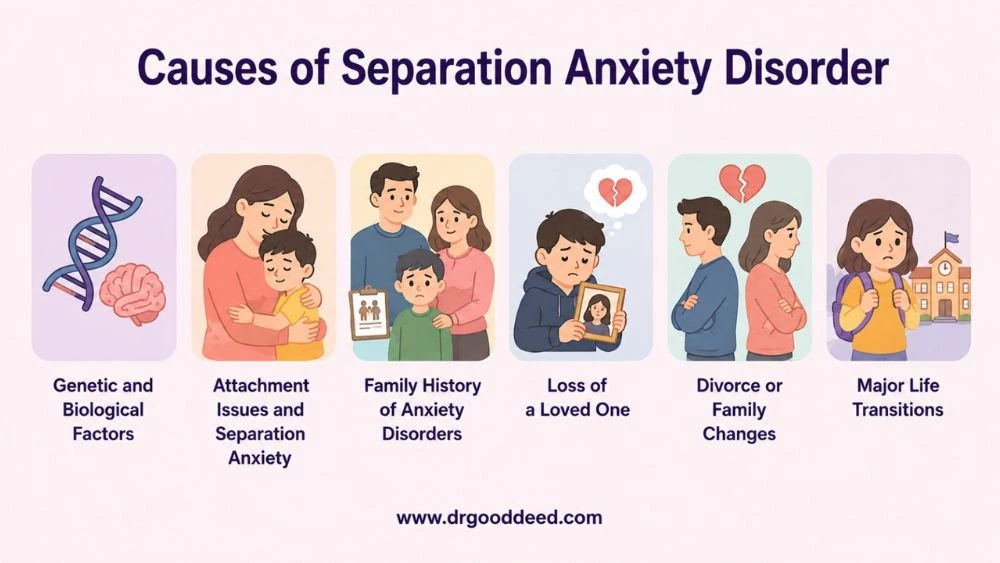
The causes of separation anxiety disorder combine genetics, early attachment experiences, and life events. The disorder emerges when several risk factors stack together.
Genetic and Biological Factors
Children with a parent diagnosed with an anxiety disorder are 3–5 times more likely to develop separation anxiety disorder, per the Journal of Child Psychology and Psychiatry (2017). The amygdala shows measurably higher activation in anxious individuals, and HPA axis dysregulation is a documented biological contributor, not a character flaw.
Attachment Issues and Separation Anxiety
Attachment issues and separation anxiety are directly connected. Dr. Mary Ainsworth’s research at Johns Hopkins showed that children with insecure-anxious attachment, formed through inconsistent caregiving, showed far higher separation distress than securely attached children. The belief that “the caregiver may not return” persists into adulthood without targeted treatment.
Family History of Anxiety Disorders
A first-degree relative with panic disorder or agoraphobia significantly increases risk, through both genetic inheritance and behavioral modeling. Children directly replicate observed parental fear responses.
Stressful Life Events and Trauma
Loss of a Loved One
Bereavement before age 10 increased anxiety disorder onset by 41% (Dr. Robin Weersing, San Diego State University; Child Psychiatry and Human Development, 2016).
Divorce or Family Changes
Even amicable divorces create repeated separation experiences through custody transitions, which entrench anxiety patterns.
Major Life Transitions
Starting school, moving cities, or changing primary caregivers carry disproportionate weight for children prone to anxious attachment. College transitions and relocations trigger the same pattern in adults.
Overprotective Parenting and Environmental Influences
Dr. Matthew Ollendick at Virginia Tech found in Clinical Child and Family Psychology Review (2013) that consistently rescuing children from discomfort predicted anxiety maintenance more strongly than the original anxiety onset.
Separation Anxiety Disorder Symptoms
Emotional Symptoms
Separation anxiety disorder symptoms in the emotional category are persistent and disproportionate. Reassurance offers brief relief, then the anxiety returns at full intensity.
- Persistent worry that the attachment figure will be harmed while apart
- Intense fear of permanent abandonment
- Recurring nightmares about separation
- Refusal to be alone even in safe, familiar environments
Behavioral Symptoms
Behavioral separation anxiety disorder symptoms are the most visible to parents and teachers. They are often misread as defiance, but they are anxiety-driven avoidance.
- School or work refusal without the attachment figure present
- Following the caregiver room to room at home
- Repeated calls or texts to the attachment figure when apart
- Refusing to sleep in a separate room or away from home
- Prolonged, clinging goodbyes before any separation
Physical Symptoms
The body’s stress response produces real physiological reactions before and during separations.
- Stomachaches and headaches specifically on school mornings
- Nausea or vomiting before events requiring separation
- Rapid heartbeat and shortness of breath when the caregiver leaves
- Dizziness during anticipated separations
Signs of Separation Anxiety Disorder by Age Group
Symptoms in Young Children
In children aged 4–8, school refusal, clinging at drop-off, and morning stomachaches are the clearest indicators. Symptoms spike during kindergarten transitions and after summer breaks. Most cannot articulate the fear verbally.
Symptoms in Teenagers
Adolescents avoid overnight trips, sleepovers, and camps. Many recognize their anxiety as excessive but feel unable to stop it. Academic decline and social withdrawal follow once avoidance becomes routine.
Symptoms in Adults
Adult separation anxiety disorder is underdiagnosed. The American Journal of Psychiatry (2006) found adult-onset cases account for approximately one-third of adult anxiety presentations. Common signs include inability to tolerate a partner traveling and intense distress when a parent’s health declines.
How Symptoms Affect Daily Life
Untreated separation anxiety disorder blocks career growth through travel refusals, strains relationships, and sustains chronically high cortisol levels.
Risk Factors for Separation Anxiety Disorder
Separation anxiety disorder risk rises when multiple vulnerability factors converge.
- Female sex (diagnosed at roughly twice the rate of males in childhood, per DSM-5)
- Inhibited temperament in infancy, a consistent predictor identified in Dr. Jerome Kagan’s longitudinal work at Harvard University
- Traumatic separation before age 10
- Parent with untreated anxiety disorder
- Urban stress environments in the USA
- Recent major stress or such as school bullying, illness, or accident
Cognitive Behavioral Therapy for Separation Anxiety
Why CBT Is the First-Line Treatment
Cognitive behavioral therapy for separation anxiety is the AACAP’s first-line treatment. Meta-analyses across 16 randomized controlled trials confirm 60–80% improvement rates. The landmark CAMS trial (New England Journal of Medicine, 2010) documented 60% remission with CBT alone.
Identifying Anxiety Triggers
Treatment starts by mapping which separations cause distress. A child may refuse school drop-off but tolerate separating from a sibling. Precise trigger mapping prevents wasted intervention effort.
Challenging Fear-Based Thoughts
A CBT therapist helps clients test thoughts like “Something bad will happen to Mom when I’m away” against evidence. This process, cognitive restructuring, weakens automatic fear beliefs over sessions.
Building Healthy Coping Skills
Clients build a coping toolkit: diaphragmatic breathing, self-talk scripts, and structured worry time (a fixed daily window for anxiety rather than all-day rumination).
Exposure Therapy for Separation Anxiety
Gradual Separation Exercises
The therapist builds a “fear ladder.” A parent leaves the room for two minutes first, then extends the duration week by week until full school-day separation is tolerable.
Reducing Avoidance Behaviors
Every successful avoidance confirms to the brain that separation was dangerous. Exposure therapy removes avoidance systematically, teaching the nervous system that separation is survivable.
Other Treatment Options for Separation Anxiety Disorder
When CBT alone is insufficient, additional approaches are added. A 2001 study by Dr. John March at Duke University found CBT combined with sertraline produced higher remission rates than either treatment alone in children aged 7–17.
- SSRIs (sertraline, fluoxetine): FDA-approved for pediatric anxiety; used in adults with separation anxiety disorder
- Family therapy: When parental behaviors maintain the child’s anxiety, family involvement in sessions accelerates progress
- School-based interventions: Coordinated plans between therapist, school counselor, and teachers prevent long-term academic disruption
- Parent-Child Interaction Therapy (PCIT): UC Davis MIND Institute research demonstrates reduced anxiety and improved parent-child relationships in children under 7
Coping Strategies for Separation Anxiety Disorder
Creating Predictable Routines
Predictable routines reduce the nervous system’s threat alerts. The same wake-up time, breakfast, and goodbye ritual every morning give the brain a known script instead of daily unknowns.
Developing Emotional Regulation Skills
The RULER approach (Yale Center for Emotional Intelligence) teaches five skills: recognizing, understanding, labeling, expressing, and regulating emotions to reduce anxiety-driven behavior.
Relaxation and Mindfulness Techniques
Box breathing (inhale 4 counts, hold 4, exhale 4, hold 4) activates the parasympathetic nervous system within 60–90 seconds. A 2014 study in Behaviour Research and Therapy found 10 daily minutes of mindfulness reduced pediatric anxiety symptoms by 38% over 8 weeks.
Encouraging Independence
Small daily tasks build separation tolerance. A 7-year-old starts by walking to the mailbox alone, then expands distance week by week. Each success updates the brain’s threat assessment.
Building Confidence Through Small Steps
Confidence builds from completing hard things, not reassurance. Recorded successes give the brain evidence against anxiety’s “you can’t do this” signal.
Living With Adult Separation Anxiety
Adult separation anxiety disorder is misidentified as codependency or jealousy, delaying diagnosis by an average of 7 years (Depression and Anxiety, 2012). Management combines CBT, scheduled check-ins with attachment figures, and personal goals that build an independent identity.
Prevention and Early Intervention
The earlier separation anxiety disorder is identified, the shorter treatment takes. Dr. Carolyn Webster-Stratton (University of Washington, 2019) found early intervention for children aged 3–6 reduced diagnosable anxiety rates by 52% at five-year follow-up.
- Responsive, consistent caregiving in the first three years builds secure attachment
- Brief, warm, consistent goodbye rituals rather than prolonged emotional ones
- Teaching age-appropriate independence from toddlerhood onward
- Pediatrician anxiety screening at annual wellness visits
FAQ
1. What is separation anxiety disorder?
Separation anxiety disorder is a DSM-5 diagnosis where fear of separation from an attachment figure lasts at least 4 weeks in children or 6 months in adults, causing impairment in school, work, or relationships.
2. What are the most common separation anxiety disorder symptoms?
The most common separation anxiety disorder symptoms are school refusal, clinging at goodbyes, repeated contact attempts when separated, stomachaches on school mornings, and recurring nightmares specifically about separation or losing a caregiver.
3. What causes separation anxiety disorder?
The primary causes of separation anxiety disorder are insecure-anxious attachment from inconsistent early caregiving, a first-degree family history of anxiety disorders, and traumatic separation before age 10.
4. How is separation anxiety different from normal childhood fears?
Normal separation anxiety peaks between 8–18 months and resolves by age 3. Separation anxiety disorder persists past age 3, worsens rather than fades, and blocks normal functioning at school or home.
5. Can adults develop separation anxiety disorder?
Yes. The American Journal of Psychiatry (2006) confirmed that one-third of adult separation anxiety disorder cases are adult-onset, often triggered by a major relationship loss or a new romantic attachment.
6. How do attachment issues and separation anxiety relate to each other?
Attachment issues and separation anxiety connect through early nervous system conditioning. Insecure-anxious attachment teaches the brain to register separation as danger. That response does not switch off without structured treatment.
7. What is cognitive behavioral therapy for separation anxiety?
Cognitive behavioral therapy for separation anxiety maps triggers, challenges fear-based thoughts through evidence testing, builds a coping toolkit, and uses graduated exposure to feared separations. Standard treatment runs 12–20 sessions.
8. How effective is CBT for separation anxiety disorder?
The CAMS trial in the New England Journal of Medicine (2010) found 60% remission with CBT alone and 81% remission with CBT plus sertraline for CBT in children and adolescents aged 7–17.
9. What coping strategies help manage separation anxiety disorder?
The strongest coping strategies for separation anxiety disorder are consistent goodbye routines, box breathing, graduated independence tasks, and scheduled contact with attachment figures instead of continuous checking.
10. How can parents support a child with separation anxiety?
Keep goodbyes brief, warm, and consistent every day. Prolonged farewells signal to the child’s brain that separation is dangerous. An AACAP-affiliated therapist teaches behavioral responses that reduce, not reinforce, separation distress.
Sources
- DSM-5: Diagnostic and Statistical Manual of Mental Disorders, American Psychiatric Association
- CAMS Trial, New England Journal of Medicine (2010)
- National Comorbidity Survey Replication, Harvard Medical School
- American Academy of Child and Adolescent Psychiatry, Anxiety Resource Center
- Yale Center for Emotional Intelligence, RULER Approach
- Weersing VR et al., Child Psychiatry and Human Development (2016)
- Ollendick TH, Clinical Child and Family Psychology Review (2013)