
Cognitive behavioral therapy for childhood anxiety is the most evidence-based psychological treatment available for anxious children, with response rates between 60% and 80% in randomized controlled trials.
Anxiety disorders affect roughly 1 in 3 children at some point before age 18 in the United States, per the National Institute of Mental Health (NIMH). CBT works by teaching children to identify distorted thoughts, change behavioral responses, and build skills that last long past the end of therapy.
What Is Childhood Anxiety?
Anxiety is a normal stress response. When it becomes frequent, intense, and interferes with daily life, it crosses into diagnosable disorder territory. Anxiety disorders are the most common pediatric mental health condition in the USA, affecting an estimated 7.1% of children aged 3 to 17, per the CDC.
Understanding Anxiety in Children
Anxiety activates the amygdala, the brain’s threat-detection center. In anxious children, this system fires too often and too strongly. The result is physical symptoms like stomachaches, headaches, and rapid heart rate combined with avoidance behaviors and excessive worry.
When Worry Becomes a Mental Health Concern
Normal worry is brief and situation-specific. Clinical anxiety is persistent (lasting more than six months per DSM-5 criteria), disproportionate to the actual threat, and impairs school performance, friendships, or sleep.
Common Types of Childhood Anxiety Disorders
Separation Anxiety Disorder
Separation Anxiety Disorder affects roughly 4% of children in the USA. Children with this condition show extreme distress when away from parents, refuse school, and fear harm coming to their caregivers.
Generalized Anxiety Disorder
Generalized Anxiety Disorder (GAD) involves chronic, hard-to-control worry about multiple topics: school grades, friendships, family finances, and health. Children with GAD often need constant reassurance.
Social Anxiety Disorder
Social Anxiety Disorder causes intense fear of embarrassment or judgment in social settings. Affected children avoid group activities, speaking in class, and birthday parties.
Specific Phobias
Specific phobias involve extreme fear of a defined object or situation: dogs, needles, storms, or vomiting. The fear is disproportionate and triggers immediate avoidance.
How Cognitive Behavioral Therapy for Childhood Anxiety Works
Cognitive behavioral therapy for childhood anxiety works on a straightforward premise: anxious feelings follow anxious thoughts, and avoidance makes anxiety stronger over time. CBT breaks that cycle by targeting thoughts and behaviors simultaneously.
Identifying Anxiety Triggers
Therapists work with children to map their specific triggers. A trigger for one child may be a crowded classroom. For another, it is being away from a parent. Identifying the trigger is the first step before any technique is applied.
Recognizing Unhelpful Thought Patterns
Anxious children frequently fall into cognitive distortions: catastrophizing (“I will fail and everyone will laugh”), mind reading (“they hate me”), and fortune-telling (“something bad will happen”). CBT names these patterns so children can recognize them in real time.
Learning Healthy Coping Skills
Children learn practical tools: diaphragmatic breathing, muscle relaxation, coping self-statements, and problem-solving frameworks. These are practiced in session and assigned as homework between sessions.
Building Confidence Through Practice
CBT does not eliminate discomfort. It teaches children to face feared situations gradually and discover that the predicted catastrophe rarely happens. Each successful approach builds self-efficacy and reduces avoidance.
Cognitive Behavioral Therapy Techniques for Kids
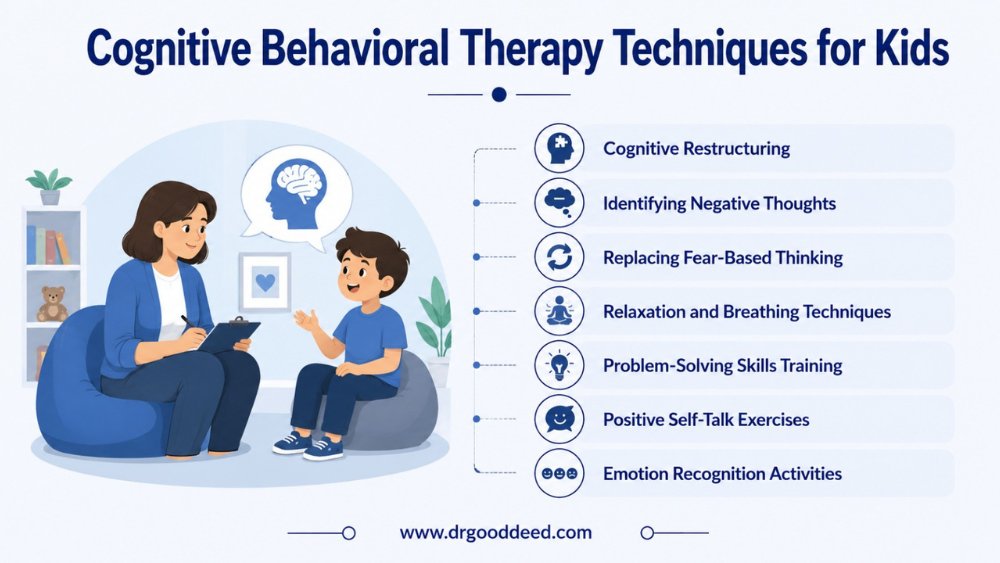
Cognitive behavioral therapy techniques for kids are adapted from adult CBT protocols using age-appropriate language, visual tools, and game-like formats that hold a child’s attention.
Cognitive Restructuring
Cognitive restructuring teaches children to examine the evidence for and against a feared belief. It is the core cognitive technique in CBT.
Identifying Negative Thoughts
Children learn to catch automatic negative thoughts using a “thought bubble” format. A therapist might ask: “What does your worry brain tell you right before you get scared?” The thought is written down and examined.
Replacing Fear-Based Thinking
After identifying the distorted thought, children generate a more balanced alternative. “What would you tell a friend who thought this?” is a standard prompt used in CBT for children. The Coping Cat program, developed at Temple University by Philip Kendall, Ph.D., uses this approach across 16 structured sessions.
Relaxation and Breathing Techniques
Diaphragmatic breathing reduces cortisol and activates the parasympathetic nervous system within minutes. Children are taught belly breathing: inhale for 4 counts, hold for 2, exhale for 6. Muscle relaxation scripts (tense a muscle group, hold 5 seconds, release) are taught as a companion skill.
Problem-Solving Skills Training
Children learn a four-step framework: identify the problem, generate solutions, pick the best one, evaluate the result. This builds tolerance for uncertainty, a core deficit in anxious children.
Positive Self-Talk Exercises
Anxious children have loud inner critics. Positive self-talk exercises teach children to create personalized coping statements: “I have done hard things before,” or “Feeling nervous is okay, I can still do this.”
Emotion Recognition Activities
Many anxious children struggle to name their feelings. Emotion charts, body mapping (where in your body do you feel scared?), and feelings thermometers help children build awareness of internal emotional and physical signals.
CBT Exercises for Childhood Anxiety
CBT exercises for childhood anxiety are structured activities children complete during sessions and as homework. Research supports homework completion as a strong predictor of treatment outcome.
Thought Journals for Kids
Children record their worried thought, rate its intensity (1 to 10), write what actually happened, and re-rate anxiety after the fact. Over time, they see their predictions are usually wrong.
Feelings Identification Activities
Feelings wheels and emotion cards help children differentiate between fear, embarrassment, sadness, and frustration. Accurate labeling of emotion is associated with lower physiological arousal, per a 2007 study by Matthew Lieberman at UCLA published in Psychological Science.
Deep Breathing Exercises
The 4-2-6 breathing pattern is the most used. For younger children, therapists use props: blow through a straw, make a pinwheel spin, or breathe like a dragon. These anchor the abstract skill to a physical action.
Anxiety Rating Scales
The Screen for Child Anxiety Related Disorders (SCARED) and Pediatric Anxiety Rating Scale (PARS) are used at baseline and throughout treatment to track progress. Families can review scores with their therapist to understand treatment response.
Coping Skills Practice
Each session ends with a real-life homework assignment. The Coping Cat workbook assigns specific practice tasks after each session. Completing between-session exercises predicts faster anxiety reduction.
Excessive Worry in Children CBT Treatment
Excessive worry in children CBT treatment specifically addresses GAD, which involves generalized, hard-to-control worry rather than fear tied to a single trigger. GAD responds well to CBT but requires techniques beyond standard exposure work.
Recognizing Excessive Worry
Children with GAD worry about multiple unrelated topics simultaneously. They seek constant reassurance. They have physical complaints (headaches, stomachaches) without medical explanation. These markers distinguish GAD from ordinary stress.
How CBT Addresses Chronic Worry
CBT for GAD adds worry time scheduling: children contain their worrying to a set 15-minute window each day. Outside that window, they postpone the worry. This externalizes worry as a behavior that can be controlled.
Building Resilience Against Future Anxiety
Resilience-building teaches children that discomfort is survivable, that mistakes are not catastrophes, and that they have tools available. These lessons reduce anxiety about anxiety itself, a key maintaining factor in GAD.
How CBT Helped Daniel Overcome School Refusal
Daniel, a 9-year-old from suburban Chicago, Illinois, had refused school for six weeks due to severe separation anxiety and stomach pain every morning. His pediatrician ruled out a medical cause.
His parents enrolled him in CBT with a licensed child psychologist. Over 12 weeks using the Coping Cat protocol, Daniel learned belly breathing, completed a worry challenge worksheet each morning, and gradually increased classroom time through a stepwise exposure plan. By week 8, he attended full school days without complaint. His SCARED score dropped from 31 (clinical range) to 12 (subclinical) by the final session.
Name altered for patient privacy.
Benefits of CBT for Childhood Anxiety
Cognitive behavioral therapy for childhood anxiety produces benefits that extend well beyond symptom reduction. A 2018 meta-analysis in the Journal of Child Psychology and Psychiatry confirmed CBT produced large effect sizes across anxiety disorder types in children aged 4 to 18.
Improved Emotional Regulation
Children learn to recognize emotional states early, before anxiety peaks. Early detection allows them to apply a coping skill before anxiety becomes overwhelming.
Better School Performance
Anxiety is the leading cause of school avoidance and academic underperformance in children. Children who complete CBT show measurable improvements in school attendance and grades, per a 2016 study in School Mental Health journal.
Stronger Social Skills
Avoidance drives social isolation. As children reduce avoidance through CBT, they re-engage with peers, join activities, and rebuild confidence in social settings.
Reduced Avoidance Behaviors
Exposure therapy and CBT for children systematically address avoidance, the single strongest maintaining factor in childhood anxiety. Graduated exposure reduces avoidance faster than reassurance or parental accommodation.
Long-Term Anxiety Management Skills
A 2019 follow-up study in Depression and Anxiety found children who completed CBT maintained gains at one-year follow-up significantly more than those who received medication alone. The skills transfer across new anxiety triggers.
Prevention and Long-Term Anxiety Management
Early CBT intervention in children aged 6 to 12 produces stronger and more durable outcomes than treatment started in adolescence, per NIMH clinical guidelines. Parents who understand CBT exercises for childhood anxiety can reinforce skills at home between sessions.
- Practice yoga exercises as a daily routine, not only during anxious moments
- Continue thought journals independently for at least six months after therapy ends
- Maintain gradual exposure to previously feared situations to prevent relapse
- Return to therapy at the first sign of significant avoidance or school refusal
- Stop answering repetitive reassurance questions: parental accommodation strengthens anxiety
When to Seek Professional Help
Cognitive behavioral therapy for childhood anxiety requires a licensed professional: a child psychologist, licensed clinical social worker, or psychiatrist trained in evidence-based CBT protocols. Do not wait if anxiety persists beyond four weeks and interferes with daily function.
- School refusal lasting more than one week
- Daily physical complaints (stomachaches, headaches) with no medical cause
- Sleep disruption lasting more than three weeks
- Panic attacks in a child under 12
- Avoidance of previously enjoyed activities
- Reassurance-seeking that takes more than 30 minutes of a parent’s time daily
Find a CBT-trained therapist through the Association for Behavioral and Cognitive Therapies (ABCT) directory or a pediatrician referral.
FAQs
What is cognitive behavioral therapy for childhood anxiety?
Cognitive behavioral therapy for childhood anxiety is a structured 12 to 20 session protocol teaching children to identify distorted thoughts, reduce avoidance, and use coping skills. Response rates reach 60 to 80% in randomized controlled trials across all childhood anxiety disorders.
How effective is CBT for treating anxiety in children?
A 2018 meta-analysis in the Journal of Child Psychology and Psychiatry found CBT produced large effect sizes across all childhood anxiety disorders. Roughly 70% of children who complete a full protocol show clinically significant improvement by session 16.
At what age can a child start CBT for anxiety?
Children as young as 4 begin play-based CBT. Standard verbal protocols like Coping Cat target ages 7 to 13. Adolescent adaptations apply from age 14 onward.
What are the most common cognitive behavioral therapy techniques for kids?
The most used cognitive behavioral therapy techniques for kids are cognitive restructuring, graduated exposure, belly breathing (4-2-6 pattern), worry challenge worksheets, and coping self-statements, all core components of the Coping Cat and FRIENDS programs.
How does CBT help with excessive worry in children?
Excessive worry in children CBT treatment adds worry time scheduling: children confine worrying to a 15-minute daily window. Combined with cognitive restructuring, this reduces worry frequency within four to six weeks.
What is separation anxiety CBT for children?
Separation anxiety CBT for children uses graduated exposure: a child increases time away from parents in small steps, from 5 minutes to a full school day over two to four weeks, staying in each step until anxiety drops by at least 50%.
How does exposure therapy work in childhood anxiety treatment?
Exposure therapy and CBT for children create a fear ladder: ranked feared situations from least to most scary. The child faces each step until anxiety peaks and falls naturally, proving the feared outcome did not occur.
What CBT exercises for childhood anxiety can be practiced at home?
Parents can support CBT exercises for childhood anxiety at home using: daily worry journals, 4-2-6 breathing before school, feelings thermometers at dinner, and practicing one small feared activity daily between therapy sessions.
How long does CBT take to show results in children?
Most children show measurable anxiety reduction by session 6 to 8. Full response takes 12 to 16 sessions for most anxiety disorders. GAD and social anxiety sometimes require 20 sessions.
Can parents participate in CBT sessions?
Yes. Protocols like Coping Cat include 2 to 4 dedicated parent sessions. Parents learn to stop accommodation behaviors (answering repetitive reassurance questions) and coach, not rescue, their child during anxious moments.
Sources
- National Institute of Mental Health (NIMH), Anxiety Disorders: https://www.nimh.nih.gov/health/topics/anxiety-disorders
- Centers for Disease Control and Prevention (CDC), Children’s Mental Health: https://www.cdc.gov/childrensmentalhealth/anxiety.html
- Journal of Child Psychology and Psychiatry, CBT Meta-Analysis (2018): https://acamh.onlinelibrary.wiley.com/journal/14697610
- Depression and Anxiety, CBT Long-Term Follow-Up Study (2019): https://onlinelibrary.wiley.com/journal/15206394
- School Mental Health, CBT and Academic Performance Study (2016): https://link.springer.com/journal/12310
- Screen for Child Anxiety Related Disorders (SCARED): https://www.psychiatry.pitt.edu/sites/default/files/Documents/assessments/SCARED%20Child.pdf
DISCLAIMER: This article is for informational purposes only and does not constitute medical advice, diagnosis, or treatment. If your child shows signs of anxiety, consult a licensed mental health professional or pediatrician. Do not delay or replace professional care with information from this article.