

Social anxiety is a disability under U.S. federal law. Social anxiety disorder (SAD) qualifies as a disability when it severely limits major life activities such as working, communicating, or leaving home.
Classified under DSM-5 and ICD-10 code F40.10, SAD affects approximately 15 million adults in the USA annually, per the Anxiety and Depression Association of America (ADAA). The SSA evaluates it under mental disorders Listing 12.06, and the Americans with Disabilities Act (ADA) protects qualifying individuals at work.
Is Social Anxiety a Disability?
Social anxiety is a disability under U.S. law when it substantially limits a major life activity. The SSA recognizes it under Listing 12.06 for SSDI or SSI eligibility, and the ADA protects qualifying employees in the workplace.
When Social Anxiety Is Considered Disabling
When social anxiety is considered disabling, symptoms must persist at least 12 months and prevent basic work-related tasks. The SSA requires documented evidence of inability to sustain employment, significant daily activity restriction, and inadequate response to standard treatment.
Factors Used to Determine Disability Status
The SSA applies “Paragraph B” criteria: extreme limitation in one domain or marked limitation in two of these four:
- Understanding, remembering, or applying information
- Interacting with others (most commonly impaired in SAD)
- Concentrating and completing tasks at a consistent pace
- Adapting to changes or managing personal care
“Paragraph C” applies when someone cannot function outside a highly supported environment despite ongoing treatment.
Social Anxiety Disorder Symptoms
When assessing whether social anxiety is a disability, clinicians examine symptoms across three categories, each contributing to impairment determinations.
Emotional Symptoms
Intense Fear of Judgment
People with SAD experience persistent fear that others are watching and negatively evaluating them, even in low-stakes situations like ordering food or signing a check in public.
Fear of Embarrassment
Fear of visibly showing anxiety symptoms (blushing, shaking) or saying the wrong thing becomes so intense it alters daily decisions.
Persistent Self-Consciousness
Excessive self-monitoring during social interactions drains mental energy and disrupts concentration and natural communication.
Physical Symptoms
Sweating
Excessive sweating in social situations, even at comfortable temperatures, is a documented physical marker of SAD.
Trembling
Visible shaking of the hands or voice during presentations and phone calls is frequently documented in disability evaluations.
Rapid Heartbeat
Palpitations during anticipated or actual social interaction signal real sympathetic nervous system activation, not imagined discomfort.
Nausea and Dizziness
Nausea and dizziness before social situations cause people with SAD to avoid eating in public or attending required work and school events.
Behavioral Symptoms
Avoidance of Social Situations
Avoidance is the most disabling behavior in SAD. People cancel appointments, refuse promotions, or quit jobs to sidestep feared situations.
Difficulty Speaking in Groups
Inability to contribute in meetings or speak in group tasks directly limits professional and academic performance.
Avoiding School or Work Activities
Absenteeism and refusal to participate in required activities are documented behavioral symptoms supporting severe social anxiety affecting daily life disability claims.
Social Anxiety and Inability to Work
Social anxiety and inability to work are one of the most searched and least specifically answered topics in this space. SAD does not just make work uncomfortable; for many, it removes employment entirely.
SAD disrupts baseline job requirements: communication and collaboration. Even remote work involves video calls and performance reviews that trigger SAD symptoms.
Difficulty With Interviews and Meetings
Job interviews are among the highest-anxiety scenarios in SAD research. Dr. Richard Heimberg at Temple University documented interview avoidance as a primary employment barrier; people with severe SAD skip interviews regardless of qualifications.
Customer-Facing and Team-Based Roles
SAD disqualifies people from customer service, healthcare support, and retail when core job functions trigger severe anxiety.
Reduced Job Performance and Productivity
Kessler et al. (Current Medical Research and Opinion, 2013) found employees with SAD averaged 5.6 impaired workdays per month.
When Social Anxiety Prevents Employment
When SAD prevents competitive employment for 12+ consecutive months, the SSA’s RFC assessment classifies the person as unable to engage in Substantial Gainful Activity (SGA), the SSDI eligibility threshold.
Long-Term Effects of Social Anxiety Disorder
Long-term effects of social anxiety disorder go beyond social discomfort. Without treatment, life restructures around avoidance.
Chronic Stress and Emotional Distress
Sustained social threat anticipation keeps cortisol chronically high, contributing to immune dysregulation and cardiovascular strain over years.
Depression and Coexisting Mental Health Conditions
The National Comorbidity Survey Replication (Harvard Medical School) found 48.9% of people with SAD develop major depressive disorder over their lifetime.
Reduced Career Opportunities
People with untreated SAD decline promotions and stay in low-advancement roles, compounding financial insecurity.
Social Isolation Over Time
As avoidance increases, social circles shrink. Dr. Deborah Roth (University of Pittsburgh) found adults with long-term SAD reported significantly smaller support networks than matched non-anxious adults.
Impact on Overall Quality of Life
The WHO ranks SAD among conditions with the highest DALYs in high-income countries, citing median onset at age 13.
Risk Factors for Severe Social Anxiety
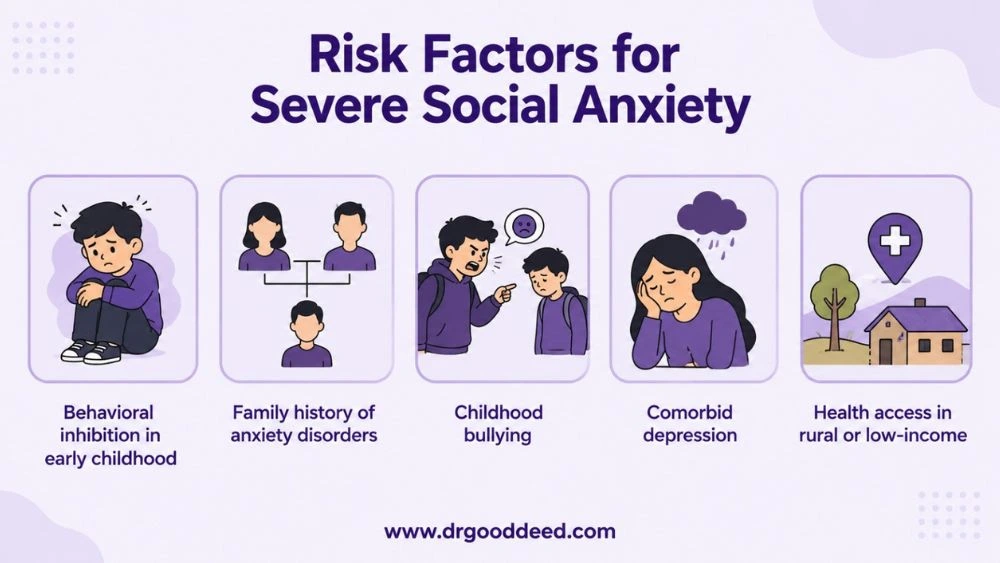
Severe social anxiety affecting daily life risk increases when biological and environmental factors combine.
- Behavioral inhibition in early childhood (Dr. Jerome Kagan, Harvard University): strongest temperamental predictor of adult SAD
- First-degree family history of anxiety disorders (2–6x higher risk, per DSM-5)
- Childhood bullying, teasing, or public humiliation
- Comorbid depression or another anxiety disorder
- Limited mental health access in rural or low-income USA communities
How Social Anxiety Disorder Is Diagnosed
When evaluating if social anxiety a disability, a licensed psychologist uses the Liebowitz Social Anxiety Scale (LSAS), developed by Dr. Michael Liebowitz at Columbia University. Scores above 60 indicate moderate SAD; scores above 95 indicate severe SAD.
DSM-5 requires avoidance or marked fear lasting 6+ months with occupational or social impairment. A GAF score below 50 documents significant functional limitation for SSA purposes.
How to Apply for Disability With Social Anxiety
How to apply for disability with social anxiety: file at SSA.gov with gathered medical evidence.
Collect 12 months of psychiatric records; treatment gaps weaken claims. A Consultative Examination by an SSA-contracted psychologist is often required, alongside a Mental RFC form from a treating psychiatrist describing specific limitations in social interaction, concentration, and adaptation. Submit applications at SSA.gov with the Adult Function Report (SSA-787).
Common reasons claims are denied:
- Insufficient medical records or treatment gaps
- Failure to show the condition prevents all types of work, not just past jobs
- GAF scores above 50 without supporting narrative
- Inconsistent self-reported activity levels versus documented limitations
Treatment Options for Social Anxiety Disorder
Cognitive Behavioral Therapy (CBT)
CBT is the gold-standard treatment for SAD. A meta-analysis by Hofmann and Smits (Journal of Clinical Psychiatry, 2008) found 61% response rates and 42% remission at follow-up.
Exposure Therapy
Systematic exposure within CBT produces the most durable improvements, teaching the nervous system that feared situations are survivable.
Medication Options
SSRIs
Sertraline (Zoloft) and paroxetine (Paxil) are FDA-approved for SAD; paroxetine was the first FDA-approved drug specifically for SAD in 1999.
Anti-Anxiety Medications
Beta-blockers (propranolol) address situational performance anxiety. Benzodiazepines are short-term only due to dependency risk.
Social Skills Training
Group social skills training reduces avoidance and builds real interaction practice, most effectively alongside CBT.
Support Groups and Counseling
ADAA support groups provide peer support and structured social exposure in low-threat settings.
Prevention and Early Intervention
Recognizing Symptoms Early
SAD onset peaks at median age 13 in the USA. NIMH data shows symptoms recognized before 18 respond better to treatment than untreated cases that carry into adulthood.
Seeking Treatment Promptly
The average delay between SAD onset and first treatment is 15–20 years in the USA (ADAA). Early CBT reduces long-term functional impairment.
Building Healthy Coping Skills
Diaphragmatic breathing and cognitive restructuring reduce impairment in social anxiety a disability cases when practiced consistently.
Supporting Emotional Resilience
School counselors and pediatricians in the USA increasingly screen for SAD. Early referral to a psychologist prevents the avoidance patterns that drive adult disability claims.
FAQ
1. Is social anxiety considered a disability?
Yes, social anxiety is a disability under U.S. law. Under ADA and SSA guidelines, social anxiety is a disability when it substantially limits working, communicating, or leaving home, with at least 12 months of clinical documentation supporting the claim.
2. When is social anxiety considered disabling?
When social anxiety is considered disabling by the SSA, the person must show marked or extreme limitation in two of four functional domains (understanding, interacting, concentrating, adapting) under DSM-5 Listing 12.06 criteria, lasting at least 12 continuous months.
3. Can severe social anxiety affect daily life?
Yes. Severe social anxiety affecting daily life disrupts eating in public, answering phone calls, attending medical appointments, grocery shopping, and maintaining relationships, all of which become avoidance targets as the disorder progresses untreated.
4. Can social anxiety prevent someone from working?
Yes. Social anxiety and inability to work is an SSA-recognized impairment when SAD prevents competitive employment for 12+ months. Kessler et al. (2013) documented 5.6 impaired workdays per month in employed SAD patients.
5. What are the long-term effects of social anxiety disorder?
The long-term effects of social anxiety disorder include major depression in 48.9% of lifetime cases (Harvard NCS-R), chronic social isolation, reduced earnings, and physical health risks from sustained cortisol elevation.
6. How do I apply for disability with social anxiety?
To apply for disability with social anxiety, file at SSA.gov with 12+ months of psychiatric records, a Mental RFC form from your psychiatrist, and a completed Adult Function Report (SSA-787).
7. What medical evidence is needed for a disability claim?
The SSA requires 12 months of psychiatric treatment records, an RFC form from a treating provider, standardized test scores (LSAS, GAF below 50), and documented employment failures. Claims without consistent treatment records are routinely denied.
8. Can students receive accommodations for social anxiety?
Yes. Under Section 504 of the Rehabilitation Act, U.S. students with documented SAD qualify for accommodations including oral exam alternatives, extended assignment deadlines, seating away from group areas, and presentation format modifications.
9. What workplace accommodations are available for social anxiety?
ADA-covered employees can request remote work arrangements, written communication in place of verbal, private workspace, flexible scheduling to avoid peak social periods, and modified meeting participation formats.
10. Does everyone with social anxiety qualify for disability benefits?
No. Is social anxiety a disability that qualifies everyone? No. The SSA approves only cases where SAD persists at disabling severity despite treatment for 12+ months. Cases that respond to CBT or medication do not qualify.
Sources
- Anxiety and Depression Association of America (ADAA), Social Anxiety Disorder Facts
- Social Security Administration, Listing 12.06: Anxiety and Obsessive-Compulsive Disorders
- DSM-5, American Psychiatric Association
- National Comorbidity Survey Replication, Harvard Medical School
- Hofmann SG, Smits JAJ. Cognitive-Behavioral Therapy for Adult Anxiety Disorders. Journal of Clinical Psychiatry (2008)
- National Institute of Mental Health (NIMH), Social Anxiety Disorder
- Americans with Disabilities Act, U.S. Department of Justice