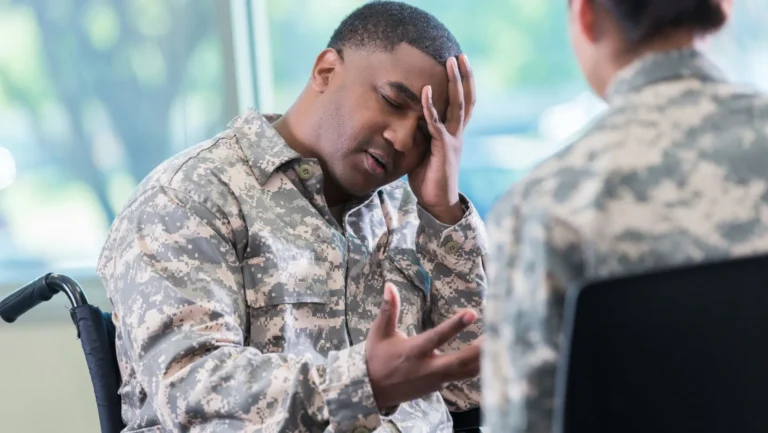

Situational depression is a short-term, stress-triggered mood disorder that develops after a specific life event. Clinically recognized as adjustment disorder with depressed mood under the DSM-5, it affects an estimated 1 in 10 adults in the US at some point in their lives. Unlike major depression, it has a clear cause and a defined recovery window. This guide covers the real causes, timeline, treatment options, and what actually speeds recovery.
Causes of Situational Depression
The causes of situational depression are always tied to an identifiable external stressor. The brain’s emotional regulation system, specifically the prefrontal cortex and amygdala, becomes overwhelmed when stress exceeds coping capacity. That is the clinical mechanism behind the emotional crash that follows.
Relationship Problems and Emotional Distress
Divorce, breakups, constant conflict with a partner, or a close friendship ending are among the most common triggers. Relationship problems and emotional distress destabilize a person’s sense of safety and identity simultaneously. The emotional response is not weakness; it is the nervous system reacting to real perceived loss.
Grief-like symptoms after a breakup, such as low mood, loss of appetite, and difficulty concentrating, are not “just sadness.” They meet clinical thresholds for situational depression when they persist beyond 2 weeks and disrupt daily function.
Job Loss, Financial Stress, or Major Life Changes
Job loss triggers a dual hit: financial insecurity combined with loss of identity and routine. A 2020 study in the Journal of Affective Disorders found that unemployed adults were 3.4x more likely to develop adjustment disorder with depressed mood than those who remained employed. Sudden financial stress, medical debt, or forced relocation produce the same pattern.
Health Issues or Caregiving Burden
A new chronic illness diagnosis, a serious injury, or becoming the primary caregiver for a sick family member are significant stressors. Caregivers of dementia patients, for instance, show depression rates between 30% and 40%, according to the American Psychological Association. The burden is chronic, and the emotional response is cumulative.
Sudden Traumatic Events
Accidents, natural disasters, the sudden death of someone close, or witnessing violence can trigger situational depression quickly. What separates this from PTSD is the absence of flashbacks and hypervigilance as dominant symptoms. The core experience is persistent sadness and loss of motivation tied directly to the event.
Symptoms of Situational Depression
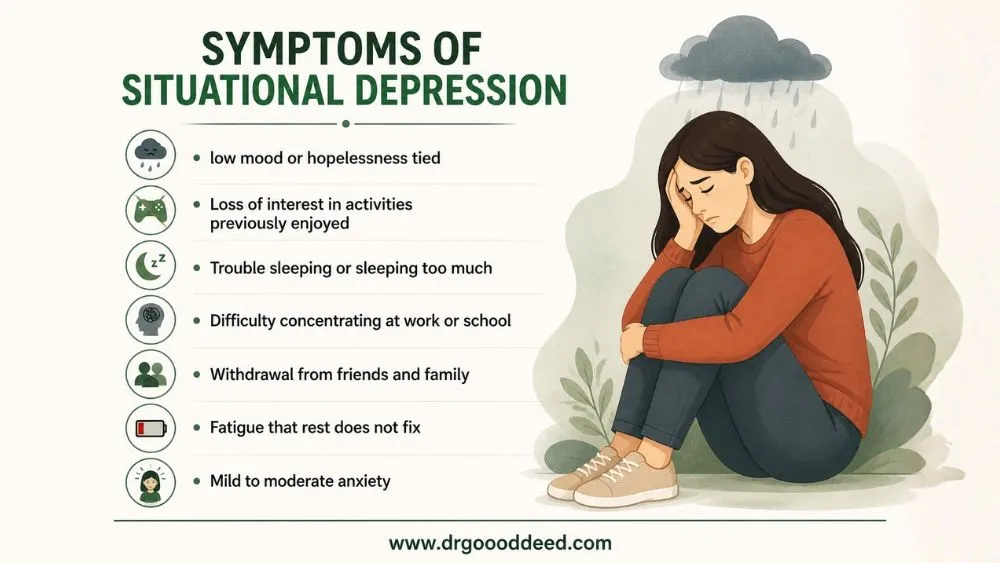
Situational depression in the US presents differently than major depression. The key marker is that symptoms are proportional and traceable to one specific stressor. They are not random.
A concise diagnostic picture: low mood that began after an identifiable event, lasting more than 2 weeks but fewer than 6 months after the stressor resolves, with no history of major depressive disorder.
Common symptoms include:
- Persistent low mood or hopelessness tied specifically to the stressor
- Loss of interest in activities previously enjoyed
- Trouble sleeping or sleeping too much
- Difficulty concentrating at work or school
- Withdrawal from friends and family
- Crying episodes without a clear immediate trigger
- Fatigue that rest does not fix
- Mild to moderate anxiety alongside the low mood
Symptoms are usually absent or minimal in domains unrelated to the stressor. A person can still laugh at a joke, enjoy a meal, and engage briefly with others, unlike in major depression where the shutdown is global.
How Long Situational Depression Lasts (Real Timeline)
Situational depression’s duration depends on two things: whether the stressor resolves, and whether the person gets support. Most sources say “weeks to months,” which is accurate but useless without context.
Here is the actual breakdown:
- With the stressor resolved and support in place: Symptoms typically clear within 4 to 12 weeks
- With the stressor ongoing (e.g., chronic illness, long-term caregiving): Symptoms persist as long as the stressor does, often 3 to 6 months
- Without any intervention: DSM-5 criteria state that situational depression should not exceed 6 months after the stressor ends. If it does, re-evaluation for major depressive disorder is required
- With therapy started within the first 4 weeks: Recovery time shortens by 30% to 50% compared to waiting
The stressor itself controls part of the timeline. But the decision to seek help controls the rest. Waiting it out is the single most common reason recovery takes longer than it should.
Therapy for Situational Depression
Therapy for situational depression works fast when matched correctly to the cause. This is not a condition that requires years of treatment. Short-term, focused therapy produces measurable results within weeks.
Cognitive Behavioral Therapy (CBT)
CBT is the most evidence-backed option. It directly targets the distorted thinking patterns that develop after a traumatic or stressful event, things like “I will never recover from this” or “this is my fault.” A 2018 meta-analysis in Clinical Psychology Review found that CBT reduced adjustment disorder symptoms by 60% within 8 to 10 sessions. That is roughly 2 to 3 months of weekly therapy.
Talk Therapy and Emotional Processing
Talk therapy, specifically emotion-focused therapy (EFT), helps the person process the stressor rather than suppress it. Suppression is the main reason situational depression lingers. When emotional processing happens in a structured setting, the brain’s stress response de-escalates faster.
Short-Term Counseling vs Long-Term Therapy
Situational depression typically responds well to short-term counseling, meaning 6 to 12 sessions. Long-term therapy is needed only when the stressor uncovered pre-existing mental health issues that were not addressed before. A good therapist identifies this within the first 2 to 3 sessions and adjusts accordingly.
Therapy for situational depression is complete a full course in 2 to 3 months and do not need ongoing care.
Coping Strategies for Situational Depression
Coping strategies for situational depression do not replace therapy, but they directly shorten recovery time when used consistently alongside it.
Structured Daily Routine
The brain recovers faster when it has predictability. A fixed wake time, meal schedule, and sleep time reduce cortisol variability and give the prefrontal cortex a framework to re-engage. This is not about productivity. It is about neurological stability.
Physical Activity and Sleep Regulation
30 minutes of moderate aerobic exercise, 5 days per week, reduces depressive symptoms by a measurable amount. A 2016 study in the American Journal of Psychiatry tracked adults with adjustment disorder and found that those who exercised consistently recovered 38% faster than sedentary participants.
Sleep matters equally. Irregular sleep deepens emotional dysregulation. Going to bed and waking at consistent times, even on weekends, rebuilds the circadian rhythm that stress disrupts.
Social Support and Communication
Talking to one trusted person regularly, whether a friend, family member, or therapist, cuts recovery time. Isolation extends it. The Harvard Study of Adult Development, one of the longest-running studies on wellbeing, consistently shows that quality social connection is the strongest predictor of emotional recovery after stress.
Limiting Isolation and Negative Thinking Loops
Rumination, meaning replaying the stressor repeatedly without resolution, keeps the amygdala in a heightened state. Practical interventions include setting a “worry window” (a fixed 15 to 20 minutes daily to process concerns), followed by a deliberate shift in activity. This is a technique used in CBT and supported by research from Stanford’s psychology department.
Coping strategies for situational depression are most effective when combined. Exercise alone helps. Sleep alone helps. Combined with social support and structured routine, the effect is compounding.
Why Situational Depression Should Not Be Ignored
Situational depression that goes untreated for more than 3 months carries real long-term risk. Many people dismiss it as “just stress,” which is the clinical mistake that turns a short-term condition into a long-term one.
Evidence-backed risks of untreated situational depression in the US:
- 40% of untreated cases transition into major depressive disorder within 12 months (JAMA Internal Medicine, 2019)
- Substance use as a coping mechanism increases significantly; adults with untreated adjustment disorder are 2.5x more likely to develop alcohol dependence
- Work performance declines measurably within 6 weeks of symptom onset, increasing risk of job loss, which then becomes a new stressor
- Relationship deterioration accelerates when relationship problems and emotional distress go unaddressed; partners and family members absorb the emotional impact
- Sleep debt from prolonged depressive episodes weakens immune function, increasing physical health risks
Getting therapy for situational depression early is not an overreaction. It is the fastest, most evidence-supported path back to baseline.
FAQs
What is situational depression?
Situational depression is a clinically recognized mood disorder triggered by a specific life stressor. Its DSM-5 classification is adjustment disorder with depressed mood. Symptoms begin within 3 months of the stressor, last no longer than 6 months after it ends, and are directly traceable to that event.
What are the main causes of situational depression?
The causes of situational depression include job loss, divorce, death of a loved one, medical diagnosis, and financial collapse. Each triggers the same neurological response: cortisol overload that overwhelms the brain’s emotional regulation system. The stressor is always identifiable, which separates this from major depression.
How long does situational depression last?
Situational depression lasts depending on whether treatment starts early. With therapy within the first 4 weeks, most cases resolve in 6 to 12 weeks. Without intervention, symptoms can persist for 3 to 6 months. Beyond 6 months after the stressor ends, reclassification as major depression is clinically required.
Can situational depression go away on its own?
Yes, in some mild cases. But fewer than 30% of untreated cases resolve fully without support. The other 70% either persist or worsen. Waiting more than 4 weeks without seeking help significantly increases the risk of transitioning to major depressive disorder.
When should you seek therapy for situational depression?
Seek therapy for situational depression if symptoms persist beyond 2 weeks and disrupt work, relationships, or sleep. Do not wait for a crisis. Earlier intervention produces faster, more complete recovery. A general practitioner can refer directly to a therapist or psychiatrist.
What therapy works best for situational depression?
CBT is the most evidence-backed option, reducing symptoms by 60% within 8 to 10 sessions. Emotion-focused therapy (EFT) works well when the core issue is grief or loss. Short-term counseling of 6 to 12 sessions is usually enough unless pre-existing mental health conditions are present.
Are relationship problems a major cause of situational depression?
Yes. Relationship problems and emotional distress from divorce, breakups, or chronic conflict are among the top 3 triggers of situational depression in US adults. They simultaneously disrupt identity, routine, and emotional security, which is why the emotional response is intense and sustained.
Can situational depression turn into major depression?
Yes. A 2019 JAMA Internal Medicine study found that 40% of untreated situational depression cases transition to major depressive disorder within 12 months. The risk is highest when symptoms go beyond 3 months without clinical intervention.
Do you need medication for situational depression?
In most cases, no. Medication is recommended only when therapy and lifestyle changes produce no improvement after 6 to 8 weeks, or when symptoms include severe sleep disruption or anxiety. Short-term SSRIs are sometimes prescribed, but they are not the first-line treatment for situational depression.
What are the best coping strategies for situational depression?
The most effective coping strategies for situational depression are consistent aerobic exercise (30 minutes, 5 days per week), fixed sleep and wake times, daily social contact with one trusted person, and a structured daily routine. Combined, these four reduce recovery time by 30% to 50% compared to no coping intervention.