
Yes, sleep apnea cause high blood pressure, and the evidence is definitive. The American Heart Association and NHLBI classify obstructive sleep apnea (OSA) as a leading secondary cause of hypertension in the USA. An estimated 30–40% of hypertension patients have undiagnosed sleep apnea. This guide covers the biological mechanism, risk factors, and evidence-based treatments.
Can Sleep Apnea Cause High Blood Pressure?
Sleep apnea can cause high blood pressure through repeated oxygen drops that trigger the body’s emergency stress response dozens of times each night. Each apnea event activates the sympathetic nervous system, floods the body with cortisol and adrenaline, and constricts blood vessels. Over time, this pushes resting blood pressure higher, even during the day when breathing is normal.
Does Sleep Apnea Increase Blood Pressure?
Sleep apnea increase blood pressure dose-dependently. The Wisconsin Sleep Cohort Study found an AHI above 15 produced 3x higher hypertension odds over 4 years.
How Oxygen Deprivation Affects Blood Vessels
Each apnea event drops blood oxygen below 90%. The body constricts blood vessels to protect vital organs. Repeated vasoconstriction damages the artery lining (endothelium), which loses its ability to relax vessels. Blood pressure stays elevated around the clock as a result.
Activation of the Stress Response System
Apnea events spike cortisol and adrenaline repeatedly throughout the night. In healthy sleepers, cortisol drops during sleep. In untreated OSA patients, it stays elevated, confirmed by a 2011 University of Chicago study (Bhatt et al.).
What Research Shows About Sleep Apnea and Hypertension
Peppard et al. (NEJM, 2000) tracked 709 people over 4 years. Each 10-unit AHI increase raised hypertension odds by 13%. Sleep apnea can cause high blood pressure in a dose-dependent way, independent of every other cardiovascular risk factor.
How Sleep Apnea Affects the Cardiovascular System
Hypertension caused by sleep apnea is one part of a broader cardiovascular burden. OSA stresses the heart, accelerates artery hardening, and drives abnormal heart rhythms.
Intermittent hypoxia generates free radicals that damage arterial walls. Research in Hypertension (Somers et al., 2000) showed sympathetic nerve activity in OSA patients ran 200–300% higher than in controls.
The European Heart Journal (2009) confirmed 1 year of CPAP use restored near-normal endothelial function. Without treatment, endothelial dysfunction accelerates coronary artery disease and left ventricular hypertrophy.
Hypertension Caused by Sleep Apnea
Sleep apnea can cause high blood pressure severe enough to resist medication. Hypertension caused by sleep apnea follows a distinctive pattern: blood pressure fails to drop at night (non-dipping), morning readings surge above daytime values, and standard medications often fail without treating the OSA first.
Sleep Apnea and Resistant Hypertension
Resistant hypertension is blood pressure that stays above target on three or more medications, including a diuretic. A 2013 study in the Journal of Clinical Sleep Medicine (Logan et al.) found OSA in 83% of resistant hypertension patients who completed sleep testing. Sleep apnea increases blood pressure enough to cause treatment resistance.
Long-Term Heart Effects and Who Is Most at Risk
A 14-year Spanish follow-up study (Marin et al., Lancet, 2005) showed untreated severe OSA patients had a cardiovascular event rate more than 3x higher than controls.
Risk is highest in: men over 40 with BMI above 30, post-menopausal women, people with neck circumference above 17 inches (men)/16 inches (women), patients on 2+ blood pressure medications without reaching target, and those with Type 2 diabetes.
Complications of Untreated Sleep Apnea
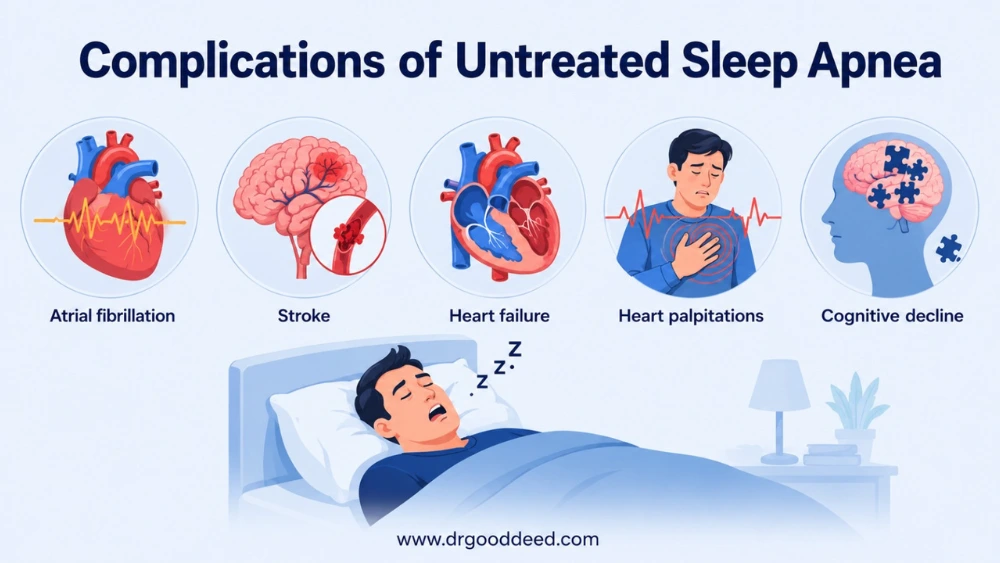
People asking if sleep apnea can cause high blood pressure are often already dealing with the downstream complications. Untreated sleep apnea in the USA creates a compounding cardiovascular risk that goes far beyond blood pressure numbers.
The NHLBI estimates people with untreated severe OSA face a 5x higher risk of sudden cardiac death between midnight and 6 AM compared to the general population.
Key complications:
- Atrial fibrillation: OSA raises AFib risk by 2–4x. AFib combined with uncontrolled hypertension raises stroke risk 5x above baseline.
- Stroke: The Yale University study (Yaggi et al., NEJM, 2005) confirmed untreated OSA doubled stroke and heart risk, independent of blood pressure levels.
- Heart failure: Left ventricular hypertrophy from chronic pressure overload reduces cardiac output over years.
- Sleep apnea causing heart palpitations: Sleep apnea causing heart palpitations happens because each apnea event causes a 20–30 beat-per-minute heart rate surge within seconds from sympathetic activation and sudden oxygen restoration.
- Cognitive decline: MRI studies confirm hippocampal shrinkage in long-term untreated OSA patients.
Treating Sleep Apnea to Lower Hypertension Risk
Treating sleep apnea to lower hypertension risk produces measurable blood pressure reductions within 4–8 weeks of consistent therapy.
CPAP Therapy
CPAP is the first-line treatment for moderate-to-severe OSA per AASM 2023 guidelines. It prevents airway collapse, eliminates intermittent hypoxia, and reduces sympathetic activation during sleep.
How CPAP Supports Blood Pressure Control
A 2014 JCSM meta-analysis (Fava et al., 12 RCTs) found CPAP reduced mean arterial pressure by 2.58 mmHg. In resistant hypertension, CPAP cut systolic pressure by 6.7 mmHg (Martinez-Garcia et al., JAMA, 2013). Nocturnal blood pressure dipping restores within 8 weeks. AFib recurrence drops at 1 year; endothelial function improves at 3–6 months.
Oral Appliance Therapy and Weight Loss
Custom mandibular advancement devices produce blood pressure reductions comparable to CPAP in mild-to-moderate OSA, with higher adherence rates, per Cochrane-referenced meta-analysis data.
A 10% body weight reduction cuts AHI by roughly 30% (NHLBI) and lowers blood pressure through reduced vascular resistance. Treating sleep apnea to lower hypertension risk without devices is achievable in positional OSA through weight loss and side-sleeping alone.
Surgical Treatment Options
Inspire Upper Airway Stimulation (STAR trial, NEJM, 2014) produced 68% AHI reduction at 12 months. Maxillomandibular advancement achieves AHI reductions above 50% in suitable candidates.
Lifestyle Changes That Support Blood Pressure Control
These five lifestyle changes reduce high blood pressure and sleep apnea symptoms with measurable clinical results:
- Weight loss: Every 1 kg of weight loss reduces systolic blood pressure by approximately 1 mmHg (AHA data). The combined OSA and BP benefit compounds.
- DASH diet: Reduces systolic blood pressure by 8–14 mmHg in hypertension patients. AHA recommends keeping sodium below 2,300 mg per day.
- Exercise: 150 minutes of moderate aerobic activity per week reduces systolic blood pressure by 4–9 mmHg and improves upper airway muscle tone independently of weight loss.
- Limit alcohol: Alcohol relaxes pharyngeal muscles and directly raises blood pressure. Staying within AHA limits (1 drink/day women, 2 men) reduces both risks.
- Quit smoking: Wisconsin Sleep Cohort follow-up data shows former smokers have measurably lower OSA severity than current smokers within 12 months of quitting.
Prevention Strategies for Better Sleep and Heart Health
Preventing high blood pressure and sleep apnea symptoms from worsening requires consistent management. A core reason why sleep apnea causes high blood pressure to remain underdiagnosed is that patients treat hypertension with medications before checking for OSA first.
Concrete prevention steps:
- Request ambulatory blood pressure monitoring if your readings do not drop at night. Non-dipping warrants a sleep study referral.
- Screen for OSA with a home sleep test if you snore loudly, have neck circumference above threshold, or take 2+ blood pressure medications without reaching target.
- Treat nasal congestion. Allergic rhinitis worsens OSA; nasal corticosteroids improve airflow and CPAP tolerance.
- Track morning blood pressure. A surge above 140/90 mmHg is a red flag for nocturnal OSA-driven hypertension.
- Tell your cardiologist about AFib; OSA and AFib share a bidirectional relationship that changes treatment planning.
FAQs
1. Can sleep apnea cause high blood pressure?
Yes. Sleep apnea causes high blood pressure, and is confirmed by the NHLBI and AHA. Repeated oxygen drops activate the sympathetic nervous system and raise cortisol, producing persistently elevated vascular resistance even during daytime.
2. Does sleep apnea increase blood pressure during sleep?
Yes. Sleep apnea increases blood pressure spikes by 20–40 mmHg during each apnea event. OSA also eliminates the normal 10–20% nighttime blood pressure dip, which is an independent predictor of cardiovascular events.
3. How does hypertension caused by sleep apnea develop?
Hypertension caused by sleep apnea builds through endothelial damage, chronic sympathetic activation, and sustained cortisol elevation, raising vascular resistance permanently over 2–5 years of untreated OSA.
4. Can treating sleep apnea lower hypertension risk?
Yes. CPAP reduces mean arterial pressure by 2.58 mmHg on average (Fava et al., 2014). In resistant hypertension patients, it reduced systolic pressure by 6.7 mmHg (Martinez-Garcia et al., JAMA, 2013).
5. What are the symptoms of high blood pressure and sleep apnea?
Overlapping high blood pressure and sleep apnea symptoms include morning headaches, fatigue, poor concentration, and nocturia. OSA adds loud snoring and gasping. Hypertension alone causes no symptoms until a cardiac event.
6. Can sleep apnea cause heart palpitations?
Yes. Sleep apnea causing heart palpitations results from sympathetic surges during each apnea event, creating 20–30 beat-per-minute heart rate spikes within seconds. Persistent cases raise atrial fibrillation risk 2–4x above baseline.
7. Why does oxygen deprivation affect blood pressure?
Oxygen drops trigger emergency vasoconstriction to protect vital organs, acutely spiking blood pressure. Repeated nightly, this damages arterial walls and raises resting blood pressure chronically, identical in mechanism to altitude-induced hypertension.
8. Can CPAP therapy help control blood pressure?
Yes. Consistent CPAP restores nocturnal blood pressure dipping within 8 weeks. In resistant hypertension, it produced a 6.7 mmHg systolic reduction in the JAMA 2013 randomized trial (Martinez-Garcia et al.).
9. Is resistant hypertension linked to sleep apnea?
Yes. Logan et al. (JCSM, 2013) found OSA in 83% of resistant hypertension patients. Treating OSA is now a standard step before escalating antihypertensive medications.
10. Can sleep apnea increase stroke risk?
Yes. Yaggi et al. (NEJM, 2005, Yale University) showed untreated OSA doubled stroke and death risk over 3.4 years after controlling for age, BMI, sex, smoking, alcohol, diabetes, and atrial fibrillation.
References
- American Heart Association, Sleep Apnea and Heart Disease
- National Heart, Lung, and Blood Institute, Sleep Apnea
- Peppard PE et al. Sleep-Disordered Breathing and Hypertension. NEJM, 2000
- Somers VK et al. Sympathetic Neural Mechanisms in OSA. Hypertension, 2000
- Marin JM et al. Long-term Cardiovascular Outcomes in Men with OSA. Lancet, 2005
- Yaggi HK et al. Obstructive Sleep Apnea as a Risk Factor for Stroke and Death. NEJM, 2005
- Martinez-Garcia MA et al. CPAP and Resistant Hypertension. JAMA, 2013
- Fava C et al. CPAP Effect on Blood Pressure in OSA. Journal of Clinical Sleep Medicine, 2014
- Strollo PJ et al. Upper-Airway Stimulation for OSA (STAR Trial). NEJM, 2014
- Wisconsin Sleep Cohort, University of Wisconsin