
Probiotics for weight loss work by shifting the mix of bacteria in your gut toward strains that support better digestion, lower inflammation, and improved control of hunger hormones.
Certain probiotic strains for weight loss , like specific Lactobacillus and Bifidobacterium types of probiotic, can reduce how many calories you absorb from food and may help lower belly fat in some people. These strains also influence blood sugar and fat storage signals, which play a major role in weight gain.
When paired with healthy eating and movement, the best probiotics for weight loss act as a small but meaningful support tool.
What Are Probiotics And How They Relate To Weight
Probiotics for weight loss are live “good” bacteria that you swallow as capsules, powders, or in some foods like yogurt and kefir. Probiotics are helpful microbes that support a healthy gut balance when you take the right amount.
Your gut already holds trillions of bacteria. Some help digestion, some make vitamins, and some affect how your body handles calories and fat. When you choose probiotics for weight loss , you are trying to shift that gut mix toward strains that may help your body store a little less fat and handle sugar and fats in a better way.
Gut Microbiome And Energy Balance
The gut microbiome means all the microbes living in your intestines. Studies in humans and animals link certain gut patterns to obesity and others to a leaner body.
Some microbes help you pull more energy from the same food. Some produce substances that change hunger signals or how your body stores fat. Probiotics for weight loss try to support microbes that line up with healthier weight and better metabolic health.
Small but real shifts in weight, BMI, and waist size are observed in some people who use probiotics, especially when they also change diet and exercise.
Which Outcomes Matter (Fat Loss, Waist, Metabolic Markers)
When you look at probiotics for weight loss , the number on the scale is only part of the picture. Researchers also check body fat, waist size, blood sugar, cholesterol, and triglycerides.
WHO reports show rising obesity rates and higher risk of diabetes and heart disease, so these markers matter a lot.
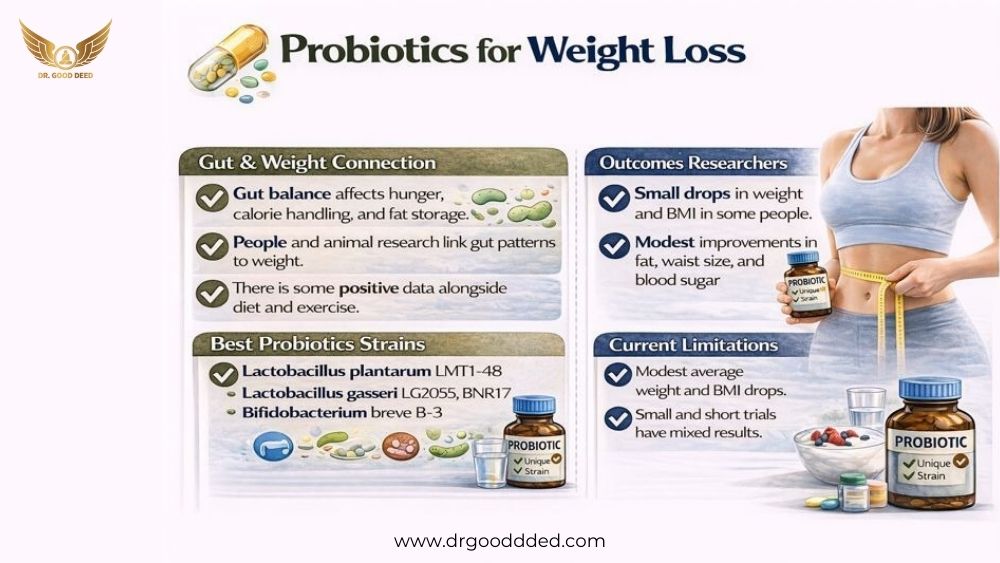
On average, probiotics for weight loss give modest extra drops in weight and BMI compared with placebo. Some studies report 1 to 2 centimetres less waist size and small improvements in fasting blood sugar and blood fats, especially when probiotics are used together with diet changes. Other trials show no effect at all.
Probiotics for weight loss may help, but they do not replace calorie control, activity, or medical care.
Best Probiotics For Weight Loss
Strains With Positive Trials
When you look for the best probiotics for weight loss , you should not only read the brand name. You need to check the exact strain. Different strains of the same species can act in opposite ways. Only some strains have good human data for weight outcomes.
Strains that stand out include Lactobacillus plantarum LMT1-48, Lactobacillus gasseri LG2055 and BNR17, and Bifidobacterium breve B-3. These strains showed reduced body fat, waist size, or improved metabolic markers in randomized trials.
That is why many experts focus on specific probiotic strains for weight loss instead of general labels like “multi-probiotic.”
Effect Sizes Reported
Probiotics for weight loss often lead to small reductions compared with placebo. Across many trials, average extra weight loss is usually under 2 kilograms, and BMI changes are also small.
This still matters if you use probiotics for weight loss as one tool inside a bigger plan that includes diet, sleep, and movement. But you should be clear that even the best probiotics for weight loss give modest effects, not dramatic ones. Lifestyle and medical treatment are still the main tools for obesity care.
Limitations Of Current Evidence
The science on probiotics for weight loss is growing, yet still limited. Many trials are small and short and use different strains, doses, and outcome measures. Only about one-third of trials show clear weight or BMI drops, while others show no change.
Also, many early results come from adults with overweight who join structured programs. This means you cannot assume the same result for every person. When evidence is limited or mixed, it is better to see probiotics for weight loss as helpful support rather than a standalone fix.
Probiotic Strains For Weight Loss
Lactobacillus plantarum (Key Effects)
Lactobacillus plantarum appears often in research on probiotic strains for weight loss . In a recent randomized trial, people with obesity who took LMT1-48 for 12 weeks had lower body fat mass, less belly fat, and better insulin resistance scores than the placebo group.
Animal work from NIH-linked databases supports these human results and suggests that this strain may reduce fat cell growth and support healthier liver fat handling.
- plantarum LMT1-48 often ranks among the more promising members of the best probiotics for weight loss group, as long as you keep your expectations realistic.
Lactobacillus gasseri (Body Fat Data)
Lactobacillus gasseri is one of the most studied probiotic strains for weight loss , especially for belly fat. In Japanese trials, people who drank fermented milk containing LG2055 for 12 weeks saw reduced abdominal fat area, lower body weight, and smaller waist size compared with placebo.
Other work on BNR17 shows less weight gain and some fat loss support, though not every study found a strong effect.
Because of these results, L. gasseri often appears in marketing for probiotics for weight loss , but remember that the benefit is modest and depends on diet and lifestyle.
Bifidobacterium Species (Metabolic Links)
Bifidobacterium species are common in the guts of healthy infants and adults. Lower levels often appear in people with obesity and metabolic syndrome.
Bifidobacterium breve B-3 showed reduced body fat mass, waist, and hip size in randomized trials, with a good safety profile.
Other Bifidobacterium strains may improve triglycerides and blood sugar even when weight change is small.
Because of this, Bifidobacterium species are common in many probiotics for weight loss formulas and often used together with Lactobacillus in a weight loss probiotics supplement .
Weight Loss Probiotics Supplement
Single-Strain Vs Multi-Strain
A weight loss probiotic supplement can contain one strain or many. Single-strain products focus on one of the probiotic strains for weight loss that has human data, like L. plantarum LMT1-48 or L. gasseri LG2055. Multi-strain products mix Lactobacillus and Bifidobacterium species to target gut balance from several angles.
CFU Targets And Label Checks
CFU means colony-forming units, or the count of live microbes in each dose. Many trials on probiotics for weight loss use from 1 to around 20 billion CFU per day. Some successful studies used even lower amounts when the strain was very active.
When you choose a weight loss probiotic supplement , you should check that the label lists the full strain name, the CFU count at the end of shelf life, and clear storage advice. If strain names or CFU details are missing, the product is not a good choice.
Formulation Quality & Third-Party Testing
Probiotics are fragile. Heat and moisture can kill them before they reach your gut. That means a weight loss probiotic supplement must be made, stored, and shipped with care.
You should look for brands that use strong packaging, give clear storage rules, and send products for third-party checks of purity and potency. Supplements are less tightly controlled than medicines, so outside testing adds some safety.
High-quality probiotics for weight loss focus on the correct strain, enough CFU, and proof that the bacteria survive until the end of the product’s shelf life.
How Probiotics Affect Weight
Appetite, Energy Harvest, Bile Acids
Some strains change gut hormones that guide hunger and fullness, such as GLP-1 and PYY. Others may reduce how much fat you absorb or how many calories you pull from certain carbs.
This means probiotics for weight loss might help you feel full a bit sooner and store a bit less fat from the same meal. Changes in bile acids, which help digest fat and send signals to the liver and muscles, are another part of this effect.
Short-Chain Fatty Acids And Inflammation
When gut bacteria break down fiber, they produce short-chain fatty acids such as acetate, propionate, and butyrate. These support gut lining cells, affect appetite hormones, and can reduce low-grade inflammation.
Some probiotic strains for weight loss increase helpful short-chain fatty acids. This may lower the chronic inflammation that often comes with obesity and that raises the risk of diabetes and heart disease.
Gut Barrier & Insulin Sensitivity
A healthy gut barrier keeps unwanted toxins out of your bloodstream. When that barrier weakens, tiny particles move into the blood and drive more inflammation. That can worsen insulin resistance.
Studies suggest that certain probiotics for weight loss help strengthen the gut barrier and improve insulin sensitivity, although research is still growing and not every strain has this effect.
You can think of how probiotics affect weight as a chain. Better gut balance leads to better barrier function, less inflammation, and slightly better control of how your body uses and stores energy.
Do Probiotics Help You Lose Weight
When Benefit Is Likely (Who, How)
You are most likely to notice help from probiotics for weight loss if you already work on basic habits. That means you watch portion size, choose more whole foods, and move your body often. In this setting, the right strains can give a small extra push.
People with overweight or early insulin resistance often respond better. Their gut bacteria are usually out of balance. When you add targeted probiotic strains for weight loss , the gut mix shifts toward a pattern linked with better blood sugar, low-grade swelling, and a slightly smaller waist.
The effect is modest. You should think of probiotics for weight loss as one tool, not the star of the plan. If you expect a small but steady change over months, your view will fit the actual research.
When Benefit Is Unlikely
You will probably not see much change from probiotics for weight loss if you keep a high-calorie diet, sit most of the day, and sleep poorly. In that case, the probiotic tries to work in a body that still faces strong weight-gaining forces.
Benefits are also less likely if you pick random products that do not list exact strains or proper CFU counts. Many cheap items on the shelf use broad species names, not real probiotic strains for weight loss with human trials behind them. In that case, the capsule may act more like a general gut support, not a focused weight tool.
Combine With Diet/Exercise For Effect
The best plan is simple. You tune your diet first, move more, then add probiotics for weight loss on top. You eat more fiber to feed good bacteria. You cut sugary drinks and limit ultra-processed snacks. You walk daily and add some strength work.
In that setting, a well-chosen weight loss probiotics supplement can change how your gut handles food and how full you feel. You may notice less bloating, better stools, and a small extra drop in waist or weight over a few months.
Timing, Dose & Taking A Weight-Loss Probiotic
Typical Dosing Ranges
Human studies use a wide range of doses for probiotics for weight loss . Many products give between one and twenty billion CFU per day. Doctors usually suggest starting near the lower middle of that range and watching how you feel. The exact amount should match the strain and your health status, so advice from a doctor or dietitian is best.
A smaller dose of a proven strain can work as well as a huge random mix. The key is a weight loss probiotics supplement that matches what was tested in clinical research.
Timing And With/Without Food (Brief)
Most brands advise you to take probiotics for weight loss with a meal or right after it. Food can buffer stomach acid and help more bacteria reach the gut alive. Breakfast or your main meal is a common choice.
The main rule is to pick a time you can stick to every day. Regular timing keeps the level of the probiotic strains for weight loss steady in your gut.
How Long To Trial A Product
Gut bacteria take time to shift. You cannot judge probiotics for weight loss in one week. A fair trial lasts at least eight to twelve weeks. During that time, keep your diet and activity as stable as possible so you know what caused any change.
If after three months you see no change in weight, waist, digestion, or energy, it may be time to stop or switch to another weight loss probiotic supplement with stronger human data. Always loop in your doctor if you have medical conditions.
Safety, Side Effects & Who Should Avoid Supplements
Common Mild Effects
Most healthy people handle probiotics for weight loss well. In the first one or two weeks, you may notice gas, mild cramping, or softer stools. These signs often fade as your gut adjusts to the new bacteria.
Drink enough water and keep meals simple while you start. If symptoms stay mild and improve over time, you can usually keep going. If you feel worse each day, stop the product and ask a health professional for advice.
Risks For Immunocompromised Patients
If your immune system is weak, live bacteria can pose more risk. This includes you if you receive chemotherapy, take strong immune drugs, have advanced HIV, or live with a central line or heart valve disease. In these cases, even probiotics for weight loss deserve careful medical review.
There are rare reports of probiotic bacteria entering the blood in very sick patients. Because of this, you should never start a weight loss probiotics supplement in that setting without clear approval from your doctor.
Drug Interactions & Clinical Cautions
Probiotics can also cross paths with some drugs. Long courses of broad-spectrum antibiotics may kill the strains before they work. Strong immune drugs can change how your body reacts to live microbes.
If you take regular medicines, especially for heart disease, cancer, or autoimmune disease, talk with your doctor or pharmacist first. Ask directly whether probiotics for weight loss fit your treatment plan. Medical care should stay in charge; supplements must fit around it.
How To Track Progress & Measure Success
Practical Measures To Monitor
To understand how probiotics affect weight in your life, you need clear measures. Choose one weight day each week, at the same time, in similar clothes. Write the number down.
Measure your waist at the level of your belly button every two to four weeks. Note stool changes, less bloating, or different cravings. These daily signs often shift before the scale moves. Together, they show how probiotics for weight loss work for you.
When To Stop Or Switch Strains
You should think about stopping or changing probiotics for weight loss if you reach twelve weeks with no sign of benefit. That means your weight and waist have not changed at all, and your digestion feels the same or worse.
At that point, you can take a break, or you can move to another weight loss probiotic supplement that uses a different strain mix. If you have health issues, a doctor or dietitian can help you decide.
Expectation Timelines (Realistic)
Real change takes time. When you pair probiotics for weight loss with better food and more movement, a realistic goal is slow, steady fat loss over many months. You should not expect sudden drops.
If you lose a small amount of weight each month, keep your waist trend stable or shrinking, and feel less bloated, that is success. In that case, probiotics help you lose weight within a balanced plan.
FAQs
Which Probiotic Is Best For Losing Belly Fat?
Studies often highlight certain Lactobacillus gasseri and Lactobacillus plantarum strains as some of the best probiotics for weight loss , especially for waist size, when you also improve diet and movement.
How Long Before I See Weight Changes?
With probiotics for weight loss , most people need at least eight to twelve weeks before the scale and waist size show real shifts, though stool comfort and bloating may improve sooner.
Can Probiotics Replace Diet Or Exercise?
No, probiotics for weight loss only give a small extra effect. Food choices, calorie control, sleep, and physical activity still handle most of the job when you want lasting fat loss.
Are Multi-Strain Mixes Better For Weight Loss?
A multi-strain weight loss probiotic supplement can help, but more strains do not always mean better results. The important factor is whether each strain has human data for weight or waist change.
Will Probiotics Make Me Gain Weight?
Most targeted probiotic strains for weight loss show neutral or small fat loss effects. If you gain weight while taking probiotics, the cause is usually diet, stress, or low activity, not the capsule.
Are There Probiotic Supplements Clinically Proven?
Some products that use exact studied strains of Lactobacillus gasseri, Lactobacillus plantarum, or Bifidobacterium breve have clinical trials. Results still vary, so probiotics for weight loss are helpful tools, not standalone cures.
Can Children Or Pregnant People Use Weight-Loss Probiotics?
Gut-friendly probiotics can be used in some cases, but specific probiotics for weight loss are rarely studied in pregnancy or childhood, so medical advice is vital before considering such supplements.
How Do I Read Probiotic Labels For Strain Info?
You should look for genus, species, and strain, not just vague names. A clear code helps you match probiotics for weight loss with the exact strains tested in human weight studies.
Do Prebiotics Improve Probiotic Weight Outcomes?
Prebiotic fibers feed good bacteria and may support how probiotics affect weight by boosting short-chain fatty acids. Pairing prebiotics and probiotics often fits well with a high-fibre eating plan.
What Are Realistic Expectations From Probiotics Alone?
On their own, probiotics for weight loss may give very small weight and waist changes or only better digestion. When joined with strong lifestyle changes, they can add a modest but useful extra effect.