
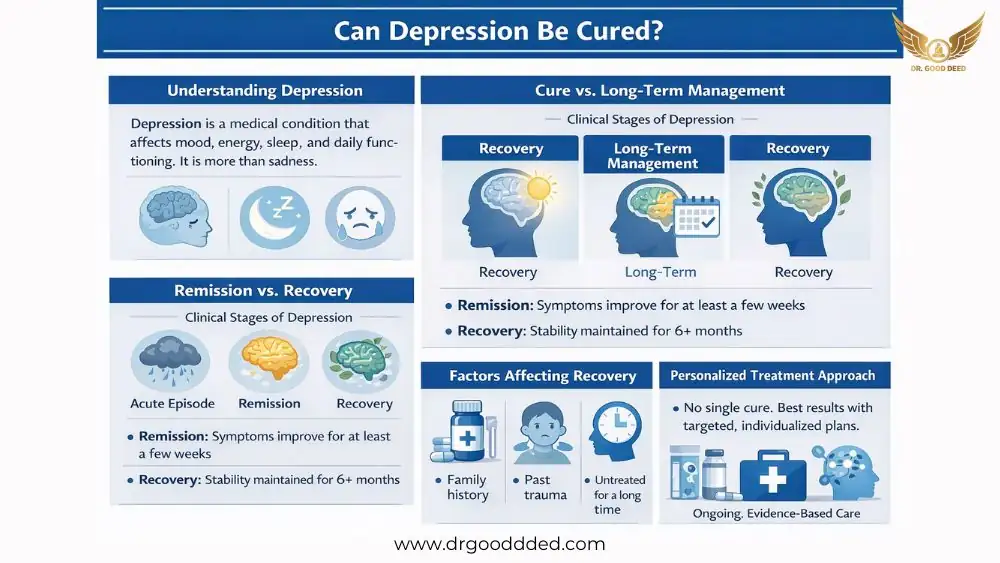
Depression is a medical condition that affects your mood, energy, sleep, focus, and daily functioning. It is more than sadness because it changes the way your brain regulates emotion and stress.
Curing depression is possible for some, strong recovery is possible for many, and early treatment gives you the best chance at long-lasting stability. You can improve with the right combination of therapy, medicine, and lifestyle support, and a significant number reach full remission where symptoms become very small or disappear for long periods.
For others, depression behaves like a long-term health condition, which means it can be managed successfully even if it does not vanish completely. Because depression has many causes, including genetics, stress, hormone shifts, and past trauma, there is no single cure that fits all. Instead, recovery happens through a plan that matches your symptoms and history.
So while not everyone reaches a permanent cure, many people do reach a point where depression no longer controls their life.
What Does It Mean To “Cure” Depression?
Depression and sadness are normal emotions. The real question is whether the illness part of depression, where your mood stays very low for weeks and blocks your life, can be stopped and stay away.
Clinical guidelines talk about stages: acute treatment, remission, and recovery. Remission means your symptoms become very small or vanish for a period of time. Recovery usually means you stay well and able to function for many months, not just a few better days.
So, depression can be cured when you reach recovery and stay there for a long time without another full episode. For others, the illness stays in the background and needs ongoing care.
Cure vs. Long-Term Management
For some people, one strong episode happens, they get good care, then life returns to normal and stays that way. In that group, it feels like depression can be cured . They may still have sad days, but the heavy, stuck feeling does not return.
For many others, depression behaves more like high blood pressure or asthma. It can flare up, then calm down again. You may need long-term treatment for depression, such as regular therapy visits, ongoing medicine, or both. In this situation, depression can be cured for the time being and requires ongoing therapy.
Why Depression Has No One-Size-Fits-All Resolution
You might look at a friend who bounced back fast and wonder why you still feel stuck. The truth is that the biology of depression is complex. Genes, early life stress, current stress, hormones, and inflammation all play roles.
Because of this mix, depression can be cured in different ways for different people. Some respond very well to one type of talk therapy. Others only feel better when therapy and medicine are combined. A smaller group needs more advanced treatments.
So there is no single answer to whether depression can be cured for everyone. There is only what works best for you, based on your history, your body, and your life situation. The recovery possibilities of depression improve a lot when help starts early and continues long enough.
Can Major Depression Be Cured Completely?
Major depression means your symptoms are strong enough and last long enough to affect your daily life seriously.
People with Major Depressive Disorder (MDD) reach full remission and return to normal functioning. Others keep some mild symptoms but feel far better than during their worst phase.
How Severe Depression Differs From Mild Or Moderate Forms
Mild or moderate depression still hurts, but you may be able to push through school or work, even if everything feels heavy. Severe depression feels different. You might not be able to get out of bed. Simple tasks such as showering or eating feel impossible. Thoughts may turn dark, and you might think the world would be better without you.
Severe cases have higher risks of self-harm and suicide, and untreated episodes can last six to twelve months or more. That is why early, active care is vital. In these strong cases, depression can be cured only if treatment is serious and steady. You may need a mix of therapy, medicine, and sometimes hospital or day program support.
Remission vs. Recovery: Understanding The Clinical Difference
Remission means that most of your symptoms have gone away. Your sleep, appetite, focus, and mood are close to normal for at least a few weeks. Recovery goes a step further. It means you stay in remission for a longer period, usually many months, and you can live your life the way you want to, with stable work, study, and relationships.
If you reach full remission, you have much lower relapse rates than those who stay in partial remission with some leftover symptoms.
Factors That Influence Recovery Chances (Genetics, Trauma, Chronicity)
You might notice that some people recover fast while others keep struggling. There are a few known reasons:
- Family history: If several people in your family have had depression, your risk of relapse can be higher.
- Childhood or adult trauma: Ongoing abuse, neglect, or violence changes stress systems in the body and brain. That can make episodes last longer and return more easily.
- Chronicity: If you have had untreated depression for years, the brain can “learn” these patterns. A longer time without treatment is tied to worse future outcomes.
These factors do not mean that depression cannot be cured . They mean you may need long-term treatment for depression and a more careful follow-up plan.
Can Depression Go Away On Its Own?
Some episodic depression, especially mild ones, improves on its own as life stress changes. However, research on untreated people shows that symptoms often only slowly fade, and many people remain partly unwell for a long time.
So depression can be cured naturally in a small group, but counting only on time and willpower is risky, especially when symptoms are strong.
Natural Course Of Untreated Depression
In untreated major depression, one episode often lasts from six months to a year. Some people in studies show a modest drop in symptoms after a year, but many still do not feel fully well. Others slide into a chronic pattern where depression is present more days than not.
During this time, your risk of lost work, school problems, relationship strain, or misuse of alcohol or drugs goes up. That is why most experts do not recommend a “wait and see” strategy if symptoms are strong or last longer than two weeks.
When Symptoms Temporarily Improve vs. Fully Resolve
You might notice that depression can go away for a few days when something good happens, such as a holiday or visit from a friend. Then, after the event, your mood drops again. These short breaks can fool you into thinking you are better when the illness is still active.
Full resolution looks different. Your mood stays more stable across different days and events. You have energy most mornings, you can enjoy normal activities again, and dark thoughts fade into the background. In this state, it becomes more real to say that depression can be cured , at least for that episode.
Risks Of Ignoring Early Or Recurrent Depression
Ignoring early signs has a cost. Large follow-up studies show that people who delay care often have more episodes over their lifetime, and each new episode can come faster than the last one.
If you have had several episodes and keep hoping that depression can go away by itself, you may be giving the illness more time to shape your brain and life. Early, active care gives you better odds that depression can be cured or at least kept very small.
How Effective Is Therapy In Treating Depression?
Talk therapy is one of the main tools used to help you get better. For many people with mild to moderate depression, structured therapy alone leads to strong improvement and sometimes full remission.
For more severe cases, therapy often works best when combined with medicine. Even in those cases, it still plays a key role, because it gives you skills that last long after sessions end.
Which Forms Of Therapy Work Best (CBT, IPT, ACT, Psychodynamic)?
Several types of therapy have good evidence:
- Cognitive behavioral therapy (CBT) helps you notice and change unhelpful thought patterns and behaviors.
- Interpersonal psychotherapy (IPT) looks at how your relationships, roles, and life changes affect mood.
- Acceptance and commitment therapy (ACT) teaches you how to accept hard feelings while still acting in line with your values.
- Psychodynamic therapy explores deeper patterns from your past and how they shape current feelings.
These major therapies work about the same for many adults with mild to moderate depression, and their benefits can last for at least a year for many patients.
How Therapy Produces Long-Term Brain And Behavior Changes
Therapy is not only “talking about your feelings.” Each time you practice a new coping skill, your brain uses different pathways. Over time, these pathways become stronger. Brain imaging studies suggest that CBT and other therapies can change activity in mood-related brain areas in a way that looks similar to medicine for some patients.
This helps explain how depression can be cured for some people through therapy alone. They do not just feel better for a week. They think and act in new ways that protect them in the future.
Therapy also teaches you early warning signs, such as sleep changes or negative thought loops. Knowing these signs makes long-term treatment for depression more active and less scary, because you learn to respond early instead of waiting until a full episode returns.
Signs Therapy Alone May Not Be Enough
There are times when therapy can cure depression but is not realistic by itself. Some warning signs that you may also need medicine or more intensive support include:
- You have had several past episodes with short gaps in between.
- You see no real change after many weeks of honest work in therapy.
- You have strong thoughts of self-harm or cannot manage daily tasks.
In these cases, a combined plan can still help cure depression in a broader sense. Your therapist and doctor can team up to add other treatments while you keep using the skills you have learned.
Can Medication Cure Depression?
Antidepressant medicines work on brain chemicals such as serotonin and norepinephrine, which are linked to mood, sleep, and focus.
Antidepressants help you reach strong symptom relief, especially in moderate to severe depression. Still, they do not help everyone, and they do not remove normal sadness or life stress.
How Antidepressants Work On Neurochemical Pathways
Antidepressants do not create “fake happiness.” They reduce the depth and weight of symptoms so your brain can work more normally again. Different classes of drugs affect brain messengers in slightly different ways, and research is still learning why one person responds to one drug but not another.
By lifting your mood a bit and improving sleep and focus, medicine can make it easier to use therapy skills, return to activities, and rebuild your life. In that way, they often support the process where depression can be cured step by step rather than in one sudden change.
Medication Response Rates And Time To Improvement
You may notice small shifts in sleep or appetite first, then mood changes over several weeks. Clinical trials show that a meaningful share of patients reach remission with the first or second medicine they try, but others need several attempts.
Even after four treatment steps, you may still have symptoms, which is why honest doctors avoid promising that depression can be cured by medicine alone for everyone.
For you, this means patience and close follow-up with your doctor are important. If one plan does not work, another one might.
When Medication Plus Therapy Provides Better Results
A combination of psychotherapy and antidepressants often works better than either treatment alone for many adults, especially those with more severe symptoms.
You may not need to choose between therapy and pills. A combined approach can raise the chance that depression can be cured for your current episode and lower your risk of relapse later.
Advanced Treatments For Hard-To-Treat Depression
When depression does not respond to two or more good treatment attempts, doctors may call it treatment-resistant depression.
Ketamine And Esketamine For Resistant Depression
Ketamine and esketamine act on the glutamate system, which is a different brain chemical system from usual antidepressants. Studies in adults with treatment-resistant depression show that ketamine infusions and nasal esketamine can reduce depression scores within hours to days for some patients, often long before regular pills would.
Esketamine is usually given with a regular antidepressant. The goal is rapid symptom relief while the slower medicine has time to work. This can be life-changing if you have strong suicidal thoughts and you need help fast.
These drugs do not prove that depression can be cured for everyone. Response rates still vary, side effects and misuse risks exist, and most people need repeat sessions over weeks.
TMS (Transcranial Magnetic Stimulation)
Transcranial magnetic stimulation (TMS) uses focused magnetic pulses on the scalp to change activity in mood-related brain areas. It is noninvasive; you stay awake, and no anesthesia is needed. It is usually given five days a week for several weeks.
In adults with major depression, active repetitive TMS has response rates around 40%t and remission rates that often fall between 20 and 35%, sometimes higher with newer deep TMS methods. Many people who did not respond to several medicines still improve.
ECT (Electroconvulsive Therapy) For Severe, Non-Responsive Depression
Electroconvulsive therapy (ECT) uses controlled electrical stimulation under anesthesia to trigger a brief seizure in the brain. Modern ECT is done in a closely monitored hospital setting.
ECT can bring substantial improvement in about 70 to 80% of people with severe major depression that has not responded to other care, especially when symptoms include psychosis or a high suicide risk.
At the same time, there are serious concerns about memory loss and other side effects, and some experts argue that the quality of long-term evidence is uneven. This means that while ECT may be life-saving for some, it must be discussed carefully, with full informed consent.
Long-Term Treatment Strategies That Improve Recovery Odds
Even when you feel better, your brain stays sensitive for a while. So the plan that helps depression can be cured or well controlled, usually includes a long-term phase, not only short-term symptom relief.
Relapse Prevention And Maintenance Therapy
Studies on major depressive disorder show that relapse risk stays high in the first year after an episode, especially if you have had more than one episode before. After two episodes, the five-year recurrence risk can reach around 70% if treatment stops.
Because of this, doctors often suggest maintenance treatment. That can mean staying on your antidepressant for many months after you feel well or keeping regular therapy sessions that focus on early warning signs and coping skills. Longer treatment is linked with lower relapse risk, although the ideal length can vary, and the evidence curve is not simple.
This stage is where long-term treatment for depression really shows its value. It does not erase every sad day, but it cuts the chance that a full episode returns.
Lifestyle Factors That Strengthen Emotional Resilience
Good sleep, daily movement, and safe relationships feed the same body systems that medical treatments use. Regular exercise, for example, has shown moderate antidepressant effects in clinical trials and is included in several guideline sets as part of standard care, especially as an add-on.
These habits on their own rarely mean that depression can be cured in severe cases. Yet they increase the recovery possibilities of depression when combined with therapy or medicine. They also help with other health problems, which in turn supports your mood.
Building A Personalized Treatment Plan
Because depression shows up in so many ways, your plan needs to match your story. A doctor or psychiatrist will check your past episodes, family history, physical health, and what you have already tried.
For one person, therapy can cure depression with regular sessions and strong support at home. For another, medicine plus CBT and then TMS might be needed. Someone with very severe, life-threatening symptoms might need ECT or ketamine on top of other tools.
Outlook: What Realistic Recovery Looks Like
You might feel stuck on the question of whether depression can be cured completely or not. A more helpful focus is what daily life can look like for you in the next year.
How Many People Achieve Full Remission
Across different studies and treatments, remission rates in clinical trials often fall in the 30 to 60% range, sometimes higher for combined or intensive treatments such as ECT or deep TMS, although results vary by study and group.
This means that for a large group of people, depression can be cured to the point that symptoms are minimal or gone for long stretches.
Predictors Of Long-Term Success
People who stay linked with care, follow long-term treatment for depression , and have good social support tend to do better over time. A strong, trusting relationship with a therapist or doctor also predicts better outcomes in many trials.
Avoiding alcohol or drug misuse and managing other illnesses like diabetes or chronic pain also helps. These things do not guarantee that depression can be cured , but they make recovery more stable.
When Depression Becomes A Chronic Condition
Some people, especially those with many past episodes or long untreated periods, develop a chronic form of depression where symptoms never fully clear for two years or more. Even here, treatment can still reduce symptoms, improve function, and lower suicide risk.
When To Seek Professional Help
The recovery possibilities of depression are better when you get support early.
Warning Signs That Need Medical Attention
You should contact a professional if low mood or loss of interest lasts most of the day for more than two weeks, if your sleep or appetite changes sharply, or if you cannot focus enough to handle school, work, or basic tasks. Any thoughts of self-harm or of not wanting to live are urgent warning signs and need same-day help.
At that point, hoping that depression can go away on its own can be dangerous. Trained help gives you a safer path forward.
How To Talk To Your Doctor About Treatment Options
When you see a doctor, describe how you feel, how long this has lasted, and how your life has changed. Ask about therapy, medicine, and, if needed, advanced options such as ketamine, TMS, or ECT. You can ask directly whether therapy can cure depression in your case, or whether a mix of treatments makes more sense.
FAQs
Can depression be permanently cured?
For some people, depression can be cured in a lasting way, with no more major episodes after good treatment and follow-up. Others need long-term treatment for depression to keep future episodes shorter and milder.
How long does treatment for depression usually last?
Treatment length varies a lot. Many people stay in active treatment for at least six to twelve months after feeling better. Ongoing long-term treatment for depression is often advised if you have had several past episodes.
Can lifestyle changes alone treat depression?
Healthy sleep, exercise, and support help your mood and raise the recovery possibilities of depression . In mild cases, they may be enough. In moderate or severe cases, they usually work best alongside therapy or medicine.
Does untreated depression worsen over time?
Untreated episodes can last many months and may return more often later. Waiting to see if depression can go away by itself can increase risks. Early treatment improves your chances of curing depression .
Can depression come back after full recovery?
Yes, it can. Stress, illness, or big losses can trigger a new episode. That is why long-term treatment for depression and a relapse plan are important, even if depression can be cured for long periods.
Is major depressive disorder lifelong?
Not always. Some people have one or two episodes and then stay well. Others have repeated episodes. For many, major depression can be cured by keeping symptoms small and manageable, rather than gone forever.
Can hormone imbalance cause depression?
Yes, thyroid problems, pregnancy, birth, and menopause can affect mood. When doctors treat the hormone issue and the mood symptoms together, depression can be cured or eased for many people with these triggers.
How effective is therapy compared to medication?
For mild to moderate symptoms, therapy can cure depression for many people, sometimes as well as medicine. In more severe cases, combining therapy and medicine gives higher remission rates and better long-term results.
What is the fastest way to feel relief from depression symptoms?
There is no instant fix, but rapid-acting options like ketamine or esketamine can help some people with severe depression. These are usually used along with other treatments and under strict medical supervision.
Can depression disappear without treatment?
Sometimes depression can go away in mild cases as stress changes. However, many people stay unwell or worsen without help. Active treatment gives a much better chance that depression can be cured or strongly reduced.