
Stress can cause back pain, and the mechanism is biological, not imaginary. Stress triggers sustained muscle contraction through cortisol and adrenaline release, reduces blood flow to spinal muscles, and lowers the body’s pain threshold simultaneously. The American Psychological Association reports that 44% of US adults experience physical muscle tension as a direct result of stress.
This guide covers the exact physiological pathway, why stress-related back pain becomes chronic, specific exercises that work, and when the pain signals something else entirely.
How Stress Affects Back Pain
Stress affects back pain, following a clear sequence that starts in the brain and ends in the muscles of the spine. The hypothalamus triggers the stress response, which sends cortisol and adrenaline through the bloodstream. These hormones reach skeletal muscles within seconds and prepare the body for physical threat. The back muscles, being large postural muscles, are among the first to respond and the last to fully release.
Activation of Fight-or-Flight Response
When stress activates the fight-or-flight response, the body tightens muscles automatically. This is protective in a physical emergency. The problem is that the brain cannot distinguish between a physical threat and a work deadline. Both trigger identical muscle responses. The paraspinal muscles, which run along both sides of the spine, contract and stay contracted.
Continuous Muscle Contraction
Cortisol keeps muscles in partial contraction even when the stressor isn’t physically present anymore. This sustained low-level tension doesn’t feel like a cramp. It feels like dull aching and tightness that builds across the day and worsens by evening.
Electromyography (EMG) studies show significantly higher baseline muscle electrical activity in chronically stressed adults compared to low-stress controls, confirming that the contraction is measurable, not subjective.
Reduced Blood Flow to Muscles
Adrenaline constricts blood vessels. Less blood reaches the paraspinal muscles during stress. Less blood means less oxygen delivery and slower removal of metabolic waste products like lactic acid. Lactic acid buildup in muscle tissue is a direct cause of the burning, aching sensation that chronically stressed people feel across the lower and upper back.
Muscle Tightness and Stress Pain
Muscle tightness and stress pain develop through a cycle that feeds itself. Stress causes tension, tension causes pain, pain increases stress, and increased stress tightens muscles further. Breaking this cycle requires understanding where the tightness actually comes from at the tissue level.
Prolonged Muscle Tension
The erector spinae, trapezius, and quadratus lumborum are the three muscle groups most affected by stress-driven tension. The erector spinae runs the length of the spine. The trapezius covers the upper back and neck. The quadratus lumborum anchors the lower back to the pelvis. All three receive direct innervation from the sympathetic nervous system and respond immediately to stress signals.
Trigger Points and Spasms
Sustained muscle tension creates trigger points, which are small, hyperirritable spots within muscle fibers that produce sharp local pain and referred pain to distant areas. A trigger point in the left quadratus lumborum, for example, refers pain to the hip and buttock. Many people chase the referred pain without addressing the trigger point source in the back. Physical therapists identify these through palpation.
Increased Pain Sensitivity
Chronic stress raises cortisol over time, but sustained high cortisol paradoxically lowers the pain threshold through a process called central sensitization. The brain’s pain processing centers become more reactive over time. This means muscle tightness and stress pain feels more intense per unit of physical stimulus than it would in a non-stressed person. The pain is real; the nervous system has simply become louder about it.
Poor Posture Due to Stress
Poor posture due to stress is a direct and measurable consequence of the stress response, not a lifestyle habit. Stress drives specific postural changes that compress the spine and strain the muscles supporting it.
Slouching and Forward Head Position
Under stress, the shoulders round forward and the head shifts forward of the shoulders. For every inch the head moves forward from its neutral position, the effective weight on the cervical spine increases by approximately 10 pounds. Most stressed adults carry their heads 2 to 3 inches forward of neutral, placing 20 to 30 extra pounds of load on the neck and upper back constantly.
Shoulder and Neck Tension
The trapezius muscle responds to stress by pulling the shoulders upward toward the ears. This compression pattern reduces the space between the shoulder blades, tightens the muscles between the cervical vertebrae, and restricts normal head rotation. People often notice they’ve been holding their shoulders up for hours without realizing it.
Sedentary Behavior Under Stress
Stress correlates directly with reduced physical movement. People under high stress sit longer, move less frequently, and skip exercise more often. Prolonged sitting without movement increases intradiscal pressure in the lumbar spine, particularly at L4-L5 and L5-S1, the two most commonly injured spinal levels. Poor posture due to stress compounds when extended sitting meets the forward-head, rounded-shoulder pattern stress already created.
Stiffness in Back From Stress
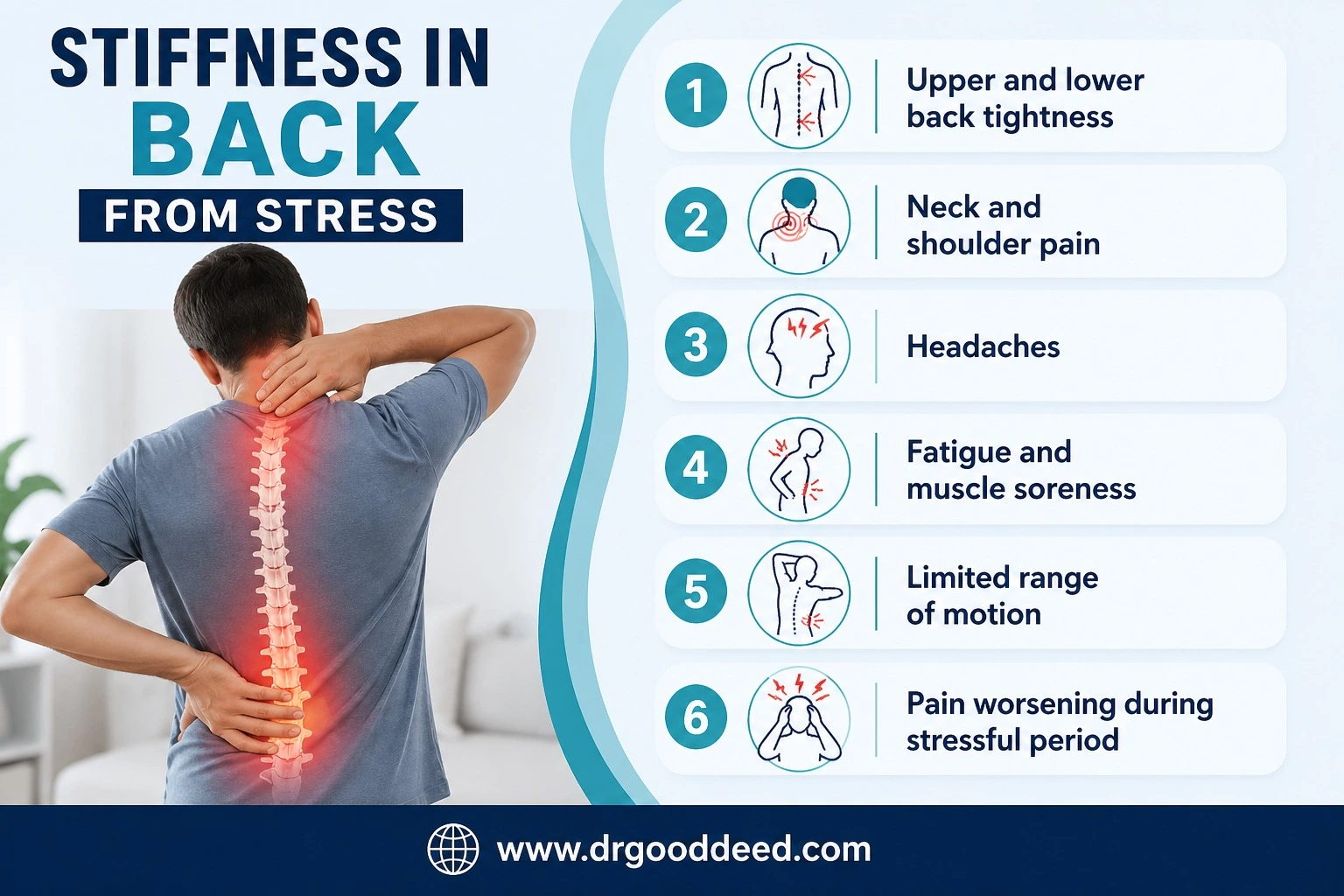
Stiffness in back from stress refers to restricted movement and persistent tension across the spinal muscles. It is one of the most common physical complaints linked to chronic stress in US adults, and it presents across multiple body areas simultaneously.
- Upper and lower back tightness: The erector spinae tightens bilaterally, making bending forward or rotating difficult
- Neck and shoulder pain: The levator scapulae and upper trapezius remain contracted, causing radiating pain from the neck base to the shoulder tip
- Headaches: Tension headaches from suboccipital muscle tightness at the skull base, often mistaken for migraines
- Fatigue and muscle soreness: Sustained contraction requires continuous energy expenditure; muscles fatigue without the person doing any physical work
- Limited range of motion: Forward bending, rotation, and lateral flexion all decrease measurably during high-stress periods
- Pain worsening during stressful periods: Many people notice their stiffness in back from stress spikes on Monday mornings, before performance reviews, or during family conflicts, which directly links the pain cycle to psychological triggers
Why Stress Back Pain Becomes Chronic
Stress-related back pain becomes chronic when three conditions persist together: sustained cortisol elevation, ongoing central sensitization, and avoidance of movement. Stress can cause back pain severe enough to become a long-term diagnosis. Research published in Spine confirmed that psychological distress at baseline predicted new-onset chronic low back pain at one-year follow-up more accurately than physical factors like disk degeneration.
- The brain registers pain as threatening, which increases vigilance toward that area
- Increased vigilance amplifies pain signal interpretation in the dorsal horn of the spinal cord
- Movement avoidance leads to muscle deconditioning, making even small physical demands painful
- Deconditioning reinforces the belief that the back is damaged, which increases psychological distress
- Increased distress elevates cortisol further, completing the cycle
Breaking this cycle before the three-month mark, the clinical threshold for “chronic” pain classification, prevents long-term nervous system changes that make recovery significantly harder.
How to Relieve Stress-Induced Back Pain
Stress Management Techniques (Breathing, Relaxation)
Diaphragmatic breathing reduces sympathetic tone within 90 seconds. Inhale through the nose for 4 seconds, hold for 4, exhale slowly for 6 to 8 seconds. The longer exhale activates the vagus nerve and signals the parasympathetic system to release muscle tension.
Progressive muscle relaxation targeting the back specifically, tensing and releasing each muscle group for 5 seconds, reduces paraspinal tension measurably within 20 minutes.
Regular Movement and Stretching
Movement is the most direct treatment for stress back pain. Walking at moderate pace for 20 to 30 minutes reduces cortisol and increases blood flow to spinal muscles within one session. Static stretching held for 30 to 60 seconds reduces trigger point activity in the trapezius and quadratus lumborum more effectively than shorter holds.
Improving Posture
Position the monitor at eye level. Keep both feet flat on the floor. Use lumbar support in chairs. Set a timer every 30 minutes to stand and reset posture. These four changes reduce the mechanical load that poor posture due to stress creates without requiring any additional time commitment.
Heat Therapy and Muscle Relaxation
Applying moist heat at 104°F to 113°F for 15 to 20 minutes increases local blood flow, reduces muscle spindle activity (the mechanism causing involuntary contraction), and lowers pain intensity by 30 to 40% in clinical studies of non-specific low back pain. Dry heat (heating pads) works but less effectively than moist heat towels or heat packs.
Exercises for Stress Induced Back Pain
Exercises for stress-induced back pain target both the muscle tension mechanism and the cortisol reduction pathway simultaneously.
Gentle Stretching Routines
- Child’s Pose: Kneel and extend arms forward on the floor for 30 to 60 seconds. Stretches the erector spinae and opens the thoracic spine
- Cat-Cow: On hands and knees, alternate arching and rounding the spine for 10 repetitions. Restores spinal fluid movement and reduces stiffness
- Seated Spinal Twist: Cross one leg over the other while seated, rotate toward the crossed knee. Hold 30 seconds per side
Core Strengthening Exercises
Weak core muscles force the paraspinal muscles to compensate for spinal stability. This overwork accelerates stress-driven tension. Dead bug, bird-dog, and plank exercises build deep core stability without compressing the spine. Two to three sets of 10 repetitions daily for two weeks produces measurable improvement in paraspinal muscle overactivation.
Yoga and Mobility Exercises
A 2017 Annals of Internal Medicine study found that yoga produced equivalent pain relief to physical therapy for chronic low back pain over 12 weeks. Poses targeting the psoas (hip flexors), which attach directly to the lumbar spine and shorten under stress, include low lunge and pigeon pose held for 60 seconds per side.
Deep Breathing Exercises
Box breathing performed in a supine position with knees bent allows the diaphragm to descend fully, which reduces thoracic compression and releases tension in the thoracolumbar fascia, the connective tissue sheet covering the lower back muscles.
Short Walks or Movement Breaks
Walking 5 minutes every hour reduces lumbar intradiscal pressure and breaks the sustained muscle contraction pattern. This single intervention, confirmed in occupational health studies, reduces reported back pain intensity in desk workers by up to 20% over a four-week period.
When Back Pain May Not Be Stress-Related
Stress can cause back pain severe enough to mask other conditions. These signs indicate the pain requires medical evaluation rather than stress management alone.
- Pain waking the person from sleep consistently (stress pain typically eases at rest)
- Pain accompanied by fever, unexplained weight loss, or night sweats
- Radiating pain down one or both legs below the knee, especially with numbness or tingling
- Bladder or bowel changes alongside back pain (indicates possible spinal cord involvement)
- Back pain following a fall, injury, or accident regardless of severity
- Pain in adults over 50 with no prior history of back issues
These presentations require imaging (MRI or X-ray) and physician evaluation. Treating structural or inflammatory spinal conditions with only stress management delays necessary care.
FAQs
Can stress cause back pain?
Yes. Stress can cause back pain through cortisol-driven muscle contraction, reduced blood flow to paraspinal muscles, and central sensitization that lowers pain tolerance. EMG studies confirm measurably higher baseline muscle electrical activity in chronically stressed adults even when they report feeling physically relaxed.
How does stress affect back pain?
How stress affects back pain: adrenaline constricts blood vessels supplying spinal muscles, cortisol keeps paraspinal muscles in sustained contraction, and chronic stress lowers the pain threshold through central sensitization. The result is real, measurable muscle tension that produces aching, burning, and stiffness across the spine.
Why do I have muscle tightness and stress pain?
Muscle tightness and stress pain happen because the sympathetic nervous system directly innervates skeletal muscles. Stress signals keep the erector spinae, trapezius, and quadratus lumborum in partial contraction. Sustained contraction depletes oxygen, builds lactic acid, and creates trigger points that refer pain to the hips, neck, and shoulders.
Can poor posture due to stress cause back pain?
Yes. Poor posture due to stress causes the head to shift 2 to 3 inches forward, adding 20 to 30 extra pounds of load on the cervical spine. Rounded shoulders compress the thoracic discs. Extended sitting under stress increases lumbar intradiscal pressure at L4-L5, the most commonly injured spinal level in US adults.
What is stiffness in the back from stress?
Stiffness in back from stress is restricted spinal movement caused by sustained paraspinal muscle contraction. It produces limited forward bending, reduced rotation, and bilateral tightness that worsens across the day. Unlike disk-related stiffness, stress-related stiffness improves within 10 to 15 minutes of gentle movement and worsens after prolonged sitting or emotional stress.
What exercises help stress-induced back pain?
Exercises for stress-induced back pain: Cat-Cow (10 repetitions daily), Child’s Pose held 60 seconds, Bird-Dog for core stabilization, and low lunge held 60 seconds per side to release the psoas. A 2017 Annals of Internal Medicine study confirmed yoga produces equivalent pain relief to physical therapy for chronic low back pain over 12 weeks.
How to relieve stress-related back pain quickly?
Apply moist heat at 104°F to 113°F for 15 to 20 minutes. It increases local blood flow and reduces muscle spindle activity within a single session. Combine with box breathing (4 seconds in, 4 hold, 6 to 8 seconds out) to activate the parasympathetic system and reduce cortisol-driven tension simultaneously.
Can stress cause chronic back pain?
Yes. Stress can cause back pain severe enough to become chronic. Research in Spine confirmed psychological distress predicts chronic low back pain at 12 months more accurately than physical disk degeneration. Pain becomes chronic when central sensitization persists beyond three months, making the nervous system increasingly reactive to normal spinal movement.
When should I see a doctor for back pain?
See a doctor if back pain wakes you from sleep, radiates below the knee with numbness, accompanies fever or unexplained weight loss, or follows any injury. These patterns indicate structural, inflammatory, or neurological causes that stress management alone will not treat and that delay in diagnosis worsens.
Can reducing stress improve back pain?
Yes. Reducing cortisol through consistent aerobic exercise (150 minutes weekly) lowers baseline paraspinal muscle tension. A four-week intervention study found that stress management combined with movement breaks every hour reduced reported back pain intensity by up to 20% in desk workers with no structural spinal abnormality.