
Yoga for constipation is one of the most accessible, drug-free approaches to improving bowel regularity. Constipation affects roughly 16% of adults in the USA and up to 33% of adults over age 60, according to the American College of Gastroenterology.
Specific yoga poses stimulate intestinal muscle contractions, reduce abdominal pain, and activate the part of the nervous system that controls digestion.
Best Yoga Poses for Constipation Relief
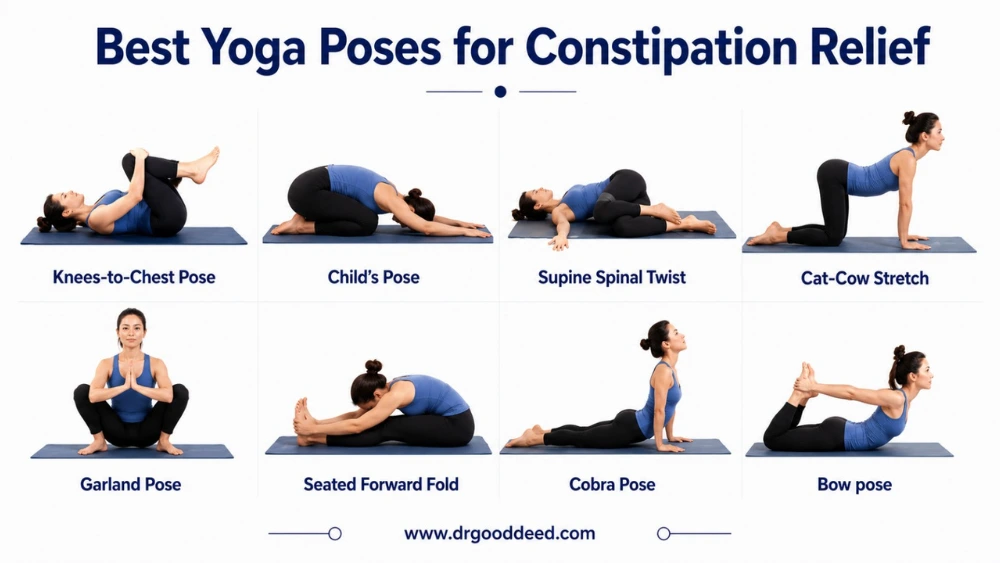
The best yoga poses for constipation relief work by compressing and releasing the abdomen, stimulating the vagus nerve (the nerve that connects the brain to the gut), and improving blood flow to digestive organs. Morning practice before eating gives the most consistent relief.
Wind-Relieving Pose for Constipation
The wind-relieving pose for constipation (Pawanmuktasana in Sanskrit, which translates to “wind-releasing pose”) is the most directly targeted pose for gas, bloating, and slow bowels. Many people first try yoga for constipation through this pose alone.
How to Perform the Pose
- Lie flat on your back on a yoga mat.
- Bend your right knee and pull it toward your chest.
- Interlace your fingers just below the knee.
- Hold for 20 to 30 seconds while breathing slowly.
- Release and repeat on the left side.
- Pull both knees to the chest together and hold for 30 to 45 seconds.
Potential Digestive Benefits
The wind-relieving pose for constipation compresses the ascending and descending colon (two sections of the large intestine where stool tends to slow down). This compression stimulates peristalsis, the wave-like muscle contractions that push stool forward. It also releases trapped intestinal gas that causes bloating and cramping.
Knees-to-Chest Pose
Bring both knees to the chest and rock gently side to side. This motion massages the transverse colon (the horizontal section across the belly). Hold for 45 to 60 seconds. The rocking adds a mechanical kneading effect that a static compression does not.
Child’s Pose
From a kneeling position, sit back onto your heels and stretch your arms forward with your forehead resting on the floor. Your abdomen presses against your thighs. This sustained pressure gently stimulates the digestive organs.
Child’s pose also activates the parasympathetic nervous system (your “rest and digest” mode), which the intestines need to function properly. Hold 1 to 2 minutes.
Supine Spinal Twist
Lie on your back with arms extended outward. Drop both bent knees to the right while turning your head left. Hold 30 to 45 seconds per side. Spinal twists compress one side of the colon while stretching the other, creating a wringing motion that moves stool forward through the large intestine.
Cat-Cow Stretch
Start on all fours. Arch your back upward (cat) while exhaling, then drop your belly toward the floor (cow) while inhaling. Repeat 8 to 10 times. This alternating movement massages the intestines from outside and increases blood flow to the gut wall.
Garland Pose (Malasana)
Squat with your feet hip-width apart and your heels flat on the floor. Press your elbows against your inner thighs. Hold 30 to 60 seconds. This pose mimics the natural squatting position, which straightens the anorectal angle (the angle between the rectum and the anal canal) for easier stool passage. It also relaxes pelvic floor muscles.
Seated Forward Fold
Sit with your legs straight in front of you. Reach toward your feet, keeping your spine long. Hold 30 to 45 seconds. This compresses the lower abdomen and stimulates the ascending colon, where sluggish stool movement often starts.
Cobra Pose
Lie face down. Place your palms on the floor beneath your shoulders. Press up to lift your chest while keeping your hips on the floor. Hold 20 to 30 seconds. Cobra stretches the entire front of the abdominal cavity, releasing muscular tension that can restrict intestinal movement.
Benefits of Yoga for Constipation
Yoga for constipation delivers digestive benefits through multiple body systems at once. A consistent yoga routine for better digestion works on the gut, the nervous system, and stress hormones together.
- Vagus nerve activation: Slow, deep breathing during yoga stimulates the vagus nerve, which directly triggers gut peristalsis. Low vagal tone is a recognized factor in slow-transit constipation.
- Cortisol reduction: Chronic stress raises cortisol (the primary stress hormone), which suppresses digestive activity. Yoga lowers cortisol measurably even after a single session.
- Improved gut motility: Research published in Evidence-Based Complementary and Alternative Medicine showed yoga significantly reduced IBS symptoms, including constipation, in a controlled intervention setting.
- Reduced straining: Consistent pelvic floor engagement through yoga makes bowel movements less painful and easier over time.
The best yoga poses for constipation relief practiced 3 to 4 times weekly show noticeable improvement in bowel frequency within 4 to 6 weeks for most people.
Abdominal Discomfort and Constipation Yoga
Abdominal discomfort and constipation yoga targets the bloating, cramping, and gut tension that backs-up bowels produce, often before any stool movement occurs.
How Yoga May Reduce Bloating
Trapped intestinal gas drives most constipation-related bloating. Poses like the wind-relieving pose and knees-to-chest physically compress different colon sections in sequence, moving gas forward and out.
Poses That Massage the Abdomen
Cat-cow, cobra, and seated forward fold repeatedly compress and release the abdominal region. This external massage stimulates the enteric nervous system (the nerve network embedded in the gut wall, sometimes called the “second brain”), improving gut-brain communication.
Stretching Tight Abdominal Muscles
Tight abdominal muscles physically slow colon movement. Backbend poses like cobra and supported bridge stretch the front of the torso, releasing the tension that directly restricts the intestines below.
Improving Overall Digestive Comfort
Abdominal discomfort and constipation yoga practiced in the morning before breakfast, or 2 to 3 hours after a meal, gives the most consistent results. Pairing each pose session with 5 minutes of slow belly breathing amplifies the parasympathetic response.
Lifestyle Factors That Affect Constipation
Yoga produces better results when the rest of your daily habits support healthy gut movement.
Diet and Fiber Intake
Adults in the USA average only 16 to 17 grams of dietary fiber per day. The recommended daily intake is 25 grams for women and 38 grams for men, per the Academy of Nutrition and Dietetics.
Soluble fiber (oats, apples, beans) softens stool. Insoluble fiber (whole grains, leafy vegetables) speeds colonic transit (the time stool takes to pass through the large intestine).
Water Consumption
When water intake is low, the colon pulls more water from stool to compensate. That hardens stool and slows transit. Aim for at least 8 cups (64 ounces) daily. A glass of warm water first thing in the morning triggers the gastrocolic reflex (the natural bowel urge that follows eating or drinking).
Physical Activity Levels
A sedentary lifestyle causing constipation is well-documented in gastroenterology. Physical inactivity slows colonic transit time significantly. Even 30 minutes of brisk walking daily improves stool frequency for most adults with mild constipation.
Sleep and Digestive Health
The gut runs on a circadian rhythm (an internal 24-hour clock). Irregular sleep disrupts this rhythm and weakens the natural morning surge in colon activity that typically triggers a bowel movement. Consistent sleep and wake times support bowel regularity.
Managing Stress Effectively
Chronic stress reduces blood flow to the intestines and shifts the body into sympathetic mode (“fight or flight”), which pauses digestion. A yoga routine for better digestion is one of the most clinically supported tools for reducing the kind of stress that directly suppresses gut function.
Additional Natural Remedies for Constipation
Yoga for constipation works best alongside these strategies:
- Prunes: Contain sorbitol (a natural sugar alcohol) and dihydroxyphenyl isatin, a compound that stimulates intestinal contractions. Three to four prunes daily produces a gentle, consistent laxative effect.
- Psyllium husk: A soluble fiber that forms a water-absorbing gel, softening stool and speeding movement. The FDA classifies it as an approved bulk-forming laxative.
- Magnesium citrate: Draws water into the intestines and relaxes gut muscles. A doctor-appropriate supplemental dose often resolves mild chronic constipation in people with low magnesium intake.
- Clockwise abdominal massage: Follow the colon’s natural path (up the right side, across the top, down the left side) for 10 minutes daily. Clinical trials show this reduces transit time and improves stool frequency.
- Probiotics: The strain Bifidobacterium lactis shows modest improvement in stool frequency in clinical research on constipation-predominant IBS.
Who Should Be Careful With Yoga for Constipation?
Most people can safely practice yoga for constipation, but certain groups need to modify their approach before starting.
Pregnancy Considerations
Pregnant women should avoid deep twists and strong abdominal compressions. Modified child’s pose (with knees wide apart) and gentle cat-cow are generally safe but need OB-GYN clearance first.
Recent Abdominal Surgery
Anyone within 6 to 8 weeks of abdominal surgery should avoid poses that press on the belly. Forward folds and spinal twists create direct pressure on surgical sites. Medical clearance is required before starting any yoga for digestion.
Severe Back or Joint Conditions
Cobra pose and seated forward fold require spinal flexibility. People with herniated discs, spinal stenosis (narrowing of the spinal canal), or significant joint damage should work with a physical therapist to modify these poses safely.
Chronic Gastrointestinal Disorders
People with Crohn’s disease, ulcerative colitis, or active bowel obstructions should consult a gastroenterologist before using yoga for digestive purposes. Some poses can worsen inflammation during active flare-ups.
When Yoga May Not Be Enough
Yoga for constipation works well for functional constipation (constipation without an identified underlying disease). Some symptoms, however, require medical evaluation rather than lifestyle changes alone.
See a doctor if you have:
- No bowel movement for more than 3 days despite yoga, water, and fiber
- Blood in the stool or on toilet paper
- Sudden-onset constipation with no obvious cause
- Unexplained weight loss alongside bowel changes
- Severe abdominal cramping
A sedentary lifestyle causing constipation typically responds to movement and dietary changes. But constipation lasting more than 3 months without a clear cause may signal hypothyroidism (underactive thyroid), colon dysmotility (a condition where colon muscles do not contract properly), or pelvic floor dysfunction.
FAQs
1. Does yoga really help with constipation?
Yes. Yoga for constipation stimulates peristalsis, activates the vagus nerve, and lowers cortisol. Research in Evidence-Based Complementary and Alternative Medicine confirmed significant bowel improvement in IBS-constipation patients after a structured yoga intervention.
2. What are the best yoga poses for constipation relief?
The best yoga poses for constipation relief are: wind-relieving pose, supine spinal twist, garland pose, and child’s pose. These compress specific colon sections, stimulate peristalsis, and relax the pelvic floor for easier stool passage.
3. How does the wind relieving pose help constipation?
The wind-relieving pose for constipation compresses the ascending and descending colon simultaneously. This stimulates peristalsis and physically moves trapped intestinal gas forward, directly targeting the colon sections where stool most commonly slows.
4. How often should I practice yoga for constipation?
Practice yoga for constipation 3 to 4 times weekly. Daily morning practice before meals produces measurable improvement in bowel frequency within 2 to 4 weeks for most adults with functional constipation.
5. Can a yoga routine for better digestion improve bowel regularity?
Yes. A consistent yoga routine for better digestion practiced 4 to 5 times weekly activates the parasympathetic nervous system and lowers stress-driven gut suppression, improving bowel frequency within 4 to 6 weeks.
6. Which yoga poses help reduce bloating and abdominal discomfort?
For abdominal discomfort and constipation, the most effective yoga poses are: wind-relieving pose, knees-to-chest, and cat-cow. These move trapped intestinal gas through sequential colon compression and stimulate the enteric nervous system directly.
7. Can a sedentary lifestyle cause constipation?
Yes. A sedentary lifestyle causing constipation slows colonic transit time, the rate at which stool moves through the large intestine. Even 30 minutes of brisk daily walking measurably improves both transit time and stool frequency.
8. Is yoga safe for people with chronic constipation?
Yes, for functional chronic constipation. Yoga for constipation is safe for most adults. People with Crohn’s disease, active bowel obstructions, or recent abdominal surgery need medical clearance first.
9. Should I practice yoga before or after meals?
Practice before breakfast or at least 2 to 3 hours after your last meal. Practicing on a full stomach limits how deeply you can compress the abdomen, reducing the digestive benefit of each pose.
10. Can yoga replace constipation medications?
For mild functional constipation, yoga for constipation combined with fiber and hydration often eliminates the need for laxatives. For medically caused constipation (thyroid disorders, pelvic floor dysfunction), yoga supports treatment but does not replace prescribed medication.
Sources: