
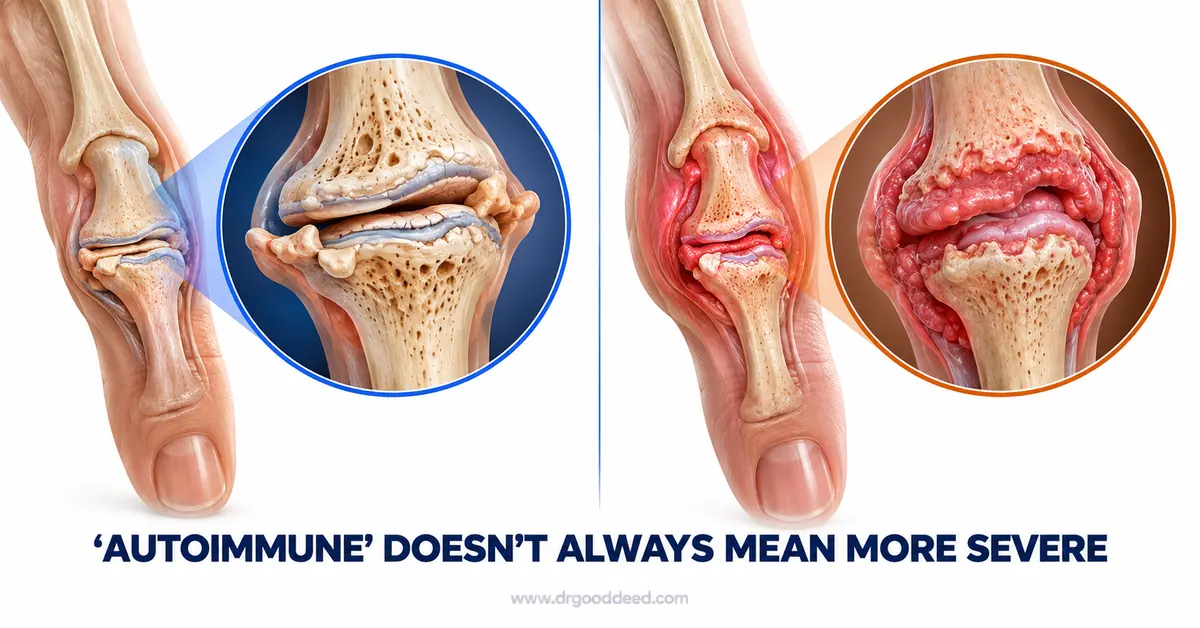

Osteoarthritis is mechanical joint damage from years of wear, while rheumatoid arthritis is an autoimmune disease that attacks the joint lining itself. Both cause pain, stiffness, and swelling, but they start differently, spread differently, and get treated differently. In the United States, osteoarthritis affects roughly 33.2 million adults and rheumatoid arthritis affects about 10.6 million, making them the two most common forms of arthritis diagnosed today.
This guide breaks down osteoarthritis vs rheumatoid arthritis symptoms, diagnosis, treatment, and a research finding most sites leave out entirely.
Key Takeaways
- Osteoarthritis results from cartilage breakdown due to mechanical stress on the joint. Rheumatoid arthritis results from the immune system attacking the synovial membrane.
- OA tends to affect the joints closest to the fingertips and weight-bearing joints. RA usually strikes the wrists and knuckles on both sides of the body.
- RA often begins with flu-like fatigue and low fever, weeks before joint swelling appears. OA rarely causes body-wide symptoms.
- Peer-reviewed comparative research shows OA is not always the milder condition, especially in the hands.
- A rheumatologist confirms the diagnosis through physical exam, imaging, and blood testing. Symptoms alone are not enough to tell them apart.
Osteoarthritis vs Rheumatoid Arthritis at a Glance (Comparison Table)
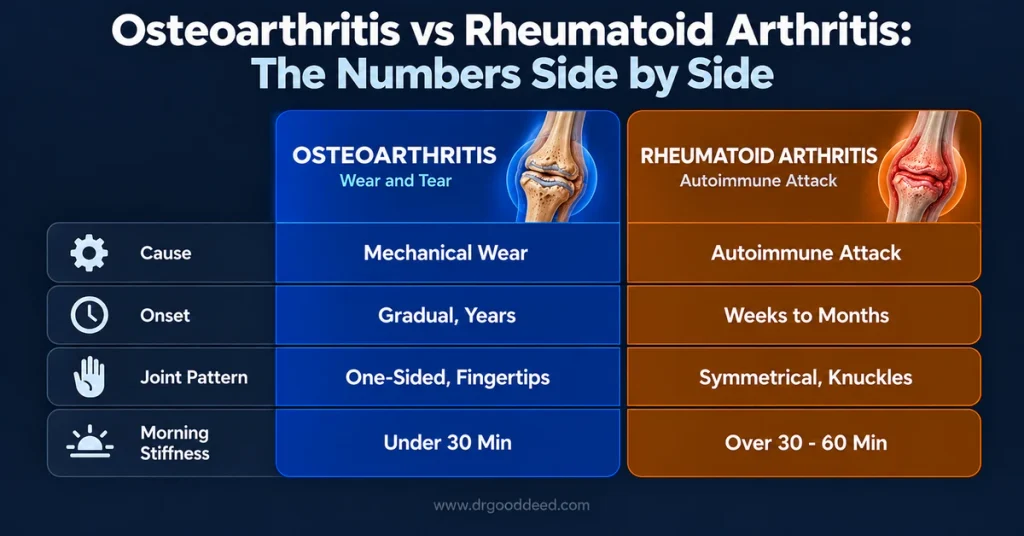
The table below uses clinical markers doctors actually rely on, not just symptom overlap, so you can compare osteoarthritis vs rheumatoid arthritis the way a rheumatologist would during an initial visit.
| Feature | Osteoarthritis | Rheumatoid Arthritis |
| Cause | Cartilage wear from mechanical stress | Autoimmune attack on the synovial membrane |
| Typical onset | Gradual, over years | Faster, over weeks to months |
| Joint pattern | Weight-bearing joints, fingertip joints, often one-sided | Wrists, knuckles, feet, usually symmetrical |
| Morning stiffness | Under 30 minutes | Often over 30 to 60 minutes |
| Key test | X-ray showing cartilage loss and bone spurs | Rheumatoid factor and anti-CCP blood tests |
What Is Osteoarthritis?
Osteoarthritis is a degenerative joint condition where the cartilage cushioning the ends of bones wears down over time.
- Once that cushion thins, bones start rubbing against each other, and that friction causes pain, swelling, and stiffness.
- It is the most common form of arthritis, typically developing slowly across years rather than appearing suddenly.
- Age, joint injury, repetitive stress, and excess body weight all raise the risk.
- Unlike inflammatory arthritis, OA does not involve a misdirected immune response. It is a structural problem, though the affected joint itself can still become inflamed and swollen during flare-ups.
What Is Rheumatoid Arthritis?
Rheumatoid arthritis is a chronic autoimmune disease in which the immune system mistakenly attacks the synovial membrane, the thin tissue lining the joint capsule. That attack triggers inflammation that can thicken the synovium, damage cartilage, and eventually erode bone if left untreated.
RA can develop over weeks to months, considerably faster than OA, and many patients report flu-like fatigue, low-grade fever, and general malaise before joint symptoms ever show up. Because RA is a systemic disease, it can also affect the eyes, lungs, and blood vessels, not just the joints. Genetics, smoking, and hormonal factors all influence individual risk.
Osteoarthritis vs Rheumatoid Arthritis: Key Differences
Symptoms overlap enough that people confuse these two conditions constantly, especially early on. Three clinical markers, covered below, separate them reliably: how fast symptoms build, which joints get hit first, and how long morning stiffness lasts.
Onset and Progression
- OA builds slowly. Cartilage erodes over years of repeated joint stress, so pain usually starts as a dull ache after activity and worsens gradually with age.
- RA moves faster. Joint swelling and pain can appear within weeks of the immune system’s first attack on the synovium, sometimes preceded by unexplained fatigue or a low fever that has nothing to do with the joints yet.
- A person in their 30s with sudden, symmetrical hand swelling is following an RA pattern, not a typical OA one.
Joint Pattern: Which Joints Are Affected
- OA tends to target the joint closest to the fingertip (the DIP joint) along with the base of the thumb, hips, knees, and spine, and it frequently shows up on just one side of the body first.
- RA usually spares that fingertip joint and instead attacks the knuckles where fingers meet the hand (the MCP joints), the wrists, and the balls of the feet, almost always symmetrically on both sides.
- For a deeper breakdown of how arthritis shows up specifically in the hands, our guide on symptoms of arthritis in hands covers the finger-by-finger presentation in more detail.
Morning Stiffness
- OA-related stiffness typically eases within 30 minutes of getting moving, since it is driven by mechanical friction that loosens with activity.
- RA stiffness lingers much longer, often past 30 to 60 minutes and sometimes for hours, because it reflects active inflammation rather than simple joint friction.
- Stiffness that persists well into the morning, especially paired with symmetrical swelling, points toward an inflammatory process rather than wear-and-tear.
Is Osteoarthritis Really “Less Severe” Than Rheumatoid Arthritis?
Most consumer health sites frame RA as the more serious diagnosis and OA as the manageable one. Research does not fully back that assumption.
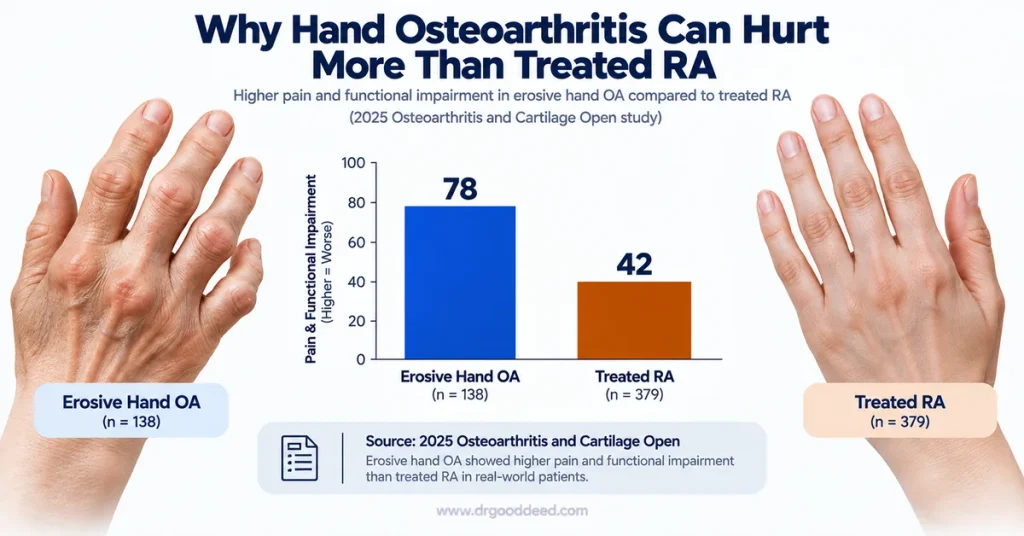
A four-site cross-sectional study published in RMD Open in 2017 measured pain, physical function, and patient global scores using the MDHAQ/RAPID3 tool and found OA patients scored similarly to, or higher than, RA patients on these standardized measures. A more recent 2025 study in Osteoarthritis and Cartilage Open compared 138 patients with chronic erosive hand OA to 379 patients with long-standing, medically treated RA.
The erosive hand OA group reported significantly greater pain during joint movement and greater functional impairment than the treated RA group, even after adjusting for age and other factors. This does not mean OA is universally worse than RA. It means the “RA is serious, OA is mild” assumption breaks down specifically for hand OA compared against RA that is already under medical treatment.
Expert Insight: A patient’s subjective pain and disability score often tracks joint-level mechanics more closely than disease category. Erosive hand OA, where bone erosion occurs at the small finger joints, can produce grip loss and pain intensity that rivals or exceeds a rheumatoid joint under active treatment, which is why “autoimmune” should never be used as shorthand for “more severe.”
How Each Is Diagnosed
Diagnosis relies on more than symptom description, since osteoarthritis symptoms and rheumatoid arthritis symptoms can look similar during a first flare. A physician typically combines physical exam findings with targeted testing before confirming either condition.
- X-ray imaging remains the primary tool for OA. It shows joint space narrowing from cartilage loss and bone spurs (osteophytes) forming at the joint edges, both classic signs of mechanical wear rather than inflammation.
- Rheumatoid factor test results, along with anti-cyclic citrullinated peptide (anti-CCP) antibody testing, are the standard blood work for suspected RA. Anti-CCP is considered more specific to RA than rheumatoid factor alone, though a small percentage of RA patients test negative on both.
- Inflammatory markers, including C-reactive protein (CRP) and erythrocyte sedimentation rate (ESR), tend to run elevated in active RA and typically stay normal in OA, since OA does not drive body-wide inflammation.
- Joint aspiration, where fluid is drawn from a swollen joint, can rule out gout or infection when the picture is unclear, and synovial fluid analysis helps distinguish inflammatory from non-inflammatory arthritis.
A rheumatologist weighs all of this together rather than relying on a single result, since early RA can occasionally present with normal blood work.
How Treatment Differs
OA treatment centers on pain control and preserving joint function, since no drug currently reverses cartilage loss.
- Options include physical therapy, weight management to reduce joint load, topical or oral pain relievers, corticosteroid injections for flares, and joint replacement surgery for advanced cases.
- RA treatment works differently because the underlying driver is immune activity, not mechanical wear.
- Disease-modifying antirheumatic drugs (DMARDs) and biologic therapies aim to suppress the immune attack itself and prevent long-term joint erosion, rather than just masking pain.
- Readers managing an RA diagnosis may find our breakdown of the 4 stages of rheumatoid arthritis useful for understanding how treatment intensity shifts as the disease progresses.
- For OA specifically affecting the spine, see our guide to the best treatment for arthritis in the lower back.
When to See a Doctor
- See a doctor if joint pain lasts more than a few weeks, interferes with daily tasks, or comes with swelling that does not improve with rest.
- Seek prompt evaluation if you notice symmetrical swelling in both hands or feet, morning stiffness lasting beyond an hour, or unexplained fatigue and low fever alongside joint pain, since these point toward an inflammatory process that benefits from early treatment.
Waiting to treat RA allows joint erosion to progress, so earlier diagnosis generally means better long-term joint preservation. If you’ve ever wondered whether a habit like cracking your knuckles causes arthritis, that question is worth a separate look, since it is a different mechanism entirely from either OA or RA.
FAQs
Can you have both osteoarthritis and rheumatoid arthritis at the same time?
Yes. This is called secondary osteoarthritis when joint damage from long-term RA inflammation leads to separate mechanical wear in the same joint. A rheumatologist distinguishes the two through imaging and antibody testing, since treatment approaches differ substantially.
Which is more common, osteoarthritis or rheumatoid arthritis?
Osteoarthritis is far more common. CDC data from 2017 through March 2020 shows OA affects about 33.2 million US adults, roughly three times the 10.6 million adults living with rheumatoid arthritis.
Does osteoarthritis turn into rheumatoid arthritis?
No. OA and RA have entirely different mechanisms, mechanical wear versus autoimmune attack, so one cannot progress into the other. A person can develop both conditions separately, but OA itself never converts into an autoimmune disease.
Is rheumatoid arthritis hereditary?
Partially. Having a first-degree relative with RA raises your risk, and certain genes like HLA-DRB1 are linked to higher susceptibility. Genetics alone do not cause RA. Smoking and other environmental triggers also play a documented role.
Can blood tests tell the difference between OA and RA?
Yes. Rheumatoid factor and anti-CCP antibody tests are typically positive in RA and negative in OA, since OA is not an autoimmune condition. Elevated CRP or ESR levels also support an RA diagnosis over OA.
Sources
- MedlinePlus – Osteoarthritis link
- MedlinePlus – Rheumatoid Arthritis link
- Harvard Health – What is the difference between osteoarthritis and rheumatoid arthritis? link
- Healthline – RA vs OA link
- CDC/NCHS Data Brief 497 – Distribution of Arthritis Subtypes Among Adults With Arthritis in the United States link
- El-Haddad C, et al. MDHAQ/RAPID3 scores in patients with osteoarthritis are similar to or higher than in patients with rheumatoid arthritis. RMD Open, 2017 link
- Berkani S, et al. Greater pain and functional impairment in chronic erosive hand osteoarthritis compared to treated rheumatoid arthritis. Osteoarthritis and Cartilage Open, 2025 link
- Mayo Clinic – Osteoarthritis versus Rheumatoid Arthritis link
- American College of Rheumatology – Rheumatoid Factor and Anti-CCP link
- NIAMS – Osteoarthritis link