

Exploding head syndrome is a sleep disorder in which you hear a sudden loud bang, crash, or explosion in your head as you fall asleep or wake up. Although the sound may feel real and frightening, it is not caused by an actual external noise and is generally harmless.
Usually, the event lasts for only a couple of seconds, and no pain or damage is inflicted. Exploding head syndrome is regarded as a benign sleep disturbance, not usually indicating any severe health issues. However, if one suffers from frequent bursts of EHS, experiences anxiety, or has other strange symptoms, it is better to contact a doctor.
Key Takeaways
- Exploding head syndrome is a sleep disorder in which you hear a sudden loud bang or explosion in your head as you fall asleep or wake up.
- If you hear a loud bang when falling asleep and feel no pain, you may have this recognized sleep disorder, but your doctor can rule out other causes.
- The percentages vary from an estimated 1% to 30% due to variations in the methodology employed in studies and in the criteria used for diagnosis.
- Seek medical attention if you experience pain, convulsions, or episodes that occur outside the transition between sleep and wakefulness, as these may indicate another underlying condition.
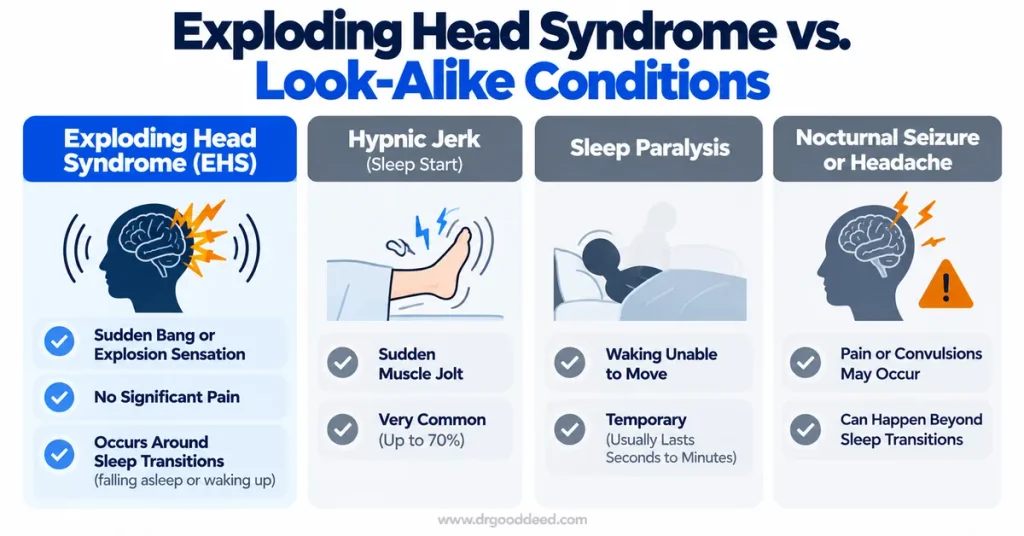
| Condition | What happens | Pain or movement | Key clue |
| EHS | Sudden bang, crash, or explosion sensation | No significant pain | Occurs around sleep transitions |
| Hypnic jerk | Sudden muscle jolt or falling sensation | Muscle twitch | Very common, affecting up to 70% |
| Sleep paralysis | Waking while unable to move | Temporary paralysis | May occur alongside the syndrome |
| Nocturnal seizure or headache | Neurological event or severe head pain | Pain or convulsions may occur | Can happen beyond normal sleep transitions |
Why Do You Hear a Loud Bang When Falling Asleep?
Exploding head syndrome (EHS) is a parasomnia in which a loud noise or sensation of an explosion occurs in the head as you fall asleep or wake in the night. It is not an outside sound and cannot be heard by another person, and it can be a very intense experience. Initially, it can be startling and confusing.
The International Classification of Sleep Disorders (ICSD-3) lists three criteria:
- A loud sound or explosion in the head.
- The event happens when falling asleep or waking up.
- You wake abruptly, often frightened, and feel no significant pain.
It is a sensory event, mostly a sound, not a muscle twitch. Hypnic jerks are sudden muscle jolts that can affect up to 70% of people.
Exploding Head Syndrome Symptoms
Exploding head syndrome symptoms may include a sudden, loud bang or explosive sound, often accompanied by a racing heart, sweating, or shortness of breath. Episodes typically last less than a second, although some people experience several in one night while others may go weeks between episodes. Some people also report flashes of light, muscle twitches, a sensation of heat, or tingling. The episode may cause sudden awakening, surprise, or fear, but it is generally brief and does not usually cause physical pain.
Episodes may cause anxiety for some people about sleeping. In a 2020 case series, sounds were reported as sounding like firecrackers or gunshots, typically heard within the head. A 2020 case series published in Case Reports in Neurology found that overnight video sleep testing was normal in 5 of 6 patients with exploding head syndrome. In one patient, an episode was recorded during stage N2 non-REM sleep. These findings suggest that routine overnight sleep testing may not capture an episode in every patient.
No actual explosion or exterior noises are heard; other people nearby will normally hear nothing.
| Essential fact: The sound does not come from outside, but the experience is real and can be frightening. Recurrence can continue to impact sleep and lead to considerable fear. |
Is Exploding Head Syndrome Dangerous?
No. It has a benign course and, by definition, causes no significant pain, but a non-typical presentation should be assessed medically.
See a doctor if there is pain, convulsions, loss of awareness, or episodes that happen when you are fully awake, since seizures and night-time headache disorders can look similar.
If the headache is sudden and severe, and reaches its peak very quickly, it is a different type and requires immediate action. A sudden, severe headache that reaches its peak within a minute (thunderclap headache) requires immediate emergency care. If you have a severe headache when lying down or concerning neurological symptoms, seek urgent medical attention. In the US, call 911 or go to the emergency department; in the UK, call 999 or go to A&E. For non-urgent concerns, consult your primary care doctor or GP. If you are afraid of having another episode and will not sleep, talk to the health care professional.
Exploding Head Syndrome Causes
The cause of exploding head syndrome is not known. Several explanations have been suggested, none of them to be taken for granted.
- One of the hypotheses has to do with the brain’s arousal system when it enters sleep. The brain may not turn off sensory processing easily so it can produce an abrupt internal sound.
- Other theorized explanations include alterations in the middle ear or some minor activity in the temporal lobe. These are not known causes, but hypotheses.
- Stopping some antidepressants has also been reported as a possible trigger for exploding head syndrome, although evidence does not establish a causal link. Some people experience unusual sensory sensations called brain zaps, particularly when discontinuing certain antidepressants.
- A 2025 cross-sectional study of Japanese workers found that exploding head syndrome was associated with symptoms of depression, anxiety, insomnia, and fatigue. These findings suggest a relationship between sleep disturbances, psychological symptoms, and exploding head syndrome, but the study design cannot establish cause and effect.
How Common Is Exploding Head Syndrome?
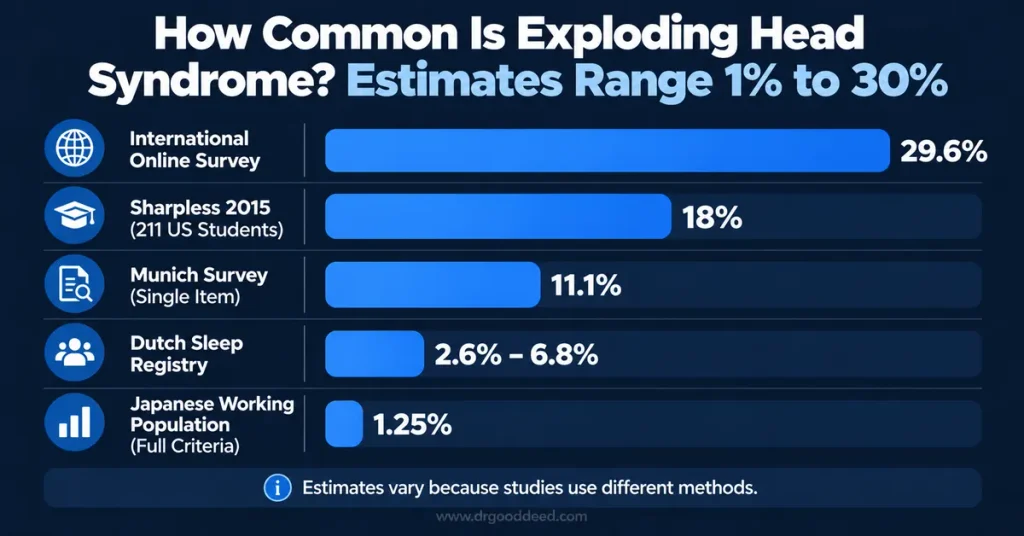
Estimates of how common exploding head syndrome is range from about 1% to 30%, because studies use different methods to recruit participants, ask questions, and apply exclusion criteria.
Exploding Head Syndrome (EHS) Prevalence Rates Across Global Studies :
Here is what the main studies found:
- Sharpless 2015, 211 US students: 18% lifetime prevalence rate, 16.6% recurrent prevalence rate.
- International online survey (recruited partly from sleep forums): 29.6% estimated lifetime prevalence rate.
- Munich Parasomnia Screening Survey: 11.1% prevalence rate for a single item.
- Dutch Sleep Registry: Estimated prevalence rates varied between 2.6% and 6.8%.
- 2025 Japanese Working Population Study (n = 1,843 eligible):
- 1.25% met full diagnostic criteria
- 2.49% reported hearing noises or an explosion sensation.
Prevalence estimates for exploding head syndrome vary because studies use different screening methods. Some rely on a single screening question, while others recruit participants online through sleep forums. Some studies also do not fully exclude conditions such as epilepsy and migraine, which may affect the accuracy of the estimates.
Exploding Head Syndrome Treatment: Reassurance, Sleep Habits and Off-Label Medicines
The treatment for exploding head syndrome starts with reassurance and attention to the other sleep problems; there is no approved medication or traditional treatment guideline specific to the condition. Having reassurance can help to decrease fear of the non-threatening nature of episodes.
- Treat other sleep problems such as insomnia or sleep apnea.
- Maintain consistent sleeping patterns and try to manage stress.
Self-care tips: Keep a symptom diary noting when episodes occur, how long they last, and any possible triggers. Try relaxation techniques before bed, maintain a consistent sleep schedule, and practice good sleep hygiene. Talk to a trained healthcare professional about ongoing or troubling experiences.
How is exploding head syndrome diagnosed?
There is no single test to confirm exploding head syndrome. Diagnosis is usually based on the person’s symptom history and whether the episodes meet the recognized diagnostic criteria. A healthcare professional may recommend a sleep study, electroencephalogram (EEG), or MRI to rule out other possible causes, depending on the symptoms and clinical findings.
Case reports and small clinical observations are all that there is to use as evidence of medication. Clomipramine, amitriptyline, calcium channel blockers (including nifedipine), topiramate, clonazepam, and ketamine (in one report) have all been reported as drugs. These are prescription medicines used off-label, and only a doctor can decide whether one is suitable. Never self-dose.
If symptoms occur often, are disruptive, or are hard to differentiate from other sleep disorders, a sleep specialist can be of assistance. Neurologist involvement is warranted in cases of seizures and/or headache disorders in the differential diagnosis.
Good sleep habits can help, but they may not stop episodes. When they result in panic or fear of sleep, that’s something to attend to and is not insignificant.
Frequently Asked Questions
Is exploding head syndrome linked to sleep paralysis?
Yes. In a 2015 student study, 36.89% of those who were at the same time suffering from isolated sleep paralysis reported it as well. They’re not the same phenomenon: sleep paralysis is being paralyzed, and the syndrome is a sudden sound or explosion perceived.
Does exploding head syndrome go away on its own?
It can go away over time, and some people have only a single episode. There is no reliable evidence about the timing. If episodes become frequent, distressing or change in nature, medical evaluation can be useful to ascertain other causes.
Who gets exploding head syndrome?
There is no one simple age or sex profile that is supported by research. Previous reports indicated a higher prevalence in females and those aged more than 50 years, but the 2015 student study and the 2025 Japanese study showed no difference between the sexes. There is a wide age distribution of cases.
Can exploding head syndrome happen when you wake up in the night?
Yes. Episodes at sleep onset and during wakefulness at night are included in the diagnostic description. The pattern is: sudden perceived sound/explosion, sudden awakening, and no significant pain.
Medical Disclaimer: This article is for informational and educational purposes only and does not replace professional medical advice, diagnosis, or treatment. Always consult a qualified healthcare professional about your symptoms or health concerns. Never delay or disregard professional medical advice based on information provided in this article.
Sources:
- Thunderclap Headaches: Symptoms and Causes — Mayo Clinic link
- International Classification of Sleep Disorders (ICSD) — American Academy of Sleep Medicine link
- Exploding Head Syndrome: Symptoms, Causes, and Treatment — Medical News Today link
- Sharpless (2015): Exploding head syndrome is common in college students. Journal of Sleep Research. This study found a lifetime prevalence of 18% among 211 undergraduate students, highlighting that the condition can occur in younger adults. link
- Tsovoosed et al. (2025): Prevalence and impact of exploding head syndrome in a Japanese working population. Sleep. This cross-sectional study found that 1.25% of eligible participants met the study’s diagnostic criteria for exploding head syndrome. It also reported associations with depression, anxiety, insomnia, and fatigue scores. link
- Pirzada et al. (2020): Exploding Head Syndrome: A Case Series of Underdiagnosed Hypnic Parasomnia. Case Reports in Neurology. In this six-patient case series, overnight video sleep testing was unremarkable in five patients, while an episode was recorded during stage N2 sleep in one patient. link
- Prevalence and impact of exploding head syndrome in a Japanese working population – PubMed link
Medical Disclaimer: This article is for general information only and is not medical advice. It does not replace a diagnosis, treatment plan, or guidance from a qualified healthcare professional. Always talk to your doctor about your own symptoms and before starting, stopping, or changing any treatment. If you think you may be having a medical emergency, call 911 or go to your nearest emergency room.