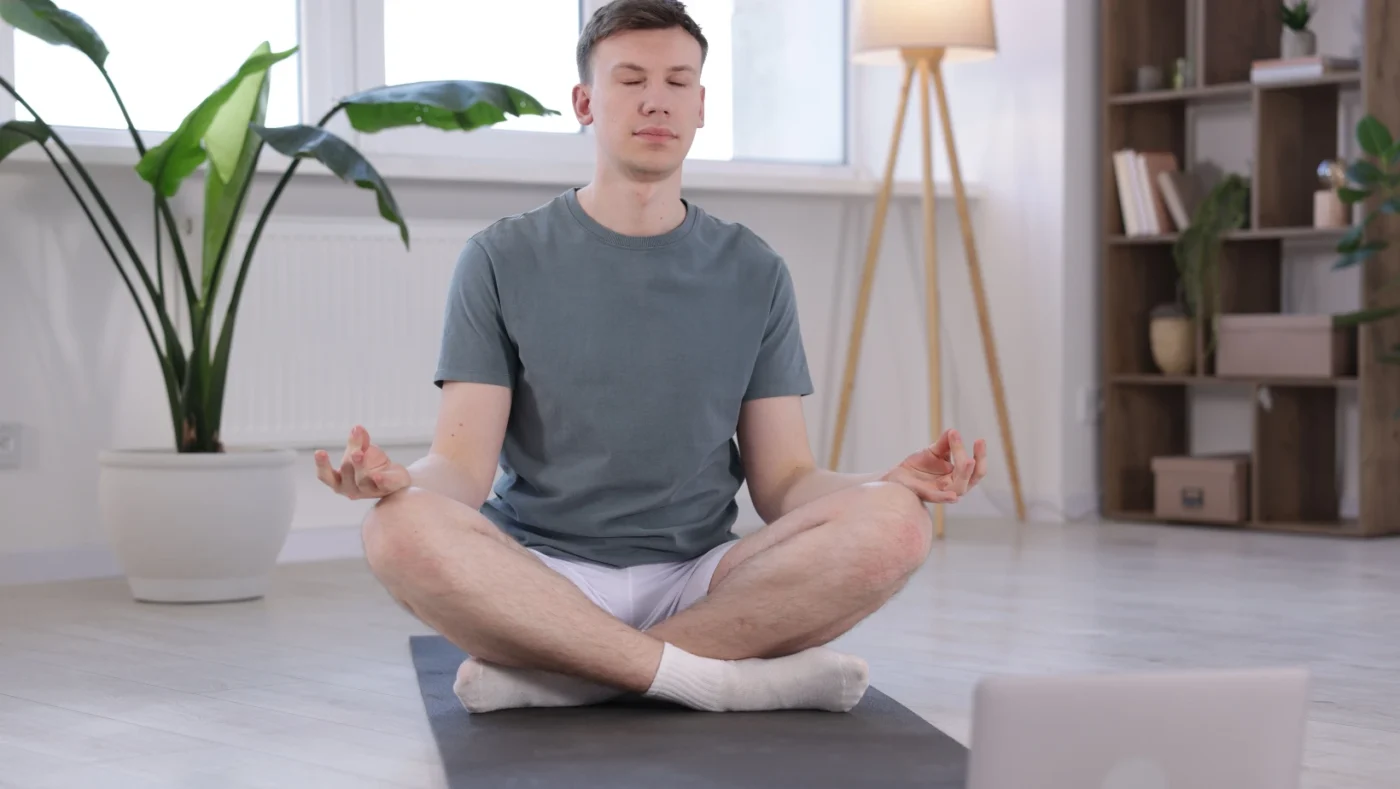

Yoga for anxiety is a clinically supported, non-pharmacological intervention that reduces anxiety symptoms by directly regulating the autonomic nervous system. A 2018 meta-analysis published in the Journal of Evidence-Based Medicine found that yoga significantly reduced anxiety scores across 17 randomized controlled trials.
It works on the body first, and the mind follows. Anxiety disorders affect over 40 million adults in the United States, making accessible, low-cost interventions like yoga more relevant than ever.
How Yoga Helps Reduce Anxiety
Yoga helps reduce anxiety through three overlapping mechanisms: nervous system regulation, hormonal changes, and body awareness. Most articles stop at “yoga calms you down.” The actual process is more specific, and understanding it helps you practice with better results.
Activation of the Parasympathetic Nervous System
Anxiety keeps the body stuck in sympathetic mode; the fight-or-flight state. Yoga for anxiety shifts the body into parasympathetic mode; rest-and-digest. This switch happens through slow, controlled movement and extended exhalation breathing, which stimulates the vagus nerve. The vagus nerve is the main highway between the brain and the gut, heart, and lungs. Activating it directly lowers heart rate, blood pressure, and cortisol within minutes.
Reduction in Stress Hormones
A 2010 study in the Journal of Alternative and Complementary Medicine found that a single yoga session reduced cortisol levels by an average of 14 percent. Regular practice over 8 weeks reduced salivary alpha-amylase (a stress marker) by 41 percent. These aren’t mild changes. They represent a measurable biological shift in how the body responds to stress.
Improved Mind-Body Awareness
Anxiety often disconnects people from their bodies. Physical tension builds without awareness, and the nervous system stays activated without a clear trigger. Yoga restores interoception, which is the ability to notice and interpret physical sensations. When you can feel tension in the shoulders or chest and consciously release it, you interrupt the anxiety feedback loop at its source.
Best Yoga Poses for Anxiety Relief
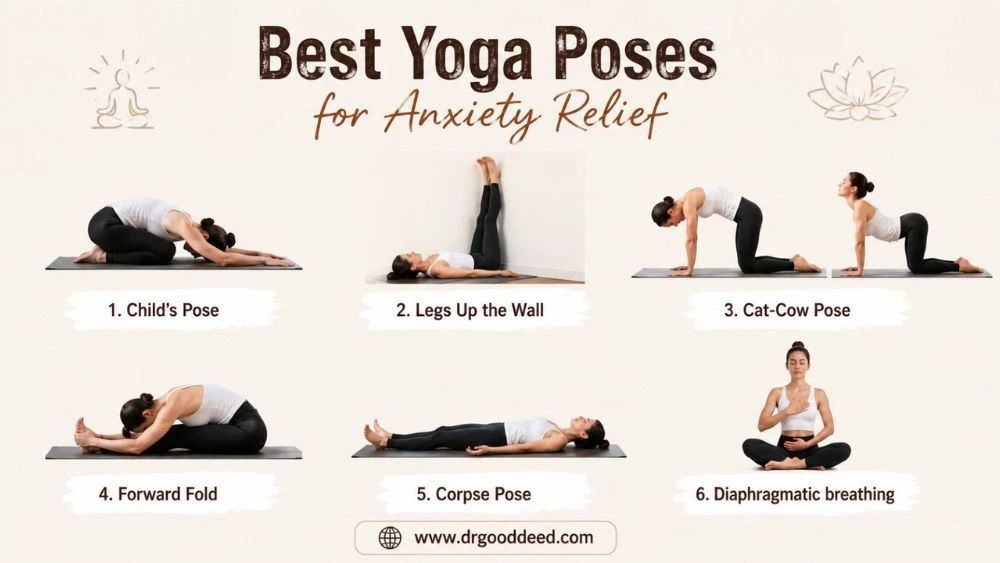
The best yoga poses for anxiety relief target the vagus nerve, slow the breath, and reduce physical muscle tension. These five poses have the strongest evidence base and the lowest barrier to entry for beginners.
Child’s Pose (Balasana), Deep Relaxation
Kneel on the floor, sit back on your heels, and fold forward with arms extended. Hold for 60 to 90 seconds. Child’s Pose compresses the abdomen gently, which stimulates the vagus nerve and activates the parasympathetic response. It also lengthens the lower back, where chronic anxiety often stores tension. Research from Harvard Medical School identifies forward-folding postures as among the most effective for reducing acute anxiety.
Legs Up the Wall (Viparita Karani), Stress Relief
Lie on your back with legs extended vertically against a wall. Hold for 5 to 10 minutes. This pose reverses blood flow from the legs back to the core, reducing the physiological arousal that accompanies anxiety. Heart rate drops noticeably within 3 to 5 minutes. It requires zero flexibility and works even on the worst anxiety days.
Cat-Cow Pose (Marjaryasana-Bitilasana), Breath Flow
On hands and knees, alternate between arching and rounding the spine while synchronizing movement with inhale and exhale. Repeat for 8 to 10 breath cycles. This is one of the few poses that directly ties breath to movement, which trains the nervous system to use breath as an anxiety regulation tool throughout the day.
Forward Fold (Uttanasana), Calming Stretch
Stand and fold forward from the hips, letting the head hang. Hold for 30 to 60 seconds. Forward folds lower blood pressure by increasing baroreceptor activity in the neck vessels. They also release the hamstrings and lower back, two areas that tighten significantly during chronic stress.
Corpse Pose (Savasana), Full Relaxation
Lie flat on your back, arms slightly away from the body, eyes closed. Hold for 5 to 10 minutes. Savasana is where physiological integration happens. The body consolidates the hormonal changes from the session.
Skipping it undermines the anxiety-reduction benefit of everything that came before. A 2017 study in Frontiers in Human Neuroscience confirmed that Savasana produces measurable reductions in sympathetic nervous system activity.
Breathing Techniques and Anxiety Reduction
Breathing techniques and anxiety reduction have a direct, immediate relationship. The breath is the only autonomic function you can consciously control, which makes it the fastest tool for interrupting an anxiety response.
Deep Diaphragmatic Breathing
Breathe in through the nose for 4 seconds, expanding the belly rather than the chest. Exhale slowly for 6 to 8 seconds. The extended exhale activates the vagus nerve more than the inhale does. Even 5 minutes of this technique lowers cortisol and heart rate in clinically anxious populations, according to research published in Frontiers in Psychology in 2017.
Alternate Nostril Breathing (Nadi Shodhana)
Close the right nostril with the thumb, inhale through the left for 4 seconds. Close both, hold for 4 seconds. Open the right nostril, exhale for 4 seconds. Repeat on the other side.
A 2013 study in the Journal of Clinical and Diagnostic Research found that Nadi Shodhana significantly reduced both perceived stress and physiological anxiety markers after just 5 minutes of practice. It also balances activity between the left and right hemispheres of the brain.
Box Breathing Technique
Inhale for 4 seconds, hold for 4, exhale for 4, hold for 4. This is the same technique used by U.S. Navy SEALs to manage acute stress in high-pressure situations. It works for anxiety because the equal-ratio pattern prevents hyperventilation and stabilizes carbon dioxide levels in the blood, which directly reduces physical anxiety symptoms like tingling and dizziness.
Yoga Routine for Daily Anxiety Management
A yoga routine for daily anxiety management doesn’t need to be long. Consistency matters more than duration. This beginner routine takes 12 minutes and produces measurable results within 3 to 4 weeks of daily practice.
10 to 15 Minute Beginner Routine
| Pose or Technique | Duration |
| Diaphragmatic breathing | 2 minutes |
| Cat-Cow Pose | 2 minutes |
| Child’s Pose | 2 minutes |
| Forward Fold | 1 minute |
| Legs Up the Wall | 3 minutes |
| Savasana | 5 minutes |
Combining Poses and Breathing
Every pose should link to a breath pattern. Inhale during expansion (arching, lifting). Exhale during compression or folding. This synchronization is what separates yoga for anxiety from simple stretching. Without breath coordination, the poses produce flexibility benefits but minimal anxiety reduction.
Best Time to Practice
Morning practice reduces baseline cortisol for the rest of the day. Evening practice improves sleep onset and reduces nighttime anxiety. Both times work. Afternoon practice is the least effective for anxiety because cortisol naturally peaks in the morning and drops in the early afternoon, leaving less room for measurable reduction.
Yoga Practices for Mental Health
Yoga practices for mental health extend beyond physical poses. The mental components are where long-term anxiety reduction happens.
Mindfulness and Meditation
A 2014 meta-analysis in JAMA Internal Medicine covering 47 trials found that mindfulness meditation programs showed moderate evidence for improving anxiety, depression, and pain. Yoga for anxiety that includes a 5-minute seated meditation after physical practice produces stronger outcomes than yoga alone.
Body Awareness Techniques
Body scan meditation, which is a practice of mentally checking in with each body part from feet to head, trains interoception. Better body awareness means identifying and releasing tension before it becomes a full anxiety response. This is a skill that improves with repetition over 2 to 3 weeks.
Consistency and Habit Building
The anxiety-reduction benefit of yoga practices for mental health follows a dose-response relationship. Practice 3 to 5 times per week produces greater anxiety reduction than once a week. The International Journal of Yoga published findings in 2012 showing that participants who practiced 4 or more times per week had significantly lower trait anxiety scores after 8 weeks compared to those practicing twice a week.
How to Start Yoga for Anxiety
Starting yoga for anxiety doesn’t require a studio, a mat, or prior experience. A carpeted floor and 12 minutes work.
- Start with Child’s Pose and Legs Up the Wall only, for the first week. These two require no instruction and produce immediate calming effects.
- Practice at the same time every day to build habit association. The body begins to expect relaxation at that time, which lowers baseline anxiety over weeks.
- Use free resources like Yoga with Adriene on YouTube, specifically her anxiety and stress playlists, which follow clinically relevant sequencing.
- Don’t force poses into discomfort. Pain activates the sympathetic nervous system. Gentle sensation is the target, not stretching limits.
Common Mistakes in Yoga for Anxiety
These mistakes reduce or eliminate the anxiety-reduction benefit of yoga. They appear across beginner and intermediate practitioners in the United States.
Skipping Savasana is the most common. Many people treat it as optional. It’s where the nervous system resets. Without it, cortisol doesn’t fully drop.
Holding the breath during difficult poses spikes the sympathetic response instead of calming it. Breathe through discomfort, not around it.
Practicing too aggressively. Hot yoga and fast-flow vinyasa raise cortisol in people with anxiety disorders, according to a 2020 study in Complementary Therapies in Medicine. Restorative and Hatha yoga styles show consistent anxiety reduction. Vigorous styles do not for anxious populations.
Expecting immediate results after one session. A single session produces temporary relief. Structural anxiety reduction requires 4 to 8 weeks of regular practice.
FAQs
Does yoga help reduce anxiety?
Yes. Yoga for anxiety reduces cortisol by up to 14 percent in a single session. Over 8 weeks of daily practice, clinical anxiety scores drop significantly. The Journal of Evidence-Based Medicine confirmed this across 17 randomized controlled trials. Restorative and Hatha styles show the strongest results.
Which breathing techniques reduce anxiety?
Diaphragmatic breathing with a 6 to 8 second exhale activates the vagus nerve fastest. Nadi Shodhana reduces anxiety markers within 5 minutes and balances brain hemisphere activity. Box breathing stops hyperventilation and stabilizes blood carbon dioxide, eliminating physical symptoms like dizziness within 4 to 6 breath cycles.
What is a good yoga routine for daily anxiety management?
The most effective yoga routine for daily anxiety management is: 2 minutes of diaphragmatic breathing, 2 minutes of Cat-Cow, 2 minutes of Child’s Pose, 3 minutes of Legs Up the Wall, and 5 minutes of Savasana. Total time: 14 minutes. Practice daily for 4 weeks for measurable results.
Can yoga replace therapy for anxiety?
No. Yoga for anxiety is a complementary tool, not a clinical treatment. CBT and medication remain first-line treatments for diagnosed anxiety disorders. Yoga improves outcomes when combined with therapy. The American Psychological Association does not list yoga as a standalone treatment for GAD or panic disorder.
How often should I do yoga for anxiety?
Practice 4 to 5 times per week. Research from the International Journal of Yoga shows that practicing 4 or more times weekly produces significantly lower trait anxiety after 8 weeks compared to twice weekly. Once a week produces measurable but modest benefits.
What is the best time to practice yoga for anxiety?
Morning is best. Cortisol peaks between 6 and 9 AM. Practicing yoga for anxiety during this window produces the largest cortisol reduction for the day. Evening practice works well for sleep-onset anxiety. Practicing within 30 minutes of waking produces better all-day anxiety management than any other time slot.
Can beginners do yoga for anxiety relief?
Yes. The best yoga poses for anxiety relief for beginners, specifically Child’s Pose, Legs Up the Wall, and Savasana, require zero prior experience, no flexibility, and no equipment. Start with these three and add Cat-Cow and Forward Fold after the first week.
When should I seek professional help for anxiety?
Seek help when anxiety disrupts sleep, work, or relationships for more than 2 consecutive weeks. Panic attacks, chest pain, persistent fear without a clear trigger, or thoughts of self-harm require immediate clinical evaluation. Yoga for anxiety is not a substitute for that level of care.