
A practical starting point is around 1 to 2 servings of fermented foods per day, gradually increasing if you tolerate them well. This could mean a small serving of plain yogurt or kefir, a few tablespoons of fermented vegetables such as sauerkraut or kimchi, or a moderate serving of other traditionally fermented foods.
The best-studied target is up to six servings daily, but six is not a mandatory minimum. A gut health diet plan should account for tolerance, food type, and whether cultures survived processing.
Key Takeaways
- Many commercial fermented foods are pasteurized or otherwise processed after fermentation.
- Most standard jarred pickles and many shelf-stable sauerkraut products do not provide live cultures, so they should not be counted like a live-culture food.
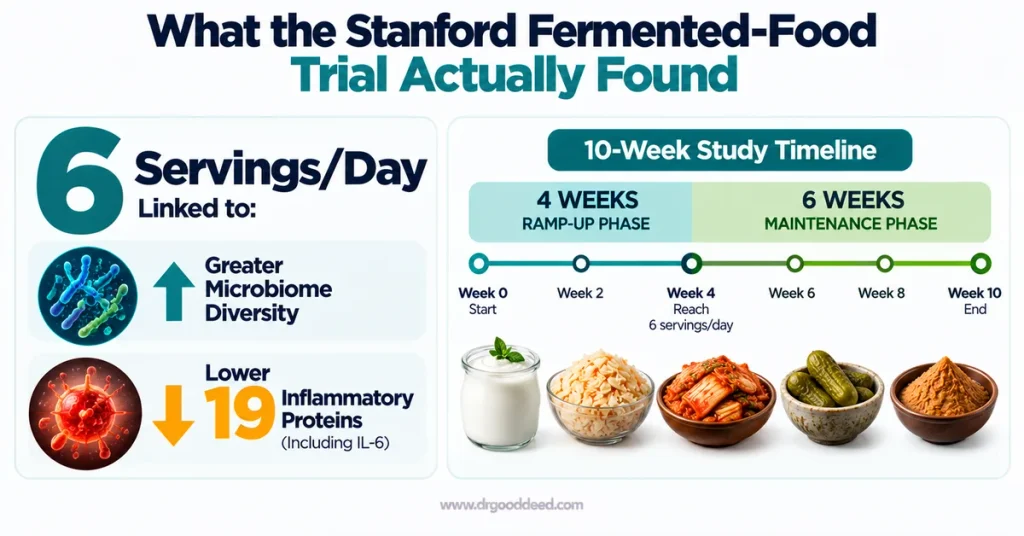
- In the Stanford trial, a diet reaching six fermented-food servings per day increased microbiome diversity and lowered 19 inflammatory proteins, including IL-6.
- Variety matters. Rotating yogurt, kefir, fermented vegetables, and other foods with live cultures avoids making one product the entire strategy.
- Start small if you are not used to fermented foods, especially if they cause bloating or digestive discomfort.
The Overlooked Catch: Not All Fermented Foods Contain Live Bacteria
Before counting how many fermented foods per day, check the product label and how the food was processed.
Fermentation can create acids, flavors, and other metabolites even when the microbes are later killed.
- Some fermented foods are potential sources of beneficial microbes, but most commercial pickles are processed after fermentation and may no longer contain live cultures when eaten.
- Many common jarred sauerkraut products, especially shelf-stable versions, are heat-treated.
- Refrigerated sauerkraut labeled for live cultures is the more relevant choice when the goal is live microbes.
- Beer and wine are fermented, but they are not useful substitutes for live-culture foods. Production may inactivate or remove fermentation organisms, and alcohol has separate health considerations.
- Look for “live and active cultures,” refrigeration instructions, and storage directions. Viable microbes can decline during shelf life.
For a broader list of probiotic foods, see high foods in probiotics, which also explains why pasteurization changes the microbial content of fermented products.
Pasteurization point: A fermented food can be chemically fermented yet microbiologically inactive. For gut-microbe purposes, six servings of pasteurized pickles are not equivalent to six servings of foods that still contain live cultures.
The Stanford Study: Why 6 Servings a Day Is the Real Target
The strongest human trial often cited for how much fermented foods per day involved generally healthy adults. Wastyk et al. published the randomized dietary intervention in Cell in 2021. The fermented-food arm progressively increased intake toward six servings per day.
- The study used a 10-week diet intervention in its main analysis, with four weeks of gradual intake increases followed by six weeks at the higher level.
- The fermented-food choices included yogurt, kefir, kimchi, fermented vegetables, and kombucha.
- The fermented-food group developed greater gut microbiome diversity and had decreases in 19 inflammatory proteins measured in blood, including interleukin-6, or IL-6.
- The study was small and focused on generally healthy adults. It was not designed to establish six servings as a prescription for every adult, every digestive disorder, or every food type.
- The full protocol included a four-week period after the intervention when participants chose their own intake.
- The rise in microbiome diversity persisted through that follow-up period, when intake was lower than during maintenance.
Stanford now states that there is no official universal fermented-food serving definition. Its educational materials use practical example portions rather than declaring one medically required daily dose.
A Realistic Ramp-Up Schedule for Sensitive Guts
If fermented foods per day cause more gas than expected, slow the pace rather than automatically abandoning the foods. The Stanford study used a four-week gradual increase, so this table is a practical adaptation, not a trial-prescribed schedule.
| Week | Target Servings Per Day | What to Watch For |
| Week 1 | 1 serving | Mild bloating or gas can occur during adjustment. If symptoms are strong or persistent, stay at this level longer. |
| Week 2 | 2 to 3 servings | Rotate different fermented foods instead of repeating a large portion of one food. |
| Week 3 | 4 servings | Symptoms should be settling. If they are not, slow down rather than push toward six. |
| Week 4 and beyond | Up to 6 servings | This matches the Stanford trial target. It is not a required number for everyone. |
Stanford’s serving guide recommends starting with one serving daily and increasing slowly, with at least two servings a day and more as tolerated.

Signs You’re Eating Too Much, Too Fast
For how much fermented food per day, tolerance matters more than forcing a preset number. Foods may contain lactose, fermentable carbohydrates, fiber, carbonation, or other compounds that affect the gastrointestinal tract.
- General gut adjustment can cause temporary gas, fullness, or bowel changes when a dietary pattern changes quickly.
- FODMAP sensitivity matters for some people, particularly those with irritable bowel syndrome. Fermented foods are not automatically low-FODMAP, and garlic, onion, some dairy products, and other ingredients can matter as much as the fermentation.
- Lactose may still matter in dairy-based fermented foods. Fermentation can change lactose content, but tolerance remains individual.
- True histamine intolerance is a possible explanation for symptoms in a smaller subset of people, but it should not be the default explanation for bloating after fermented foods. Biogenic amine levels vary widely across fermented products.
- Persistent diarrhea, vomiting, bleeding, fever, weight loss, severe abdominal pain, or symptoms that repeatedly disrupt daily life need medical assessment rather than more dietary experimentation.
A 2025 systematic review and meta-analysis of randomized trials in IBS found fermented foods were associated with overall symptom relief, but the pooled evidence did not show a significant improvement in abdominal pain or bloating specifically.
Best Fermented Foods to Start With
Start with a familiar food that has clearly identified live cultures, then add variety. Foods differ in lactose, FODMAP content, acidity, sodium, carbonation, added sugar, and microbial composition.
- Yogurt is a practical first choice because its starter cultures are well established and the portion is easy to measure.
- Kefir is another convenient option. See the best time to drink kefir guide for timing considerations.
- Refrigerated sauerkraut or other fermented vegetables labeled for live cultures can add variety, but begin with a small portion if cabbage, garlic, or onion tends to trigger gas.
- Kimchi and kombucha can come later if tolerated. Kombucha is acidic and carbonated, and some products contain added sugar or small amounts of alcohol.
- Miso and other fermented foods can increase variety even though they do not necessarily provide the same microbial profile as yogurt or kefir.
Pro Tip: Test one new fermented food at a time and keep the portion stable for several days. That makes it easier to identify whether symptoms come from the fermentation, FODMAP load, lactose, carbonation, or another ingredient.
When to See a Doctor
A food experiment should not delay evaluation of symptoms that suggest something other than ordinary dietary adjustment. Do not keep increasing fermented foods per day when symptoms are persistent or severe. They may reflect IBS, lactose intolerance, celiac disease, inflammatory bowel disease, infection, or another gastrointestinal problem.
Seek medical care promptly for blood in stool, black stools, persistent vomiting, dehydration, unexplained weight loss, fever, severe or worsening abdominal pain, or symptoms that wake you from sleep. People at higher risk for foodborne illness should take extra care with unpasteurized products.
FAQs
Can you eat too many fermented foods?
Yes. There is no established universal upper limit, but a rapid increase can cause gas, bloating, diarrhea, or reflux. The practical ceiling is the highest amount tolerated without persistent symptoms, not an obligation to reach six servings.
Do fermented foods fully replace probiotic supplements?
No. Fermented foods can supply live microbes, but they do not reliably provide the defined strains, doses, or condition-specific evidence used for some supplements. NIH notes that probiotic effects are strain-specific.
How do you know if a fermented food still has live cultures?
Look for “live and active cultures,” refrigeration requirements, and storage instructions. Fermentation alone does not prove that microbes remain alive because post-fermentation processing, including pasteurization, can eliminate them.
Is it safe to eat fermented foods every day long-term?
For most healthy adults, fermented foods can fit a varied diet daily, but no universal six-serving requirement or long-term dose standard exists. Sodium, added sugar, alcohol, food safety, and individual tolerance still matter.
Can children eat fermented foods daily?
Yes, suitable fermented foods can fit a child’s balanced diet, but portions should be age-appropriate. Choose pasteurized dairy products and avoid unpasteurized products; homemade kombucha is not appropriate for young children.
Sources
- Wastyk et al., “Gut-microbiota-targeted diets modulate human immune status,” Cell, 2021, PubMed link
- Stanford Medicine, Fermented and Fiber-rich Food Study link
- Stanford Medicine, What Counts as a Serving of Fermented Foods? link
- NIH Office of Dietary Supplements, Probiotics Fact Sheet for Health Professionals link
- PubMed, Efficacy of fermented foods in irritable bowel syndrome, 2025 link
- CDC, Safer Food Choices for Children Under 5 Years Old link
- American Academy of Pediatrics, Nutritional Supplements and Probiotics for Children link
Medical Disclaimer: This article is for general information only and is not medical advice. It does not replace a diagnosis, treatment plan, or guidance from a qualified healthcare professional. Always talk to your doctor about your own symptoms and before starting, stopping, or changing any treatment. If you think you may be having a medical emergency, call 911 or go to your nearest emergency room.