

If you get sick abroad, focus first on assessing how serious your symptoms are and finding appropriate medical care. Keep your passport, travel insurance details, medication list, and copies of prescriptions accessible, and use your insurer’s assistance service when available to locate suitable healthcare providers and understand coverage. Avoid taking unfamiliar medications without checking with a qualified healthcare professional, especially if you already take prescription medicines.
This guide covers how to stay healthy while traveling, including fever, stomach illness, colds, finding care, medicines, and recovery.
Key Takeaways
- Treat yourself at the hotel, see a clinician today, or call emergency services.
- Most travel illness is mild and clears with fluids, rest, and basic over-the-counter medicine.
- Fever, travelers’ diarrhea, and respiratory symptoms are the three problems this guide covers in depth.
- Fever of 100.4°F (38°C) or higher, blood in stool, confusion, or breathing trouble move you to the second or third group.
- Safe care exists in most destinations when you screen clinics and pharmacies with the right questions.
- Recovery continues after landing, and any fever within two weeks of return needs a doctor.
How to Tell If Your Symptoms Need Urgent Care
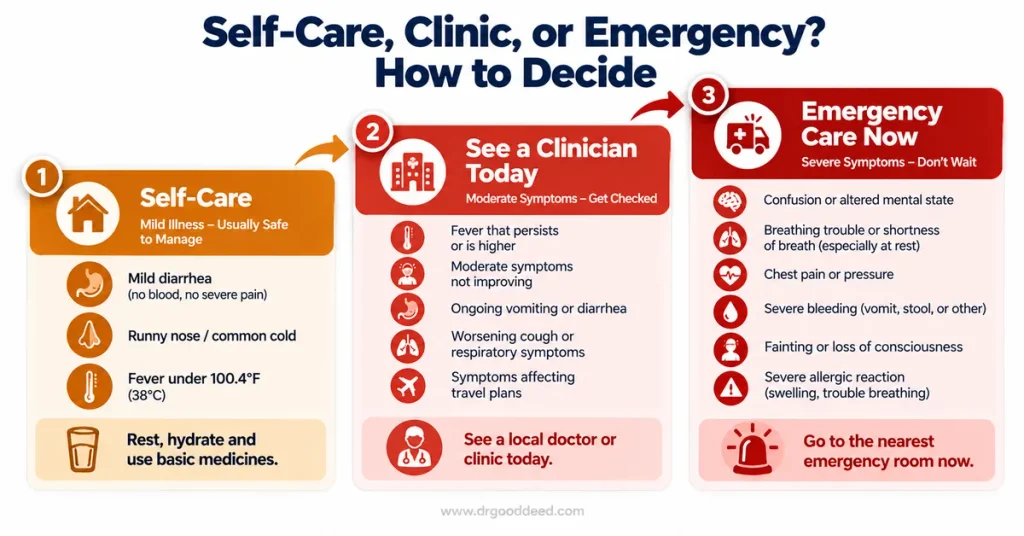
Urgent care fits any symptom that involves the brain, lungs, heart, or circulation, or that stops you from keeping fluids down. Bleeding, low blood pressure, altered consciousness, and fast breathing need prompt attention in a feverish traveler.
Go to a hospital or call emergency services for:
- Confusion, extreme drowsiness, or fainting. These signal severe infection, dehydration, or dangerously low blood pressure.
- Chest pain or trouble breathing at rest. Do not wait for a fever to appear first.
- Bleeding from the gums or nose, blood in vomit, or black or bloody stool. Dengue and other serious infections cause bleeding.
- Fever with a stiff neck, severe headache, or a rash that does not fade under pressure. These point to meningitis until proven otherwise.
- Dehydration signs. Little or no urination, dry mouth, sunken eyes, a heartbeat above 100, and cold clammy fingers all count.
Self-care usually works for loose stools without fever or blood, a runny nose with no breathlessness, and mild aches under 100.4°F.
The Most Common Illnesses Travelers Get, and How to Treat Them
Each needs a different first move, and each has a trigger that upgrades home care to a clinic visit. Find your main symptom, treat the mild version, and watch the listed warning signs.
Fever While Traveling
A fever while traveling deserves more caution than one at home. Treat it with acetaminophen (called paracetamol abroad), fluids, and rest. Skip aspirin, ibuprofen, and naproxen until a clinician rules out dengue, because it’s linked to bleeding risk. A fever that lasts or returns can signal a travel-specific infection. Our guide to home remedies for viral fever covers dengue, malaria, and typhoid causes.
| Infection | Where the CDC lists it | Clue to know |
| Dengue | Latin America, Asia, Caribbean | Warning signs start 24 to 48 hours after the fever breaks |
| Malaria | Sub-Saharan Africa most often | Fever or chills; taking prophylaxis does not rule it out |
| Typhoid | South-Central Asia, sub-Saharan Africa | Some strains resist azithromycin and fluoroquinolones |
See a doctor the same day for any fever within two weeks of leaving a dengue-risk area.
Expert Insight: A single negative malaria test does not close the case when suspicion stays high. Clinicians repeat blood testing over the following 24 to 48 hours, and a history of taking prophylaxis does not exclude the diagnosis.
Stomach and Digestive Illness
Travelers’ diarrhea comes from contaminated food or water, and mild cases clear without antibiotics. Follow this order:
- Rehydrate first. Sip oral rehydration salts in small, frequent amounts. Fluid loss, not the infection itself, sends most people to hospital.
- Use loperamide with limits. The standard dose is 4 mg, then 2 mg after each loose stool. US over-the-counter labels cap adults at 8 mg daily, and higher doses can trigger dangerous heart rhythms.
- Skip loperamide alone if you have fever or bloody stool. Those signs suggest invasive infection that needs a clinician.
- Ask about antibiotics for moderate or severe cases. Azithromycin is the preferred choice for dysentery, febrile diarrhea, and Southeast Asia. Antibiotics shorten illness by about a day.
Our guide to home remedies for stomach flu covers gentle food reintroduction.
Colds, Coughs, and Sore Throat
Respiratory infections spread fast in airports, buses, and crowded hotels. Being sick while traveling with a cold rarely needs a clinic, but three habits speed recovery:
- Hydrate and rest. Warm fluids, honey for adults, and saltwater gargles ease throat pain.
- Match the medicine to the symptom. Acetaminophen treats aches and fever, and a saline rinse clears congestion.
- Watch for the second wave. Breathlessness, chest pain, coughing blood, or a fever that returns after improving suggest pneumonia and need same-day care.
Read our guide to home remedies for cold for symptom-by-symptom relief.
Finding a Doctor You Can Trust When You’re Far From Home
Start with your hotel concierge, a nearby pharmacy, or an international clinic network. Ask each for English-speaking clinicians who treat foreign visitors. Screen before you pay, because being sick while traveling does not oblige you to accept the first option.
- Hotel concierge: Ask for a doctor the hotel uses regularly for guests.
- Local pharmacist: A pharmacist can triage minor problems and name a nearby clinic. Apply the safety checks in the next section.
- International networks: Hospitals with an international patient desk handle foreign insurance paperwork and language needs. Joint Commission International accreditation signals audited safety standards.
- Screening questions: Ask whether the clinic uses sterile single-use needles, tests for malaria and dengue on site, and gives you written diagnoses and lab results.
What to Do If You Need Medication Without a Prescription
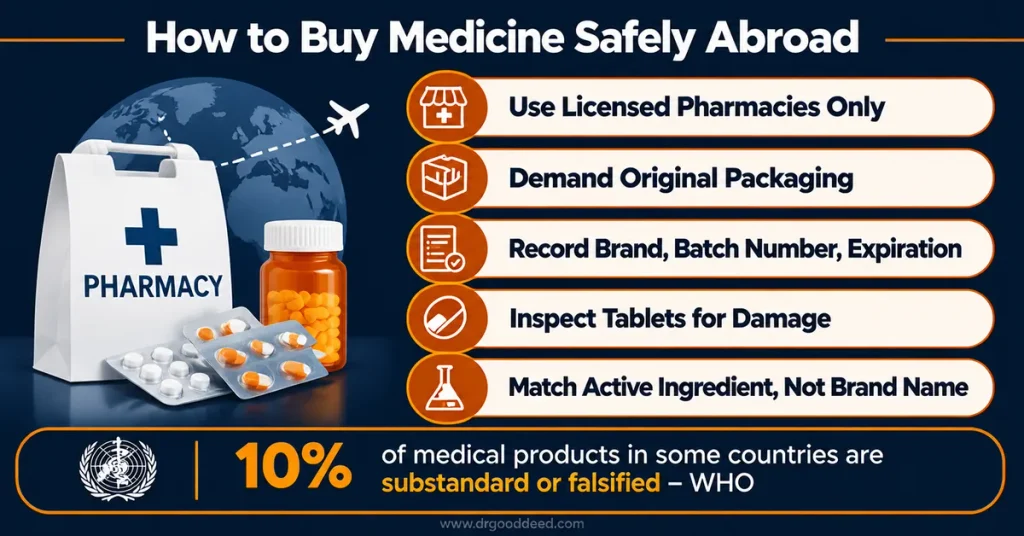
Rules differ by country, and quality varies widely. The CDC cites a WHO estimate that 10% of medical products in low- and middle-income countries are substandard or falsified.
- Use licensed pharmacies only. Avoid open markets and street vendors, and request a receipt.
- Demand original packaging. If a pharmacist hands over loose tablets in a bag, ask to see the container they came from.
- Record brand, batch number, and expiration date. This at the counter.
- Inspect the tablets. Discoloration, cracks, spots, or stickiness suggest a fake or poor storage.
- Expect unfamiliar names. Match the active ingredient, since strength and brand names differ by country.
Carrying prescriptions with generic drug names, covered in our travel pharmacy checklist, makes this much easier.
Pro Tip: Photograph every box, blister strip, and receipt before your first dose. Brand, batch number, and expiration date let a clinician verify what you took and let authorities trace a suspect batch if you react badly.
When It’s Time to Consider Coming Home for Treatment
Returning home for care is a medical decision. Consider it when your diagnosis stays unclear, treatment fails, or the local facility cannot provide the care you need.
- The diagnosis stays unclear. Fever persists after tests and treatment.
- You need surgery, intensive care, or specialty care. The local hospital cannot deliver it safely.
- Language or consent barriers block understanding. You cannot follow the diagnosis, risks, or options.
- A chronic condition destabilizes. The CDC advises stabilizing heart, lung, diabetic, and similar conditions before flying, and consulting a physician after recent surgery.
Ask your treating doctor for a written fitness-to-fly opinion. Cabin pressure sits at the equivalent of 6,000 to 8,000 feet, which strains a body already fighting illness.
How to Recover and Rebuild Your Health After You Get Home
Tell your US clinician where you traveled, when, and what you took. Most post-travel infections appear within a month.
- Book a visit within days. Bring itinerary dates, hospital records, lab results, and medicine packaging.
- Report any fever within two weeks of return. A fever while traveling can outlast the trip, so name malaria-risk regions explicitly.
- Test diarrhea that lasts beyond 14 days. Stool testing looks for parasites such as Giardia.
- Finish every antibiotic course. Stopping early invites relapse.
- Rebuild gradually. Restart bland foods, hydration, and sleep first, then normal exercise.
FAQs
Will your domestic health insurance cover treatment received abroad?
No, Original Medicare pays abroad only in three narrow cases, such as a closer foreign hospital during a US emergency. Private plans vary, so confirm international emergency terms. Some Medigap plans add limited coverage.
Is it safe to fly home on a commercial flight while still sick?
No, not with fever of 100.4°F (38°C) or higher, ongoing vomiting, or dehydration. A cold is usually fine, but ear or sinus infection risks painful pressure injury, called barotrauma, in the cabin.
How do you know if you need to see a doctor immediately vs wait it out?
Go immediately for confusion, bleeding, chest pain, breathing trouble, or dehydration signs like little urination and a heartbeat above 100. Self-treat only mild diarrhea or cold symptoms without fever.
Sources
- CDC Yellow Book 2026: Travelers’ Diarrhea link
- CDC Yellow Book: What To Do When Sick Abroad link
- CDC Yellow Book: Dengue link
- CDC Yellow Book: Post-Travel Evaluation of the Ill Traveler link
- CDC Yellow Book 2024: Avoiding Poorly Regulated Medicines and Medical Products During Travel link
- CDC Yellow Book 2024: Air Travel link
- Medicare.gov: Travel Outside the U.S. link
- CDC: Protect Yourself from Dengue When You Travel (traveler brochure) link
Medical Disclaimer: This article is for general information only and is not medical advice. It does not replace a diagnosis, treatment plan, or guidance from a qualified healthcare professional. Always talk to your doctor about your own symptoms and before starting, stopping, or changing any treatment. If you think you may be having a medical emergency, call 911 or go to your nearest emergency room.