
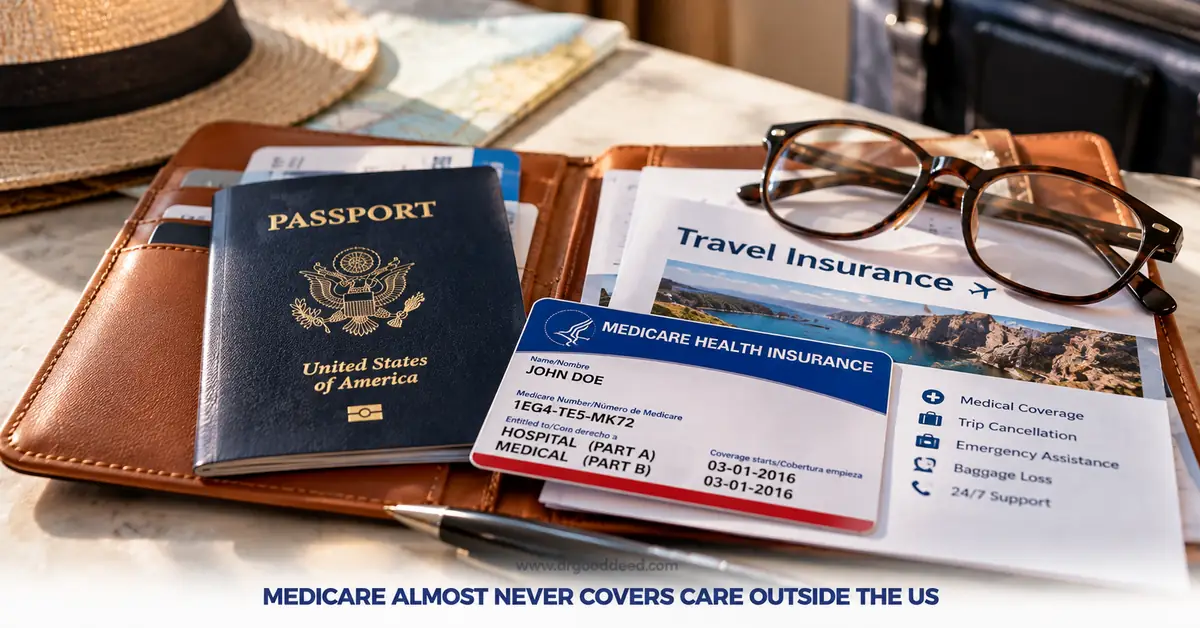

The best safe travel tips for older adults protect two things at once: your body and your money. Blood clots, medication mix-ups and infections that hide their usual symptoms threaten the first. Theft, scams and the limits of Medicare abroad threaten the second. Americans 60 and older filed 201,266 complaints with the FBI’s Internet Crime Complaint Center in 2025 and reported about $7.7 billion in losses, the highest of any age group.
This guide builds on our advice on how to stay healthy while traveling and covers scam defense, hotel access, insurance gaps, the aspirin question, medication letters and warning signs.
Key Takeaways
- Start preparing four to six weeks before departure, while a pre-travel visit can still change your plans.
- Adults over 60 reported the largest fraud losses of any age group in 2025, so hold back trip photos until you’re home.
- Phone each hotel yourself to confirm accessible features, even if a tour company made the booking.
- Original Medicare rarely pays for care abroad. Some Medigap plans reimburse emergency treatment up to a $50,000 lifetime limit.
- Clot risk rises after age 40, and for drug prevention the CDC favors anticoagulants over aspirin.
- Infection in older adults often shows up as confusion or a fall instead of a high fever.
Protecting Yourself from Theft, Fraud and Travel Scams
Older travelers are a documented target, and a handful of habits cut the risk sharply. Most travel scams depend on two things: pressure to act fast and a payment method you can’t reverse.
- Keep your plans private. A public post about an empty house invites a burglary, and a boarding pass photo exposes your booking code. Share photos after you land back home.
- Split your valuables. Lock the passport, spare cards and extra cash in the room safe. Carry one card and one day’s cash.
- Check “front desk” calls. A caller who says your card failed at check-in wants your number. Hang up and phone the front desk yourself.
- Agree a family code word. Scammers can now clone a relative’s voice with AI. A code word lets your family test any urgent plea for money.
- Pay by credit card. Fake rental listings and cloned airline sites ask for wire transfers, gift cards or crypto. A card gives you chargeback rights, and a wire doesn’t.
- Keep banking off public Wi-Fi. Use cellular data, and turn down help from strangers at ATMs.
If you do lose money, report it at ic3.gov straight away. Speed matters because banks can sometimes still freeze a transfer.
Checking Hotel and Destination Accessibility Before You Book
A listing marked “accessible” can still mean a bathtub and one slow elevator. Hotel accessibility for seniors depends on specific features, so call the property directly. Do it even when a tour company made the reservation.
- Ask for exact room features. Request a walk-in or roll-in shower, grab bars, toilet height, bed height and door width, and get the answers in writing.
- Ask about elevators. Find out how many serve your floor and what happens in an outage. A ground-floor room beats a fourth-floor room with one working lift.
- Know the ADA limits. US hotels must let you reserve an accessible room and describe its features accurately. Rules abroad vary, so confirm everything.
- Measure the routes. Ask how far your room is from the lobby, restaurant and pool, and whether any path has steps.
- Screen remote destinations. Ask how far the nearest hospital is and how the property arranges transport. In remote areas, medical access matters as much as ramps.
Email for confirmation and carry a printout, because front desks sometimes reassign rooms. Ask about night lighting and non-slip bathroom floors too, since both help prevent falls.
What Medicare Covers Abroad, and What It Doesn’t
Original Medicare generally does not cover healthcare outside the United States. In most situations it won’t pay for medical expenses abroad, including prescription drugs and dialysis.
The exceptions are narrow, such as a medical emergency inside the US where a foreign hospital is closer than the nearest US hospital that can treat you. So does Medicare cover travel abroad? Rarely. A Medigap plan or travel medical insurance has to fill the gap.
| Coverage | What it pays abroad |
| Original Medicare | Almost nothing, apart from narrow exceptions near the border |
| Medigap Plans C, D, F, G, M and N | 80% of billed emergency charges after a $250 yearly deductible, for care that begins in the first 60 days of a trip, up to a lifetime maximum of $50,000 |
| Medicare Advantage | Varies by plan. Some cover emergencies, and the details differ |
| Travel medical insurance | Set by the policy. Check for emergency evacuation |
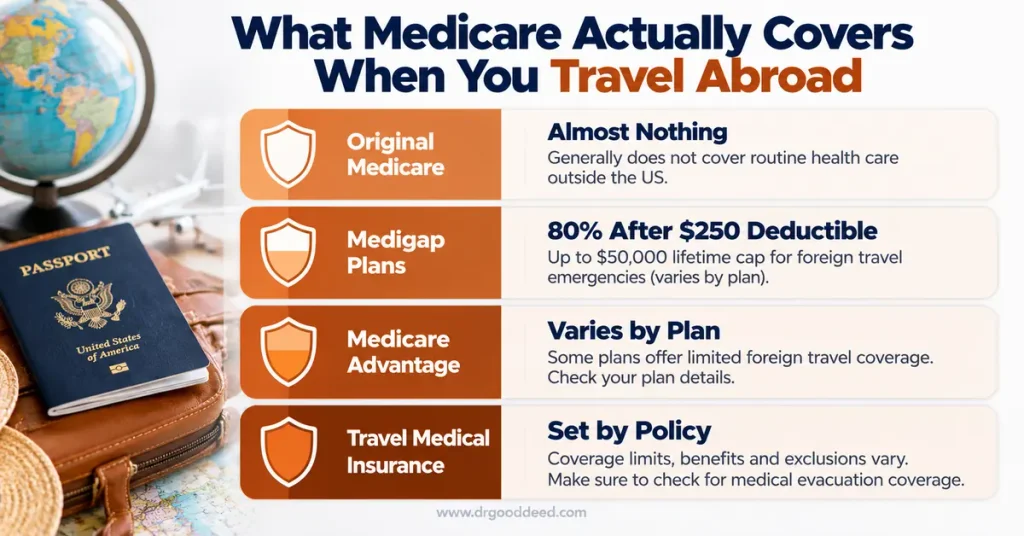
A few practical points follow from that table:
- Expect to pay first. Foreign hospitals won’t bill your Medigap insurer directly, so you pay on the spot and claim the money back at home.
- Know the cap. The $50,000 limit applies across all your trips in a lifetime, not per trip. People on high-deductible Plan F or G must also meet that plan’s own deductible before the travel benefit starts.
- Buy evacuation separately. Emergency medical transport is a standard feature of travel policies, not of Medicare. Dialysis patients should arrange care in advance, because Medicare doesn’t pay for it abroad.
- Read the pre-existing condition terms. Many travel policies waive those exclusions only if you buy soon after your first trip deposit, so check the deadline.
Call your Medigap insurer before you leave and ask exactly what it will reimburse. That one call may be the most valuable of all the safe travel tips for older adults.
Why Blood Clot Risk Rises With Age, and Why Aspirin Isn’t the Answer
The CDC Yellow Book lists older age as a risk factor for travel-related blood clots, with risk increasing after age 40. The same chapter puts the overall risk in perspective: for travelers with no preexisting risk factors, the risk is low. The picture changes when age combines with other factors such as recent surgery, obesity, hormone therapy or a previous clot.
How a travel clot forms
Long sitting slows blood flow in the legs. The CDC says this venous stasis appears to play the major role in travel-related clots. A clot in a deep leg vein is a deep vein thrombosis (DVT). If part of it breaks off and reaches the lungs, it becomes a pulmonary embolism, which can be life-threatening.
The risk is not limited to planes. Buses, cars and trains carry a similar increase, which points to long immobility rather than cabin air. Studies define a long trip differently, but more than four hours is the cutoff used most often.
Why aspirin doesn’t help
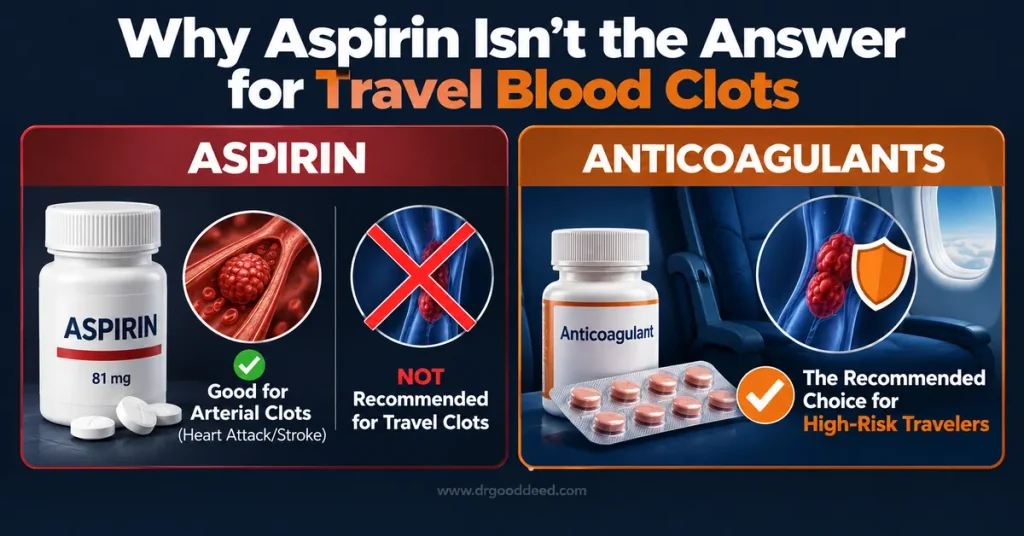
Aspirin works on platelets. It has good evidence behind it for arterial clots, the type behind heart attacks and strokes, but it isn’t recommended for preventing the venous clots that form on trips.
When drug prevention is judged worthwhile for a high-risk traveler, anticoagulants are recommended rather than antiplatelet drugs such as aspirin. That decision belongs to a clinician, made case by case.
If a cardiologist prescribed aspirin after a stent or heart attack, keep taking it as directed. The advice here is only about starting aspirin on your own as clot protection.
What does help
- Move often. The CDC calls frequent walking and calf exercises reasonable for long-distance travelers. On road trips, stop regularly and walk around.
- Consider an aisle seat. In one study, window-seat passengers had twice the clot risk of aisle passengers, probably because aisle sitters move around more.
- Ask about compression stockings. Graduated stockings appear to reduce symptomless DVT in travelers and are generally well tolerated. The American College of Chest Physicians recommends properly fitted below-the-knee pairs for travelers at increased risk, and not for everyone else.
- Stay hydrated, without expecting it to prevent clots. The CDC calls it reasonable and unlikely to cause harm, but can’t recommend it specifically for clot prevention.
One swollen, tender calf deserves prompt attention, because most pulmonary emboli start as a leg DVT. Most travel-related clots appear within one to two weeks of the trip, and risk returns to baseline by about eight weeks. A calf symptom after you get home still counts.
Preparing for Travel With a Chronic Condition
A pre-travel visit four to six weeks before departure matters most if you manage a long-term condition. It leaves time for vaccines, refills and any surprises. Ask for a medication letter listing each drug by generic name, dose and the condition it treats.
- Check destination drug laws. Some countries restrict medicines that are legal in the US. The CDC directs travelers to State Department country pages to see what needs prior permission.
- Plan around time zones. Ask your clinician for a written schedule that shifts timed doses, such as insulin or blood thinners, across zones.
- Pack diabetes supplies in your carry-on. Bring extra test strips, insulin and fast-acting sugar. Our blood sugar levels chart by age can help you compare your targets before you go.
- Carry heart records. Bring a recent ECG copy, plus the device card for any pacemaker or defibrillator.
- Request a vacation override. Ask your pharmacy to approve an early refill if your plan blocks one.
Brand names change between countries, but generic names don’t. Photograph every pill bottle label and keep a generic-name list on your phone and on paper. A foreign pharmacist or emergency doctor can then identify each drug in minutes.
How Illness Looks Different in Older Adults
Infections and dehydration in older adults often appear as sudden confusion, fatigue, a fall or poor balance instead of a high fever. Aging can blunt the fever response, so a normal temperature doesn’t rule out infection. Heat, long flights and unfamiliar water all raise the odds on a trip.
- Urinary tract infection: new confusion, agitation or urgency, sometimes without fever.
- Dehydration: dizziness on standing, dark urine and a dry mouth. Diuretics raise this risk.
- Pneumonia: fatigue and fast breathing can show up before any cough.
- Heat illness: older bodies adjust to heat more slowly, so rest through midday and drink on a schedule.
When a fever does appear, our guide to home remedies for fever covers mild cases. Treat confusion as urgent either way. Name a travel companion who knows your normal mental state, because a change from your baseline is the signal to act.
Documents and Logistics: REAL ID, TSA PreCheck and What to Pack
Since May 7, 2025, domestic air travelers need a REAL ID-compliant license or another accepted ID, such as a passport. Look for the star on your license. Without compliant ID, expect delays and extra screening.
- Shoes. Travelers 75 and older long kept their shoes on. Since July 2025, TSA has let everyone keep shoes on, though officers can still ask you to remove them.
- PreCheck. It still lets you leave laptops and liquids in your bag and keep belts and light jackets on.
- Medications. Pack them in your carry-on, in original labeled containers. TSA allows medically necessary liquids in reasonable quantities, and you should declare them at the checkpoint.
- Copies. Store photocopies of your passport and insurance cards separately. Keep your medication letter, insurance cards and emergency contacts in cloud storage and on paper.
When to See a Doctor
Call 911 or go to the nearest emergency department for:
- Chest pain
- Sudden shortness of breath
- Coughing up blood
- Fainting
- Sudden confusion
Abroad, dial the local emergency number, such as 112 in the European Union. Leg swelling with pain, especially on one side, needs same-day evaluation. Contact your doctor or an urgent care clinic for fever with diarrhea, persistent vomiting or burning on urination. Symptoms that start after you return count too, since clots can show up weeks later.
FAQs
How many weeks before a trip should an older adult see a doctor?
Four to six weeks. That window covers multi-dose vaccines, the medication letter, refill overrides and any lab work, and it still leaves time to fix problems. Bring your itinerary and a full medication list.
Should I take aspirin before a long flight?
Not on your own. The CDC recommends anticoagulants over aspirin when drug prevention is warranted. The American Society of Hematology suggests aspirin only for substantially higher-risk travelers who can’t use stockings or heparin, and advises against it for travelers without risk factors. Ask your doctor to assess your own risk.
How long after a flight can a blood clot appear?
Usually within the first one to two weeks, and sometimes up to about eight weeks afterward. That’s why a swollen, painful calf after you’re home should still be checked.
Is travel insurance worth it if I already have a Medigap plan?
Usually yes. The Medigap travel benefit covers only emergency care that begins in the first 60 days of a trip, and it caps out at $50,000 for your whole life. A travel medical policy can pay first, so you don’t use up that lifetime allowance, and it can cover evacuation.
What should I do if I think I’ve been scammed while traveling?
Call your bank or card issuer immediately and file a report at ic3.gov. Speed counts. In 2025, the FBI’s Recovery Asset Team froze $32.9 million of the $65.4 million in reported elder-fraud losses it handled through the Financial Fraud Kill Chain.
Sources
- CDC Yellow Book 2026: Deep Vein Thrombosis and Pulmonary Embolism link
- CDC Yellow Book 2026: Traveling with Prohibited or Restricted Medications link
- CDC Yellow Book 2026: Preparing International Travelers link
- AARP: Does Medicare Cover Me Outside the US? link
- FBI Internet Crime Complaint Center (IC3): 2025 Internet Crime Report link
- TSA: REAL ID link
- AARP: TSA Shoe Policy link
- UK Civil Aviation Authority: Haematological Disorders and Air Travel link
Medical Disclaimer: This article is for general information only and is not medical advice. It does not replace a diagnosis, treatment plan, or guidance from a qualified healthcare professional. Always talk to your doctor about your own symptoms and before starting, stopping, or changing any treatment. If you think you may be having a medical emergency, call 911 or go to your nearest emergency room.