

Signs of borderline personality disorder (BPD) in women can include intense and rapidly changing emotions, strong sensitivity to rejection or perceived abandonment, unstable or highly conflicted relationships, an uncertain or changing sense of identity, chronic feelings of emptiness, intense anger, impulsive or risky behaviors, and episodes of feeling detached from oneself or reality. Some people may also experience self-harm or suicidal thoughts.
Key Takeaways: Signs of BPD in women involve ongoing patterns in relationships, self-image, and emotion regulation, not a single hard week or one bad breakup.Federal health sources genuinely disagree on whether BPD is truly more common in women or simply diagnosed in women more often.BPD misdiagnosis as bipolar disorder or complex PTSD happens frequently because the surface symptoms overlap.Only a licensed psychiatrist or psychologist can diagnose BPD. No online quiz replaces a clinical evaluation.Structured therapy, especially dialectical behavior therapy, has strong evidence behind it for reducing BPD symptoms over time.
Why This Is Diagnosed More Often in Women
Clinics record borderline personality disorder symptoms in women at far higher rates than in men.
- MedlinePlus, part of the National Library of Medicine, states that BPD occurs at equal rates in men and women, and that women simply tend to seek treatment more often, which pushes female diagnosis numbers higher without necessarily meaning more women have the condition.
- SAMHSA, on the other hand, states plainly that BPD tends to occur more often in women.
- Men with similar traits are sometimes labeled with substance use disorder or antisocial personality disorder instead, which pulls them out of BPD statistics entirely.
- BPD signs female presentations tend to lean toward internalizing symptoms like anxiety and chronic emptiness, while male presentations often show up as anger or risk-taking, and that difference alone can steer a diagnosis in one direction or another.
Common Signs and Symptoms
The National Institute of Mental Health and the American Psychiatric Association both describe a consistent pattern that shows up across relationships, self-image, and emotional life, usually present since adolescence.
- Unstable, intense relationships: swinging between idealizing a partner, friend, or family member and feeling suddenly and deeply disappointed in them, sometimes within the same week or even the same conversation.
- Fear of abandonment BPD patterns: frantic efforts to avoid real or imagined separation, which can look like repeated reassurance-seeking, panic over a delayed text reply, or distress when plans change without warning.
- Unstable self-image: a sense of identity that shifts depending on who someone is with or what’s happening around them, sometimes described as not having a stable sense of who they are.
- Emotional dysregulation: intense reactions that escalate fast and take longer than expected to settle, even once the triggering event has clearly passed.
- Impulsivity in at least two risky areas: spending, binge eating, substance use, reckless driving, or unsafe sexual activity.
- Chronic feelings of emptiness that persist even during calm periods without an obvious crisis.
- Recurring suicidal behavior, gestures, threats, or self-harm risk, which federal sources identify as meaningfully elevated in people with BPD compared to the general population.
These features have to appear together, persist over time, and disrupt daily functioning before a clinician would even consider a BPD diagnosis.
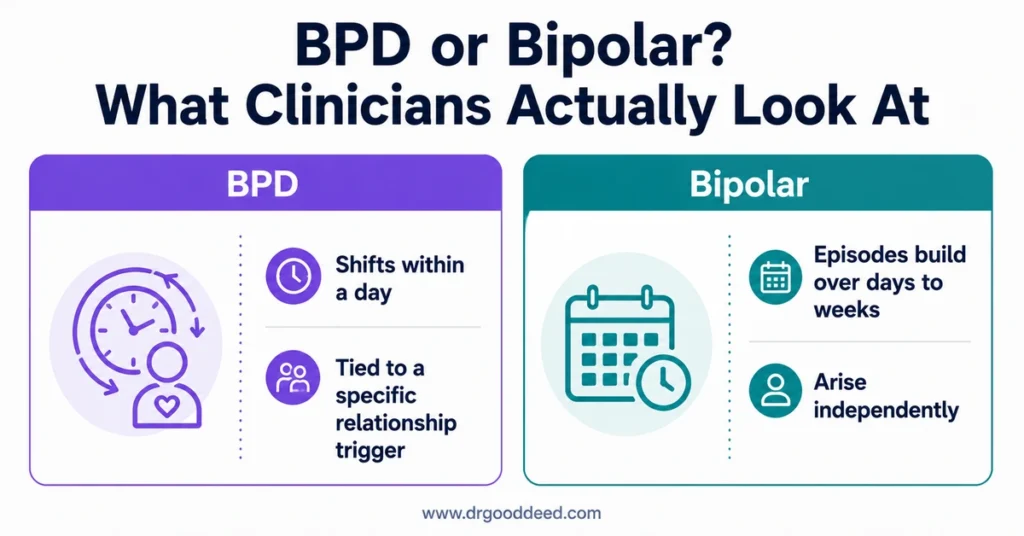
Expert Insight: Clinicians distinguish BPD-related mood shifts from bipolar episodes largely by looking at what triggers them, not how long they last. In BPD, an emotional swing is typically reactive to a specific interpersonal event, a canceled plan, a perceived slight, while bipolar mood episodes tend to arise on their own timeline, independent of an outside trigger.
Why BPD Is Often Misdiagnosed as Bipolar Disorder or PTSD
BPD misdiagnosis happens routinely because its symptoms overlap on the surface with two other conditions, bipolar disorder and complex PTSD.
- BPD vs bipolar: the American Psychiatric Association notes that BPD symptoms tend to be present over years, waxing and waning, while bipolar mood episodes arrive and resolve in discrete stretches of days to weeks. BPD’s shifts within a single day, tied to a relationship trigger, are a different pattern than a bipolar manic or depressive episode building over time.
- Complex PTSD overlap: both conditions commonly involve a childhood trauma history, emotional numbing, and relationship instability, which makes them genuinely easy to confuse without a detailed clinical history that traces symptoms back to their origin.
- Treatment mismatch: mood stabilizers, often a first-line option for bipolar disorder, don’t reliably address the identity instability and relationship patterns that BPD-specific therapies are built to target.
- Getting the diagnosis wrong can mean years spent on a treatment plan aimed at the wrong target, while the underlying pattern keeps running in the background.
A detailed clinical history, tracking how symptoms started and what consistently triggers them, is what actually separates these conditions.
This Is Not Something to Diagnose Yourself
Online quizzes and symptom checklists cannot diagnose BPD, and treating one as a real diagnosis is a mistake with genuine consequences for treatment. Many of the individual signs described above, fear of rejection, mood swings, impulsivity, also show up in depression, anxiety, ADHD, and ordinary stress responses that have nothing to do with a personality disorder.
A licensed psychiatrist or psychologist diagnoses BPD through a structured clinical interview, a review of symptom history reaching back to adolescence, and often input from people close to the person being evaluated. If these patterns sound familiar, the next step is a professional evaluation, not a self-test.
Pro Tip: Keeping a simple daily log of mood shifts and what triggered them for two to four weeks gives a clinician far more useful diagnostic information than trying to recall symptoms from memory during a single appointment, since BPD’s fast, trigger-linked shifts are easy to underreport in hindsight.
If You Recognize These Signs in Yourself
Recognizing signs of BPD in women in your own life is unsettling, and reaching out for a professional evaluation is the most useful next step you can take. Start with a primary care doctor, a psychiatrist, or a psychologist who can run a full clinical assessment rather than trying to self-label beforehand. Bring specific, concrete examples, particular relationship patterns, specific mood shifts, specific impulsive episodes, rather than a general sense that something feels off.
If you’re having thoughts of suicide or self-harm right now, call or text 988 to reach the Suicide and Crisis Lifeline, available 24 hours a day across the United States. BPD carries a meaningfully elevated suicide risk compared with the general population, and that risk is one of the clearest reasons professional support matters here, not something to manage alone.
If You’re Worried About Someone You Love
Approaching someone you love about BPD relationship patterns works better as an ongoing, low-pressure conversation than a single confrontation. Focus on specific behaviors you’ve actually noticed, rather than naming a diagnosis they haven’t received from a professional. Avoid ultimatums tied to their emotional reactions, since invalidating how someone feels tends to escalate the exact instability you’re worried about in the first place.
Encourage professional evaluation gently and repeatedly, rather than pushing it once and giving up. If you ever believe someone is in immediate danger of harming themselves, treat it as a crisis: call or text 988, or go to the nearest emergency room. Family involvement in treatment, when the person consents to it, is consistently linked to better outcomes.
Getting Help: Treatment That Works
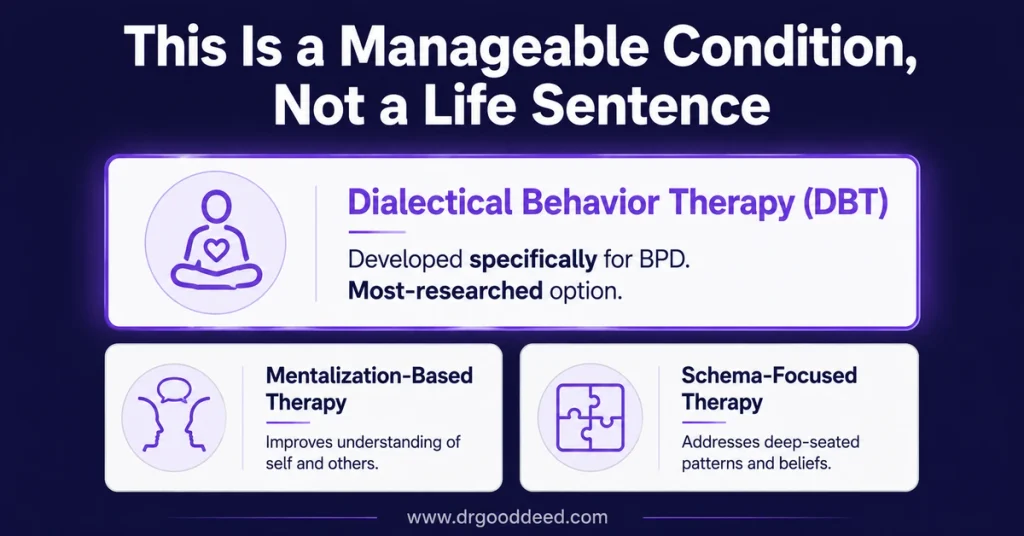
BPD treatment options with the strongest evidence base are structured talk therapies, not medication alone. Dialectical behavior therapy was developed specifically for BPD, and it teaches skills for tolerating distress, managing intense emotions, and improving relationships; it remains the most researched therapy for this condition. Other evidence-based options include mentalization-based therapy and schema-focused therapy, both aimed at the identity and relationship instability at the core of BPD.
Medication isn’t the primary treatment for BPD itself, though doctors sometimes prescribe it for co-occurring conditions like depression or anxiety that show up alongside it. Dosage and specific regimens vary by individual and are determined by a prescribing physician. Many people with BPD see substantial, lasting symptom improvement with consistent treatment. This is a manageable condition with real, evidence-backed paths forward, not a permanent life sentence.
Sources
- National Institute of Mental Health: Borderline Personality Disorder link
- American Psychiatric Association: What Is Borderline Personality Disorder? link
- American Psychiatric Association: Personality Disorders link
- MedlinePlus: Borderline Personality Disorder link
- SAMHSA: What Is Borderline Personality Disorder? link
- 988 Suicide and Crisis Lifeline link