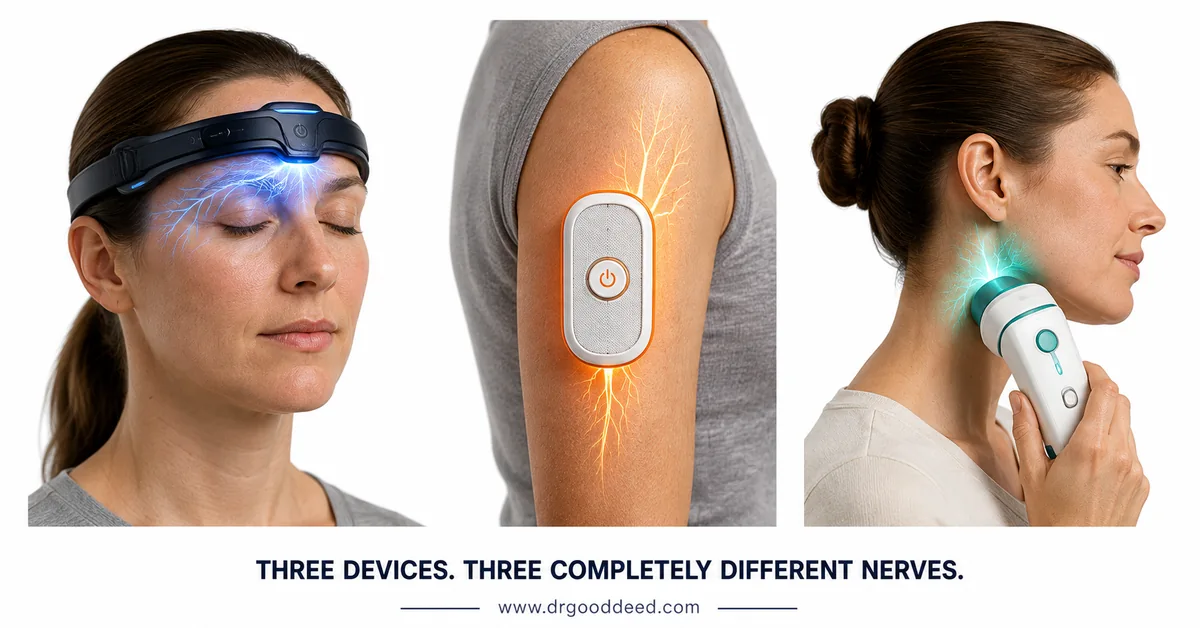

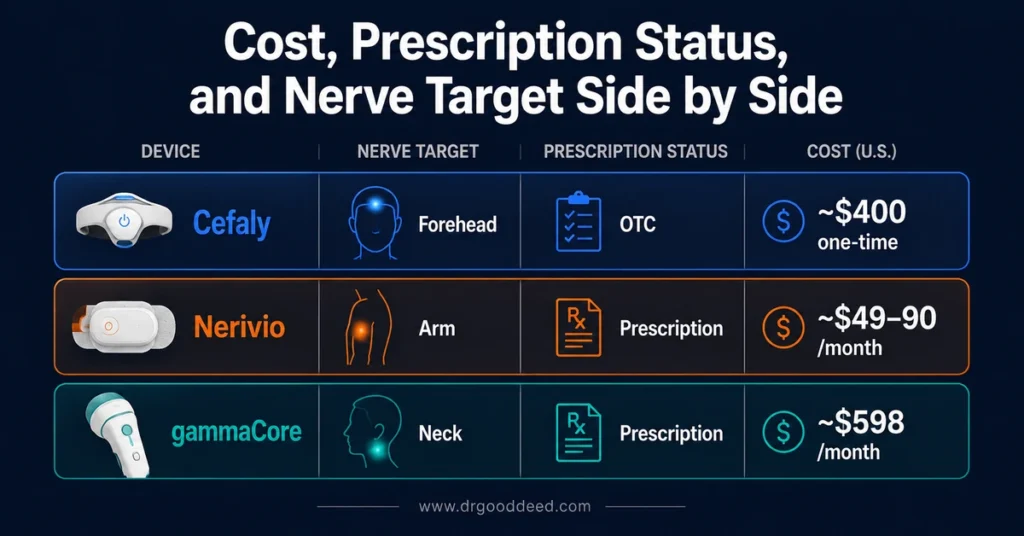
A migraine device works by stimulating a specific nerve pathway to interrupt or prevent migraine pain, and the three leading FDA-cleared options, Cefaly, Nerivio, and gammaCore, each target a completely different nerve. That distinction matters more than most comparison articles admit. Cefaly works on your forehead, Nerivio works on your arm, and gammaCore works on your neck. Picking between them is about which mechanism, cost, and daily routine actually fits your life.
Key Takeaways
- Cefaly stimulates the trigeminal nerve through a forehead electrode and is sold over the counter in the US, no prescription needed.
- Nerivio stimulates nerves in the upper arm through a smartphone-controlled patch, triggering a body-wide pain-blocking response called conditioned pain modulation.
- GammaCore stimulates the vagus nerve in the neck using a handheld device pressed against your skin, and it requires a prescription.
- All three are FDA cleared, but they were cleared for slightly different uses (prevention, acute treatment, or both).
- Cost varies enormously between them, so talk to a headache specialist about which migraine wearable device matches your budget and daily schedule.
Migraine Devices at a Glance (Comparison Table)
Before choosing a migraine device, it helps to see the core differences side by side rather than reading three separate product pages. Nerve target, prescription status, and session length all affect how realistically you’ll stick with the device long term. Here’s how Cefaly, Nerivio, and gammaCore stack up on the details that actually change day-to-day use.
| Feature | Cefaly | Nerivio | gammaCore |
| Nerve targeted | Trigeminal nerve (forehead) | Arm nerve fibers (upper arm) | Vagus nerve (neck) |
| Prescription required | No, over the counter | Yes | Yes |
| Session length | 20 min (prevention) or up to 60 min (acute) | 45 minutes | Two 2-minute stimulations per use |
| Approximate cost | One-time device cost, roughly 400 | About 90 per month for refill codes | About $598 per month before assistance programs |
| FDA-cleared for | Migraine prevention and acute treatment | Acute migraine and cluster headache treatment | Migraine and cluster headache, acute and preventive |
Cefaly: How It Works and What to Expect
Cefaly delivers mild electrical pulses through a small electrode placed on your forehead, targeting the trigeminal nerve, the nerve most closely linked to migraine pain signaling.
- Cefaly is a migraine device you buy directly, no doctor’s note required, which makes it the easiest of the three to try first. For prevention, sessions run about 20 minutes daily.
- For treating an active migraine attack, sessions can run up to 60 minutes. That longer acute session is the trade-off worth knowing before you buy: you’re expected to sit or lie down quietly with the electrode in place, which can feel inconvenient if you’re at work or need to keep functioning during an attack.
Nerivio: How It Works and What to Expect
Nerivio uses a small patch worn on your upper arm and controlled entirely through a smartphone app, a setup called remote electrical neuromodulation.
- Instead of acting directly on a pain nerve near your head, Nerivio stimulates arm nerve fibers to trigger conditioned pain modulation, a mechanism where your brain’s own descending pain-control pathways get activated to dial down migraine pain.
- Nerivio migraine device requires a prescription, and treatment sessions last about 45 minutes. Because the app runs quietly in the background, you can keep doing normal tasks, answering emails, resting on the couch, even light chores, while the session runs, which is a real practical advantage over devices that demand you stay still.
gammaCore: How It Works and What to Expect
gammaCore is a handheld device you hold against the side of your neck to stimulate the vagus nerve, a nerve that runs from your brainstem down through your neck and influences pain processing, inflammation, and several other body functions.
- gammaCore requires a prescription, and each use involves two separate 2-minute stimulation cycles, making individual sessions notably shorter than Cefaly or Nerivio.
- gammaCore migraine wearable device is cost: it runs meaningfully higher than the other two options, often around $598 a month before any manufacturer assistance program is applied, which shapes who realistically has access to it.
Which One Might Be Right for You
Choosing between these three often comes down to three practical filters, since head-to-head trials comparing all three directly are limited. Access, lifestyle, and budget tend to matter more day to day than which mechanism sounds most advanced.
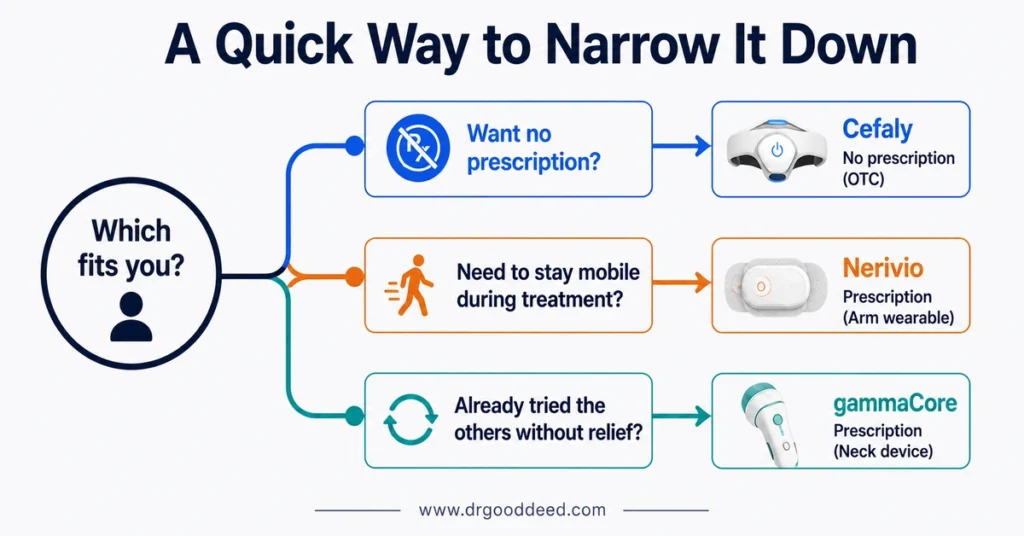
- If you want to try something without a doctor’s visit first, Cefaly’s over-the-counter status makes it the lowest-friction starting point.
- If sitting still during a migraine isn’t realistic for you, Nerivio’s app-controlled arm patch lets you stay mobile during treatment.
- If cost is your primary constraint, Cefaly’s one-time purchase and Nerivio’s lower monthly cost are more accessible than gammaCore for most people without extensive insurance support.
- If you’ve already tried trigeminal or arm-based options without relief, gammaCore’s different nerve target (vagus nerve) may be worth discussing with your doctor, since a different mechanism sometimes helps when another hasn’t.
Migraine response to any migraine device varies from person to person, and evidence comparing long-term outcomes across all three head-to-head is still limited.
Expert Insight: A patient who doesn’t respond to trigeminal nerve stimulation via Cefaly isn’t necessarily a poor candidate for neuromodulation overall, since Nerivio and gammaCore work through entirely separate pain-control pathways, arm-based conditioned pain modulation versus vagus nerve stimulation, so a non-response to one device says little about the other two.
Cost and Insurance Considerations
Cost is where these three migraine devices diverge the most, and it’s often the deciding factor once mechanism and prescription status are settled.
- Cefaly involves a single upfront device purchase, typically in the 400 range, with no recurring cost beyond replacing electrodes.
- Nerivio runs on a subscription-style model, roughly $49 to $90 monthly for refill treatment codes.
- gammaCore sits in a different bracket entirely, often near $598 monthly before any patient assistance program is factored in.
Insurance coverage varies widely by plan and by device, some insurers cover prescription-only devices like Nerivio or gammaCore under durable medical equipment benefits, while Cefaly, being over the counter, is rarely covered directly, though it may qualify for HSA or FSA reimbursement.
Pro Tip: Before assuming a device is unaffordable, check the manufacturer’s own patient assistance or savings program directly, gammaCore in particular offers a savings card that can substantially cut the out-of-pocket monthly cost for eligible patients, a detail often left out of basic cost comparisons.
When to Talk to Your Doctor
Talk to your doctor before starting any migraine device if you have a pacemaker, implanted metal near the device site, epilepsy, or if you’re pregnant, since manufacturers list these as situations needing individual medical guidance. A doctor can also help you decide between Nerivio and gammaCore, since both need a prescription anyway, and can flag whether your specific migraine pattern makes one nerve target more logical to try first.
FAQs
Is Cefaly available without a prescription?
Yes. Cefaly is sold over the counter in the US, unlike Nerivio and gammaCore, which both require a prescription from a licensed provider before purchase.
Which migraine device is the cheapest long term?
Cefaly, due to its one-time purchase model. Nerivio costs 90 monthly on an ongoing basis. gammaCore is the most expensive at roughly $598 monthly before assistance programs.
Can I use more than one migraine device at the same time?
Ask your doctor first. No published data confirms it’s safe or more effective to combine devices targeting different nerves, so this decision should be individualized, not self-directed.
Do these devices replace migraine medication?
No. All three are cleared as treatment options, not medication replacements. Many patients use them alongside, not instead of, prescribed migraine medication under a doctor’s guidance.
Which device requires the least time per session?
gammaCore, at two 2-minute stimulation cycles per use. Cefaly’s acute sessions run up to 60 minutes, and Nerivio’s sessions run about 45 minutes.
Sources
- U.S. Food and Drug Administration, medical device clearance database link
- Cefaly manufacturer clinical and product information link
- Nerivio (Theranica) manufacturer clinical and product information link
- gammaCore (electroCore) manufacturer clinical and product information link
- National Institute of Neurological Disorders and Stroke, migraine information link