
Bipolar disorder with psychotic features often gets noticed by family first, not by the person experiencing it. Psychosis genuinely impairs a person’s ability to recognize their own delusions or hallucinations as abnormal, so a loved one watching from the outside is frequently the one who sees something has shifted. This guide explains what this combination looks like, why it always needs urgent psychiatric evaluation, and how to help.
Key Takeaways
- Psychosis during a mood episode often impairs the person’s own insight, family members frequently notice it before the person does.
- This combination always requires urgent professional evaluation, not a wait-and-see approach.
- Psychotic bipolar symptoms do not automatically mean a more severe illness across every measure, research on this is genuinely mixed.
- Effective psychiatric treatment, typically including medication, exists and works.
- Crisis support is available around the clock through 988.
What “Psychotic Features” Means in Bipolar Disorder
Bipolar disorder with psychotic features refers to hallucinations or delusions occurring during a manic, depressive, or mixed episode, a recognized clinical specifier. Roughly three out of five people with bipolar I disorder experience psychotic symptoms at some point.
- Hallucinations: hearing, seeing, or sensing things that aren’t there, most often auditory during bipolar episodes.
- Delusions: fixed, false beliefs held with complete conviction despite clear contrary evidence, such as believing one has extraordinary powers or is being targeted by outside forces.
- This is distinct from borderline personality disorder, which involves relationship and identity instability rather than a break from shared reality, and from schizoaffective disorder, where psychosis persists independent of mood episodes rather than appearing alongside them.
Signs Loved Ones Often Notice First
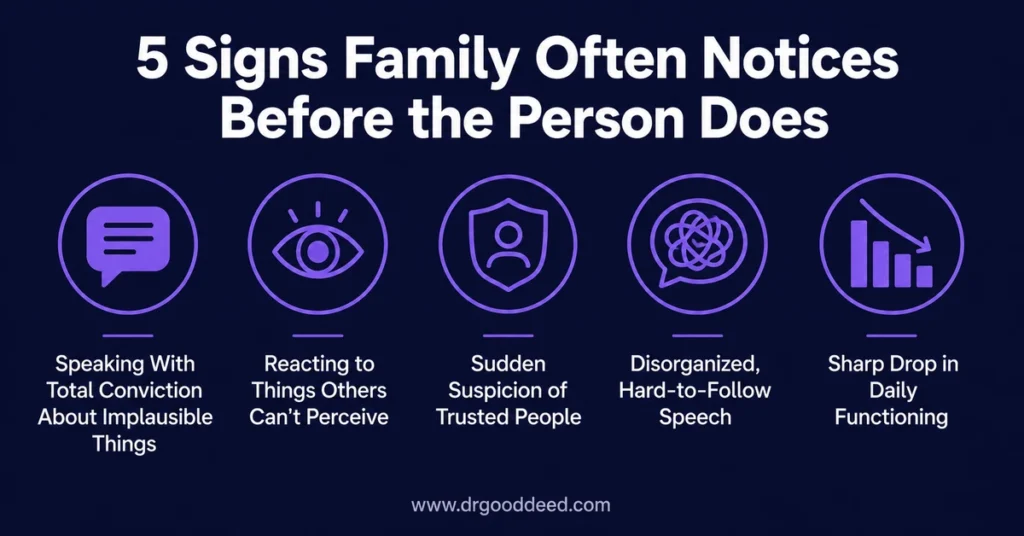
Family members typically notice behavioral shifts before the person recognizes anything unusual themselves, since psychosis directly disrupts the self-awareness needed to flag it.
- Speaking with total conviction about implausible things, unlimited wealth, special abilities, or a secret mission, delivered with no doubt or hesitation.
- Reacting to things others can’t see or hear, glancing at empty corners, responding to voices, or appearing distracted by something not present in the room.
- Sudden, extreme suspicion of trusted people, accusing family or close friends of plotting against them without any triggering event.
- Speech that becomes difficult to follow, rapid, disorganized, or jumping between unconnected ideas well beyond ordinary excitement or sadness.
- A dramatic drop in daily functioning, missed work, neglected hygiene, or an inability to carry out basic routines that were manageable days earlier.
Why This Always Requires Urgent Professional Care
Psychosis combined with a mood episode is a psychiatric emergency category. It always warrants prompt evaluation by a psychiatrist or an emergency department, distinct from a general nervous breakdown, which doesn’t involve a break from shared reality.
- If there’s any risk of harm to the person or others, or if the episode is acute, active, and escalating, call 911 or go to the nearest emergency room immediately.
- For crisis support at any point, call or text 988 to reach the Suicide and Crisis Lifeline, available 24 hours a day across the United States.
- Untreated psychosis alongside a mood episode carries real safety risk, and earlier intervention consistently leads to better outcomes.
Mood-Congruent vs Mood-Incongruent Delusions: Why the Difference Matters
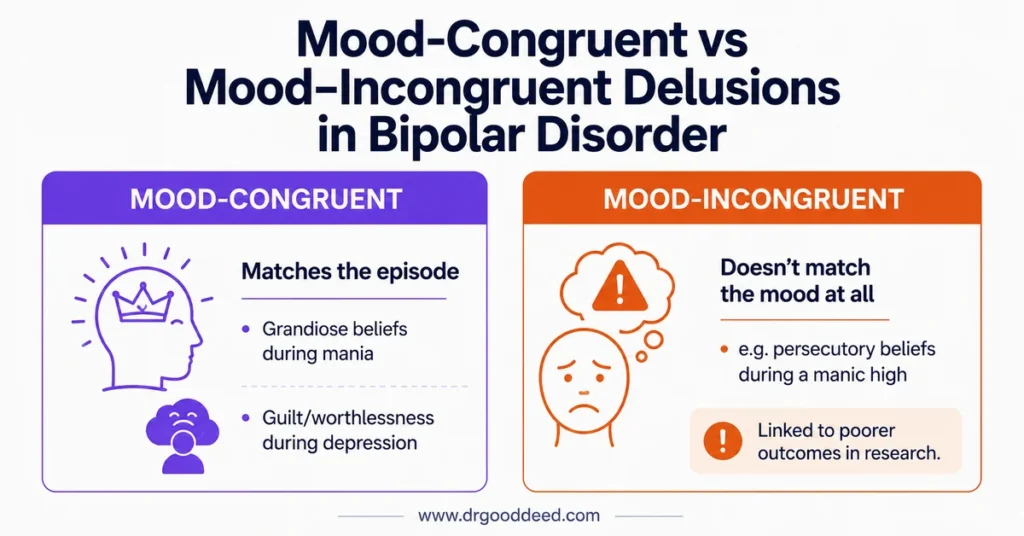
The content of a delusion tells a psychiatrist something clinically important.
- Mood-congruent delusions match the emotional tone of the episode: grandiose beliefs about wealth or special ability during mania, or beliefs about guilt, illness, or worthlessness during depression.
- Mood-incongruent delusions don’t match the emotional tone at all, persecutory or bizarre beliefs unrelated to mood during a manic high, for example.
- Research indicates mood-incongruent presentations are associated with poorer outcomes than mood-congruent ones, making this distinction genuinely useful for a psychiatrist assessing severity and treatment direction, not just a diagnostic label.
Does Psychosis Mean More Severe Bipolar Disorder?
A 2022 systematic review by Chakrabarti and Singh, along with earlier work by Burton and colleagues in 2017, found that psychotic bipolar disorder is linked to higher hospitalization rates, longer hospital stays, and poorer insight into illness.
But the same body of research found psychosis was not consistently linked to worse outcomes across every measure, some studies even found lower rates of rapid-cycling and lower suicide risk compared to non-psychotic bipolar disorder.
Expert Insight: Clinicians weigh hospitalization risk and insight impairment heavily when psychosis is present, but severity assessment in bipolar disorder with psychotic features has to look at the whole clinical picture rather than assuming psychosis alone predicts a worse overall course.
How to Support Someone During a Psychotic Episode
- Stay calm and avoid arguing directly against the delusion, contradiction rarely helps in the moment and can increase distress or mistrust.
- Speak in simple, direct sentences and avoid overwhelming the person with too much information at once.
- Remove immediate safety risks from the environment where reasonably possible without escalating tension.
- Contact their psychiatrist or care team promptly, or emergency services if the situation is acute or unsafe.
Pro Tip: Keeping a brief written timeline of specific behaviors observed, dates, what was said, how long it lasted, gives the treating psychiatrist far more diagnostic clarity in the first evaluation than a general description of “acting strange” recalled after the fact.
Getting Help: Treatment and Emergency Resources
Bipolar disorder with psychotic features requires professional psychiatric treatment, typically combining a mood stabilizer with an antipsychotic medication, decided by a psychiatrist based on the individual’s specific presentation.
Once the acute episode stabilizes, ongoing psychiatric care, therapy, and medication management support long-term stability. If the situation is an active emergency, call 911. For crisis support at any hour, call or text 988. Recovery is genuinely possible with consistent, professional treatment.