
The best prebiotic fiber powder depends on your digestive needs and tolerance. Look for a product with a clearly stated type and amount of fiber, minimal added sugar, no unnecessary ingredients, and a dose you can increase gradually.
Common prebiotic fibers include inulin, fructooligosaccharides (FOS), galactooligosaccharides (GOS), and partially hydrolyzed guar gum (PHGG), but some can cause gas or bloating, especially at higher doses. If you have a sensitive gut, start with a small serving, increase slowly, and choose a fiber you can tolerate consistently.
Key Takeaways
- Check the fiber type: Inulin, FOS, GOS, and PHGG have different effects and tolerability, so choose based on your digestive needs.
- Prioritize fiber content: Compare the actual grams of prebiotic fiber per serving rather than relying on claims like “high fiber.”
- Start with a low dose: Increasing prebiotic fiber gradually can reduce gas, bloating, cramps, and other digestive discomfort.
- Consider gut sensitivity: If you are prone to bloating or IBS-type symptoms, a gentler, better-tolerated fiber may be preferable.
- Avoid unnecessary additives: Look for simple formulas without excessive sugar, artificial sweeteners, or long lists of unnecessary ingredients.
- Check your overall fiber intake: A supplement should complement fiber from vegetables, fruits, legumes, whole grains, nuts, and seeds rather than replace them.
What Makes A Fiber Powder Genuinely Prebiotic Rather Than Simply High In Fiber?
A fiber only counts as a prebiotic when beneficial gut microorganisms selectively use it and produce a measurable health effect.
- Dietary fiber is a broad category that includes soluble, insoluble, fermentable, and non-fermentable types, so two products with identical fiber grams can behave completely differently in your gut.
- Prebiotic activity depends on selective fermentation. A substance earns the prebiotic label only when specific gut microorganisms use it as fuel and this produces a demonstrable physiological benefit.
- Fermentability varies widely across fiber types. Inulin and fructooligosaccharides ferment almost completely in the colon, while other fibers pass through largely intact and add bulk instead of feeding bacteria.
- A product can be excellent for stool regularity without being a strong prebiotic. Psyllium, for example, is prized for bowel regularity but is only modestly fermented.
Which Fibers Should Readers Expect To See In A True Prebiotic Powder Comparison?
- Inulin is a chicory-root-derived fiber that is highly fermentable and one of the most studied prebiotic substrates.
- Fructooligosaccharides (FOS) are shorter-chain relatives of inulin, also rapidly fermented, and common in “gut health” blends.
- Partially hydrolyzed guar gum (PHGG) ferments more slowly and gradually than inulin or FOS, which can mean fewer immediate gas symptoms.
- Acacia fiber is a soluble fiber that ferments slowly and is often chosen specifically because it is gentler on sensitive digestive systems.
- Resistant dextrin and other dextrin-type fibers are partially fermentable and frequently used in low-residue or IBS-friendly formulas.
- Psyllium is a bulking, gel-forming soluble fiber with strong clinical evidence for stool regularity, but its role differs from highly fermentable prebiotic fibers.
How We Compare Prebiotic Fiber Powders
A trustworthy comparison method looks past front-label claims and evaluates the actual fiber source, its fermentation behavior, and whether the dose on the Supplement Facts panel matches what the marketing implies.
Fiber Type Comes Before The Number Of Grams
- Fermentability determines how much gas-producing bacterial activity a fiber generates, and highly fermentable fibers like inulin create more short-chain fatty acids but also more gas in some people.
- Viscosity and gel formation matter for stool consistency; gel-forming soluble fibers such as psyllium slow transit and add moisture to stool, while non-gelling fibers mainly add bulk.
- Stool-bulking effect differs by fiber, so a probiotic for constipation needs a bulking or gel-forming fiber.
- Likely gas production should be weighed against fermentability, since the fibers with the strongest prebiotic reputation are often the same ones most likely to cause bloating at higher doses.
Does The Label Tell You Exactly How Much Active Fiber You Are Getting?
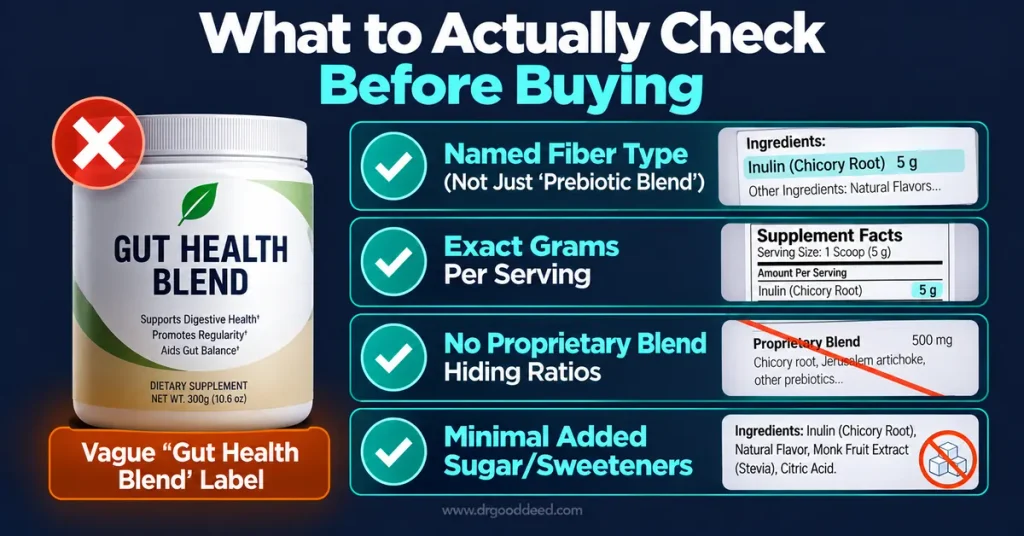
- Grams of fiber per serving should be checked against the named ingredient.
- Named fiber ingredient should be identifiable by type (inulin, PHGG, acacia, psyllium).
- Proprietary blends often hide the ratio of ingredients, making it impossible to know how much of the active prebiotic substrate you are actually consuming.
- Serving-size inflation can make a product look higher-fiber than a competitor simply because the recommended scoop is larger.
- A “prebiotic blend” listing without individual gram amounts prevents you from comparing true fermentable fiber content across brands.
- Added sugars and sweeteners can undercut a “gut health” positioning, since high-fructose sweeteners can themselves ferment and add unwanted gas.
- Unnecessary digestive enzymes, vitamins, or probiotic strains stacked into a fiber product often dilute the actual fiber dose per scoop and add cost without added benefit for most users.
Is The Product Designed For One Purpose Or Trying To Do Everything?
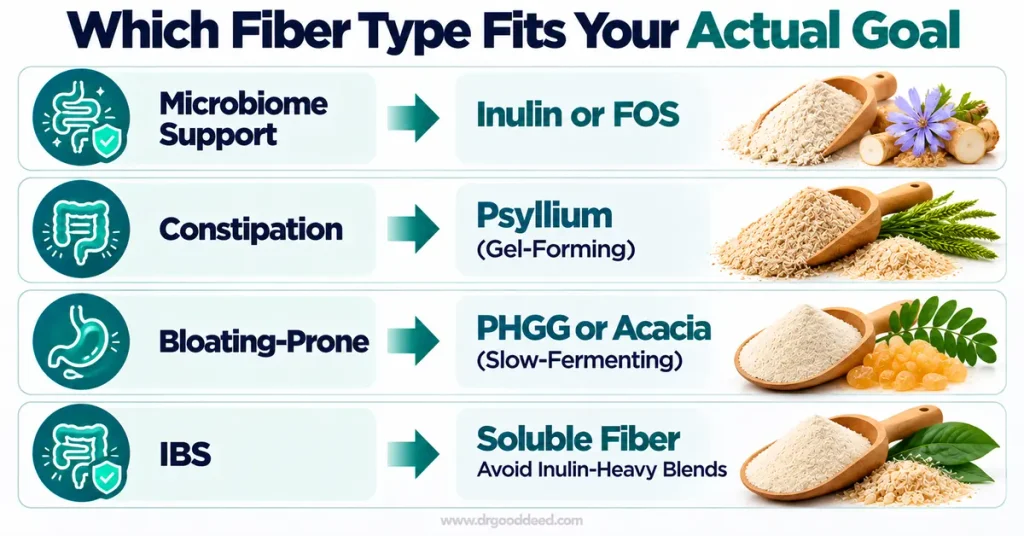
- Microbiome-support products typically lean on inulin or FOS at meaningful doses.
- Constipation and stool-regularity products typically center on psyllium or a comparable gel-forming soluble fiber.
- General daily fiber top-up products aim for a moderate, well-tolerated blend rather than an aggressive fermentation profile.
- IBS-sensitive formulations usually favor slower-fermenting soluble fibers such as PHGG or acacia over inulin-heavy blends.
A product should not score well in a comparison simply because it lists more ingredients. More components often mean a smaller effective dose of the fiber that actually matters for your goal.
Which Prebiotic Fiber Powder Fits Which Digestive Goal?
The right choice depends entirely on whether your priority is feeding gut bacteria, relieving constipation, avoiding bloating, or managing IBS.
Best Type When The Main Goal Is Supporting Beneficial Gut Microbes
Inulin and FOS remain the most heavily studied fermentable fibers for shifting gut bacterial populations, particularly increasing Bifidobacteria. However, it is important to note that changes in bacterial counts do not automatically translate into a measurable clinical health outcome, and evidence connecting microbiome shifts from powder supplementation to specific disease prevention in healthy adults remains limited.
Best Type When Constipation Matters More Than Microbiome Claims
Psyllium deserves separate treatment from fermentable prebiotics because its clinical strength lies in bulk and water-holding capacity, not fermentation. Psyllium is described as a poorly fermented, soluble, gel-forming fiber, and this gel formation is what improves stool frequency and consistency, distinct from how inulin works on bacterial populations.
Best Type For Someone Who Bloats Easily
Highly fermentable fibers like inulin and FOS can generate more gas in people with sensitive digestion because rapid bacterial fermentation produces gas as a byproduct.
- Slower-fermenting soluble fibers, along with gradual dose titration, tend to be easier to tolerate for bloating-prone individuals.
- Increase fiber intake gradually, since a rapid increase in fiber can cause gas and bloating regardless of which fiber source is used.
What Changes If Someone Has IBS?
- Fiber choice matters more than simply increasing total fiber intake when IBS is present.
- Soluble fiber has stronger evidence than insoluble fiber for improving overall IBS symptoms.
- A prebiotic powder should not be promised to improve IBS microbiome-driven symptoms, since fermentable prebiotic fibers can worsen bloating and abdominal pain in a subset of IBS patients.
Soluble fiber such as ispaghula (psyllium) when increasing fiber intake is appropriate for IBS, while discouraging insoluble fiber such as bran.
Which Prebiotic Fiber Powder Should You Choose For Your Specific Goal?
Choose based on your primary digestive goal rather than which product has the most aggressive marketing:
- Microbiome-focused goal: prioritize a named, well-studied prebiotic substrate such as inulin or FOS at a clearly labeled dose.
- Constipation: consider a soluble, gel-forming fiber such as psyllium, supported by ACG guidance for stool frequency and consistency.
- IBS or bloating: prioritize tolerability and soluble-fiber evidence over aggressive fermentation, and avoid inulin-heavy blends if bloating is your main complaint.
- Simple daily fiber top-up: prioritize transparent labeling and minimal unnecessary added ingredients over trendy “gut health” branding.
FAQs
Why Do Prebiotic Fiber Powders Cause Sudden Gas And Bloating?
Yes, this is common and expected. Rapidly fermentable fibers like inulin produce gas as bacteria break them down quickly in the colon.
How Many Weeks Does It Take To Notice Benefits?
Stool regularity changes from bulking fibers like psyllium can appear within days, while microbiome-related shifts from fermentable prebiotics like inulin typically take several weeks of consistent daily use, and full symptom stabilization can take up to 4 weeks in clinical settings.
Is It Safe To Take Prebiotic Fiber Every Day Long-Term?
Yes, for most healthy adults, daily prebiotic fiber intake within recommended amounts is considered safe long-term. Adequate water intake matters, especially with gel-forming fibers like psyllium, and anyone with a diagnosed GI condition should confirm suitability with a healthcare provider first.
Can Children Take Prebiotic Fiber Supplements?
This depends on age, dose, and the specific fiber, and should be guided by a pediatric healthcare provider rather than adult dosing charts. Children’s fiber needs are lower than adults’, and some fermentable fibers have limited pediatric safety data at adult-marketed doses.
Does Mixing Fiber Powder Into Hot Coffee Destroy Its Benefits?
No, moderate heat from coffee or tea does not meaningfully destroy fiber’s structure or fermentability. Fiber is generally heat-stable compared to some vitamins or live probiotic strains, so mixing into a warm beverage is not a significant concern for most fiber types.
Sources:
- U.S. FDA: Dietary Fiber Guidance link
- NIDDK: Fiber and Digestive Health link
- ACG Clinical Guideline on IBS Management link
- NICE Guidance on IBS in Adults link
- NHS: Fiber Recommendations link
- UK Food Standards Agency: Supplement Guidance link
Medical Disclaimer: This article is for general information only and is not medical advice. It does not replace a diagnosis, treatment plan, or guidance from a qualified healthcare professional. Always talk to your doctor about your own symptoms and before starting, stopping, or changing any treatment. If you think you may be having a medical emergency, call 911 or go to your nearest emergency room.