

The best probiotic for constipation contains clinically tested strains like Bifidobacterium lactis, Lactobacillus casei, or Bifidobacterium longum, with a CFU (colony-forming units, the count of live bacteria per dose) of at least 10 billion. Constipation affects around 16% of adults in the US, and probiotic use for gut health has grown significantly as research continues to support specific strains for stool frequency and gut transit (how fast food moves through your intestines).
Not every probiotic on the shelf works for constipation. Most products don’t list the specific strains that actually matter. Knowing which strains to look for, how much to take, and how long to stay consistent will determine whether your probiotic works or sits on a shelf doing nothing.
Which Probiotic Strains Relieve Constipation
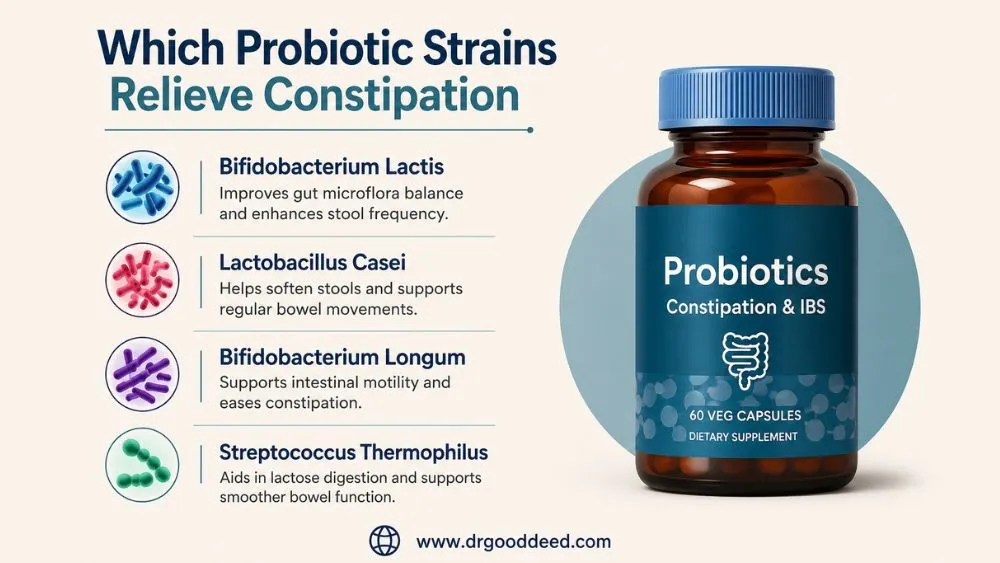
Whether probiotic strains relieve constipation is the most important question to answer before buying anything. Strain identity, not brand name, determines results. Three strains have the strongest clinical support for constipation relief specifically.
Bifidobacterium Lactis (Improves Stool Frequency)
Bifidobacterium lactis is the most studied strain for constipation. It directly increases bowel movement frequency by improving gut motility (the speed at which your intestines move waste through). Clinical studies show it increases stool frequency by up to 1.3 times per week in people with chronic constipation. It also softens stool consistency, making passage easier without causing diarrhea.
Look for the specific sub-strains B. lactis HN019 or B. lactis DN-173 010. These two have the strongest research behind them for constipation specifically.
Lactobacillus Casei (Supports Gut Motility)
Lactobacillus casei works by stimulating the muscles in your intestinal wall. Those muscles contract in waves (called peristalsis) to push waste forward. When gut motility slows down, constipation develops. L. casei helps restore normal muscle movement in the gut, reducing the time waste stays in your colon.
It works well alongside B. lactis in multi-strain formulas, especially for people whose constipation worsens with stress or dietary changes.
Bifidobacterium Longum (Reduces Transit Time)
Transit time is how many hours it takes food to move from your mouth to elimination. Normal transit time is 24 to 72 hours. In constipation, it often stretches past 72 hours. Bifidobacterium longum reduces transit time measurably. It also lowers gut inflammation (irritation in your intestines) that sometimes makes constipation worse. People with constipation linked to IBS (Irritable Bowel Syndrome) respond particularly well to this strain.
How to Choose the Best Probiotic for Constipation
The best probiotic for constipation isn’t always the most expensive or the one with the most strains listed on the label. Four factors matter most when choosing.
CFU Count (10 to 20 Billion Recommended)
Doses below 5 billion CFU rarely produce measurable results for constipation. Most clinical studies on constipation use doses between 10 and 50 billion CFU daily. For most adults, starting at 10 to 20 billion CFU is effective and well-tolerated.
Single Strain vs Multi-Strain Formulas
Single-strain products give you the highest dose of one specific strain. Multi-strain products spread the CFU across several strains. For constipation, a single-strain product with 20 billion CFU of B. lactis HN019 outperforms a multi-strain product with 2 billion CFU of five different bacteria. Concentration matters more than variety for this specific condition.
Clinically Tested Strains
Always check the label for exact strain identifiers. A label that just says Lactobacillus acidophilus with no strain code tells you very little. Labels that specify B. lactis HN019 or L. rhamnosus GG signal that the manufacturer is using research-backed strains. Avoid generic blends with no strain-level detail.
Capsule vs Powder vs Food Sources
Capsules with enteric coating (a protective layer that prevents stomach acid from destroying the bacteria before they reach your intestines) survive better in the digestive tract. Powders work but require careful storage.
Probiotic-rich foods like yogurt, kefir, and sauerkraut contain live cultures but in much lower CFU counts, typically under 1 billion per serving. They support gut health but are unlikely to resolve active constipation on their own.
Probiotics for Irregular Bowel Habits
Probiotics for irregular bowel habits work by addressing the three core problems that cause unpredictable or infrequent bowel movements.
Improving Gut Motility
Slow intestinal muscle contractions are the most common cause of chronic constipation. L. casei and B. lactis both stimulate intestinal muscle activity, pushing stool forward more reliably. Most people see improvement in bowel regularity within 2 to 3 weeks of consistent use.
Balancing Gut Microbiome
An overgrowth of harmful bacteria in your gut (called dysbiosis) slows fermentation, reduces gas production that helps move stool, and increases gut inflammation. Probiotics restore a healthier bacterial balance. A balanced microbiome (the full community of bacteria in your digestive system) produces short-chain fatty acids that feed your gut lining and improve bowel regularity.
Softening Stool Consistency
Hard, pellet-like stools are a direct sign of slow gut transit and insufficient water retention in the stool. B. lactis strains improve the water-holding capacity of stool, making it softer and easier to pass without the need for laxatives (medicines that force bowel movements). This change typically appears within 2 weeks of daily probiotic use.
Probiotics for Hard Stools and Constipation
Probiotics for hard stools and constipation target three specific physiological problems, each of which contributes to the difficulty and pain of passing hard stool.
Increasing Water Retention in Stool
Stool becomes hard when your colon absorbs too much water from it during slow transit. B. lactis HN019 speeds up transit time, reducing the window your colon has to extract water. Faster transit means softer, bulkier stool.
Reducing Gut Inflammation
Chronic low-grade gut inflammation is a frequently missed cause of constipation. Inflamed gut tissue loses its ability to secrete mucus properly. Mucus coats the intestinal lining and helps stool slide through. B. longum reduces inflammatory markers in the gut lining, partially restoring mucus secretion and improving stool passage.
Supporting Regular Bowel Movements
Regular bowel movements (at least 3 per week for adults) depend on consistent bacterial activity in the colon. Probiotics produce lactic acid and butyrate (short-chain fatty acids that stimulate the nerves controlling bowel movement). Without enough beneficial bacteria, this nerve signaling becomes weak, and bowel movements slow down.
How to Take Probiotics for Constipation
Taking probiotics for constipation correctly matters as much as which strain you choose. Timing, consistency, and what you pair them with all affect results.
Best Time to Take Probiotics (Morning vs Before Meals)
Take probiotics 20 to 30 minutes before your first meal of the day. Stomach acid is lowest before you eat, so more live bacteria survive the trip to your intestines. B. lactis HN019 and B. longum survive better in a lower-acid environment. Avoid taking them with hot beverages, since heat above 40°C (104°F) kills most probiotic bacteria.
Consistency and Duration
Constipation responds to probiotics over 2 to 4 weeks, but only with daily use. Missing doses reset the colonization process. Use the same probiotic daily for at least 4 weeks before concluding whether it works. Stopping after 10 days because you don’t see results is one of the most common errors people make.
Combining with Fiber and Hydration
Probiotics and prebiotic fiber to survive and multiply in your gut. Add foods like oats, garlic, bananas, and onions. Drink at least 6 to 8 glasses of water daily. Without adequate hydration, stool remains hard regardless of probiotic use, because the colon pulls water from stool when the body is dehydrated.
How Long Probiotics Take to Relieve Constipation
For constipation specifically, the typical timeline is: stool softening begins within 7 to 14 days, bowel movement frequency improves within 2 to 3 weeks, and consistent regularity is established by week 4. Severe or long-standing constipation takes 6 to 8 weeks of daily use. Taking the wrong strain extends the timeline without producing results.
- Days 1 to 7: Gut bacteria begin adjusting. Some temporary gas is normal.
- Weeks 1 to 2: Stool starts softening. Transit time shortens slightly.
- Weeks 2 to 4: Bowel movements become more frequent and predictable.
- Weeks 4 to 8: Full regularity establishes. Symptoms of chronic constipation reduce significantly.
Common Mistakes When Using Probiotics for Constipation
The common mistakes when using probiotics for constipation are specific and avoidable. Most people make at least two of these.
- Choosing the wrong strain. Taking a vaginal health probiotic or immune-focused blend for constipation rarely works. Match the strain to the condition.
- Stopping too early. Two weeks is not enough for chronic constipation. Give it 4 to 8 weeks.
- Low CFU count. A product with 1 billion CFU won’t produce measurable results. Use 10 to 20 billion minimum.
- Skipping fiber. Probiotics without fiber are like planting seeds in dry concrete. They won’t grow.
- Taking probiotics with hot drinks. Heat above 40°C kills probiotic bacteria before they reach your gut.
- Ignoring storage instructions. Some strains die at room temperature. If the label says refrigerate, refrigeration is not optional.
When Probiotics May Not Work
Probiotics for constipation don’t work in every case. Certain situations reduce or eliminate their effectiveness.
- Structural issues. Conditions like pelvic floor dysfunction (when the muscles controlling bowel movements don’t coordinate properly) or rectal prolapse (when the rectum slides out of position) don’t respond to probiotics.
- Medication-induced constipation. Opioid pain medications, iron supplements, and some antidepressants slow gut motility in ways probiotics cannot overcome. Addressing the medication is the priority.
- Hypothyroidism. An underactive thyroid (a gland in your neck that controls metabolism) slows every body system, including gut motility. Probiotics help slightly but don’t fix the root cause.
- Severely depleted microbiome. Extended antibiotic use can wipe out gut bacteria to a point where standard probiotic doses can’t rebuild the population fast enough on their own.
When to See a Doctor
Constipation lasting more than 3 weeks without any improvement needs medical evaluation. See a doctor if you also notice blood in stool, unexplained weight loss, severe abdominal pain, or a sudden change in bowel habits after age 50. These symptoms can signal conditions like colorectal cancer, inflammatory bowel disease (IBD), or bowel obstruction, none of which respond to probiotics.
Probiotics are safe to try for functional constipation. They are not a substitute for diagnosis when warning signs are present.
FAQs
What Is the Best Probiotic for Constipation?
The best probiotic for constipation contains Bifidobacterium lactis HN019 at 10 to 20 billion CFU. This specific sub-strain increases stool frequency by up to 1.3 times per week in clinical testing. Look for the strain code on the label, not just the genus name.
Which Probiotic Strains Relieve Constipation Effectively?
Probiotic strains relieve constipation most reliably: B. lactis HN019 for stool frequency, B. longum for faster transit time, and L. casei for gut muscle movement. These three have direct clinical evidence for constipation. Other strains are formulated for different gut conditions.
Do Probiotics Help with Irregular Bowel Habits?
Yes. Probiotics for irregular bowel habits restore gut motility and bacterial balance, two root causes of irregular bowel movements. B. lactis and L. casei improve bowel movement frequency within 2 to 3 weeks of daily use at 10 to 20 billion CFU.
How to Take Probiotics for Constipation Correctly?
To take probiotics for constipation, take them 20 to 30 minutes before breakfast, with water (not hot beverages), at 10 to 20 billion CFU daily. Pair with prebiotic fiber from oats or garlic, and drink 6 to 8 glasses of water daily. Consistency every single day is non-negotiable.
How Long Do Probiotics Take to Work for Constipation?
Stool softening starts within 7 to 14 days. Bowel movement frequency improves by weeks 2 to 3. Full regularity is established by week 4. Chronic constipation takes 6 to 8 weeks. Results depend entirely on daily consistency and correct strain selection.
Can Probiotics Soften Hard Stools?
Yes. Probiotics for hard stools and constipation, specifically B. lactis HN019, reduce colon transit time so less water gets absorbed from stool. Softer stool appears within 1 to 2 weeks of daily use. Combining the probiotic with 25 to 30 grams of daily fiber accelerates this effect.
Why Are Probiotics Not Working for My Constipation?
Check four things: the strain (must be B. lactis, B. longum, or L. casei), the dose (10 billion CFU minimum), the duration (must be at least 4 weeks), and your diet (fiber and water intake must be adequate). If all four are correct, constipation may have a structural or hormonal cause needing medical evaluation.
What Foods Improve Probiotic Effectiveness?
Prebiotic-rich foods directly feed probiotic bacteria: garlic, onions, oats, bananas, and asparagus. These foods contain inulin and resistant starch (types of fiber that probiotic bacteria ferment for energy). Adding these daily speeds up probiotic colonization and extends how long beneficial bacteria survive in your gut.
Are Probiotics Safe for Daily Use?
Yes. Probiotics are safe for most adults to take daily, including long-term. People with severely weakened immune systems (such as those on chemotherapy or with HIV) should consult a doctor before starting. For healthy adults with constipation, daily use of 10 to 20 billion CFU has no known serious risks.
When Should I See a Doctor for Constipation?
See a doctor if constipation lasts more than 3 weeks with no improvement, or if you notice blood in stool, abdominal pain that worsens, or sudden changes in bowel habits. These signs go beyond what the best probiotic for constipation can address and need medical diagnosis.