
The time it takes for probiotics to work depends on your specific gut issue. For mild bloating or gas, changes appear in 3 to 7 days. For IBS (Irritable Bowel Syndrome) or chronic constipation, expect 4 to 8 weeks. The probiotic strain you take, your current gut health, and what you eat all determine how fast results show up.
Your gut contains over 1,000 bacterial species. Adding new probiotic bacteria into that environment doesn’t instantly fix things. It triggers a process. That process follows a predictable pattern, and knowing it helps you set realistic expectations.
Timeline for Probiotic Benefits
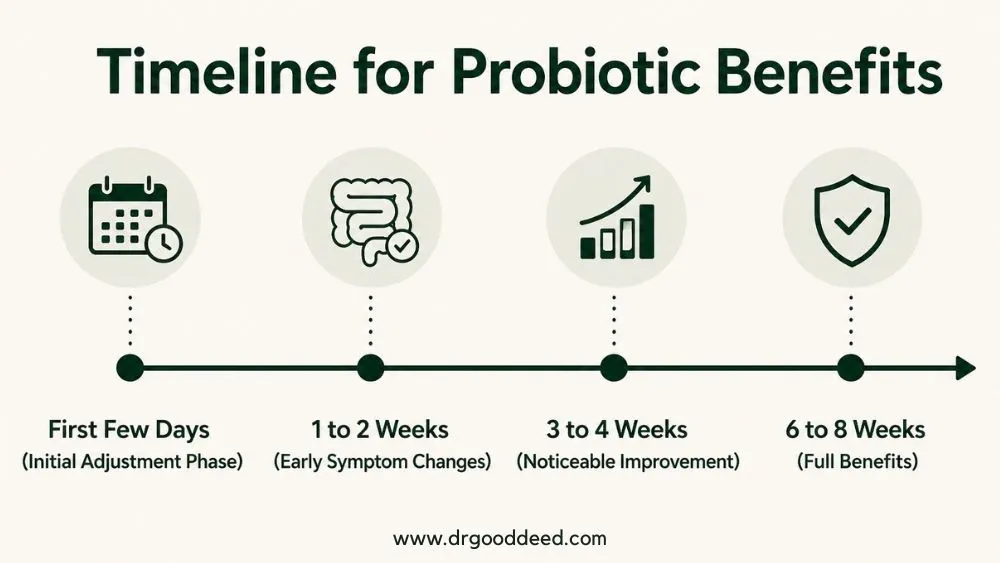
The timeline for probiotic benefits follows four distinct stages. Results don’t arrive randomly. They follow a biological sequence that most people skip past when they expect fast outcomes. Here’s what actually happens, week by week.
First Few Days (Initial Adjustment Phase)
Days 1 through 4 are often the most uncomfortable. You may feel more bloated or gassy than before starting. This is your gut microbiome (the full community of bacteria living in your digestive tract) reacting to a sudden influx of new bacteria. It’s not failure. It’s adaptation. This phase typically clears by day 5.
1 to 2 Weeks (Early Symptom Changes)
By week one, early changes start appearing. Gas becomes less frequent. Bloating after meals eases up. Bowel movements become slightly more predictable. These are signs that probiotic bacteria are beginning to attach to your gut lining and compete with harmful bacteria.
People who recently finished antibiotics sometimes notice faster early changes because antibiotics wipe out competing bacteria, leaving more space for probiotics to colonize.
3 to 4 Weeks (Noticeable Improvement)
This is where most people first say they actually feel a difference. Digestion feels smoother. Bloating after meals becomes occasional rather than constant. Loose stools or constipation starts to normalize. The time it take for probiotics to work for general digestive health? For most healthy adults, this is the honest answer: 3 to 4 weeks.
6 to 8 Weeks (Full Benefits)
Full gut microbiome stabilization happens around the 6 to 8 week mark. Probiotic strains become fully integrated into your gut’s bacterial community. Energy improves for some people. Skin and immune responses also shift during this window. Benefits like reduced gut inflammation and improved gut lining integrity (the strength of your gut’s protective wall) take at least 6 weeks of consistent use to develop.
How Fast Probiotics Improve Gut Health
Probiotics improve gut health is shaped by three factors, none of which is the brand you buy.
Type of Gut Issue (Bloating, IBS, Constipation)
Simple gas from food sensitivity improves in under a week with the right strain. IBS takes 4 to 6 weeks minimum. best probiotics help Constipation typically improves by weeks 2 to 3, especially with Bifidobacterium lactis strains. The more complex the gut issue, the longer the wait.
Severity of Imbalance
Severe gut bacterial imbalance (called dysbiosis) slows everything down. Someone with mild occasional bloating sees results faster than someone who spent two weeks on broad-spectrum antibiotics. The deeper the disruption, the longer the rebuild takes.
Individual Microbiome Differences
No two guts are identical. Your personal bacterial composition directly affects how well a specific strain survives and multiplies. This explains why two people take the same product and report completely different results at completely different speeds.
Best Probiotic Strains for Quick Relief
The best probiotic strains for quick relief are determined by strain identity, not brand name. Strain selection is the single most important factor for faster results.
Lactobacillus Strains (Fast Symptom Relief)
Lactobacillus rhamnosus GG is one of the most clinically studied strains in the world. It reduces diarrhea symptoms within 2 to 3 days. Lactobacillus acidophilus targets general gut discomfort and begins working within the first week for most people with mild issues.
Bifidobacterium Strains (Bloating and IBS Support)
Bifidobacterium infantis 35624 is the most studied strain for IBS. It reduces abdominal pain and bloating within 4 weeks of consistent use. Bifidobacterium lactis speeds up bowel movement frequency in people with constipation, usually showing results within 2 weeks.
Saccharomyces Boulardii (Gut Stability)
Saccharomyces boulardii is technically a yeast, but it functions as a probiotic. It’s the fastest-acting option for antibiotic-associated diarrhea, with measurable effects appearing within 24 to 48 hours. It also survives stomach acid better than most bacterial strains, meaning more of it arrives in your gut alive.
Probiotics for IBS Symptom Improvement Time
Probiotics for IBS symptom improvement time varies based on how long you’ve had IBS and how severe your symptoms are. IBS affects roughly 10 to 15% of adults in the US, making it one of the most common gut disorders treated with probiotics.
Mild IBS (2 to 4 Weeks)
Occasional cramping, infrequent bloating, and mild unpredictable bowel habits typically respond within 2 to 4 weeks. Bifidobacterium infantis and L. rhamnosus show the strongest results for mild IBS.
Moderate IBS (4 to 6 Weeks)
Weekly cramping with alternating constipation and diarrhea needs 4 to 6 weeks before symptoms stabilize. Skipping even one dose per week during this phase delays progress noticeably.
Chronic IBS (6 to 8+ Weeks)
Daily IBS symptoms that have persisted for months or years require at least 6 to 8 weeks of consistent use before meaningful relief appears. Most people in this group also need dietary changes alongside probiotics before anything shifts.
Diet Impact on Probiotic Results
Diet impact on probiotic results is one of the most overlooked factors. Probiotics are live bacteria. Your food either supports or destroys them inside your gut.
Fiber Intake and Prebiotics
Probiotic bacteria feed on prebiotic fiber, found in garlic, onions, oats, bananas, and asparagus. Without enough fiber, probiotics die off faster than they can colonize. Adding prebiotic foods or a prebiotic supplement alongside your probiotic visibly speeds up results.
Processed Foods Slowing Results
High sugar and ultra-processed foods actively feed harmful bacteria in your gut. These harmful bacteria compete directly with probiotic strains for space and resources. People eating high-processed-food diets consistently report slower improvement than those eating mostly whole foods.
Hydration and Gut Environment
Your gut lining depends on adequate hydration to stay functional. Dehydration thickens the mucus layer that lines your intestines, making it harder for probiotic bacteria to attach and grow. Six to eight glasses of water daily creates a significantly better environment for probiotics to work in.
Why Some People Don’t See Results Quickly
The time it takes for probiotics to work when nothing seems to be happening? These are the specific reasons results stall.
- Wrong strain selected. A strain formulated for women’s vaginal health won’t fix IBS. Match the strain to your exact condition.
- CFU count too low. CFU (colony-forming units) is the count of live bacteria per dose. Effective doses usually fall between 10 to 50 billion CFU. Doses below 5 billion rarely produce visible gut changes.
- Improper storage. Many strains die within weeks if not refrigerated. If the label says refrigerate and your bottle sat in a warm cabinet, the bacteria inside are likely dead.
- Concurrent antibiotic use. Antibiotics don’t distinguish between bad and good bacteria. Taking both simultaneously wipes out probiotics before they can colonize.
- Inconsistent dosing. Missing even 2 doses per week slows gut colonization enough to push your results back by weeks.
Signs Probiotics Are Working
Reduced Bloating and Gas
Meals that used to leave you uncomfortable start feeling easier. After-meal bloating decreases first, usually before any other symptom changes.
Improved Digestion
Food moves through your system more efficiently. Heartburn or acid reflux (stomach acid rising into your throat) episodes become less frequent. Sluggishness after eating reduces.
Regular Bowel Movements
Bowel habits become predictable. Whether you were dealing with constipation or loose stools, the shift toward regularity is one of the clearest signals that the time it takes for probiotics to work has reached its answer.
Better Energy Levels
Gut health connects directly to nutrient absorption. Better absorption leads to more usable energy. Most people report reduced afternoon fatigue after 4 to 6 weeks of consistent use.
How to Speed Up Probiotic Results
You don’t have to wait passively. These steps actively cut down the time it takes to see results.
- Take probiotics at the same time every day. Morning before breakfast works for most strains.
- Add prebiotic foods daily. Garlic, oats, and onions are the easiest to include.
- Cut processed sugar aggressively. Even moderate reduction helps probiotic bacteria compete.
- Drink enough water. Six to eight glasses supports the gut lining where probiotic bacteria attach.
- Choose strain-specific, high-CFU products. 20 to 50 billion CFU with strains matched to your condition outperforms any generic low-dose supplement.
- Check storage requirements before buying. If a label says refrigerate, that instruction is not optional.
FAQs
How Long Does It Take for Probiotics to Start Working?
The time it takes for probiotics to work varies by condition. Gas and bloating: 3 to 7 days. Constipation: 2 to 3 weeks. IBS: 4 to 8 weeks. Strain choice and daily consistency are the two biggest factors that speed up or delay those timelines.
How Fast Probiotics Improve Gut Health?
Probiotics improve gut health, depending on your starting point. Mild bloating in a healthy adult improves within 2 weeks. Antibiotic-damaged gut flora takes 4 to 6 weeks minimum. Severe dysbiosis (deep bacterial imbalance) can take 8 to 12 weeks to meaningfully correct.
What Is the Timeline for Probiotic Benefits?
The timeline for probiotic benefits runs: days 1 to 7 (adjustment, possible temporary bloating), weeks 1 to 2 (early digestion ease), weeks 3 to 4 (clear symptom reduction), weeks 6 to 8 (full microbiome integration with sustained results).
What Are the Best Probiotic Strains for Quick Relief?
The best probiotic strains for quick relief by speed: Saccharomyces boulardii acts in 24 to 48 hours for antibiotic diarrhea; L. rhamnosus GG reduces general diarrhea in 2 to 3 days; Bifidobacterium infantis 35624 reduces IBS pain and bloating within 4 weeks.
How Long Do Probiotics Take for IBS Symptom Improvement?
Probiotics for IBS symptom improvement time ranges from 2 to 4 weeks for mild IBS to 8+ weeks for chronic daily IBS. Bifidobacterium infantis 35624 is the most clinically validated strain for IBS, with measurable bloating and pain reduction appearing by week 4.
Does Diet Impact Probiotic Results?
Yes. Diet impact on probiotic results is direct. Prebiotic fiber feeds probiotic bacteria and speeds results. Processed sugar feeds competing harmful bacteria and slows results. The difference between a high-fiber and a high-sugar diet can shift your probiotic timeline by 2 to 3 weeks.
Why Are Probiotics Not Working for Me?
Check these four things first: wrong strain for your condition, CFU count below 10 billion, improper storage (heat kills most strains), and antibiotic interference. If all four are fine, check consistency. Two missed doses per week is enough to prevent gut colonization.
Can Probiotics Work within a Few Days?
Yes, for specific issues. Saccharomyces boulardii reduces antibiotic-associated diarrhea within 24 to 48 hours. L. rhamnosus GG reduces general diarrhea within 2 to 3 days. For complex gut conditions like IBS or constipation, the time it takes for probiotics to work is always measured in weeks.
When Should I Switch Probiotics?
Switch after 8 weeks of zero improvement. Before switching, verify you used the correct strain, 20 billion or more CFU per dose, proper storage, and daily consistency without gaps. Switching at week 3 or 4 is premature and the most common mistake people make.
What Are Signs Probiotics Are Working?
Less bloating after meals, regular bowel movements, reduced gas, and improved energy are the first signs. If digestion feels predictably smoother within 3 to 4 weeks, the time it takes for probiotics to work has been answered by your own body, without needing a test.