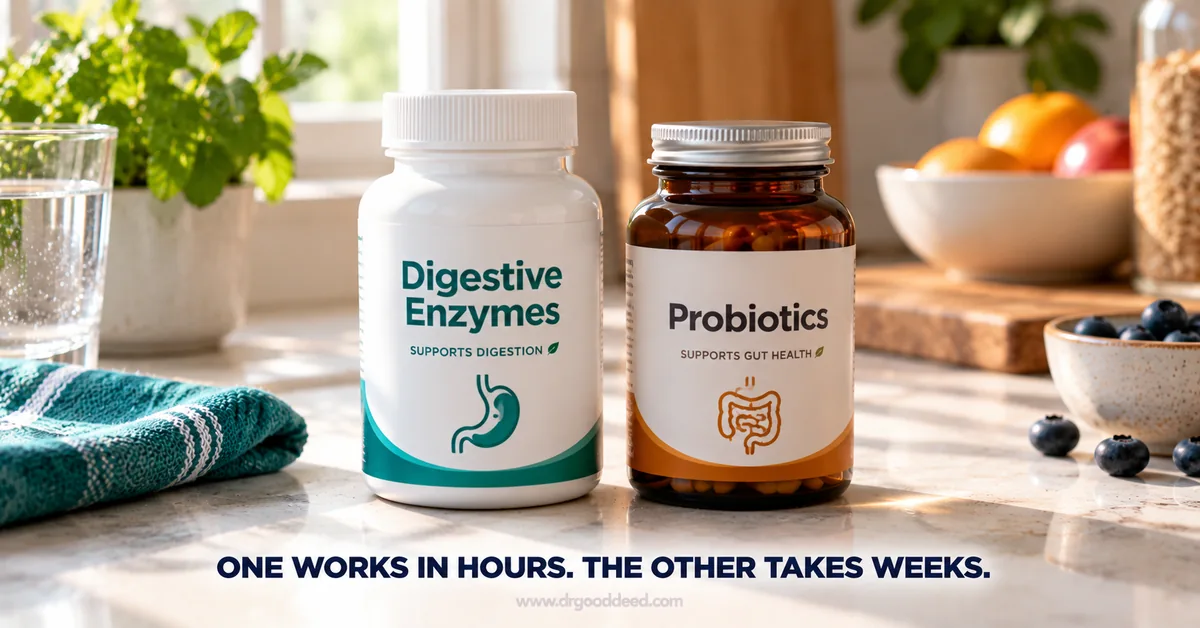

Bloating and gas send a lot of people straight to the supplement aisle, and enzymes and probiotics both get grabbed without much thought behind the choice. Enzyme problems show up minutes to hours after a specific food. Probiotic-related issues build slowly, over days or weeks. Before buying anything, the broader signs of digestive problems worth tracking are what you ate, how much, and exactly when symptoms started.
Key Takeaways
- Digestive enzymes break down specific nutrients, lactose, fat, or the complex sugars in beans, within minutes to a few hours of eating. The signs you need digestive enzymes almost always trace back to one food or food group.
- Probiotics work on your gut’s bacterial population over one to four weeks. The signs you need digestive probiotics tend to be broader shifts in bowel habits rather than a reaction to a single meal.
- Symptoms starting 30 minutes to a few hours after dairy, beans, or a fatty meal point toward an enzyme gap, not a bacterial one.
- Delayed or irregular symptoms with no clear food link, especially after antibiotics or a stomach bug, point toward probiotic use instead.
- Enzymes and probiotics are not competing products and can work together in some cases, but a true enzyme deficiency, such as exocrine pancreatic insufficiency, needs medical treatment, not just an over-the-counter supplement.
What’s the Real Difference Between Digestive Enzymes and Probiotics?
Enzymes and probiotics sit on the same store shelf but do fundamentally different jobs. Enzymes are proteins that chemically break food apart on contact. Probiotics are live organisms that settle into your intestines and interact with the bacteria already living there.
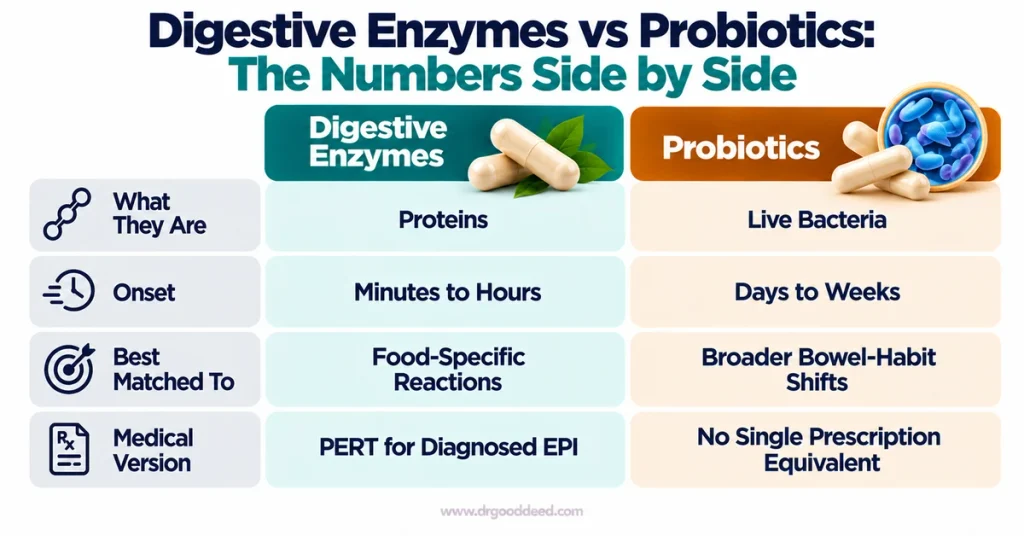
| Feature | Digestive Enzymes | Probiotics |
| What they are | Proteins: lactase, amylase, lipase, protease, alpha-galactosidase | Live bacteria or yeast strains, part of the wider types of probiotics category, including Lactobacillus, Bifidobacterium, and Saccharomyces boulardii |
| What they do | Break a specific nutrient into an absorbable form | Interact with and help balance existing gut bacteria |
| Onset of effect | Minutes to a few hours after the trigger food | Days to several weeks of consistent daily use |
| Best matched to | Food-specific reactions, such as dairy or beans | Broader bowel-habit shifts, some IBS symptoms, post-antibiotic disruption |
| Medical version | Pancreatic enzyme replacement therapy (PERT) for diagnosed EPI | No single prescription-grade equivalent; strain and dose vary by brand |
Which Symptoms More Strongly Point Toward a Digestive Enzyme Problem?
Enzyme-related symptoms share one defining feature: they follow a pattern tied to specific foods instead of showing up at random. A reaction that consistently follows one type of meal is the clearest signal among the signs you need digestive enzymes that people report.
Food-specific symptoms that can suggest a digestion problem
- Symptoms consistently after dairy: cramping, gas, or loose stools within 30 minutes to two hours of milk, cheese, or ice cream suggest lactose intolerance, where the small intestine does not make enough lactase to break down milk sugar.
- Gas after beans or certain vegetables: bloating after beans, lentils, cabbage, or broccoli often traces back to raffinose, a sugar human enzymes cannot fully break down; alpha-galactosidase, the enzyme in products like Beano, may help here.
- Symptoms after fatty meals plus greasy or oily stools: this combination, especially stools that are hard to flush, needs medical evaluation rather than a trip to buy the best digestive enzymes for bloating and gas, since it can signal a fat-digestion problem tied to the pancreas or bile system.
- Persistent diarrhea, bloating, and abdominal discomfort with no food pattern: when symptoms happen regardless of what you eat, a single missing enzyme is a less likely explanation, and a broader workup is warranted.
When digestive enzyme symptoms could indicate pancreatic insufficiency
The National Institute of Diabetes and Digestive and Kidney Diseases lists bloating, abdominal cramps, diarrhea, loose, greasy, foul-smelling stools, excess gas, and unexplained weight loss as symptoms of exocrine pancreatic insufficiency (EPI), a condition in which the pancreas produces too few enzymes for normal digestion.
Greasy, foul-smelling stools, unintentional weight loss, or suspected malabsorption should prompt a doctor’s visit. These findings can point to chronic pancreatitis, cystic fibrosis, or other conditions that require prescription-strength pancreatic enzyme replacement therapy.
Expert Insight: Bloating after fatty food is often blamed on gallbladder trouble, but persistent greasy stools with weight loss should raise suspicion for exocrine pancreatic insufficiency first, since EPI is frequently misdiagnosed as irritable bowel syndrome for months before a stool elastase test confirms it.
Which Symptoms Are More Relevant to a Probiotic Question?
Probiotic research is built around specific, studied conditions and defined bacterial strains, not a vague sense of low good bacteria. Deciding whether you need one of the many types of probiotics on the market starts with tracking bowel-habit changes over time, not one uncomfortable day.
- Changes in bowel habits over one to several weeks: a shift toward looser or harder stools than your usual baseline, without an obvious dietary trigger, fits a probiotic question better than an enzyme one.
- Some forms of diarrhea: antibiotic-associated diarrhea and certain infectious diarrheas have research support for specific strains, though results depend heavily on which strain and dose was actually studied.
- Certain IBS symptoms: some people with irritable bowel syndrome report improved bloating or stool consistency with specific strains, though not every IBS symptom responds the same way.
- Symptoms following disruption of the gut microbiome: a recent antibiotic course, a GI infection, or a major diet change can shift bacterial balance in ways some probiotics are studied to help restore.
Why bloating alone does not mean you need a probiotic
Bloating is one of the least specific GI symptoms there is. Bloating can come from:
- Fermentable carbohydrates in the diet, including onions, garlic, wheat, and certain fruits
- Constipation, where stool retention itself causes visible distension
- An undiagnosed food intolerance, including lactose or fructose malabsorption
- Irritable bowel syndrome with a visceral sensitivity component
- Swallowed air from eating quickly, carbonated drinks, or chewing gum
- Other gastrointestinal conditions, including small intestinal bacterial overgrowth
How to Decide What to Try Without Taking Both Supplements at Once
A short, structured trial that changes one variable at a time gives you a real answer within two to three weeks.
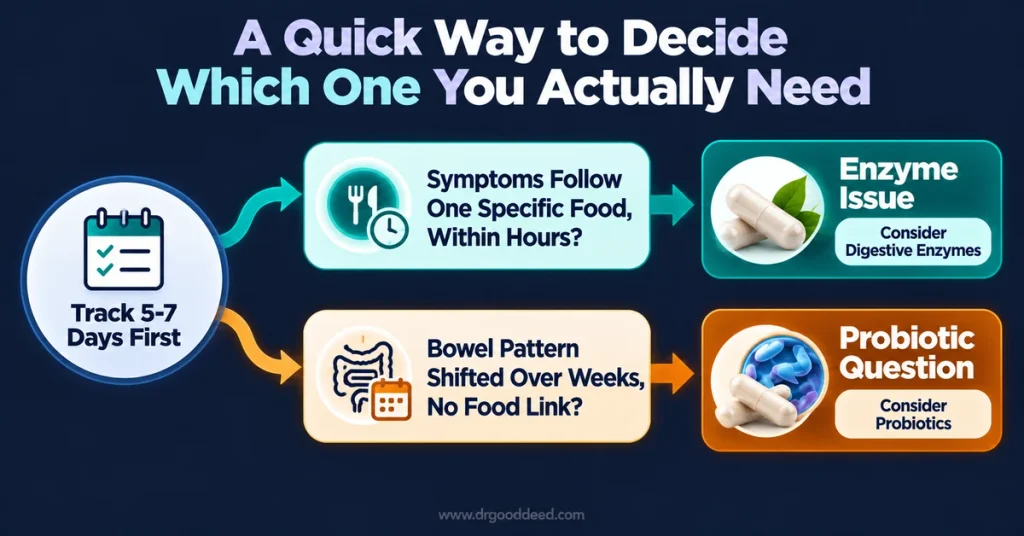
Use a symptom-and-food pattern before choosing a supplement
Track the following for five to seven days minimum:
- What you ate, including hidden ingredients like dairy powder or bean flour
- Portion size, since a small amount of a trigger food may not cause symptoms
- The time symptoms started relative to the meal
- Whether bloating, gas, or both occurred
- Any change in stool consistency or frequency
- Abdominal pain location and timing
- Reactions specifically to dairy, legumes, and high-fat foods
- Recent antibiotics, illness, or travel in the past one to two months
If the log shows a same-day pattern tied to one food, that is one of the clearest signs you need digestive enzymes. If it shows a multi-week drift with no food link, that is one of the clearest signs you need digestive probiotics.
Change one variable at a time
Do not start a lactase supplement, a probiotic, a prebiotic fiber, and an elimination diet in the same week. Stacking four interventions at once means that if symptoms improve, you cannot tell which one worked, and if they worsen, you cannot isolate the cause either.
Can You Take Digestive Enzymes and Probiotics Together?
Yes, digestive enzymes and probiotics are different categories of product and can be used together in some circumstances, but combining them is not automatically better than using either alone.
Someone with suspected exocrine pancreatic insufficiency needs medically supervised pancreatic enzyme replacement therapy, not a general enzyme paired with a probiotic bought on impulse.
The NIDDK recommends medical management of EPI with prescription PERT rather than reliance on generic over-the-counter enzyme supplements, and that guidance does not change based on whether a probiotic is added to the routine.
When Enzyme Replacement Is a Medical Necessity
Enzyme replacement moves from optional to necessary once a diagnosed condition is actively damaging pancreatic function or removing part of the digestive tract. Conditions in this category include chronic pancreatitis, cystic fibrosis, pancreatic cancer or pancreatic surgery, and, less commonly, longstanding untreated celiac disease or inflammatory bowel disease affecting enzyme output.
In these cases, PERT is dosed by a physician based on fat intake and body weight, not chosen by trial and error with a supplement bottle. Anyone with a diagnosed pancreatic or intestinal condition should treat OTC enzymes as a food-comfort tool at most, never as a replacement for prescribed PERT.
A Simple Self-Check to Help You Decide
Run through this quick filter before buying anything:
- Do symptoms happen within a few hours of one specific food group? That leans toward an enzyme issue.
- Does it feel like a general shift in bowel pattern over weeks, with no clear food link? That leans toward a probiotic question.
- Do you have greasy stools, unexplained weight loss, or a diagnosed pancreatic or intestinal condition? Stop self-treating and book an appointment.
- Have you already removed the suspected trigger food for a week with no change? That result argues against a pure enzyme explanation.
When Should You See a Doctor?
See a doctor promptly for greasy, floating, or foul-smelling stools, unexplained weight loss, blood in your stool, persistent vomiting, or symptoms that do not improve after a genuine two-to-three-week trial of a targeted change. These findings can indicate exocrine pancreatic insufficiency, inflammatory bowel disease, or another condition that needs testing rather than another supplement.
FAQs
Can you take digestive enzymes and probiotics at the same time?
Yes. They target different mechanisms, food breakdown versus bacterial balance, so combined use is generally fine for most people. The exception is diagnosed EPI, which needs prescription PERT dosed by a doctor, not a general combination product.
Which one works faster for bloating relief?
Enzymes usually act faster, often within 30 minutes to a few hours, because they break down the specific food causing the reaction. Probiotics need one to four weeks of consistent, daily use before any bacterial-balance effect becomes noticeable.
Do you need both if you have IBS?
Not automatically. Some IBS patients respond to specific probiotic strains, per limited evidence, while others have food-specific triggers better matched to an enzyme. Test one variable first, based on your own symptom pattern, before combining both.
Can taking the wrong one make symptoms worse?
Yes, in a practical sense. A probiotic will not resolve a lactose-driven reaction, and an enzyme will not fix a bacterial imbalance, so using the mismatched product wastes weeks while the actual cause stays untreated.
How long should you try one before switching to the other?
Try an enzyme for three to five days tied to the suspected trigger food. Try a probiotic for two to four weeks minimum, since bacterial changes take longer to produce a measurable symptom shift than enzyme action does.
Sources
- National Institute of Diabetes and Digestive and Kidney Diseases: Exocrine Pancreatic Insufficiency, Symptoms & Causes link
- National Institute of Diabetes and Digestive and Kidney Diseases: Exocrine Pancreatic Insufficiency, Definition, Diagnosis & Treatment link
- National Institute of Diabetes and Digestive and Kidney Diseases: Lactose Intolerance link
- Harvard Health Publishing: Digestive Enzymes, How Supplements Like Lactaid and Beano Can Help With Digestion link
- National Center for Complementary and Integrative Health: 7 Tips, Irritable Bowel Syndrome and Complementary Health Approaches link
- National Center for Complementary and Integrative Health: Irritable Bowel Syndrome and Complementary Health Approaches, What the Science Says link
- American Journal of Gastroenterology / PubMed: ACG Clinical Guideline, Management of Irritable Bowel Syndrome, 2021 link
Medical Disclaimer: This article is for general information only and is not medical advice. It does not replace a diagnosis, treatment plan, or guidance from a qualified healthcare professional. Always talk to your doctor about your own symptoms and before starting, stopping, or changing any treatment. If you think you may be having a medical emergency, call 911 or go to your nearest emergency room.