
Common signs of skin cancer include a new or changing mole or skin growth, a sore that does not heal, persistent scabbing or bleeding, a spot that grows or changes in color or shape, or a lesion that looks noticeably different from the others (“ugly duckling” sign).
For melanoma, the ABCDE warning signs are Asymmetry, irregular Border, uneven or multiple Colors, Diameter that is increasing (often >6 mm), and Evolution or any noticeable change over time.
Skin cancer can also appear in less typical ways, so any persistent or changing skin lesion should be examined by a healthcare professional, particularly if it bleeds, itches, hurts, or fails to heal.
Key Takeaways
- The three main types of skin cancer, basal cell, squamous cell, and melanoma, each look different, so no single checklist catches all of them.
- The ABCDE rule and the ugly duckling sign are two separate, complementary ways to check moles at home.
- Melanoma often shows up on the palms, soles, or under the nails in people with darker skin, and it tends to get diagnosed later there.
- Melanoma is not just a disease of older adults. It is one of the most common cancers in people aged 25 to 29.
- Any new or changing spot deserves a dermatologist visit, regardless of your age or skin tone.
Common Signs and Symptoms to Watch For
Beyond changing moles, several other skin cancer symptoms show up on skin that never had a mole at all.
- A sore that won’t heal, or one that heals and then reopens within a few weeks. Basal cell carcinoma is notorious for this pattern.
- A new growth or bump that looks shiny, pearly, or waxy, sometimes with tiny visible blood vessels running through it.
- A rough, scaly, red patch that may crust over or bleed with minor friction, such as shaving.
- A spot that bleeds, oozes, or crusts without an obvious injury causing it.
- A mole or spot that itches, stings, or feels tender, especially if that sensation is new.
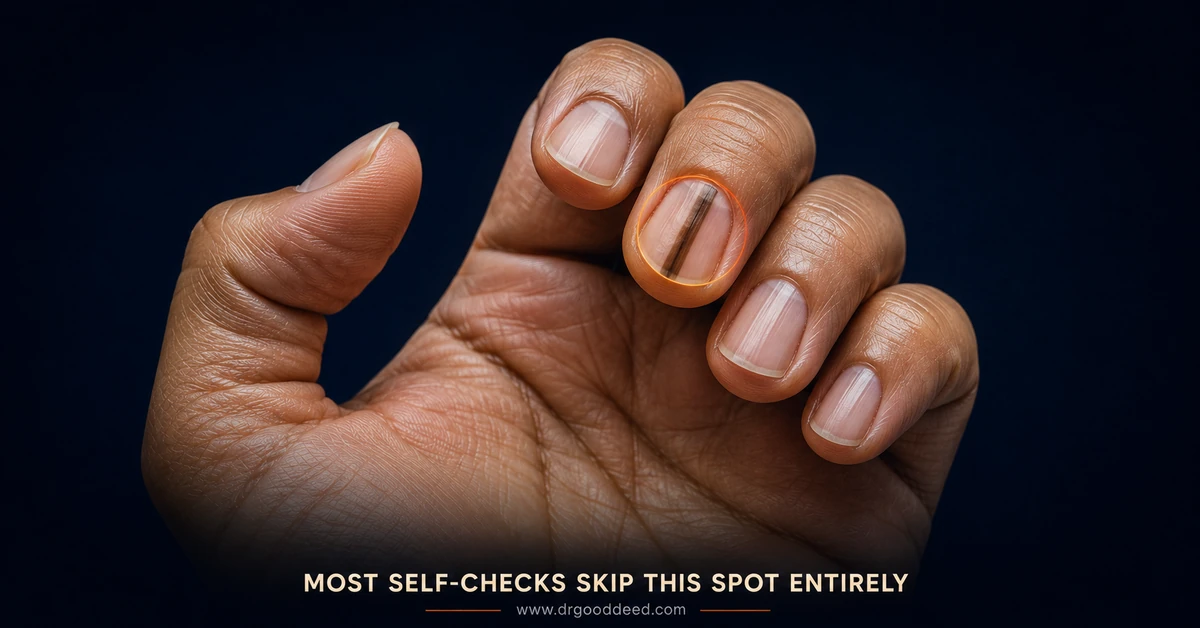
- A dark streak or discoloration under a fingernail or toenail that wasn’t caused by an injury.
- A firm, scar-like area with no clear border, which can be mistaken for an old injury site.
A spot that matches more than one of these patterns, or one that is new and does not resolve, is worth a dermatologist’s attention rather than a wait-and-see approach.
The Three Types of Skin Cancer Look Different
What does skin cancer look like? It depends entirely on the type. Basal cell carcinoma, squamous cell carcinoma, and melanoma have distinct appearances, growth patterns, and risk profiles.
| Type | Common appearance | Typical location | Behavior |
| Basal cell carcinoma | Pearly, shiny, or translucent bump, sometimes with visible blood vessels; can also look like a flat, scar-like patch | Sun-exposed skin: face, ears, neck, scalp | Grows slowly, rarely spreads, but can damage nearby tissue if ignored |
| Squamous cell carcinoma | Firm, hard lump with a rough, scaly top, or a wound that won’t heal | Head, neck, arms, hands, lips | Grows faster than basal cell carcinoma and carries a higher risk of spreading |
| Melanoma | A mole that changed in size, shape, or color, or a new dark spot | Anywhere, including palms, soles, and under nails | The most dangerous type; can spread quickly if not caught early |
According to the American Academy of Dermatology, basal cell carcinoma is the most common of the three, while melanoma causes the large majority of skin cancer deaths despite being far less common overall. Squamous cell carcinoma sits in between, growing faster than basal cell carcinoma and requiring quicker evaluation.
Expert Insight: A basal cell carcinoma symptom presentation that many people dismiss is a spot that bleeds after shaving and then scabs over repeatedly for weeks. That cycle of bleeding and healing is often the first thing a dermatologist notices, and patients frequently mistake it for a stubborn pimple or ingrown hair.
The ABCDE Rule for Checking Moles
The ABCDE rule skin cancer framework, developed to help you and clinicians spot melanoma early, breaks a mole check into five specific features.
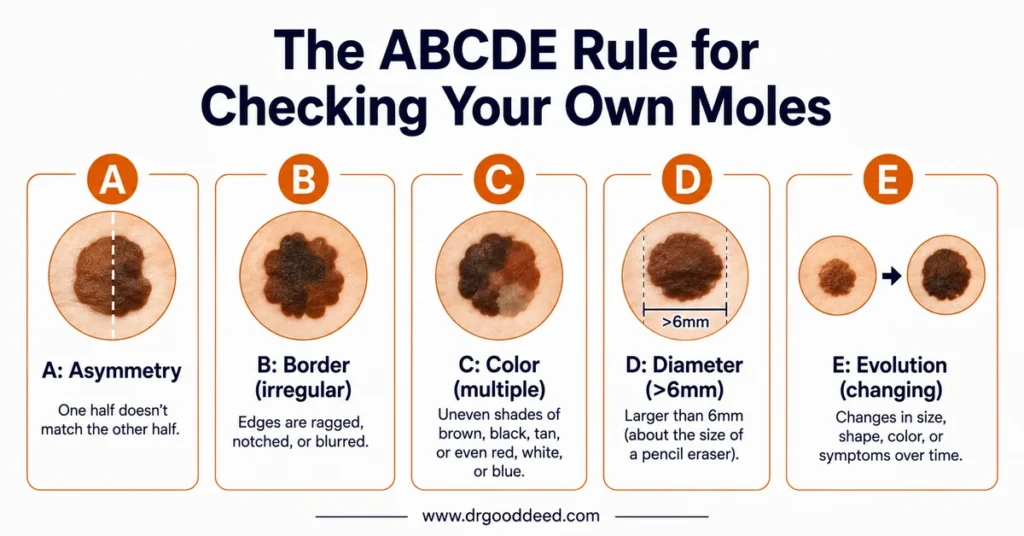
- Asymmetry: Draw an imaginary line through the middle of the mole. In a normal mole, both halves match. In melanoma, one half often looks different from the other in shape or thickness.
- Border: Healthy moles usually have smooth, even edges. Melanoma borders are often notched, blurred, or ragged instead of a clean circle or oval.
- Color: A single, even shade of brown is typical of a benign mole. Multiple colors within one spot, brown, black, tan, red, or white, raise concern.
- Diameter: Melanomas are often, though not always, larger than 6 millimeters, roughly the size of a pencil eraser. Smaller spots can still be melanoma.
- Evolution: Any change in size, shape, color, elevation, or symptoms like itching or bleeding over weeks to months is the single most important sign to track.
Not every melanoma follows all five letters, and dermoscopy, a handheld magnification tool used during professional skin exams, can catch subtler cases that the naked eye misses. The ABCDE rule remains a useful starting point precisely because it turns a subjective glance into five concrete checks you can repeat monthly.
The Ugly Duckling Sign: A Simpler Way to Check
Most moles on one person’s body tend to resemble each other in size, color, and shape, following a personal pattern. The ugly duckling sign flags melanoma warning signs by looking for the one mole that breaks that pattern rather than measuring each mole against a fixed rulebook.
- If you have twenty moles and nineteen look similar, the twentieth one that stands out, larger, darker, or oddly shaped, deserves closer attention even if it technically fails only one ABCDE criterion.
- This method works especially well for people with many moles, where checking each one against ABCDE individually becomes impractical and error-prone.
- It also catches melanomas that look deceptively ordinary on their own but are clearly out of place next to a person’s typical mole pattern.
- Dermatologists frequently use this alongside ABCDE during full-body exams, not as a replacement for it.
Pro Tip: Take a photo of your moles every few months using the same lighting and angle. Comparing photos side by side makes the ugly duckling sign and the “evolving” criterion far easier to catch than relying on memory, which tends to smooth out gradual changes.
Skin Cancer Looks Different in Skin of Color
The idea that dark skin prevents melanoma is false, yet it remains common enough that it delays diagnosis. Recognizing skin cancer in skin of color requires looking in different places than the standard sun-exposed-skin checklist suggests.
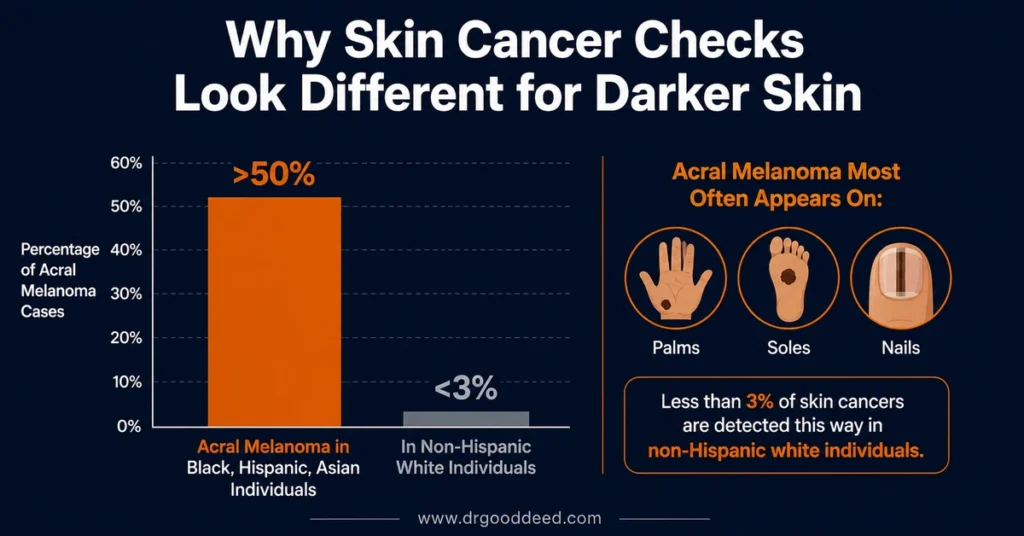
- Melanoma in people with darker skin most often appears on the palms, soles, or under the nails, a pattern called acral lentiginous melanoma, rather than on sun-exposed areas like the face or arms.
- This subtype accounts for over half of melanomas diagnosed in Black, Hispanic, and Asian individuals in the United States, compared with under 3 percent in non-Hispanic white individuals, even though the overall biological rarity of this subtype is similar across groups.
- A dark, unexplained streak running the length of a fingernail or toenail, sometimes with pigment spreading onto the surrounding skin, is a recognized warning sign and should never be assumed to be a bruise without evaluation.
- Because incidence is lower in people of color, clinical suspicion is often lower too, and self-checks frequently skip palms, soles, and nail beds entirely.
- The result, documented by dermatology researchers, is that melanoma in people of color is more often diagnosed at a later, thicker, more advanced stage, which directly worsens survival odds.
Expert Insight: Lower overall melanoma rates in people with darker skin do not equal lower risk once melanoma actually develops. Stage at diagnosis is the strongest predictor of outcome, and acral melanoma on the sole of the foot is frequently mistaken for a plantar wart, blister, or callus until it has grown.
Skin Cancer Isn’t Just an Older Person’s Disease
The average age at melanoma diagnosis sits in the mid-sixties. Recognizing the signs of skin cancer matters at every age, not just after 50.
- Melanoma is the most common cancer diagnosed in adults age 25 to 29, according to the Skin Cancer Foundation, ranking above far more widely discussed cancers in that age bracket.
- It is also among the most frequently diagnosed cancers in people age 15 to 29 overall, with rates rising fastest in young women.
- Indoor tanning before age 35 is strongly linked to this pattern. Using a tanning bed even once before 35 measurably raises lifetime melanoma risk.
- Childhood and teenage sunburns compound this risk over decades, meaning a 20-something’s skin cancer often traces back to sun exposure from a decade or two earlier.
How to Do a Self-Check at Home
A thorough self-check takes about ten minutes once you know the routine, and doing it monthly builds the baseline you need to notice genuine change.
- Use a full-length mirror plus a hand-held mirror to inspect areas you can’t see directly, including your back, scalp, and the backs of your ears.
- Check often-missed spots specifically: palms, soles, between fingers and toes, under nails, the scalp, and skin folds.
- Look at every mole using both the ABCDE rule and the ugly duckling sign, not just the ones that catch your eye immediately.
- Consider mole mapping, a service some dermatology practices offer that photographs your entire body to track changes precisely over years rather than relying on memory.
- Note the date of each self-check somewhere, even a phone note, so you can accurately answer “how long has this been there” at your next appointment.
When to See a Dermatologist
See a dermatologist promptly for any new growth, any mole that has changed, or a sore that hasn’t healed in a few weeks. This applies even to spots that resemble common red spots on skin from other causes, since a professional exam is the only reliable way to rule out cancer. Don’t wait for a spot to become painful. Painless is not the same as harmless when it comes to the signs of skin cancer.
Sources
- American Academy of Dermatology: Types of Skin Cancer link
- American Academy of Dermatology: Squamous Cell Carcinoma link
- American Academy of Dermatology: Basal Cell Carcinoma Pictures link
- American Academy of Dermatology: Nail Melanoma link
- Skin Cancer Foundation: Basal Cell Carcinoma Warning Signs and Images link
- American Cancer Society: Basal and Squamous Cell Skin Cancer Symptoms link
- American Cancer Society: Key Statistics for Melanoma Skin Cancer link
- Melanoma Research Foundation: Skin of Color link
- AAMC: Why Are So Many Black Patients Dying of Skin Cancer link
- Cleveland Clinic: Melanoma Symptoms, Staging & Treatment link