

Throat cancer symptoms often show up as ordinary problems, a scratchy throat, a bit of hoarseness, a lump you brush off as a swollen gland. Most of the time, these symptoms have nothing to do with cancer. Throat cancer itself is uncommon, and infections, allergies, and acid reflux cause the vast majority of similar complaints. Still, learning to recognize the early signs of throat cancer helps you know when a symptom deserves a second look instead of a shrug.
This guide breaks down what throat cancer symptoms typically look like, how they differ by cancer type, and when it is time to call a doctor.
Why Throat Cancer Symptoms Are Easy to Miss
Throat cancer symptoms tend to mimic a common cold, seasonal allergies, or the tail end of a sinus infection– things you have probably dealt with before without a second thought.
A rough voice after a late night, a sore throat during flu season, a swollen lymph node (a small gland that filters fluid in your body) from a dental issue, none of these automatically point toward cancer.
Throat cancer warning signs often build slowly over weeks rather than days, so people wait them out the way they would a normal cold. By the time symptoms feel unusual enough to raise concern, they have frequently been present for over a month. Knowing the early signs of throat cancer, rather than waiting for something dramatic to happen, is what actually shortens that delay.
Common Throat Cancer Symptoms
The most frequently reported throat cancer symptoms include a hoarse or raspy voice that does not clear up, a sore throat that lingers beyond the usual week or two, and trouble swallowing food or liquids comfortably (a symptom doctors call dysphagia).
Other common throat cancer symptoms include a persistent cough unrelated to a cold, a sensation of something stuck in your throat, unexplained ear pain on one side, and a lump or swelling in your neck that does not go away.
Some people notice unplanned weight loss without changing their diet, or blood in their saliva or phlegm. None of these symptoms confirm cancer on their own, they show up with far more common conditions too.
What actually matters is how long a symptom lasts, whether it is getting worse, and whether more than one shows up at the same time. Among the early signs of throat cancer, a symptom that quietly worsens over three or four weeks carries more weight than one that flares up and fades within days.
Rising rates of HPV throat cancer over the past two decades are part of why doctors now take a persistent, painless neck lump more seriously than they once did.
Symptoms by Type of Throat Cancer
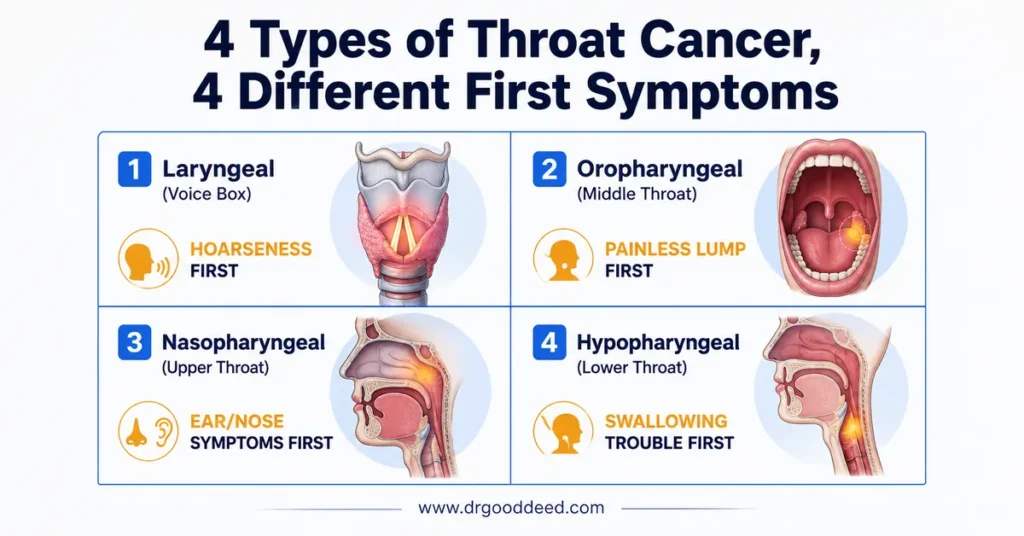
Throat cancer can develop in different parts of the throat, and where it starts changes which throat cancer symptoms tend to appear first. Doctors generally group throat cancer symptoms into four categories based on location, the voice box, the middle throat, the upper throat behind your nose, and the lower throat near your esophagus.
Laryngeal Cancer Symptoms (Voice Box)
Laryngeal cancer symptoms usually start with your voice, since the larynx houses your vocal cords. Hoarseness lasting more than three weeks, especially without a cold to explain it, is often the earliest clue among throat cancer symptoms. As it progresses, you might notice a chronic cough, a strained feeling when talking, noisy or labored breathing, or a persistent lump sensation in your throat. Because the voice box sits at the top of your windpipe, some people also notice mild shortness of breath before any pain develops.
Hoarseness throat cancer cases tend to be caught earlier than other throat cancer types, largely because a changed voice is hard to ignore for long. Doctors frequently list hoarseness throat cancer symptoms as the single clearest early warning tied to the voice box specifically, more so than to any other throat cancer type.
Oropharyngeal Cancer Symptoms (Middle Throat)
Oropharyngeal cancer symptoms affect the tonsils, base of the tongue, and soft palate, and they often behave differently from laryngeal cancer symptoms. Many cases fall under HPV throat cancer, and the very first noticeable sign is frequently a painless throat cancer neck lump rather than pain or a voice change. Because the swollen lymph node does not hurt, people often assume it is a passing infection and wait it out for weeks.
Other oropharyngeal cancer symptoms include a sore that will not heal on one tonsil, persistent difficulty swallowing, a sore throat that favors one side, and ear pain despite a normal ear exam.
Voice changes tend to appear later here than with laryngeal cancer, if they appear at all. Because HPV throat cancer often develops in younger, otherwise healthy nonsmokers, a throat cancer neck lump in this group is sometimes dismissed for months before anyone connects it to oropharyngeal disease.
Nasopharyngeal Cancer Symptoms (Upper Throat)
Nasopharyngeal cancer sits behind your nose, close to the Eustachian tube (the narrow passage connecting your middle ear to the back of your throat), so early symptoms often show up in your ears and nose rather than your throat.
One-sided nasal congestion, unexplained nosebleeds, ringing in one ear, and hearing loss or a feeling of fullness in one ear are common early clues tied to nasopharyngeal cancer. Some people also notice a neck lump or recurring headaches.
Because these symptoms overlap so heavily with sinus infections or ear infections, nasopharyngeal cancer is one of the throat cancer types most often mistaken for something minor, and diagnosis frequently comes later than with laryngeal or oropharyngeal disease.
Hypopharyngeal Cancer Symptoms (Lower Throat)
Hypopharyngeal cancer develops just above the esophagus, and it is the rarest of the four, often the hardest to catch early.
Hypopharyngeal cancer symptoms tend to be vague at first, throat discomfort that seems to radiate toward the ear, a sensation of food catching on the way down, and a raspy voice that develops gradually rather than suddenly. Because the lower throat has more room for a tumor to grow before pressing on anything noticeable, symptoms often do not appear until the disease is more advanced.
Progressive difficulty swallowing, especially when it starts with solid food and slowly extends to liquids, is one of the more reliable throat cancer warning signs tied to this location.
What Throat Cancer Pain Actually Feels Like
Throat cancer pain has a fairly consistent pattern that sets it apart from an everyday sore throat. It is almost always one-sided rather than affecting both sides evenly, dull rather than sharp, and persistent rather than coming and going.
A typical sore throat from a virus tends to ease within days and responds to rest, fluids, or over-the-counter remedies. Throat cancer pain tends to stick around regardless of what you try, and it often radiates toward the ear on the same side, a pattern doctors call referred pain, caused by shared nerve pathways between the throat and ear.
If a sore throat feels distinctly worse on one side, does not respond to usual home care, and lasts beyond a few weeks, that combination among your throat cancer symptoms is worth mentioning to a doctor.
Is It a Cold, Allergies, or Throat Cancer? The Two-Week Rule
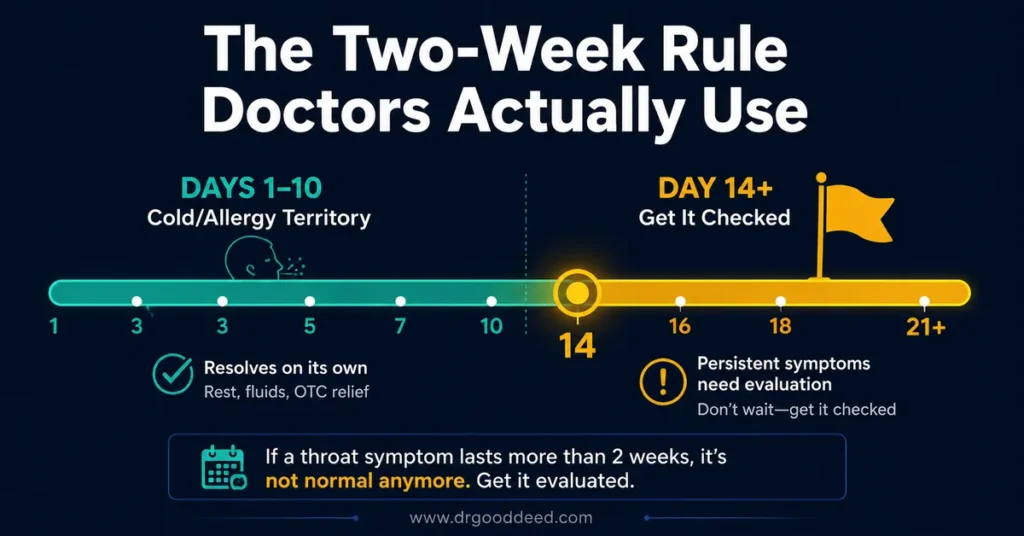
Colds and allergies typically resolve within seven to ten days, sometimes a little longer with allergies during peak season. A practical benchmark many clinicians use informally is what is often called the two-week rule, if a sore throat, hoarseness, or swallowing difficulty has not meaningfully improved after two weeks, it is reasonable to get it checked rather than continuing to wait. This does not mean two weeks equals cancer, most prolonged throat cancer symptoms still turn out to be something like reflux, a sinus infection, or a stubborn throat infection.
One symptom worth addressing directly: a bumpy, textured appearance at the back of the throat, sometimes called cobblestone throat, is a sign of irritation from postnasal drip or chronic allergies, not a symptom of throat cancer, despite how often that myth circulates online.
Cobblestone throat usually improves on its own once the underlying allergy or drainage issue is treated, and it does not require a cancer workup by itself.
Can You See or Feel Throat Cancer?
Sometimes, yes. A throat cancer neck lump can often be felt as a firm, usually painless swelling that does not shrink after a few weeks, unlike a lymph node reacting to an ordinary infection.
Sores or unusual patches at the back of the mouth or on the tonsils may also be visible with a flashlight and mirror. Beyond a throat cancer neck lump you can feel with your fingers, that said, most throat cancer symptoms are not visible this way. Cancers of the voice box, upper throat, or lower throat sit in places a home inspection simply cannot reach.
Diagnosing them typically requires a trained doctor using a thin, flexible scope, a procedure called laryngoscopy or nasopharyngoscopy, to properly examine those areas.
When to See a Doctor
See a doctor if you notice any throat cancer symptoms lasting longer than two to three weeks, especially hoarseness, a sore throat, or difficulty swallowing that is not improving.
A neck lump that persists beyond three to four weeks, unexplained weight loss, coughing up blood, or one-sided ear pain without an ear infection are also reasons to get evaluated sooner rather than later. Your primary care doctor can examine you and refer you to an otolaryngologist (a specialist in ear, nose, and throat conditions, often called an ENT) if needed.
Sources