
A dangerous PSA level generally starts above 4.0 ng/mL, but the real answer depends on your age, your prior readings, and how fast the number moved between tests. The prostate-specific antigen test measures a protein made by the prostate gland, and prostate cancer remains the second most diagnosed cancer among men in the United States.
US urologists read a result alongside age-based ranges, biopsy history, and PSA velocity before deciding who needs a closer look. This guide covers what is a dangerous PSA level, the age-specific chart doctors actually use, and a federally funded research finding that most competing articles never mention.
What Is a Normal PSA Level by Age?
Normal PSA level by age rises as the prostate naturally enlarges over time, so a reading that looks high at 45 can sit well within range at 75. Cleveland Clinic and MD Anderson both use age-banded reference values instead of a flat cutoff. A complete PSA level chart needs four separate age bands to stay accurate.
| Age Range | Normal PSA (ng/mL) | Flagged for Follow-Up (ng/mL) |
| 40 to 49 | 0 to 2.5 | Above 2.5 |
| 50 to 59 | 0 to 3.5 | Above 3.5 |
| 60 to 69 | 0 to 4.5 | Above 4.5 |
| 70 to 79 | 0 to 6.5 | Above 6.5 |
A result above your age band is not a diagnosis. It is a signal to ask your doctor for context.
PSA Levels and Cancer Risk: The Elevation Tiers
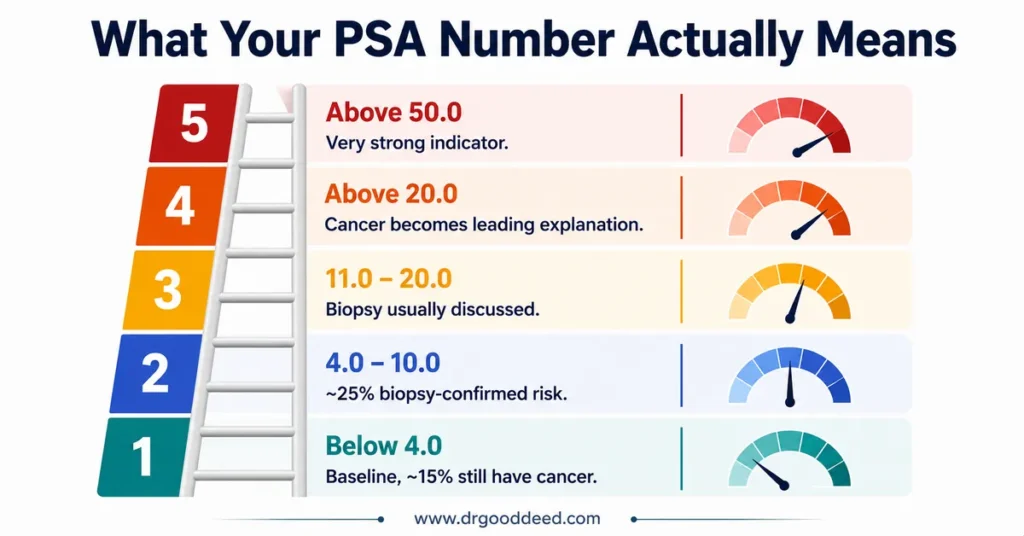
Urologists increasingly describe results in elevation tiers rather than a simple pass or fail. This framework matters more than any single PSA level chart, because a 6 ng/mL result and an 18 ng/mL result both count as elevated yet carry very different odds and next steps.
| PSA Range (ng/mL) | What It Generally Means |
| Below 4.0 | Baseline range, though roughly 15% of men here still have prostate cancer on biopsy |
| 4.0 to 10.0 | Minimally elevated, about 25% biopsy-confirmed cancer risk |
| 11.0 to 20.0 | Moderately elevated, biopsy is usually discussed |
| Above 20.0 | High elevation, cancer becomes the leading explanation |
| Above 50.0 | Very strong indicator of cancer, rarely explained by infection alone |
Your urologist weighs automatic biopsy against your age, family history, and digital rectal exam findings before recommending next steps. Locating your own result on this table is the fastest way to judge a dangerous PSA level without guessing.
Is There a Truly Safe PSA Level?
Most articles on this topic stop at the tiers above. They skip a landmark, NCI-funded trial that changes how a comfortable number should be read. The Prostate Cancer Prevention Trial followed 9,459 men on placebo with annual PSA testing and a biopsy at the end of the study. Results appeared in the New England Journal of Medicine in 2004.
About 15% of men whose PSA stayed at or below 4.0 ng/mL throughout the trial still had prostate cancer on that final biopsy. High-grade, aggressive tumors turned up at every PSA level tested, including men with readings under 0.5 ng/mL. This does not mean a low number is meaningless.
Most cancers found in the trial were low-grade and slow-growing, and screening every man aggressively would cause more harm than good. But it does mean no threshold has been shown to carry zero risk, which is exactly why doctors now pair a single dangerous PSA level reading with your full risk picture instead of one cutoff.
What Else Can Raise PSA Besides Cancer?
Elevated PSA causes extend well beyond cancer, and most elevated results turn out to be benign once a doctor works through the list. Ruling these out is usually the first step before anyone discusses a biopsy.
- Benign prostatic hyperplasia, a noncancerous enlargement of the prostate common after age 50
- Prostatitis, inflammation or infection of the prostate gland
- A urinary tract infection
- Ejaculation within 24 to 48 hours of the blood draw
- Cycling or other activity that puts direct pressure on the prostate
- A recent catheter placement or prostate biopsy
- 5-alpha reductase inhibitors like finasteride, which can cut PSA by roughly 50%
Mention any of these to your doctor before your next test. Some, like ejaculation timing, are easy to avoid.
Does a Rising PSA Matter More Than the Number Itself?
PSA velocity, the rate of change between tests, often carries more weight than any single reading. A climb from 1.0 to 2.0 ng/mL within a year raises more concern than a stable reading of 3.5 ng/mL held for a decade. The classic threshold flagged a rise above 0.75 ng/mL per year as suspicious.
Research published in The Journal of Urology found that threshold misses 48% of cancers in men under 60. In that age group, a rise of just 0.4 ng/mL per year identified significantly more cancers, since younger prostates have less background noise from benign enlargement. Ask your lab to track your PSA test results across visits instead of judging your latest number in isolation.
What Happens If Your PSA Is High?
A high PSA does not automatically mean a prostate biopsy. Your doctor typically repeats the test first, since 20% to 40% of newly elevated results return to normal on their own. If the number stays high, next steps often include a free PSA percentage test, a digital rectal exam, or a prostate MRI. A free PSA percentage under 25%, when total PSA sits between 4 and 10 ng/mL, leans more toward cancer than a benign cause.
A biopsy removes small tissue samples for lab analysis and remains the only way to confirm a diagnosis. If cancer is found, treatment ranges from active surveillance for slow-growing tumors to surgery, radiation, or hormone therapy for more aggressive disease.
When to Talk to a Doctor About PSA Testing
The American Cancer Society and the US Preventive Services Task Force both recommend a shared decision-making conversation about testing starting at age 50 for average-risk men. Black men and those with a father or brother diagnosed with prostate cancer should start that conversation at 40 to 45, since these groups carry meaningfully higher risk.
Raise the topic sooner if you notice new urinary symptoms, such as a weak stream, frequent urination at night, or blood in the urine. One conversation about your family history changes how every future PSA result should be interpreted.
FAQs
Is 4.0 ng/mL always a dangerous PSA level?
No. A 45-year-old at 4.0 ng/mL sits above his age-specific range, but a 75-year-old at that same number falls within the normal band for his decade.
What PSA level counts as a medical emergency?
No single PSA value is an emergency by itself. A reading above 50 ng/mL warrants an urgent urology referral, since it strongly points to advanced disease needing imaging within days.
Can PSA be high with no cancer present?
Yes. Benign prostatic hyperplasia and prostatitis cause most elevated readings. Most men with PSA above 4.0 ng/mL never receive a cancer diagnosis after a full workup.
Does a normal PSA rule out prostate cancer?
No. The PCPT trial found 15% of men with PSA at or below 4.0 ng/mL had cancer on biopsy, some with aggressive, high-grade tumors already present.
How fast can PSA rise before it becomes concerning?
A rise above 0.75 ng/mL per year is the classic warning sign. In men under 60 with low baseline PSA, even 0.4 ng/mL per year meaningfully raises cancer risk.
Should women worry about PSA test results?
No. PSA is a prostate-specific marker and applies to men. Routine PSA testing has no established screening role in women.
Sources
- Cleveland Clinic: Elevated PSA (Prostate-Specific Antigen) Level link
- MD Anderson Cancer Center: PSA Levels by Age, What to Know link
- National Cancer Institute: Prostate Cancer Prevention Trial (PCPT) Questions and Answers link
- New England Journal of Medicine: Prevalence of Prostate Cancer Among Men With a PSA Level ≤4.0 ng/mL link
- National Cancer Institute: Prostate-Specific Antigen (PSA) Test Fact Sheet link
- American Cancer Society: Screening Tests for Prostate Cancer link
- US Preventive Services Task Force: Prostate Cancer Screening Recommendation link
- MD Anderson Cancer Center: Prostate Cancer Screening Algorithm link
- PubMed: PSA Velocity Threshold for Predicting Prostate Cancer in Young Men, Journal of Urology link
- Johns Hopkins Medicine: Prostate Cancer Age-Specific Screening Guidelines link
This article is for informational purposes only and does not replace professional medical advice. Talk to a licensed healthcare provider about your specific PSA results and prostate health.