Medical Disclaimer: This article is for educational purposes only and is not a substitute for professional medical advice, diagnosis, or treatment. Consult a healthcare professional if caffeine causes persistent palpitations, anxiety, or sleep problems.
A standard 8-oz drip coffee holds 80 to 100 milligrams of caffeine. Espresso carries 63 mg per 1-oz shot. Cold brew can reach 150 to 200 mg per 8 oz. The exact amount shifts based on bean type, roast, brewing method, and serving size. Understanding these variables helps you control your intake and avoid the side effects that come with drinking too much. Explore in this blog more detail about “how much caffeine in a cup of coffee” must one have.
Key Takeaways
- Caffeine content varies: An 8-ounce cup of regular drip coffee typically contains around 80–100 mg of caffeine, depending on the beans and brewing method.
- Coffee types differ: Espresso contains about 63 mg per single shot, while cold brew may contain 150–200 mg per 8-ounce serving.
- Know your daily limit: The FDA states that up to 400 mg of caffeine daily is not generally associated with negative effects for most healthy adults.
- Protect your sleep: Caffeine can remain in your system for several hours and may interfere with sleep, especially when consumed later in the day.
- Reduce caffeine gradually: Switching to smaller servings, half-caf, or decaf can help lower intake and reduce withdrawal symptoms.
What Affects Caffeine Levels in Coffee?
Caffeine content is not fixed across all coffee. Four variables determine how much ends up in your cup: bean type, brewing method, roast level, and serving size. Most people guess wrong on at least two of these, which leads to unintentional overconsumption.
Coffee Bean Type
Two major species exist: Arabica and Robusta. Robusta carries nearly twice the caffeine of Arabica. Premium and specialty coffees use Arabica for flavor. Budget blends and many instant coffees use Robusta, meaning higher caffeine per cup even when the serving looks small.
Brewing Method and Extraction Time
Longer brewing time pulls more caffeine out of the grounds. Cold brew steeps 12 to 24 hours and produces the highest caffeine output of any common method. French press extracts more than drip coffee because the grounds stay in contact with water longer. Espresso extracts quickly but uses very little water, giving high caffeine per ounce even if the total per shot is moderate.
Roast Type and Caffeine Amount
Roast type and caffeine amount have a relationship most people get backwards. Light roast retains slightly more caffeine than dark roast because heat breaks down caffeine molecules during roasting. The longer a bean roasts, the more caffeine degrades. The difference is roughly 5 to 10%, but dark roast’s bolder taste does not equal more caffeine.
Serving Size Differences
A “cup” is not standardized. In the US, a standard serving is 8 oz. A large coffee at most chains is 16 to 20 oz. Drinking a 20-oz drip coffee means consuming 200 to 300 mg of caffeine in one sitting. Serving size is the most underestimated variable when asking how much caffeine is in a cup of coffee.
Caffeine Levels by Coffee Type
Caffeine levels by coffee type vary widely, and knowing the actual numbers prevents accidental overconsumption. The table below shows real-world caffeine ranges for the most common coffee drinks.
| Coffee Type | Serving Size | Caffeine Content |
| Drip coffee | 8 oz | 80–100 mg |
| Espresso (single shot) | 1 oz | 63 mg |
| Americano | 8 oz | 63–125 mg |
| Cold brew | 8 oz | 150–200 mg |
| Instant coffee | 8 oz | 30–90 mg |
| Decaf coffee | 8 oz | 2–15 mg |
| Latte / Cappuccino | 8 oz | 63 mg (per shot) |
Drip Coffee Caffeine Content
Drip coffee is the most common brew in American homes. An 8-oz cup contains 80 to 100 mg of caffeine. Brewing with a higher coffee-to-water ratio or using a Robusta-blend can push that number to 150 mg per cup without any change in drink size.
Espresso and Espresso-Based Drinks
One espresso shot has 63 mg in just 1 oz of liquid. The caffeine concentration per ounce is very high, but the total per shot is lower than a full mug of drip coffee. A double-shot latte gives 126 mg. A triple-shot drink reaches close to 190 mg. The size of the milk does not change the caffeine count; the number of shots does.
Cold Brew vs Regular Coffee
Cold brew steeps in cold water for 12 to 24 hours, extracting significantly more caffeine than hot brewing. An 8-oz cup holds 150 to 200 mg, and some commercial concentrates carry even more. Many people assume cold brew is gentler on the body than hot coffee. It is not. It carries more caffeine, not less.
Instant Coffee Caffeine Levels
Instant coffee typically has 30 to 90 mg per 8-oz cup, the lowest range among brewed options. Freeze-drying and spray-drying reduce the total caffeine compared to fresh brewing. It is a reasonable first step when you want to reduce caffeine consumption without switching fully to decaf.
How Caffeine Affects the Body
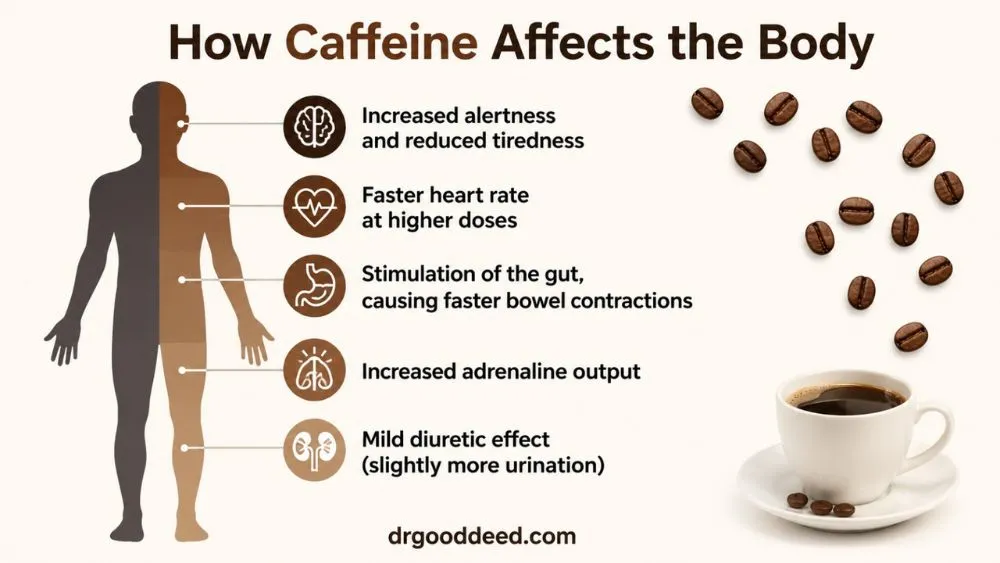
Caffeine is a stimulant (a substance that speeds up your brain and nervous system). It works by blocking adenosine (ad-en-OH-seen), a chemical that makes you feel sleepy. When adenosine is blocked, you feel alert instead of tired. Effects begin within 15 to 45 minutes and peak around 30 to 60 minutes after drinking.
Key effects on your body:
- Increased alertness and reduced tiredness
- Faster heart rate at higher doses (above 400 mg per day)
- Slight blood pressure rise lasting 1 to 3 hours
- Stimulation of the gut, causing faster bowel contractions
- Increased adrenaline output
- Mild diuretic effect (slightly more urination), though this is minimal in regular drinkers
Best Time to Drink Coffee Caffeine Effects
Getting the best time to drink coffee caffeine effects right actually matters for how alert you feel and how well you sleep at night. The timing of your cup matters more than most people realize.
Morning Caffeine Timing
Your body produces cortisol (your natural alertness hormone) at peak levels between 8 AM and 9 AM. Drinking coffee during that window gives you less of a boost because cortisol already handles the alert-feeling function. The more effective window is between 9:30 AM and 11:30 AM, when cortisol starts to drop and caffeine fills in most efficiently.
Avoiding Coffee Late in the Evening
Caffeine has a half-life of 5 to 6 hours. A 200 mg cup at 3 PM still has roughly 100 mg active in your system at 8 to 9 PM. That is enough to delay when you fall asleep and reduce deep sleep quality, even if you feel like you can doze off without trouble.
Caffeine and Sleep Disruption
Caffeine consumed within 6 hours of bedtime reduces total sleep time by roughly 1 hour. It suppresses slow-wave sleep, which is the deepest and most restorative sleep phase. Most sleep specialists recommend stopping all caffeine intake by 2 PM for adults who sleep between 10 PM and midnight.
Too Much Caffeine Side Effects Coffee
Too much caffeine side effects coffee drinkers notice most often appear above 400 mg per day in healthy adults. In sensitive individuals, side effects can begin at 200 mg or even lower.
Anxiety and Jitteriness
Caffeine raises adrenaline and blocks GABA (a calming brain chemical). This creates physical shakiness, racing thoughts, and nervousness that resembles anxiety symptoms. People with generalized anxiety disorder are especially sensitive and should stay well below 200 mg daily.
Rapid Heartbeat and Restlessness
High caffeine intake speeds up the heart rate in a condition called caffeine-induced tachycardia (tak-ih-KAR-dee-ah), meaning the heart beats faster than normal. This usually resolves within a few hours. Persistent or irregular palpitations need medical evaluation.
Sleep Problems and Digestive Discomfort
Excess caffeine relaxes the lower esophageal sphincter (the valve between your stomach and throat), worsening acid reflux. It also speeds up bowel contractions. People with irritable bowel syndrome (IBS) often see a sharp increase in symptoms with high daily caffeine intake.
How much caffeine in a cup of coffee is Safe ?
The FDA’s guidance sets 400 mg per day as the safe upper limit for healthy adults. That equals roughly 4 standard 8-oz cups of drip coffee per day.
Recommended Daily Caffeine Limits
- Healthy adults: up to 400 mg per day
- Teenagers (12 to 18): under 100 mg per day
- Children under 12: no caffeine recommended
- Pregnant women: under 200 mg per day from all sources combined
Sensitivity Differences Between Individuals
Caffeine metabolism is largely genetic. The CYP1A2 enzyme controls how fast your body clears caffeine. Fast metabolizers process it in 2 to 3 hours. Slow metabolizers carry active caffeine in their system for 8 to 10 hours. This explains why the same cup of coffee leaves one person alert for an hour while keeping another wired all afternoon.
Special Considerations During Pregnancy
Pregnant women should limit caffeine to under 200 mg per day from all sources, including tea, soda, energy drinks, and chocolate. Higher intake links to increased risk of low birth weight and preterm delivery.
How to Reduce Caffeine Consumption
The most effective way to reduce caffeine consumption is gradual tapering. Cutting all caffeine at once triggers withdrawal symptoms including headaches, fatigue, and irritability that start within 12 to 24 hours and can last 2 to 9 days.
Gradually Lowering Intake
Reduce daily caffeine by 10% every 1 to 2 weeks. If you currently drink 400 mg daily, drop to 360 mg first. This pace lets your brain adjust without a painful withdrawal period.
Switching to Half-Caf or Decaf
Half caffeine in a cup of coffee blends must have decaf 50/50 regularly. One must know how many mg of caffeine in a cup of coffee must have. Roughly 40 to 50 mg per cup. It is a practical middle ground during tapering. Decaf drops the total further, providing the taste of coffee with just 2 to 15 mg of caffeine per cup.
Choosing Smaller Serving Sizes
Switching from a 16-oz to an 8-oz coffee cuts your caffeine intake roughly in half with no change to your daily routine. Ordering a small instead of a large is the simplest and least disruptive way to reduce caffeine consumption while still enjoying coffee.
Decaf Coffee vs Regular Coffee
Decaf is not caffeine-free. It retains 2 to 15 mg of caffeine per 8-oz cup after the decaffeination process removes around 97% of the original caffeine.
How Decaf Still Contains Small Caffeine Amounts
Because decaffeination removes roughly 97%, not 100%, of caffeine, a person drinking 4 to 5 cups of decaf daily could still consume 40 to 75 mg total, roughly equivalent to one small regular coffee. How much caffeine is in a cup of coffee labeled decaf varies by brand and processing method.
Taste and Stimulant Differences
Modern decaf blends taste nearly identical to regular coffee. The stimulant effect is minimal but not zero. People with extreme caffeine sensitivity often report a slight alertness boost even from decaf, confirming that the residual caffeine is biologically active even at low levels.
Who May Benefit From Decaf Options
Decaf suits pregnant women, people with heart arrhythmias (irregular heartbeats), those with severe anxiety, and anyone who wants coffee in the evening without disrupting sleep. It also suits people who take cup of coffee caffeine to reduce work stress.
FAQs
Which Coffee Type Contains the Highest Amount of Caffeine?
Cold brew concentrate. An 8-oz serving can carry 250 to 350 mg of caffeine. Ready-to-drink cold brew averages 150 to 200 mg per 8 oz. When comparing caffeine levels by coffee type, cold brew leads every standard option. Store-bought cold brew concentrates are often diluted before drinking, so always check the label.
Does Cold Brew Have More Caffeine Than Regular Coffee?
Yes. Cold brew has 150 to 200 mg per 8 oz versus 80 to 100 mg in drip coffee. The 12 to 24-hour steep extracts significantly more caffeine. How much caffeine is in a cup of coffee made as cold brew consistently exceeds every common hot-brew method at the same serving size.
Why Do Espresso Shots Feel Stronger Despite Smaller Serving Sizes?
Espresso has 63 mg per 1 oz versus 10 to 12 mg per 1 oz in drip coffee. That high concentration absorbs into your bloodstream rapidly due to the small liquid volume. However, one shot of espresso (63 mg) contains less total caffeine than one full 8-oz mug of drip coffee (80 to 100 mg).
Is Dark Roast Coffee Lower in Caffeine Than Light Roast?
Yes, slightly. Roast type and caffeine amount are directly linked. Heat degrades caffeine during roasting. Light roast retains 5 to 10% more caffeine than dark roast by weight. The flavor of dark roast tastes bolder, but that intensity comes from oils and compounds, not from higher caffeine.
How Late in the Day Should Coffee Be Avoided for Better Sleep?
Stop caffeine by 2 PM if you sleep between 10 PM and midnight. Caffeine’s 5 to 6-hour half-life means a 3 PM cup keeps roughly 100 mg active at 8 PM. The best time to drink coffee caffeine effects research consistently shows that afternoon cutoffs around 2 PM protect sleep quality most effectively.
Can Too Much Caffeine Increase Anxiety and Heart Palpitations?
Yes. Too much caffeine side effects coffee drinkers most commonly report are anxiety and palpitations. Above 400 mg daily, caffeine raises adrenaline and suppresses GABA, producing anxiety-like symptoms. Heart palpitations typically resolve within 2 to 4 hours. If palpitations feel irregular or persist longer, seek medical evaluation immediately.
How Long Does Caffeine Stay Active in the Body?
Caffeine’s half-life is 5 to 6 hours in most healthy adults. A 200 mg cup at noon still has 100 mg active at 5 to 6 PM and 50 mg active at 10 to 11 PM. Slow metabolizers, determined by CYP1A2 gene variants, carry active caffeine for 8 to 10 hours after their last cup.
Is Decaf Coffee Completely Caffeine-Free?
No. Decaf contains 2 to 15 mg of caffeine per 8-oz cup. Decaffeination removes only 97% of caffeine, not 100%. Drinking five cups of decaf daily can add up to 75 mg. How much caffeine is in a cup of coffee labeled decaf depends on the brand, bean origin, and decaffeination method used.
What Are the First Signs of Caffeine Overconsumption?
The first signs are jitteriness, slightly elevated heart rate, and difficulty sitting still. These typically appear after exceeding 400 mg in a day. Stomach irritability and a migraine behind the eyes follow. Too much caffeine side effects coffee drinkers often mistake for stress, while caffeine is the actual trigger.
How Can Caffeine Intake Be Reduced Without Withdrawal Headaches?
Taper by 10% every 1 to 2 weeks instead of quitting suddenly. Switch one daily cup to half-caf first, then to decaf over several weeks. Drinking extra water and maintaining consistent sleep reduces headache severity noticeably. Trying to reduce caffeine consumption all at once is the most common mistake and causes the worst withdrawal symptoms.
Source Link
Mayo Clinic – Caffeine Content for Coffee, Tea, Soda, and More
U.S. Food and Drug Administration
Harvard T.H. Chan School of Public Health – Caffeine
MedlinePlus – Caffeine in the Diet
American College of Obstetricians and Gynecologists – Coffee During Pregnancy
NHS – Foods to Avoid in Pregnancy