
The best sleeping position to avoid stroke is on your side, with the left side holding a slight advantage based on brain drainage mechanics. Research confirms that side sleeping activates the brain’s glymphatic system, which flushes out waste proteins tied to vascular inflammation and cerebrovascular damage.
The brain repairs itself during sleep. The position you sleep in shapes how well that repair happens, whether the airway stays open, whether toxic proteins get cleared, and whether blood pressure gets the overnight rest it needs.
Safest Sleeping Posture for Brain Health
The safest sleeping posture for brain health is left-side or right-side sleeping. Side sleeping keeps the airway open, reduces overnight blood pressure spikes, and supports consistent oxygen delivery to the brain. For stroke prevention, position matters as much as total sleep duration. The left side has a slight edge because of how the glymphatic drainage system is angled, but either side is significantly better than back or stomach sleeping.
Side Sleeping for Better Circulation
Side sleeping for better circulation works by preventing the upper airway from collapsing. When the airway stays open, blood oxygen stays stable through the night. The brain gets what it needs.
A 2019 study published in Stroke found that people sleeping fewer than 6 hours had a 4.5x higher stroke risk compared to those getting 7 to 8 hours. Sleep position influences how well the brain recovers during those hours.
Left-side sleeping also keeps the aorta angled slightly downward, reducing the heart’s overnight workload. Less cardiac strain means more stable brain perfusion.
Neutral Spine and Neck Alignment
The vertebral arteries, which supply blood to the brain’s posterior region, run through the cervical spine. When the neck is misaligned during sleep, these arteries get compressed. A pillow that is too flat or too thick causes this.
For side sleepers, the optimal pillow keeps the head level with the shoulder. This isn’t about comfort alone. Chronic mild compression of the carotid or vertebral arteries builds up over time, especially in people over 50.
Reduced Pressure on Blood Vessels
Side sleeping reduces pressure on the inferior vena cava, the large vein that returns blood from the lower body to the heart. Less compression here means the heart pumps more efficiently overnight.
The glymphatic system is most active during sleep and works best when the body is on its side. It clears amyloid-beta and tau proteins, both linked to cerebrovascular damage. Most articles mention airflow. Few mention that sleep position determines how thoroughly the brain cleans itself each night.
Sleep Apnea Increasing Stroke Risk
Sleep apnea increasing stroke risk is one of the strongest, most underreported connections in cardiovascular medicine. People with obstructive sleep apnea (OSA) have a 2x to 3x higher stroke risk than those without it, according to the Sleep Heart Health Study. Most people with OSA don’t know they have it.
Interrupted Breathing During Sleep
In OSA, the throat muscles relax and repeatedly block the airway during sleep. Each blockage drops blood oxygen, sometimes below 90%. The heart responds by spiking blood pressure to compensate. These repeated spikes stress the arterial walls progressively.
Reduced Oxygen to the Brain
Every apnea episode triggers the release of cortisol and adrenaline as the brain scrambles to restore oxygen. This is not a benign process. Those stress hormones also promote platelet aggregation, meaning blood clots more readily. That is a direct stroke pathway that happens quietly, while the person is unconscious.
Strong Link With Stroke and Heart Disease
The American Heart Association formally recognizes OSA as an independent stroke risk factor. People with severe untreated OSA have stroke rates comparable to heavy smokers. CPAP therapy, which keeps the airway open during sleep, measurably reduces stroke risk when used consistently every night.
Worst Sleeping Positions for Stroke Risk
Stomach sleeping is the worst position for stroke risk. Back sleeping is a close second for anyone with OSA or high blood pressure. The best sleeping position to avoid stroke is the direct opposite of both.
Sleeping on the Back (Sleep Apnea Risk)
Back sleeping causes the tongue and soft palate to fall backward, narrowing or blocking the airway. In people with existing OSA, it makes every episode worse and more frequent.
Blood pressure naturally drops 10% to 20% during healthy sleep, a process called the “nocturnal dip.” People whose blood pressure doesn’t dip, called non-dippers, have significantly higher stroke and heart attack rates. Back sleeping with untreated OSA actively prevents this dip from happening.
Poor Posture Causing Circulation Issues
Sleeping with the neck twisted restricts the jugular veins, which drain blood from the brain. Impaired drainage raises intracranial pressure overnight. This matters more as people age and vascular elasticity decreases.
Stomach Sleeping and Neck Strain
Stomach sleeping forces the head into a sharp rotation for hours at a time. This compresses the carotid artery on the lower side and strains the cervical vertebrae that house the vertebral arteries. Every hour spent stomach sleeping is an hour of reduced blood supply to the brain.
Poor Sleep Quality and Stroke Risk
Poor sleep quality and stroke risk are directly linked, and the connection goes beyond hours slept. The depth and consistency of sleep change the body’s cardiovascular profile.
Insomnia and Fragmented Sleep
People with chronic insomnia, defined as difficulty sleeping three or more nights per week for three months, have a 54% higher stroke risk, based on a large Taiwanese cohort study. Fragmented sleep prevents the brain from reaching slow-wave sleep, which is when blood pressure drops to its overnight low.
Increased Stress Hormones
Poor sleep keeps cortisol elevated through the next day. Chronically elevated cortisol raises blood pressure, promotes arterial inflammation, and raises blood glucose. All three are independent stroke risk factors. A single night of poor sleep raises systolic blood pressure by 5 to 10 mmHg in many adults.
Long-Term Cardiovascular Impact
Adults who consistently sleep under 6 hours have measurably thicker carotid artery walls, a direct marker of atherosclerosis. This was confirmed in a 2012 study in Arteriosclerosis, Thrombosis, and Vascular Biology. Poor sleep quality and stroke risk compounds with age, and the damage is structural, not just functional.
Sleeping Habits to Reduce Stroke Risk
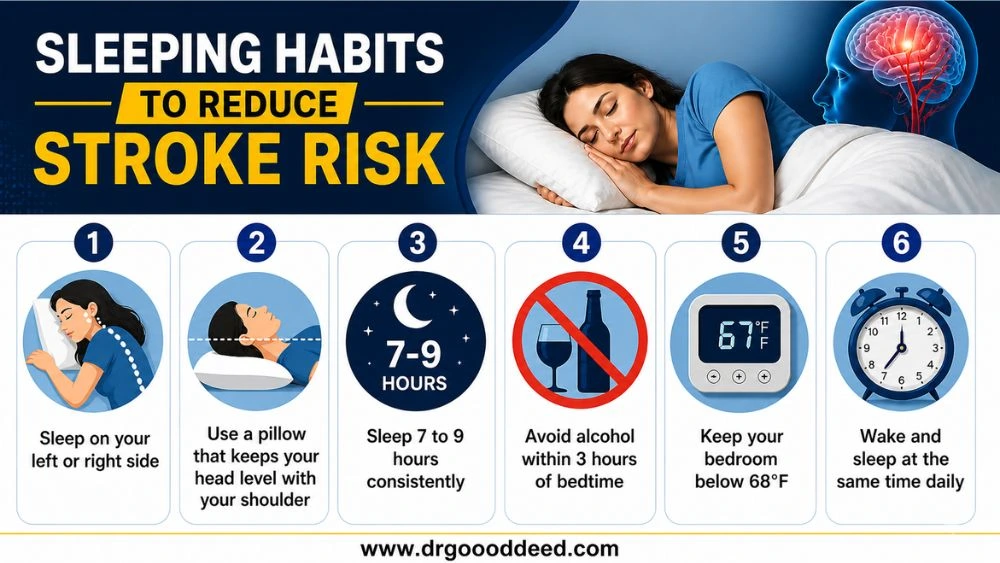
Sleeping habits to reduce stroke risk are specific and evidence-backed. These are not general wellness tips.
- Sleep on your left or right side; avoid back and stomach sleeping entirely
- Use a pillow that keeps your head level with your shoulder during side sleeping
- Sleep 7 to 9 hours consistently; both under 6 hours and over 9 hours raise stroke risk
- Get screened for sleep apnea if you snore loudly, wake up tired, or have uncontrolled blood pressure
- Avoid alcohol within 3 hours of bedtime; it fragments sleep architecture and worsens OSA
- Keep your bedroom below 68°F; cooler temperatures improve sleep depth and support the nocturnal blood pressure dip
- Wake and sleep at the same time daily; irregular schedules disrupt cardiovascular rhythms
How to Improve Your Sleeping Position
Switching from back or stomach sleeping to side sleeping takes time. These methods work.
- Place a body pillow along your front side to prevent rolling backward during the night
- Put a pillow between your knees when side sleeping to keep hips aligned and reduce lower back compensation
- Tape a tennis ball to the back of a sleep shirt; this trains the body to avoid back sleeping within two to four weeks
- Use a contoured side-sleeper pillow to maintain neck alignment without active adjustment
- If you use a CPAP machine, ask your provider to confirm your settings are calibrated for side sleeping
The best sleeping position to avoid stroke takes consistent practice. Most people adapt fully within two to four weeks, and the cardiovascular benefits follow shortly after.
FAQs
What is the best sleeping position to avoid stroke?
The best sleeping position to avoid stroke is on your side, preferably the left. It keeps the airway open, activates glymphatic brain cleaning, and prevents the blood pressure spikes caused by airway obstruction during back or stomach sleeping.
Does side sleeping improve circulation?
Yes. Side sleeping for better circulation works by keeping the inferior vena cava uncompressed and the airway open. Left-side sleeping also reduces the heart’s overnight output demand, supporting steady blood delivery to the brain throughout the night.
Can poor sleep quality increase stroke risk?
Yes. Poor sleep quality and stroke risk are clinically linked. Chronic insomnia raises stroke risk by 54% according to a Taiwanese cohort study. Fragmented sleep blocks the nocturnal blood pressure dip and keeps cortisol elevated, both of which damage arterial walls over time.
How does sleep apnea increase stroke risk?
Sleep apnea increasing stroke risk works through repeated oxygen drops that trigger cortisol and adrenaline release, promote blood clot formation, and spike blood pressure repeatedly through the night. Untreated severe OSA doubles to triples stroke risk and is recognized by the American Heart Association as an independent risk factor.
What sleeping habits reduce stroke risk?
The most effective sleeping habits to reduce stroke risk: sleep 7 to 9 hours nightly, side-sleep with a correctly aligned pillow, maintain consistent sleep and wake times, avoid alcohol before bed, and get tested for sleep apnea if you snore or wake unrefreshed.
Is sleeping on the back bad for stroke risk?
For healthy people without OSA, back sleeping alone isn’t a major risk. For anyone with sleep apnea or high blood pressure, it worsens airway collapse, prevents the nocturnal blood pressure dip, and raises overnight cortisol levels, all of which increase stroke risk measurably.
How to train yourself to sleep on your side?
Place a body pillow in front of you to block rolling. Tape a tennis ball to the back of your shirt to prevent back sleeping. Most people adapt fully within 2 to 4 weeks. A contoured side-sleeper pillow helps maintain alignment from the first night without conscious effort.
Does sleep position affect brain blood flow?
Yes. Side sleeping activates the glymphatic system, which clears toxic proteins from brain tissue overnight. Stomach and back sleeping compress blood vessels and reduce oxygen delivery. The best sleeping position to avoid stroke directly supports better cerebral blood flow during sleep.
When should I see a doctor for sleep issues?
See a doctor immediately if you snore loudly most nights, wake up gasping, feel exhausted after 8 hours of sleep, or have blood pressure that isn’t responding to treatment. These are signs of obstructive sleep apnea, a confirmed independent stroke risk factor that is treatable.