
The four types of swimming strokes recognized by FINA (World Aquatics), the international governing body for competitive swimming, are freestyle (front crawl), backstroke, breaststroke, and butterfly. Each stroke uses a different body position, arm movement, kick pattern, and breathing rhythm.
Freestyle is the fastest; butterfly is the most physically demanding; breaststroke is the slowest; and backstroke is the only stroke swum entirely on the back. USA Swimming and the American Red Cross use these four strokes as the foundation of all swim instruction programs across the United States.
Types of Swimming Strokes Explained
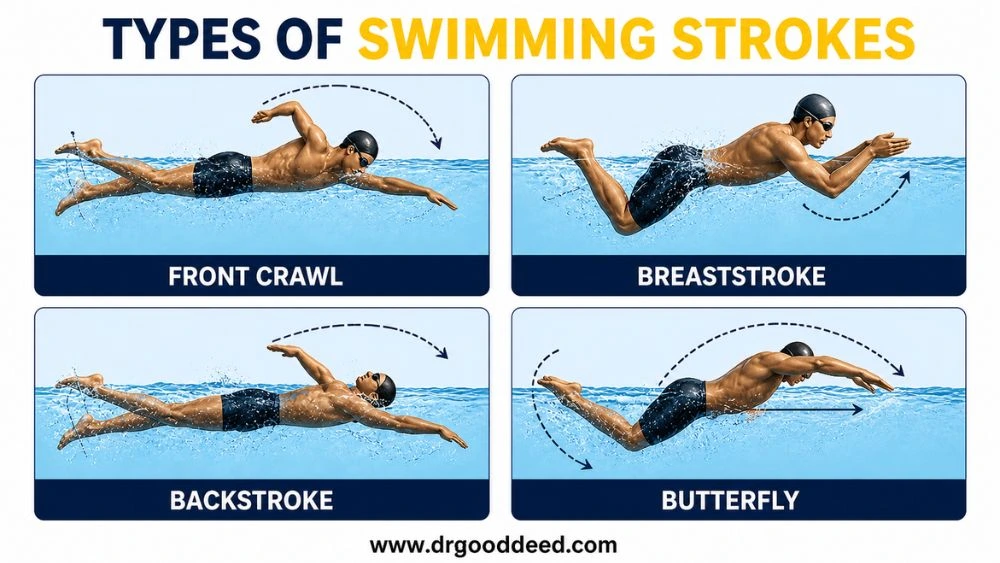
The types of swimming strokes each have distinct mechanics. Choosing the wrong one for your skill level or fitness goal slows progress and increases injury risk, particularly in the shoulders and lower back pain .
Freestyle (Front Crawl): Fastest and Most Efficient
Freestyle, technically called front crawl, is the default stroke in competitive swimming. It uses alternating arm pulls, a flutter kick, and rotational breathing to generate the highest sustained speed of any stroke. World record times in the 100m freestyle are under 47 seconds for men and under 52 seconds for women.
Backstroke: Performed on the Back
Backstroke is the only stroke where the swimmer faces upward. Arm movements alternate in a windmill rotation above the water. The flutter kick is identical to freestyle but performed while floating on the back. Because breathing is unrestricted (the face stays above water), backstroke is physically accessible to swimmers with breathing coordination difficulties.
Breaststroke: Slowest Swimming Stroke
Breaststroke uses a simultaneous outward arm sweep and a frog kick, followed by a full-body glide phase. The glide is what makes it the slowest swimming stroke, breaststroke in competition; the body decelerates during each glide, and propulsion restarts with every kick cycle. Average competitive 100m breaststroke times run 10-15 seconds slower than freestyle over the same distance.
Butterfly: Most Advanced and Powerful
Butterfly requires simultaneous arm entry and a double dolphin kick. The power demand is substantially higher than the other three strokes. Most competitive swimmers do not attempt butterfly training until they are proficient in at least two other strokes. It burns approximately 450 calories per hour at moderate effort, the highest of all four strokes.
Freestyle (Front Crawl): The Fastest Stroke
Freestyle is the stroke used in open-water competitions, triathlons, and most competitive swimming events because its mechanics produce the least drag and the highest forward thrust per stroke cycle.
Basic Technique and Body Position
The body lies face-down and nearly horizontal. Hips rotate slightly with each arm pull, which reduces drag and increases reach. The head stays in line with the spine. Lifting the head too high raises the hips and increases drag, slowing forward movement significantly.
Breathing Pattern
Freestyle breathing involves rotating the head to one side during the arm pull on that side, inhaling, then returning the face to the water. Bilateral breathing, alternating between right and left every three strokes, is the standard technique used by competitive swimmers because it balances stroke mechanics and prevents shoulder overuse on one side.
Why It’s Best for Speed and Endurance
Freestyle generates continuous propulsion. The alternating arm pull means one arm always pulls through the water while the other recovers above it. This overlapping cycle produces near-constant thrust, which no other stroke replicates. USA Swimming recommends freestyle for aerobic endurance training because it sustains elevated heart rate efficiently across long distances.
Backstroke: Best for Beginners to Learn Control
Backstroke is the only one of the four types of swimming strokes that allows a swimmer to breathe freely without timing breath to arm movement. That single factor makes it more approachable than freestyle for many beginners.
Body Alignment and Floating
The swimmer lies on the back with ears submerged, hips near the surface, and toes pointed. Dropping the hips causes the legs to sink and creates drag. Keeping the core engaged and the body flat is the primary technique challenge in backstroke.
Arm Rotation Technique
Each arm enters the water pinky-first directly behind the shoulder (not wide). The arm pulls through the water in a bent-elbow S-curve, generating propulsion toward the hip, then recovers straight above the body before re-entering. A common error is entering the arm across the centerline of the body, which causes the body to snake left and right and reduces speed.
Beginner Backstroke Tips Swimming
Beginner backstroke tips swimming coaches consistently emphasize:
- Keep the chin neutral; looking at the ceiling rather than toward your feet prevents neck tension and body sinking
- Use a pull buoy between the legs during early practice to isolate arm technique
- Count arm strokes per lap to develop awareness of stroke consistency
- Practice the flutter kick with a kickboard held above the chest before adding arm movements
Breaststroke: The Slowest Swimming Stroke
The slowest swimming stroke, the breaststroke, is popular for recreational swimming precisely because its pace is sustainable. The glide phase allows full recovery between propulsion cycles.
Frog Kick and Arm Coordination
The breaststroke kick begins with both feet drawn toward the body simultaneously (heels to buttocks), followed by a wide circular outward push, and then a leg-closing glide. The kick and arm pull alternate rather than overlap: arms sweep out and pull in, then legs kick, then the glide phase follows. Disrupting this sequence breaks the rhythm and reduces efficiency.
Glide Phase Importance
The glide is the defining mechanical feature of breaststroke. After the kick, the body should extend fully and hold a streamlined position for 0.5-1 second before the next arm sweep begins. Skipping the glide phase by pulling too early shortens the effective propulsion distance per stroke cycle and, paradoxically, slows the swimmer down.
Why It’s the Slowest Stroke
The slowest swimming stroke breaststroke designation comes from its mechanics. The frog kick pushes water backward but also outward, dissipating force laterally. The glide causes active deceleration. And the arm sweep begins inside the water rather than above it (unlike freestyle and backstroke), which adds frontal drag. Together, these features make breaststroke fundamentally slower than the other three strokes at equivalent effort levels.
Butterfly Stroke: Most Advanced Technique
Butterfly is the second fastest of the types of swimming strokes in competition, behind freestyle, but it is the most physically demanding and the last stroke a swimmer should attempt to learn.
Dolphin Kick Movement
The dolphin kick involves both legs moving together in a wave-like undulation from the hips through the knees to the feet. Two dolphin kicks occur per stroke cycle: one as the arms enter the water and one as the arms complete the pull. The power comes from the hips and core, not the feet. Kicking from the knees rather than the hips is the most common technique error in butterflies.
Arm Synchronization
Both arms enter the water simultaneously shoulder-width apart, pull through in a keyhole shape beneath the body, and recover simultaneously above the water surface. The simultaneous recovery is what distinguishes butterflies from freestyle visually and mechanically. Any asymmetry in arm timing disrupts the body’s undulation rhythm and causes loss of speed.
Butterfly Breathing Technique Swimming
The butterfly breathing technique swimming coaches teach involves lifting the chin forward (not upward) during the arm pull phase. The head rises just enough to clear the water for a breath, then returns face-down as the arms enter.
Lifting the head too high raises the hips and disrupts the undulation. Most competitive butterfly swimmers breathe every two stroke cycles rather than every stroke to maintain rhythm and speed.
Easiest Swimming Stroke for Beginners
The easiest swimming stroke for beginners depends on one factor: breathing coordination. Strokes that allow unrestricted breathing are easiest to learn because breath timing is the skill beginners find hardest to master.
Why Backstroke Is Easiest to Learn
Backstroke requires no breath timing. The face stays above water. A beginner can focus entirely on arm rotation and body position without managing when to inhale. USA Swimming’s learn-to-swim programs introduce backstroke as the second stroke after basic floating and kicking skills.
Breaststroke for Relaxed Swimming
Breaststroke suits beginners who want a slow, controlled pace. The glide phase provides rest time within each stroke cycle. Recreational lap swimmers in the US use breaststroke more than any other stroke because it is sustainable for 30-45 minutes without significant cardiovascular strain for average fitness levels.
Freestyle for Gradual Progression
Freestyle is the most commonly taught stroke overall, but breathing coordination takes 4-8 weeks of regular practice to feel natural. Beginners who start with backstroke and breaststroke develop body awareness in water that makes transitioning to freestyle significantly faster.
Common Mistakes in Swimming Strokes
Most beginners learning types of swimming strokes repeat the same errors regardless of which stroke they practice. These mistakes reduce efficiency, increase effort, and sometimes cause shoulder or knee injuries.
- Freestyle: Crossing the arm over the body’s centerline during entry, which causes the body to rotate excessively and snake through the water
- Backstroke: Bending the elbow during the arm recovery above the water, which drops the hand too close to the face on re-entry
- Breaststroke: Skipping the glide, which eliminates the stroke’s primary efficiency feature and causes early fatigue
- Butterfly: Kicking from the knees rather than the hips, which produces minimal propulsion and places excessive strain on the knee joints
- All strokes: Holding breath rather than exhaling continuously underwater, which leads to carbon dioxide buildup and premature fatigue
How to Choose the Right Swimming Stroke
Based on Skill Level
Beginners start with backstroke or breaststroke. Intermediate swimmers add freestyle. Butterfly is appropriate only after solid freestyle and breaststroke mechanics are established, typically after 6-12 months of regular swim practice.
Based on Fitness Goals
- Calorie burn: Butterfly (450 cal/hr) then freestyle (400 cal/hr) then backstroke (300 cal/hr) then breaststroke (300 cal/hr at moderate pace)
- Cardiovascular endurance: Freestyle for sustained aerobic work
- Low-impact rehabilitation: Backstroke and breaststroke for joint-sensitive swimmers
- Full-body strength: Butterfly for core and shoulder development
Based on Comfort in Water
Swimmers with shoulder injuries should avoid butterfly and minimize freestyle rotation load. Those with knee issues should approach breaststroke cautiously, as the frog kick places medial stress on the knee. Backstroke is the most joint-neutral of all four types of swimming strokes for swimmers managing orthopedic limitations.
FAQs
Which are the types of swimming strokes explained simply?
The types of swimming strokes: freestyle (face-down, alternating arms, fastest stroke), backstroke (face-up, alternating arms, easiest to breathe), breaststroke (face-down, frog kick, slowest stroke with a glide phase), and butterfly (face-down, both arms move together, most physically demanding). These four are the only strokes recognized in FINA competitive swimming.
What is the easiest swimming stroke for beginners?
Backstroke is the easiest swimming stroke for beginners because the face stays above water, eliminating breath timing entirely. A beginner can focus on arm rotation and floating position without managing inhalation timing. USA Swimming introduces backstroke as the second skill in its learn-to-swim curriculum, after basic floating and kicking.
Why is breaststroke the slowest swimming stroke?
The slowest swimming stroke breaststroke is slow because the frog kick pushes water outward (not just backward), dissipating force laterally; the arms pull inside the water rather than above it, adding frontal drag; and the glide phase causes active deceleration between each propulsion cycle. These three mechanical features combine to reduce average speed by 10-15 seconds per 100m versus freestyle.
What are beginner backstroke tips for swimming?
Beginner backstroke tips swimming coaches agree on: enter the hand pinky-first directly behind the shoulder, keep your chin neutral (not looking at your feet), use a pull buoy to isolate arm technique early, and keep hips near the surface by engaging the core. Counting strokes per length helps track consistency. Practice the kick with a kickboard across the chest before adding arms.
How does butterfly breathing technique swimming work?
The butterfly breathing technique swimming requires lifting the chin forward (not upward) during the arm pull, inhaling quickly, then returning the face down as arms re-enter the water. Most competitive swimmers breathe every two stroke cycles to avoid disrupting the body’s undulation. Lifting the head too high sinks the hips and breaks rhythm, which is the most common breathing error in butterfly.
Which swimming stroke is the fastest?
Freestyle (front crawl) is the fastest of all types of swimming strokes. World record 100m freestyle times are 46.91 seconds (men, Caeleb Dressel, 2021) and 51.71 seconds (women, Sarah Sjöström, 2017). Butterfly is second fastest. Backstroke ranks third. Breaststroke is the slowest in competition at every distance.
How long does it take to learn swimming strokes?
Backstroke and breaststroke take 4-6 weeks of twice-weekly practice to perform with functional technique. Freestyle breath timing becomes comfortable at 4-8 weeks for most adults. Butterfly requires 6-12 months of consistent practice after mastering freestyle and breaststroke, because it demands established core strength and body undulation skills that take time to develop.
Can beginners learn butterfly strokes easily?
No. Butterfly is the most technically demanding of all types of swimming strokes and requires prerequisite skills in freestyle and breaststroke before it becomes learnable efficiently. Attempting butterfly too early builds bad habits in the dolphin kick (kicking from the knees instead of hips) that take longer to correct than building up properly through other strokes first.
Which stroke burns the most calories?
Butterfly burns the most calories of all types of swimming strokes, approximately 450 calories per hour at moderate effort. Freestyle follows at around 400 calories per hour. Backstroke and breaststroke burn approximately 300 calories per hour at moderate pace. These figures apply to a 155-pound adult; heavier individuals burn more per hour across all strokes.