
The right gut health smoothie recipes blend fiber, probiotics, and prebiotics into one glass, feeding beneficial bacteria in minutes instead of hours. A well-built smoothie keeps the fiber that whole fruits and vegetables in a solid gut health diet plan already call for, since that fiber supports regularity and bacterial diversity.
Busy professionals, new parents, and anyone recovering from a stomach bug can use these blends as a fast, low-effort digestive support tool.
Key Takeaways
- Smoothies retain the fiber that juicing strips away, and that fiber feeds beneficial gut bacteria directly in the colon.
- Pairing a prebiotic ingredient like banana or oats with a probiotic like kefir inside one blend creates a true synbiotic combination.
- Homemade gut health smoothie recipes typically contain far less added sugar than bottled or shop-bought versions.
- Combining several high FODMAP fruits in one smoothie can concentrate fermentable carbohydrate and trigger bloating in sensitive drinkers.
- Rotating between different recipes exposes gut bacteria to a wider range of fiber types, which supports greater microbial diversity over time.
Smoothies vs Juices: The Fiber Advantage for Gut Bacteria
Whole fruit smoothies keep the pulp, skin, and fiber that juicing extracts and discards. That fiber, particularly the fermentable kind, travels intact to the colon, where resident bacteria break it down into short-chain fatty acids.
- Soluble fiber, found in oats and the flesh of apples and bananas, dissolves into a gel that slows sugar absorption and feeds bacteria that produce butyrate, a short-chain fatty acid that nourishes colon cells.
- Insoluble fiber, found in spinach stems and berry seeds, adds bulk to stool and speeds transit time through the intestine.
- A single cup of orange juice contains close to zero grams of fiber, while a whole-orange smoothie retains roughly 3 to 4 grams per serving.
- Compare this directly to juices for gut health, which absorb faster into the bloodstream but leave the colon with far less material for bacteria to ferment.
Smoothies function as a middle ground between whole produce and juice, since blending breaks cell walls for easier digestion while leaving the fiber matrix largely intact.

The Science of Synbiotic Blending: Pairing Prebiotics With Probiotics
In 2020, a panel convened by the International Scientific Association for Probiotics and Prebiotics defined a synbiotic as a mixture of live microorganisms and a substrate those microorganisms can use, working together toward a measurable health benefit.
Blending a prebiotic fiber source with a probiotic food in one smoothie puts this definition into practice.
- Prebiotic ingredients feed bacteria already living in your gut. Slightly green bananas, rolled oats, and ground flaxseed all supply fermentable fiber types that resident bacteria prefer.
- Probiotic ingredients add live bacterial strains directly. Kefir typically carries more bacterial and yeast strains than yogurt, while plain yogurt with live and active cultures still supplies meaningful strain diversity.
- The panel distinguished a complementary synbiotic, where each ingredient already meets prebiotic and probiotic criteria on its own, from a synergistic one, designed only to work in combination.
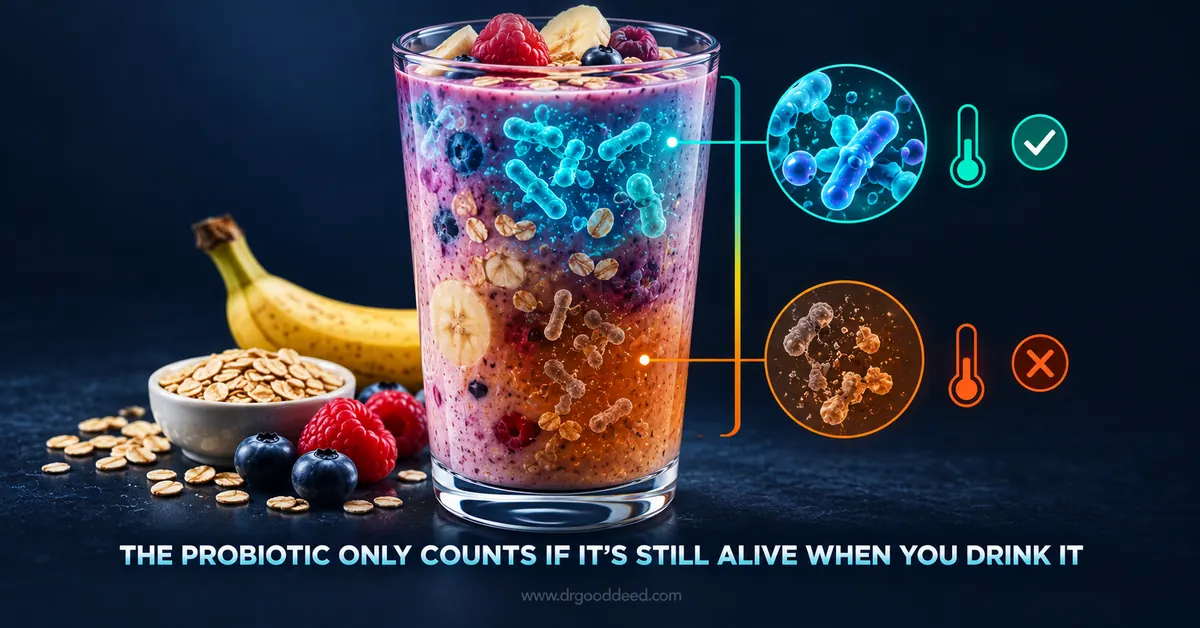
- Heat kills live cultures, so never blend kefir or yogurt with hot liquid or add it to a smoothie that will sit in a warm car for hours before drinking.
Expert Insight: A synbiotic smoothie only delivers on its promise if the probiotic ingredient still contains live cultures when you drink it. Refrigerated kefir or yogurt within its printed date typically retains active strains, but a blended smoothie left warm on a counter for several hours can lose meaningful bacterial viability before it ever reaches your gut.
4 Gut Health Smoothie Recipes
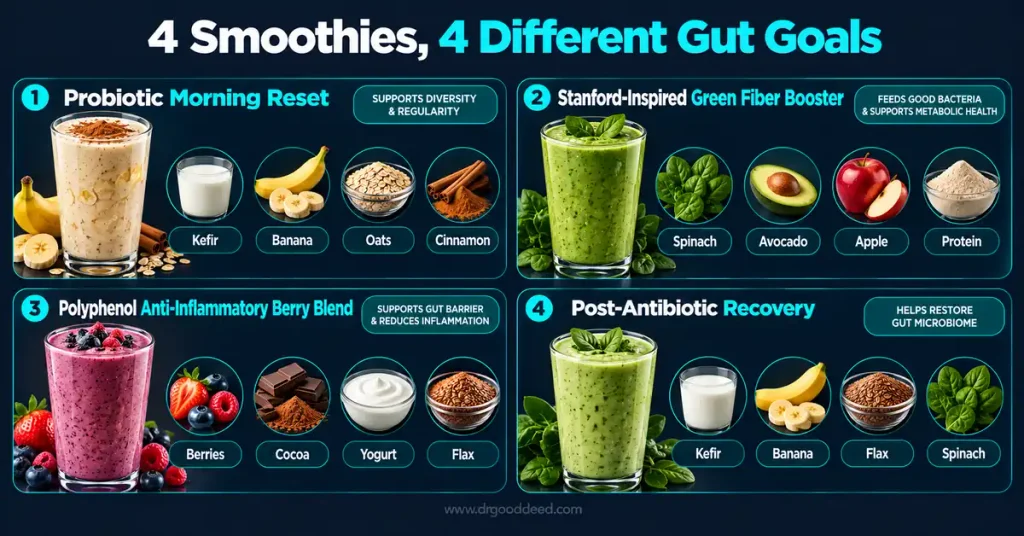
Each of these four gut health smoothie recipes targets a different digestive goal, from morning regularity to post-antibiotic recovery.
The Probiotic Morning Reset Blend
- 1 cup plain kefir or Greek yogurt
- 1 medium banana, slightly green if possible
- ¼ cup rolled oats
- ½ teaspoon cinnamon
- Ice as needed
This blend pairs a probiotic base with two prebiotic fiber sources, banana and oats, forming a genuine synbiotic combination recognized in nutrition science. Cinnamon adds polyphenols without added sugar.
Drinking this within thirty minutes of waking follows similar logic to best time to drink kefir, since stomach acid tends to run lower first thing in the morning, giving live cultures a better chance of surviving transit.
The Stanford-Inspired Green Fiber Booster
- 1 cup spinach
- ½ avocado
- ½ apple, cored (swap for banana or blueberries if apple triggers bloating)
- 1 scoop plant-based protein powder
- Water or unsweetened plant milk to thin
This recipe draws inspiration from a smoothie developed by Sean Spencer, MD, PhD, a gastroenterologist and physician-scientist at Stanford University, adapted here for general use rather than reproduced exactly.
Half an avocado alone supplies roughly 6 to 7 grams of fiber alongside heart-healthy monounsaturated fat. The apple-for-banana or blueberry swap is a genuinely practical fix for anyone whose gut reacts poorly to apples’ fructose content.
The Polyphenol Anti-Inflammatory Berry Blend
- 1 cup mixed berries (blueberries, strawberries, raspberries)
- 1 tablespoon unsweetened cocoa powder
- ½ cup plain yogurt or a plant-based alternative
- 1 tablespoon ground flaxseed
Berries and cocoa both rank among the foods high in polyphenols, plant compounds that gut bacteria metabolize into anti-inflammatory byproducts. For an optional polyphenol boost, stir in a tablespoon of pomegranate arils before blending. Ground flaxseed contributes both soluble fiber and lignans, compounds that also feed beneficial bacteria.
The Post-Antibiotic Microbiome Recovery Smoothie
- 1 cup kefir or a probiotic yogurt
- 1 banana
- 1 tablespoon ground flaxseed or chia seeds
- 1 handful spinach
Pairing live probiotic strains with prebiotic fiber the surviving bacteria can use to rebuild. Recovery speed after a course of antibiotics still depends heavily on the specific drug, dose, and each person’s baseline microbiome.
Pro Tip: Grind flaxseed fresh in a small coffee grinder right before adding it to the blender instead of buying pre-ground flax, since its omega-3 content oxidizes within days of grinding. Freshly ground flax also retains more lignans, the specific compound that acts as a prebiotic fiber source for gut bacteria.
Why High-FODMAP Fruits Can Trigger Bloating in Smoothies
FODMAP stands for fermentable oligosaccharides, disaccharides, monosaccharides, and polyols, a group of short-chain carbohydrates that the small intestine absorbs poorly.
- Apples and mangoes carry excess fructose, a monosaccharide FODMAP, beyond what the small intestine can absorb in one sitting.
- Blackberries and watermelon contain fructans, an oligosaccharide FODMAP that ferments quickly once it reaches the colon.
- Combining two or three high FODMAP fruits in a single smoothie concentrates fermentable substrate delivered to the colon at once, which can increase gas production noticeably in people with irritable bowel syndrome.
- Monash University’s Low FODMAP research program has tested exact serving sizes for many fruits, since some become high FODMAP only above a specific portion, not at any amount.
For those with confirmed IBS or FODMAP intolerance, swapping one high FODMAP fruit per recipe for a low FODMAP option like blueberries or a small ripe banana usually resolves the bloating without sacrificing flavor.
Why Homemade Beats Store-Bought for Gut Health
A homemade smoothie built with whey or plant protein, a cup of spinach, unsweetened almond milk, and half a banana often stays under 250 calories with about 22 grams of protein and no added sugar.
Bottled smoothies sold at retail chains list between 350 and 600 calories with 40 grams or more of added sugar per bottle, largely from fruit juice concentrates and syrups added for shelf stability and taste.
- Store-bought labels frequently list “fruit juice blend” or “cane sugar” among the first three ingredients, both signals of added sugar rather than whole-fruit fiber.
- This sugar load matters for blood sugar control, since best drinks for diabetes patients notes that sugary bottled smoothies can spike blood glucose about as fast as a can of soda.
- Homemade versions also let you control probiotic content directly, since most bottled smoothies are pasteurized after blending, a process that kills any live bacterial cultures the ingredients once contained.
Building your own gut health smoothie recipes at home takes five extra minutes but removes most of the added sugar and preservatives found in bottled alternatives.
When to See a Doctor
Smoothies support routine digestive maintenance, but they do not treat underlying disease. See a gastroenterologist promptly if you notice blood in your stool, unintended weight loss, diarrhea lasting longer than two weeks, or severe abdominal pain. Persistent bloating that does not improve after adjusting smoothie ingredients for two to three weeks also warrants a clinical evaluation rather than further dietary experimentation.
FAQs
Can smoothies fully replace whole fruits and vegetables?
No. Blending breaks down cell walls and speeds sugar absorption, so whole produce still offers more chewing-related satiety and a more intact fiber structure than a blended version of the same ingredients.
What’s the most common smoothie mistake that hurts gut health?
Using only sweet fruit with no protein, fat, or fiber source. This spikes blood sugar quickly and skips ingredients like kefir, oats, or flaxseed that actually feed beneficial gut bacteria.
Why do some green smoothies cause gas and bloating?
Raw kale and other cruciferous greens contain raffinose, a fermentable oligosaccharide gut bacteria break down into gas. Blending does not remove raffinose, so sensitive drinkers may notice bloating within a few hours.
Are dairy-based or plant-based smoothies better for gut health?
Neither is universally better. Dairy kefir contains more clinically studied probiotic strains, while plant-based versions suit lactose intolerance but often need an added probiotic powder for comparable bacterial content.
Can children safely drink gut health smoothies daily?
Generally yes, in age-appropriate portions. Pediatricians typically recommend limiting added sugar and introducing new high-fiber ingredients gradually, since a sudden fiber increase can cause temporary gas in young children.
Sources
- Sean Spencer, MD, PhD. “Dr. Spencer’s Science-Based Smoothie for Gut Health.” Stanford Lifestyle Medicine. link
- Swanson KS, et al. “The International Scientific Association for Probiotics and Prebiotics (ISAPP) Consensus Statement on the Definition and Scope of Synbiotics.” Nature Reviews Gastroenterology & Hepatology, 2020. link
- Harvard T.H. Chan School of Public Health. “Fiber.” The Nutrition Source. link
- Monash University. “About FODMAP and the Monash University Low FODMAP Diet.” link
- National Institute of Diabetes and Digestive and Kidney Diseases. “Irritable Bowel Syndrome.” link
- American Gastroenterological Association. “AGA Clinical Practice Guidelines on the Role of Probiotics in the Management of Gastrointestinal Disorders.” Gastroenterology, 2020. link
- USDA FoodData Central. “Avocados, Raw.” link
- MedlinePlus, National Institutes of Health. “Probiotics.” link
Medical Disclaimer: This article is for general information only and is not medical advice. It does not replace a diagnosis, treatment plan, or guidance from a qualified healthcare professional. Always talk to your doctor about your own symptoms and before starting, stopping, or changing any treatment. If you think you may be having a medical emergency, call 911 or go to your nearest emergency room.