
Airplane headache is a headache that can occur during takeoff or landing, often linked to rapid changes in cabin pressure, particularly when the sinuses cannot equalize pressure effectively. Staying hydrated, swallowing, yawning, chewing gum, and treating nasal congestion may help reduce pressure-related discomfort.
If you fly often, our guide focuses on how to stay healthy while traveling. The pain usually fades within 30 minutes, and a doctor can help you plan ahead.
Key Takeaways
- Airplane headache causes and treatment start with one fact: the International Headache Society has listed airplane headache as its own disorder since 2013.
- It typically causes sudden, severe, one-sided pain during landing. The pain usually resolves within 15 to 30 minutes.
- Sinus barotrauma (pressure injury to the air-filled spaces in your face) is the likely mechanism.
- A history of high-altitude headache is a documented risk factor.
- Triptans, prescription migraine drugs, are noted as the most effective treatment. They need a doctor’s approval.
Airplane Headache Is a Real, Officially Recognized Diagnosis
The International Headache Society has formally classified airplane headache as a headache disorder since 2013. Doctors use the term for a sudden, short, severe headache that appears only during air travel, mostly at landing. It is a real diagnosis, not a vague description of feeling bad after a flight.
- Where it is listed: The International Classification of Headache Disorders (ICHD-3) is the reference neurologists use to name headaches. A listing means doctors agreed on written rules for diagnosing it.
- What the rules look for: Repeated attacks tied to flights, severe pain, relief within about 30 minutes, and no other explanation. One bad flight alone does not make the diagnosis.
- Why so few know about it: Many people blame stress or a “flight headache.” Because the pain ends fast, they rarely mention it to a doctor, so real numbers are probably undercounted.
- How strong the evidence is: The disorder is described mostly through small case series and surveys, so some details are still uncertain.
What Airplane Headache Actually Feels Like
Airplane headache feels like a sudden, stabbing pain over one eye or in the forehead, mostly as the plane descends. It is intense, often rated severe, and brief. Most attacks end within 15 to 30 minutes.
- Pain type: Stabbing or jabbing rather than a dull ache. It hits fast, without the slow build of a tension headache.
- Location: Usually one side, in the forehead or around the eye. Doctors call this the frontal-orbital area.
- Timing: Mostly during landing. Reports during takeoff exist but are far less common.
- Duration: Roughly 15 to 30 minutes, sometimes fading as the plane touches down.
- What is usually missing: Watery eyes, a runny nostril, and restlessness, common in cluster headache, tend to be absent. Nausea and light sensitivity, common in migraine, are generally less prominent.
What Causes It: Sinus Barotrauma Explained
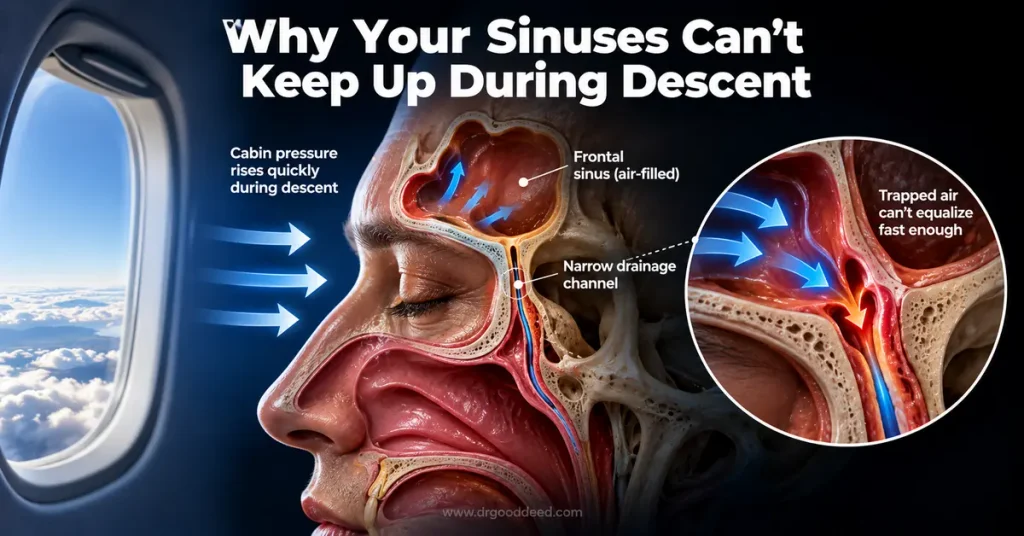
Sinus barotrauma is the leading explanation. During descent, cabin air pressure rises faster than the air trapped in your frontal sinuses (air pockets behind your forehead) can adjust. The pressure gap irritates the sinus lining and nearby nerves, and pain follows.
- The narrow drainage channel: Each frontal sinus connects to the nose through a thin passage. A cold, allergies, or nasal swelling can narrow it, so air cannot move in or out quickly enough.
- Why descent: Cabin pressure is usually kept close to an altitude of 6,000 to 8,000 feet. It changes most while the plane climbs and descends. Rising pressure during descent presses on a blocked sinus.
- Speed matters: The faster pressure changes, the less time your sinuses have to equalize.
- Not fully proven: Sinus pressure is rarely measured in flight. Barotrauma is the best-supported theory.
Who Gets Airplane Headache? The Research Is Genuinely Mixed
A case series by Mainardi and colleagues in Cephalalgia found it mostly affected men. A survey by Potasman and colleagues found about two-thirds of sufferers were women. Neither result has settled the question.
- Why the results differ: One group studied patients who came to a clinic. The other surveyed travelers. Different groups can produce different pictures, and both samples were small.
- What can be said safely: Anyone who flies can get it. Sex and age do not reliably predict who will.
- Plausible risk factors: Sinus congestion during a flight is a reasonable suspect, though the evidence is limited.
- Reporting bias: Frequent flyers get more chances to notice the pattern, which may skew who appears in studies.
The Real Link Between Altitude Headaches and Airplane Headaches
A study found that high-altitude headache (HAH) is a statistically significant risk factor for developing airplane headache (p<0.05). If mountain trips have given you altitude headaches, flying may too. HAH is one symptom of altitude sickness, and the overlap hints at shared pressure sensitivity.
- What HAH is: The ICHD-3 describes a headache within 24 hours of rapid ascent above about 2,500 meters (8,200 feet) that eases within 24 hours after descent.
- Why flights matter: Pressurized cabins sit near 6,000 to 8,000 feet, close to that threshold. A flight is a short, mild altitude exposure.
- What p<0.05 means: It signals an association unlikely to be chance. It does not prove one condition causes the other, and the exact mechanism is unknown.
- What to do with it: Tell your doctor about any altitude headache history. It helps them judge whether your flight headaches fit this pattern.
How Airplane Headache Is Actually Treated
Treatment aims to stop or prevent a short attack. A systematic review notes triptans (prescription drugs such as sumatriptan) as the most effective option. NSAIDs (anti-inflammatory painkillers) such as naproxen, acetaminophen, and nasal decongestants also play a role. A doctor decides which fits you.
| Option | Role | Key notes |
| Triptans | Most effective per review | Prescription only. Not suitable for everyone, including some people with heart or blood pressure problems. |
| NSAIDs (naproxen) | Pain relief | Can irritate the stomach. Not right for some kidney or ulcer conditions. |
| Acetaminophen | Pain relief | Usually gentler on the stomach. Excess amounts can harm the liver. |
| Nasal decongestants | Target sinus blockage | Often used shortly before descent. Use beyond a few days can cause rebound congestion. Caution with high blood pressure. |
Pro Tip: Plan before the descent announcement, not after the pain begins, because attacks peak within minutes and last under 30 minutes. Ask your doctor whether pre-descent dosing or a decongestant plan suits you. Log each flight with congestion status and pain timing, since that record speeds diagnosis.
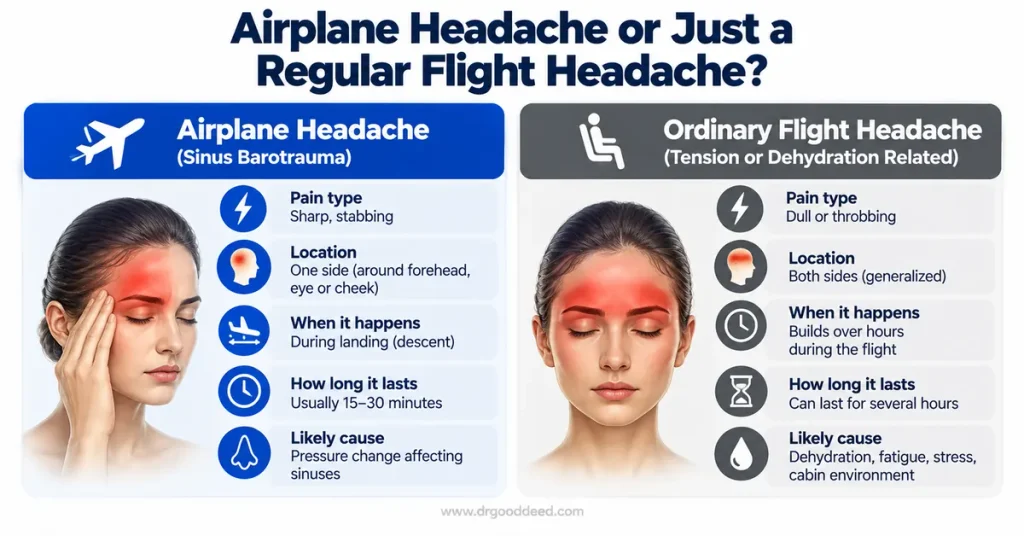
How to Tell It Apart From a Regular Flight-Related Headache
Airplane headache is tied to landing pressure changes. Ordinary flight headaches come from stress, dehydration, cabin noise, or dry air, and they build slowly. The sudden, stabbing, under-30-minute pattern points toward barotrauma. Compared with other types of headaches, it is unusually predictable.
| Feature | Airplane headache | Stress, dehydration, noise, dry air |
| Pain | Stabbing, severe | Dull, pressing, or throbbing |
| Side | Usually one side, forehead or eye | Often both sides |
| Timing | During landing | Any time, builds over hours |
| Duration | 15 to 30 minutes | Hours |
| Relief | Passes on its own | Often eases with fluids, rest, sleep |
When to See a Doctor
See a doctor if flight headaches keep happening, because treatments exist and other causes need ruling out. Seek urgent care for warning signs.
- Attacks on more than one flight, or pain that lasts longer than 30 minutes or continues after landing.
- A sudden, explosive “worst headache of your life”: call 911.
- Headache with weakness, vision loss, confusion, trouble speaking, fever, or a stiff neck: get emergency care.
- Ear pain, hearing loss, or dizziness after a flight.
- Any heart or blood pressure condition, before you ask about triptans.
FAQs
Can you prevent airplane headache before it starts?
Yes, partly. Avoiding flights with heavy congestion, staying awake through descent, and asking a doctor about pre-descent medication or a decongestant plan may reduce attacks. Prevention evidence is limited, so nothing guarantees success.
Does airplane headache happen on every flight once you’ve had one?
No. Many people get attacks on some flights but not others, and congestion or a fast descent may explain the difference. Diagnosis usually requires repeated flight-linked attacks, not pain on every trip.
Can children get airplane headache?
Yes, in theory, but reports are rare. Most published cases involve adults, so evidence in children is limited. Kids more often get ear pain from pressure changes, so persistent symptoms deserve a pediatrician’s review.
Is airplane headache the same as a migraine?
No. Airplane headache is a separate classified disorder: stabbing, under 30 minutes, tied to landing. Migraine usually lasts 4 to 72 hours, though flying can also trigger migraine in people prone to it.
Does cabin pressure on newer planes reduce the risk?
No proven benefit yet. Newer jets often hold a lower cabin altitude, but no study has tested whether that reduces airplane headache. Sinus congestion at landing remains the more likely driver.
Sources
- International Headache Society, ICHD-3 Classification link
- Mainardi et al., Cephalalgia (airplane headache case series) link
- Potasman et al., airplane headache survey (PubMed) link
- Systematic review of airplane headache treatment (PubMed) link
Medical Disclaimer: This article is for general information only and is not medical advice. It does not replace a diagnosis, treatment plan, or guidance from a qualified healthcare professional. Always talk to your doctor about your own symptoms and before starting, stopping, or changing any treatment. If you think you may be having a medical emergency, call 911 or go to your nearest emergency room.