
Amnesia vs. dementia is one of the most searched and most misunderstood comparisons in brain health. Both involve memory problems, but they have completely different causes, patterns, and outcomes. Amnesia is a sudden loss of specific memories, usually caused by a single event like a head injury, stroke, or severe psychological trauma. Dementia is a progressive brain syndrome that slowly destroys memory, thinking, language, and the ability to function independently.
This guide covers the exact difference between amnesia and dementia, their symptoms, causes, how each progresses, treatment options, and when to see a doctor.
Amnesia vs. Dementia at a Glance
| Feature | Amnesia | Dementia |
| Definition | Specific memory loss from a single cause | Progressive decline in memory and multiple cognitive functions |
| Onset | Sudden | Gradual (months to years) |
| Cause | Brain injury, stroke, trauma, medication | Neurodegenerative disease, vascular damage |
| Memory gap | Specific time period or event | Spreads across all types of memory over time |
| Other cognitive functions | Usually preserved | Impaired; language, reasoning, judgment all decline |
| Personality changes | Rare | Common; often early |
| Reversibility | Often reversible | Not reversible; manageable only |
| Progression | Stable or improving | Continuously worsening |
Difference Between Amnesia and Dementia
When comparing amnesia vs. dementia, amnesia targets memory specifically. Dementia attacks the whole brain system, step by step, over years.
Primary Symptoms of Amnesia
Amnesia symptoms center on memory gaps that are specific and bounded. The person cannot recall a particular event, period of time, or specific information. Two main types exist.
- Retrograde amnesia: the person loses memories formed before the brain injury or trauma. They may not remember their wedding, their childhood, or events from the past several years.
- Anterograde amnesia: the person cannot form new memories after the triggering event. They may have a full conversation and forget it entirely within minutes.
Crucially, a person with amnesia often retains their personality, language skills, and the ability to reason and make decisions. They know who they are. They can hold a job in some cases. They just cannot access certain memory blocks.
Primary Symptoms of Dementia
Early dementia symptoms often start with forgetting recent events or misplacing objects. But within months to years, language breaks down, judgment fails, and the ability to manage daily tasks disappears.
- Forgetting names, dates, and recent events
- Getting lost in familiar places
- Difficulty finding words mid-sentence
- Poor judgment with money or safety
- Personality shifts, such as sudden irritability, suspicion, or withdrawal
- Inability to plan or follow multi-step tasks
Cognitive Function Comparison
In amnesia, cognitive function outside of memory stays intact. Problem-solving, language, and spatial awareness remain normal. This is the clearest clinical sign that separates amnesia from dementia. A doctor testing someone with amnesia would find a specific memory deficit but normal scores on tests of language, executive function, and attention.
In dementia, multiple cognitive domains fail simultaneously. A neuropsychological evaluation reveals impairment across memory, language, attention, and executive function. This pattern is required for a formal dementia diagnosis under DSM-5 criteria.
Communication and Language Differences
People with amnesia speak clearly and follow conversations. People with dementia lose language progressively. In Alzheimer’s disease and dementia , word-finding difficulty (called anomia) appears early. In later stages, sentences become fragmented, and some patients lose the ability to speak entirely.
Amnesia Symptoms vs Dementia Symptoms
Understanding amnesia symptoms and dementia symptoms side by side prevents misdiagnosis and delayed treatment.
Memory Problems in Amnesia
Memory loss in amnesia is isolated. The person knows they have a memory gap. They may feel frustrated by it. They do not lose autobiographical identity in most cases. A person with anterograde amnesia introduced to someone new will shake hands, have a conversation, and forget the person entirely in 20 minutes. Yet they can tell you their own name, their job, and describe their personality accurately.
Memory Problems in Dementia
Memory loss in dementia spreads outward from recent events to older memories as the disease progresses. The person often does not recognize the gap. They may confabulate, meaning they unconsciously fill memory gaps with invented details they believe to be true. This is not lying. It is a brain compensation mechanism documented extensively in Alzheimer’s research.
Confusion and Cognitive Decline in Dementia
Confusion and cognitive decline in dementia go together because the disease damages multiple brain regions at once. The hippocampus, which stores new memories, is typically the first region damaged in Alzheimer’s. The frontal lobe, which controls judgment and planning, loses function next. This is why dementia patients make unsafe decisions, forget to turn off the stove, or give away money to scammers.
Amnesia does not produce this pattern of spreading confusion and cognitive decline in dementia. A person with amnesia can still make sound judgments, even if they cannot remember yesterday’s lunch.
Personality and Behavioral Changes
Personality changes are rare in amnesia. When they do occur, they are usually linked to depression or anxiety about the memory loss itself.
In dementia, behavioral changes in dementia are a core feature. Apathy, aggression, paranoia, wandering, and day-night sleep reversal all result from progressive damage to the frontal lobe and limbic system. A 2022 study in JAMA Psychiatry found that neuropsychiatric symptoms, meaning behavioral and psychological symptoms, appeared before significant memory loss in 54% of Alzheimer’s cases, making them an under-recognized early warning sign.
Ability to Learn New Information
People with retrograde amnesia can still learn new information. Their brain’s learning mechanism is intact even when past memories are inaccessible. This is a key diagnostic clue.
People with dementia progressively lose the ability to learn new information. The same information repeated daily fails to stick. This inability to form new memories is one of the first functional losses families notice.
Causes of Amnesia
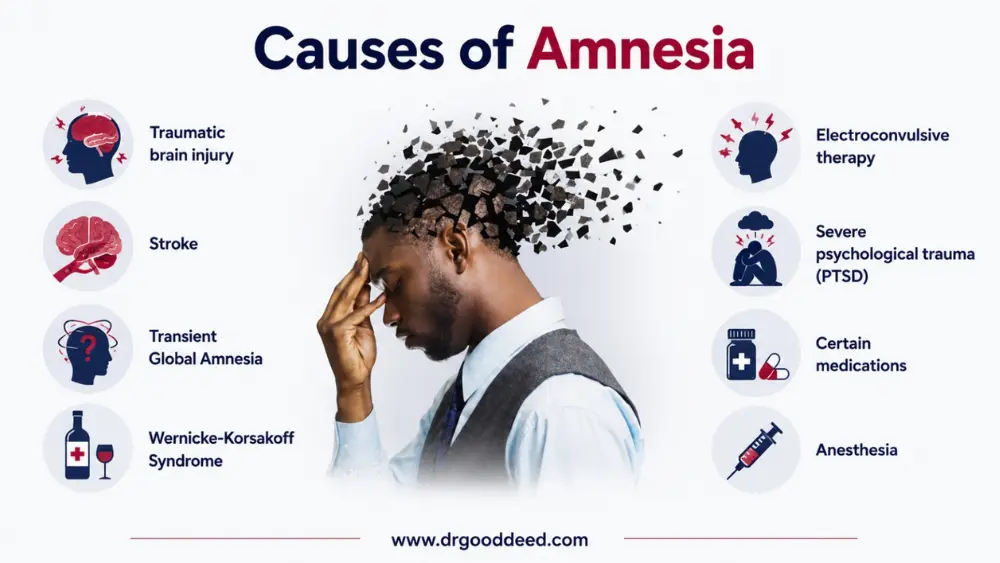
Understanding what triggers amnesia is essential in amnesia vs. dementia comparison, because the causes are completely different. Brain injury causing amnesia is the most common trigger, but several other causes exist.
- Traumatic brain injury (TBI): a blow to the head from a fall, car accident, or sports injury damages the hippocampus or surrounding structures
- Stroke: disrupted blood flow to the temporal lobe or hippocampus causes sudden memory loss
- Transient Global Amnesia (TGA): a temporary episode of total memory loss, usually resolving within 24 hours, with no identified cause in most cases
- Wernicke-Korsakoff Syndrome: severe thiamine (Vitamin B1) deficiency, most often from chronic alcohol use, damages the thalamus and mammillary bodies
- Electroconvulsive therapy (ECT): used for severe depression, can temporarily disrupt memory consolidation
- Severe psychological trauma or PTSD: dissociative amnesia causes the brain to block traumatic memories as a protective response
- Certain medications: benzodiazepines and anticholinergic drugs can cause temporary amnesia, particularly in older adults
- Anesthesia: some patients report gaps in memory around surgical procedures
Causes of Dementia
Dementia is not a single disease. It is a syndrome caused by multiple different conditions.
- Alzheimer’s disease: amyloid plaques and tau tangles destroy neurons; accounts for 60–80% of all dementia cases
- Vascular dementia: stroke and reduced cerebral blood flow damage brain tissue; second most common type
- Lewy body dementia: stages of abnormal protein deposits (Lewy bodies) disrupt brain signaling; often causes visual hallucinations and movement problems
- Frontotemporal dementia (FTD): damage to the frontal and temporal lobes; causes severe personality and language changes before memory loss
- Mixed dementia: two or more dementia types occurring simultaneously, most commonly Alzheimer’s plus vascular dementia
- Parkinson’s disease dementia: cognitive decline develops in up to 80% of Parkinson’s patients over time
- Chronic Traumatic Encephalopathy (CTE): repeated head impacts, common in contact sport athletes, cause progressive neurodegeneration
How Progression Differs Between Amnesia and Dementia
Most forms of amnesia improve over time with treatment of the underlying cause. Brain injury causing amnesia from a single TBI often shows significant recovery within three to six months.
- Transient Global Amnesia resolves within 24 hours in nearly all cases, with full memory recovery.
- Wernicke-Korsakoff Syndrome stops progressing when thiamine is replaced, though existing damage may be permanent.
- Dissociative amnesia from psychological trauma resolves with psychotherapy in many cases.
Amnesia does not progressively worsen on its own. It stays stable or improves unless a new brain injury occurs.
Dementia Progression
Dementia always worsens. The speed varies by type. Alzheimer’s disease typically progresses over 8–10 years from diagnosis to end-stage, though some cases span 20 years. Vascular dementia progresses in steps, with sudden drops after each new stroke. Lewy body dementia progresses faster than Alzheimer’s on average, with many patients reaching severe impairment within four to eight years of diagnosis.
Treatment Options for Amnesia
This is another area where amnesia vs. dementia diverge sharply. Treatment options for amnesia depend entirely on the cause.
Treating the Underlying Cause
A stroke causing amnesia requires anticoagulants or antiplatelet therapy to prevent further events. Wernicke-Korsakoff Syndrome requires immediate intravenous thiamine. Medication-induced amnesia resolves when the drug is stopped or the dose is reduced.
Cognitive Rehabilitation Therapy
Cognitive rehabilitation works on compensatory strategies rather than directly restoring lost memories. A trained neuropsychologist teaches the person to use external memory tools systematically, rebuild daily routines, and develop alternative pathways for information recall.
Memory Aids and Strategies
Practical tools make daily life manageable despite persistent memory gaps. Structured notebooks, labeled photographs, digital reminder apps, and consistent daily schedules all reduce the functional impact of amnesia significantly.
Psychological Support
Many people with amnesia develop significant depression and anxiety. Losing access to personal memories is disorienting and distressing. Cognitive behavioral therapy (CBT) helps patients adapt to their memory limitations and reduce emotional distress. Family therapy helps caregivers understand what the person is experiencing.
Recovery Expectations
Recovery from amnesia is highly cause-dependent. Transient Global Amnesia: full recovery in 24 hours. Mild TBI amnesia: significant improvement within three months. Severe TBI: some permanent gaps remain, but function improves. Wernicke-Korsakoff: no recovery if treatment is delayed beyond the acute phase. Dissociative amnesia: often full recovery with psychotherapy.
How a Misdiagnosis Between Amnesia and Dementia Affected One Patient’s Care Plan
Privacy Note: The following case is a realistic composite based on documented clinical scenarios involving misdiagnosed memory conditions. The patient’s name has been altered to protect privacy.
Dorothy Nakamura, a 68-year-old retired librarian from Portland, Oregon, was referred to a memory clinic in 2022 after her family reported she could not remember recent events and seemed confused at home. Her primary care physician documented “probable early Alzheimer’s disease” based on a brief cognitive screen.
What the initial evaluation missed: Dorothy had been on lorazepam (a benzodiazepine) for anxiety for eleven years. She had also fallen six months earlier and struck the back of her head. Neither factor was mentioned in the referral notes.
The memory clinic neuropsychologist administered a full cognitive battery. Dorothy’s language, spatial reasoning, and executive function scores were all normal. Only episodic memory tested below expected range. Her MRI showed no atrophy pattern consistent with Alzheimer’s. A detailed medication review flagged the lorazepam.
Her neurologist gradually tapered the lorazepam over 12 weeks, replacing it with an SSRI (escitalopram) for anxiety. Within four months, her family reported her memory was nearly back to her baseline. Her six-month cognitive retest showed normal scores across all domains.
The insight most online articles skip: benzodiazepine-induced cognitive impairment in older adults is frequently misdiagnosed as early dementia. A 2021 study in The BMJ found that 1 in 5 older adults referred to memory clinics with suspected dementia had a fully reversible cause, with medication effects being the most common. Dorothy’s case was not unusual. It was just properly investigated.
Can Someone Have Both Amnesia and Dementia?
Yes. In amnesia vs. dementia, both conditions can coexist. A person with dementia can also experience a discrete amnestic episode on top of their baseline cognitive decline. For example, a patient with mild Alzheimer’s who suffers a stroke may develop sudden anterograde amnesia from the stroke in addition to their underlying Alzheimer’s symptoms.
Similarly, Wernicke-Korsakoff Syndrome, which causes amnesia, can progress into Korsakoff Psychosis with broader cognitive impairment that resembles dementia in its functional impact. In these cases, a neurologist must distinguish which symptoms belong to which condition to guide treatment correctly.
Can Amnesia or Dementia Be Prevented?
Prevention strategies differ completely in amnesia vs. dementia because the underlying mechanisms are different.
Amnesia from TBI: wearing helmets, seatbelts, and fall prevention measures for older adults reduce risk significantly. Alcohol-related amnesia is preventable by managing alcohol consumption and ensuring adequate thiamine intake.
Dementia prevention is an active research area. The Lancet Commission on Dementia Prevention (updated 2024) identified 14 modifiable risk factors that collectively account for 45% of all dementia cases.
These include: low education, hearing loss, hypertension, obesity, smoking, depression, physical inactivity, diabetes, excessive alcohol, traumatic brain injury, air pollution, social isolation, untreated vision loss, and high LDL cholesterol. Managing these factors from midlife onward offers the most meaningful population-level impact on dementia incidence.
FAQs
Is amnesia a type of dementia?
No. Amnesia vs. dementia are separate conditions. Amnesia is isolated memory loss from a specific cause, with other cognitive functions intact. Dementia is a progressive syndrome impairing memory, language, judgment, and behavior simultaneously. Amnesia does not inevitably progress to dementia.
Can brain injury cause amnesia?
Yes. Brain injury causing amnesia is the most common cause after TBI, stroke, or oxygen deprivation. Damage to the hippocampus or thalamus disrupts memory storage and retrieval. Recovery depends on injury severity; mild TBI often resolves within three months.
Does dementia always cause memory loss?
Not always initially. Frontotemporal dementia causes severe personality and language changes before any memory loss. Lewy body dementia often starts with visual hallucinations and movement problems. Memory loss is the dominant early dementia symptom only in Alzheimer’s disease.
Can someone have both amnesia and dementia?
Yes. A person with Alzheimer’s who suffers a stroke can develop acute anterograde amnesia on top of their existing cognitive decline. Wernicke-Korsakoff Syndrome can also progress from amnesia into a broader dementia-like state if thiamine replacement is delayed or inadequate.
Is amnesia permanent?
Not always. Transient Global Amnesia resolves fully within 24 hours. Mild TBI-related amnesia symptoms improve significantly within three to six months. Severe TBI or delayed treatment for Wernicke-Korsakoff Syndrome can cause permanent memory gaps. Dissociative amnesia from trauma often resolves with psychotherapy.
Can amnesia be treated?
Yes, when the underlying cause is treatable. Treatment options for amnesia include thiamine replacement for Wernicke-Korsakoff, stopping causative medications, stroke management, and cognitive rehabilitation therapy. Psychological trauma-based amnesia responds to trauma-focused CBT in most cases.
What are the early warning signs of dementia?
The earliest dementia symptoms include forgetting recent conversations, getting lost on familiar routes, difficulty finding words mid-sentence, poor financial decisions, and sudden personality shifts like withdrawal or irritability. A 2022 JAMA Psychiatry study found behavioral symptoms preceded memory loss in 54% of Alzheimer’s cases.
When should memory loss be evaluated by a doctor?
Seek evaluation immediately if memory loss is sudden, follows a head injury, or accompanies confusion and cognitive decline in dementia such as getting lost, using wrong words, or behavioral changes.
References
- Alzheimer’s Association. 2024 Alzheimer’s Disease Facts and Figures.
- American Psychiatric Association. DSM-5-TR Diagnostic Criteria for Neurocognitive Disorders. 2022.
- Livingston G, et al. Dementia prevention, intervention, and care: 2024 report of the Lancet Commission. The Lancet. 2024.
- Maust DT, et al. Benzodiazepines and cognitive impairment in older adults referred for dementia evaluation. The BMJ. 2021.
- Lyketsos CG, et al. Neuropsychiatric symptoms as early markers of Alzheimer’s disease. JAMA Psychiatry. 2022.
- National Institute of Neurological Disorders and Stroke. Amnesia Information Page. 2023.
- Alzheimer’s Association. Types of Dementia. 2023.
- Hodges JR, et al. Transient Global Amnesia: clinical features and prognosis. Brain. 2020.